zaterdag, maart 12, 2011


donderdag, maart 10, 2011

Vooruit lopend op de bevindingen van de Comissie Samson en de Comissie Deetman
worstelen vandaag in de
Tweede Kamer der Staten Generaal van het Koninkrijk der Nederlanden
hulpverleners en de HH volksvertegenwoordiging met de vraag:
Moeten falende ouders gedwongen aan de anticonceptie?
Voor de goede orde en ter vermijding van misverstanden:
hieronder wordt niet verstaan het inschakelen van werkers met een kerkelijke zending en andere pastoraal geroepenen die condooms omdoen bij potentiele vaders.
Acquisitie wordt niet op prijs gesteld.
(Novum) - De zorgkantoren, die zorg voor gehandicapten en chronisch zieken moeten regelen, functioneren onder de maat. Ze zijn slecht bereikbaar, reageren niet op brieven of telefoontjes en laten mensen onnodig lang wachten. Dat zegt de Nationale Ombudsman, Alex Brenninkmeijer.
Er zijn 32 zorgkantoren. Zij moeten zorgen dat mensen die recht hebben op AWBZ-zorg, die zorg ook ontvangen of geld krijgen waarmee ze zelf zorg kunnen inhuren. Brenninkmeijer krijgt veel klachten over de zorgkantoren. Hij wil ze nader onder de loep nemen. Daarom heeft hij donderdag een meldpunt op internet geopend.
Uit de klachten die Brenninkmeijer tot nu toe heeft ontvangen, rijst het beeld op van organisaties die fouten niet of pas na veel aandringen herstellen. Ernstig zieke mensen worden onverschillig behandeld en geld wordt ten onrechte niet uitbetaald.
"Ik ben de wanhoop nabij", schrijft de ouder van een gehandicapt kind. "Ik liep op tegen een afschuwelijke muur van onbegrip en onbekwaamheid", meldt de moeder van een inmiddels overleden kind. "De werkwijze van zorgkantoren kan iemand tot wanhoop drijven. De beschikkingen zijn onduidelijk en mensen voelen zich niet behoorlijk behandeld", vat Brenninkmeijer de klachten samen.
De zorgkantoren worden gerund door negen zorgverzekeraars, maar voeren een overheidstaak uit
woensdag, maart 09, 2011


dinsdag, maart 08, 2011
maandag, maart 07, 2011
Cor Schilder: Cordaid shocked by news of abuse

Cordaid.nl
4-3-2011
On March 1, 2011 we learned from the media that the Vatican has banned the Dutch bishop Schilder from his function in 2009.
This was confirmed by Schilder’s superior of the Netherlands Mill Hill congregation. Schilder, bishop of the Diocese of Ngong in Kenya, was relieved from his post after allegations of sexual abuse. Cordaid is shocked by this news because in recent decades they have been actively involved in development projects in the diocese of Ngong.
Cordaid has supported, like many other (international) development agencies, the programs in the diocese for some time. In 2003, these projects were carried out under the responsibility of Schilder. During the years 2000-2009 Cordaid supported six different projects in this diocese, investing in the areas of health, water and sanitation. The regular audits showed that the programs met the quality of Cordaid, including the financial management. The projects, focusing on land rights, water and micro-credits, were completed successfully and yielded direct results for the local population.
In their frequent contacts with the staff of the diocese, Cordaid never had any indications of sexual abuse on the part of the bishop. Cordaid deeply regrets that while the abuse was known both to Mill Hill and the Vatican, they were not informed. This is in conflict with Cordaid’s ethics, which are based on openness and transparency.
 Our trust in the Mill Hill Congregation has been damaged severely. Cordaid has suspended all funding of Mill Hill.
Cordaid requires organizations that receive funding, to have a code of conduct on the prevention of sexual abuse. If an (employee of an) organization funded by Cordaid is known to be involved with sexual abuse, Cordaid immediately suspends funding.
In their frequent contacts with the staff of the diocese, Cordaid never had any indications of sexual abuse on the part of the bishop. Cordaid deeply regrets that while the abuse was known both to Mill Hill and the Vatican, they were not informed. This is in conflict with Cordaid’s ethics, which are based on openness and transparency.
Our trust in the Mill Hill Congregation has been damaged severely. Cordaid has suspended all funding of Mill Hill.Cordaid requires organizations that receive funding, to have a code of conduct on the prevention of sexual abuse. If an (employee of an) organization funded by Cordaid is known to be involved with sexual abuse, Cordaid immediately suspends funding.
zaterdag, maart 05, 2011
Argentina’s Grandmothers of the Plaza de Mayo awarded UNESCO peace prize


4 March 2011 – The Grandmothers of the Plaza de Mayo, a non-governmental organization that has been working for over 30 years to locate the families of children kidnapped and “disappeared” during the military dictatorship in Argentina, is this year’s recipient of the United Nations cultural agency’s peace prize.
The Jury of the Félix Houphouët-Boigny Peace Prize, meeting in Paris, awarded the 2010 prize to the Grandmothers of the Plaza de Mayo for their “tireless battle for human rights and peace by standing up to oppression, injustice and impunity.”
"Their ceaseless effort has made it possible for 100 young people to rediscover their true identities, thereby setting right a flagrant injustice."
The award, created in 1989 by the UN Educational, Scientific and Cultural Organization (UNESCO), honours people, institutions and organizations that have contributed significantly to the promotion, research, preservation or maintenance of peace. It is named for the first president of Côte d’Ivoire.
The Grandmothers of the Plaza de Mayo was founded in 1977  and seeks to ensure that violations of children’s rights such as those that occurred during the military dictatorship in Argentina never happen again by demanding the prosecution of all those responsible for the tragedy.
 and seeks to ensure that violations of children’s rights such as those that occurred during the military dictatorship in Argentina never happen again by demanding the prosecution of all those responsible for the tragedy.
“With all my heart I congratulate the Grandmothers of the Plaza de Mayo and their president Estela Carlotto,” said UNESCO Director-General Irina Bokova.
“Their ceaseless effort has made it possible for 100 young people to rediscover their true identities, thereby setting right a flagrant injustice. This is an inspiring example of the defense of human rights.”
“Their ceaseless effort has made it possible for 100 young people to rediscover their true identities, thereby setting right a flagrant injustice. This is an inspiring example of the defense of human rights.”
Previous winners of the prize include former Brazilian president Luiz Inácio Lula da Silva; Nelson Mandela and Frederik W. De Klerk; Yitzhak Rabin, Shimon Peres and Yasser Arafat; King Juan Carlos of Spain and former United States President Jimmy Carter.
The award ceremony for the prize – which consists of $150,000, a gold medal and a diploma – will be held on a date to be announced.
The award ceremony for the prize – which consists of $150,000, a gold medal and a diploma – will be held on a date to be announced.


"lies cannot last forever." Argentina 'stolen baby' cases legacy of Dirty War

Vladimir Hernandez
Francisco Madariaga is blunt about how most of his life has been until now.
"I spent 32 years living a lie," he says.
Mr Madariaga, 33, used to be called Alejandro Ramiro Gallo, the name given to him by his adoptive parents.
"I spent 32 years living a lie," he says.
Mr Madariaga, 33, used to be called Alejandro Ramiro Gallo, the name given to him by his adoptive parents.
Last year he came face-to-face for the first time with his real father and
 confirmed his fears.
He is the son of one of thousands of left-wing activists who were tortured and killed during military rule in Argentina between 1976 and 1983, a period known as the Dirty War.
'Systematic plan'
"For decades my captors [as he describes his adoptive parents] told me I was their biological son. But lies can't last forever," says Mr Madariaga.
"For decades my captors [as he describes his adoptive parents] told me I was their biological son. But lies can't last forever," says Mr Madariaga.
The fate of Argentina's "stolen babies" has been back in the headlines this past week, with the start of the trial of key members of the former military junta on charges of operating a systematic plan to take babies from pregnant detainees.
Eight people are on trial, including former leaders Jorge Videla and Reynaldo Bignone.
The accusation against them relates to 34 children who were allegedly stolen. But it is estimated that hundreds of children were given away to members of the security forces, and in some cases to the same captors of the jailed activists.
Mr Madariaga's supposed "father" was Victor Gallo, an intelligence officer at the clandestine detention centre at the Campo de Mayo military base.
He was handed over to his new "mother" only a few days after his real mother was forced to have a caesarean at the military base.
Route to discovery
The lack of resemblance to his new family made Mr Madariaga suspicious of his origins over the years.
The lack of resemblance to his new family made Mr Madariaga suspicious of his origins over the years.
“Some of the people who regain their identities don't want to know anymore from their adoptive parents. Others keep in touch” Rosa Roisinbit Grandmothers of the Plaza de Mayo
"It is something difficult to explain. It's like I always knew something was not right," Mr Madariaga says.
Mr Madariaga says he was regularly beaten by his adoptive father, abuse that reinforced his doubts.
"I think I was like a prize of war," Mr Madariaga says.
It was only last year that he confronted his "mother", who is now separated from her husband, about his real origin.
When she revealed what had happened, Mr Madariaga approached the human rights group, Grandmothers of Plaza de Mayo, who helped him have a DNA test that confirmed his true identity.
But the group's biggest help was to arrange a meeting between Francisco and his biological father, Abel, who had fled the country during the military rule.
"It was the best moment in my life. I couldn't believe how much I looked like him," says Mr Madariaga.
Francisco was labelled "Grandson 101". The number represents the amount of adults with similar stories who have now, after many years, regained their identities.
Human rights groups believe there could be some 400 people in the same situation.
Contact severed
But not everyone wants to know the truth.
The trial is expected to last several months
Finding out that your parents colluded in the atrocities committed by the military government is something some choose to ignore.
The trial is expected to last several months
Finding out that your parents colluded in the atrocities committed by the military government is something some choose to ignore.
One well-known case is that of Marcela and Felipe Noble, whose adoptive mother is the owner of the newspaper Clarin, one of the biggest media groups in Argentina.
They were adopted in 1976, the first year of the military government, and now two separate families are seeking through court to prove that they were taken from their imprisoned relatives.
They were adopted in 1976, the first year of the military government, and now two separate families are seeking through court to prove that they were taken from their imprisoned relatives.
However, Marcela and Felipe have publicly expressed their trust in their adoptive mother, saying there is no evidence against her.
"I can understand those who don't want to know," says Mr Madariaga.
"For some, it takes more time than for others. Every case is different", says Rosa Roisinbit, a member of the Grandmothers.
In 2001, after years of investigation, she finally found her missing grandson who lived under a different name.
"For some, it takes more time than for others. Every case is different", says Rosa Roisinbit, a member of the Grandmothers.
In 2001, after years of investigation, she finally found her missing grandson who lived under a different name.
"However, the truth has to be above everything," she says.
"Some of the people who regain their identities don't want to know anymore from their adoptive parents. Others keep in touch", says Ms Roisinbit.
"Some of the people who regain their identities don't want to know anymore from their adoptive parents. Others keep in touch", says Ms Roisinbit.
In Mr Madariaga's case, he severed all contact with his "father" and says he looks forward to seeing him in court.
His adoptive father, Victor Gallo, the former intelligence officer, was arrested last year. He is expected to testify, as part of the trial that is currently focussing on Videla and Bignone but which is expected to include many more people accused of kidnapping babies.
Mr Gallo's side of the story is that he was a training officer and that baby Francisco was given to him by chance by a superior officer.
Mr Gallo's side of the story is that he was a training officer and that baby Francisco was given to him by chance by a superior officer.
"It is all lies", says Mr Madariaga.
"And lies cannot last forever."
"And lies cannot last forever."
vrijdag, maart 04, 2011
Heerome Loeks

Kennt ji all dat nige Leed, nige Leed, nige Leed,
Wat dat ganze Dörp all weet, von Herrn Pastor sien Kauh?
Doch dat Leed is man ers half, man ers half, man ers half,
in´n Stall dor steiht jo noch een Kalf
Bron Preda Foundation,
III
Kaya bata ika'y magsikap,
upang maabot ang iyong pangarap
naabot dahil sa iyong kakayahan,
kakayahan dahil sa karapatan mong
makibahagi sa lipunan.
IV
Ngayon, bukas at kailanman,
ating isipin na ang bata ay
may halaga sa bayan.
Pinagsikapan niya at ito ay kanyang pinahalagahan,
dahil alam ko "Bata, Kaya mo Yan"!!!
woensdag, maart 02, 2011
Die Geiseln
In seinem Roman, der 1953 erstmals auf Italienisch erschienen ist, arbeitet der
Autor Giovanni Bonalumi mit der Romanfigur Emilio seine Leiden und Freuden auf,
die er im Priesterseminar als angehender Kleriker erfahren hat.
Cora Grimm
Abgehandelt als skandalträchtiges, blasphemisches Buch und von der katholischen Kirche totgeschwiegen, löste Bonalumi im Tessin der 50er Jahre mit seinem Romanerstling «Gli Ostaggi» einen Skandal aus; trotzdem erhielt er ein Jahr nach Erscheinen seines Romans den Charles-Veillon-Literaturpreis.
Emilio, Sohn eines Tessiner Bahnarbeiters, ist zehn Jahre alt, als sein Vater plötzlich stirbt. Der Dorfpfarrer legt ihm nahe, dem Seminar San Carlo di Lugano beizutreten.
Der Pfarrer überzeugt ihn mit den Argumenten, es sei ein Ort, wo er sich vergnügen könne und Freunde in seinem Alter hätte. Doch kaum im Seminar angekommen, wird Emilios Vorfreude schnell getrübt.
Im Seminar soll er sich mit lauter Kutten tragenden Altersgenossen einem asketischen
Leben, bestehend aus Gebeten, Verboten, Strafen und Denunziationen, widmen. Er muss sich auf eine keusche Zukunft als katholischer Priester vorbereiten. Immer
mehr fühlt sich Emilio ausgegrenzt und sehnt sich nach der Welt ausserhalb
der Mauern. Und da ist auch noch das Mädchen Ilaria, das in Emilio verbotene Gedanken erweckt…
Zehn Jahre hält es Emilio im Klosterseminar aus, bis er aus dem Seminar verbannt wird.
«Die Geiseln», im Jahr 2010 erstmals auf Deutsch übersetzt, nimmt den Leser mit auf eine Reise ins Tessin der 30er Jahre und lässt einen Einblick in den damaligen Seminaralltag von angehenden Priestern gewähren. Doch was sich in Bonalumis Roman in der Realität wirklich abgespielt hat und was Fiktion ist, kann der Leser nur erahnen.
Das Nachwort von Danielle Benzonelli gibt einen interessanten Einblick in Giovanni Bonalumis Leben und Werk als Autor, der es vom ehemaligen Klosterschüler bis zum
Professor für italienische Literatur an der Universität Basel gebracht hat.
Giovanni Bonalumi starb im Jahre 2002 in Locarno.
Giovanni Bonalumi
Die Geiseln (Gli Ostaggi)
Huber Verlag Frauenfeld, 2010, 198 S.
dinsdag, maart 01, 2011
Cor Schilder bischop Ngong Kenya, gedragscode Mill Hill


The Pastoral Relationship
Boundaries:
Boundary violations are committed when we knowingly or unknowingly cross the emotional, physical or sexual limits of
Boundaries:
Boundary violations are committed when we knowingly or unknowingly cross the emotional, physical or sexual limits of
another
We are always responsible for maintaining appropriate behaviour
We never initiate sexual behaviour and refuse it when another initiates it
We are prudent in physical touch
We are familiar with the dynamics of transference and counter-
We are always responsible for maintaining appropriate behaviour
We never initiate sexual behaviour and refuse it when another initiates it
We are prudent in physical touch
We are familiar with the dynamics of transference and counter-
transference and their consequences (a person seeking pastoral help can project on to the minister their own unmet needs or unresolved conflicts which hark back to earlier relationships with others. This is called transference. When the minister does the same and projects his or her unmet needs and unresolved conflicts onto the person seeking help, this is called counter-transference).
If we are ordained priests we clearly distinguish the Sacrament of Reconciliation from other relationships such as counseling
We always satisfy our needs for affection, intimacy and friendship outside the pastoral relationship
We avoid anything in speech or behaviour that might involve sexual harassment of another
We choose an appropriate physical environment in which to exercise ministry
We are discerning and prudent in showing expressions of regard and in the giving and receiving of gifts
Where the bond of trust is jeopardized by encroachment on the boundaries, we take steps to bring the relationship to a close and arranges referral to another minister.
Confidentiality
If we are ordained priests we respect the absolute secrecy of the seal of confession
We keep confidential, information which is disclosed to us while acting as pastoral ministers
we are aware that there are circumstances in which confidential information can or must be revealed
We seek the permission of the discloser before sharing private information with others and have serious reasons for seeking that permission
When the condition and behaviour of a person seeking help indicate clear and imminent danger to self or others, or when abuse is involved, we must take reasonable action to inform potential victims and/or inform proper responsible authorities.
...
Terugblikkend vindt Cor Schilder dat hij erin is
geslaagd om de samenwerking tussen de bisschop
en de priesters, zusters, lekenmissionarissen
en catechisten soepel te laten verlopen. Hij kijkt met
gepaste trots terug op wat er bereikt is met de
steun van Mill Hill en de aanvullende steun
van de Week Nederlandse Missionaris. De middelen
zijn goed besteed, hoe moeilijk meetbaar dat
soms ook is. Dankzij het cultureel centrum
bijvoorbeeld hebben de Maasai zichzelf en hun cultuur
herontdekt. Ze zijn meer geworden dan een
bezienswaardigheid. Ze zijn weer mens.’
The Cover-up: Sexual Abuse of Children under the Tenure of Cardinal Bevilacqua, at the Archdiocese of Philadelphia
The Grand Jury has No Doubt that Cardinal Bevilacqua Endangered Thousands of Children
Dangerous Impostors
AVE MARIA, Florida- Following a long and painful investigation of the sexual abuse of children in the Archdiocese of Philadelphia, a Grand Jury has issued a final report stating that they have no doubt that Cardinal Bevilacqua's "knowing and deliberate actions during his tenure as Archbishop also endangered thousands of children in the Philadelphia Archdiocese." This endangerment included vulnerable and poor immigrant children from the Hmong community — an alarming fact, considering Bevilacqua's experience, having served as Director of the Migration and Refugee Office in the Diocese of Brooklyn.
Cardinal Bevilacqua is one of America's best known Roman Catholic Cardinals. He is also considered to be one of the most notorious protectors of dangerous sexual predators, in the history of the Catholic Church in America.
This "prince of the Church" served as Archbishop of Philadelphia from 1987-2003, after having served as Bishop of the Diocese of Pittsburgh from 1983-1987.
Bevilacqua arrived in Pennsylvania from his native New York, after serving in various positions under Bishop Mugavero, culminating with his appointment in 1980 as Auxiliary Bishop of the Diocese of Brooklyn.
But Bevilacqua's history of cover-ups is not limited to Pennsylvania.
Memos reveal that during Bevilacqua's tenure as Auxiliary Bishop at the Diocese of Brooklyn, he covered up and transferred an extremely dangerous predator, Father Romano J. Ferraro, who is now serving a life sentence.
Cardinal Bevilacqua has been closely associated for many years with Tom Monaghan, the former pizza king who arrived in Southwest Florida a few years ago, with his controversial Ave Maria brand — including the Town of Ave Maria and Ave Maria University.
Monaghan's involvement with Cardinal Bevilacqua will be further discussed below.
But above all, this is a story involving some of the most horrendous and systematic crimes committed against the dignity of a human being: the sexual abuse of children, and what some inside the Roman Catholic Church are willing to do to cover up the existence of these crimes.
It is a story that shatters hearts — not just because of the heinous nature of the crimes, but because these are crimes perpetrated against children, using God and the Church as a protective shield.
It is also a story about how some, who appear to be "pillars of the community" — who, on one hand, claim to be pro-life, and claim to stand in defense of the unborn — abuse them after they are born.
These are not just rapists of children, but impostors and hijackers of sacred causes.
Such is the hypocrisy of certain Catholics who profess to be "orthodox" "conservative" "liberal" or "progressive" — in order to attract followers. They use these political and social labels in order to create a 'cult of personality' around them, and they actively use the media for their propaganda and puff pieces written by their beholden followers.
These are individuals whose repulsive, deceptive and dangerous practices are luring thousands to schools, organizations, prayer groups, parishes, retreats, lectures, etc., — many times resulting in substantial monetary gain that allows them to continue their criminal and deceptive activities.
These individuals are not "orthodox" or "conservative," "liberal" or "progressive."They are monsters. They are dangerous — and they are organized.
The Cover-up: Sexual Abuse of Children under the Tenure of Cardinal Bevilacqua, at the Archdiocese of Philadelphia
"We would like to hold Cardinal Bevilacqua accountable as well. The Grand Jurors have no doubt that his knowing and deliberate actions during his tenure as Archbishop also endangered thousands of children in the Philadelphia Archdiocese. Msgr. Lynn was carrying out the Cardinal's policies exactly as the Cardinal directed. In most of the cases we reviewed from the previous grand jury report, Cardinal Bevilacqua knew substantially everything that Msgr. Lynn knew about the danger posed by the accused priests."
Marielena Montesino de Stuart
Renew America
28-02-2011
Benedict XVI must surround himself with holy men, morally capable of acting as ecclesiastical officials.

A Special Report
Dangerous Impostors
AVE MARIA, Florida- Following a long and painful investigation of the sexual abuse of children in the Archdiocese of Philadelphia, a Grand Jury has issued a final report stating that they have no doubt that Cardinal Bevilacqua's "knowing and deliberate actions during his tenure as Archbishop also endangered thousands of children in the Philadelphia Archdiocese." This endangerment included vulnerable and poor immigrant children from the Hmong community — an alarming fact, considering Bevilacqua's experience, having served as Director of the Migration and Refugee Office in the Diocese of Brooklyn.
Cardinal Bevilacqua is one of America's best known Roman Catholic Cardinals. He is also considered to be one of the most notorious protectors of dangerous sexual predators, in the history of the Catholic Church in America.
This "prince of the Church" served as Archbishop of Philadelphia from 1987-2003, after having served as Bishop of the Diocese of Pittsburgh from 1983-1987.
Bevilacqua arrived in Pennsylvania from his native New York, after serving in various positions under Bishop Mugavero, culminating with his appointment in 1980 as Auxiliary Bishop of the Diocese of Brooklyn.
But Bevilacqua's history of cover-ups is not limited to Pennsylvania.
Memos reveal that during Bevilacqua's tenure as Auxiliary Bishop at the Diocese of Brooklyn, he covered up and transferred an extremely dangerous predator, Father Romano J. Ferraro, who is now serving a life sentence.
Cardinal Bevilacqua has been closely associated for many years with Tom Monaghan, the former pizza king who arrived in Southwest Florida a few years ago, with his controversial Ave Maria brand — including the Town of Ave Maria and Ave Maria University.
Monaghan's involvement with Cardinal Bevilacqua will be further discussed below.
But above all, this is a story involving some of the most horrendous and systematic crimes committed against the dignity of a human being: the sexual abuse of children, and what some inside the Roman Catholic Church are willing to do to cover up the existence of these crimes.
It is a story that shatters hearts — not just because of the heinous nature of the crimes, but because these are crimes perpetrated against children, using God and the Church as a protective shield.
It is also a story about how some, who appear to be "pillars of the community" — who, on one hand, claim to be pro-life, and claim to stand in defense of the unborn — abuse them after they are born.
These are not just rapists of children, but impostors and hijackers of sacred causes.
Such is the hypocrisy of certain Catholics who profess to be "orthodox" "conservative" "liberal" or "progressive" — in order to attract followers. They use these political and social labels in order to create a 'cult of personality' around them, and they actively use the media for their propaganda and puff pieces written by their beholden followers.
These are individuals whose repulsive, deceptive and dangerous practices are luring thousands to schools, organizations, prayer groups, parishes, retreats, lectures, etc., — many times resulting in substantial monetary gain that allows them to continue their criminal and deceptive activities.
These individuals are not "orthodox" or "conservative," "liberal" or "progressive."They are monsters. They are dangerous — and they are organized.
The Cover-up: Sexual Abuse of Children under the Tenure of Cardinal Bevilacqua, at the Archdiocese of Philadelphia

Naar hele artikel, met veel linken waaronder de verwantschap met Legatus/ Pro Life en The Papal Foundation klik
maandag, februari 28, 2011
Cardinal Rigali Avoids Prison ... For Now!
On January 21, 2011 the Philadelphia Grand Jury under District Attorney R. Seth Williams issued a Report on sexual abuse by Roman Catholic priests.[1] The entire text (124 pages) is included in the attached PDF which you can download or view HERE. It is the finest, clearest, and most complete account of the pattern and practice of the Catholic Church in dealing with priests who abuse minors and their victims. If you want to know the real dynamics of the Catholic clerical system read this report.[2]
In short: the Grand Jury released what has been termed a "sordid" (in content) report on clergy sex abuse. This led to the arrest of a Catholic schoolteacher and three archdiocesan priests on rape, indecent sexual assault and other criminal charges:
In short: the Grand Jury released what has been termed a "sordid" (in content) report on clergy sex abuse. This led to the arrest of a Catholic schoolteacher and three archdiocesan priests on rape, indecent sexual assault and other criminal charges:
- Fr. Charles Engelhardt, 64, an Oblate of St. Francis de Sales, is accused of orally sodomizing and molesting a 10-year-old altar boy in 1998 in the sacristy at St. Jerome Parish in Northeast Philadelphia.
- Fr. Edward Avery, 68, an Archdiocesan priest who was defrocked in 2006, is charged with the same offenses against the same boy. And ths boy's sixth-grade teacher at St. Jerome School, 48-year-old Bernard Shero, is accused of orally and anally sodomizing the then-11-year-old in the back of the teacher's car.
- Fr. James Brennan, 47, an Archdiocesan priest, is accused of forcing his penis into the buttocks of a 14-year-old former parishioner when he was in the priest's bed. At the time, the summer of 1996, Father Brennan was on leave from Cardinal O'Hara High School. In 1997, he was returned to active ministry and assigned to St. Jerome Parish.
Importantly, Monsignor William Lynn, former Vicar for clergy is charged with endangering the welfare of children for allowing the priests work in 1996 and 1998.
So much for the church's claim that clergy abuse is in the distant past.
Cardinal Bevilacqua who was not indicted, but whose hands were obviously dirty according to the 2005 Philadelphia Grand Jury Report (after 6 appearances), escapes an indictment again because he has "dementia" and cancer.
There have been priests accused and convicted of child rape before, but what is very significant for the entire church in the U.S. is that the supervising priest, William Lynn, is indicted for the endangerment of children. (Cf. LA and Mahony). The noose is getting closer to episcopal necks as investigations get more objective and the pattern of abuse in the system is laid out. Children are endangered precisely because cardinals know exactly what their Vicars do. Vicars do exactly what their boss wants. (Cardinals do exactly what their boss wants — that is the Pope.) Bishops and cardinals use an elaborate system of denial to cover their tracks. Chancery offices are filled with people who will take the "fall" for their boss. Bishops — especially cardinals — act like Hogan's Heroes Sergeant Schultz, they proclaim "I know nothing" or "they did it".[3] Or, as Governor Frank Keating portrayed them, as operating like "cosa nostra".
Cardinal Rigali was on the defense immediately once the report became public and he claimed, "there are no archdiocesan priests in ministry today who have an admitted or established allegation of sexual abuse of a minor against them". This, of course, is not what the Report laid out for all to examine. The Grand Jury could trace 37 credibly accused offenders who are still in ministry.
Rigali went on YouTube to reassure the faithful of his sadness for abuse, but he thumbs his nose at the problem and victims — all of the faithful — as he pulls a legalistic hat-trick when he insists, "Mistakes are one thing…Intentions are another". No evidence of effective reforms or real responsibility are evident in his statements. PR hustle, yes.
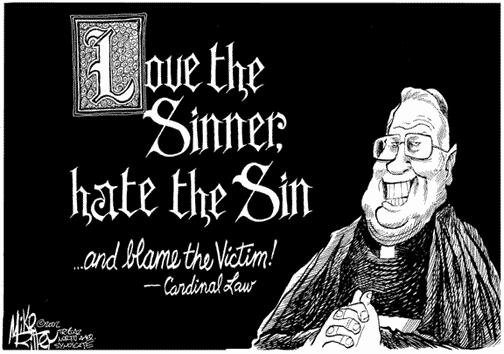
Cardinal Law was not pursued for criminal behavior, not because the Massachusetts Grand Jury Report lacked evidence, but because state law demanded "criminal intent" to convict.
It remains to be seen if Lynn will be convicted. Will he be a foil for his superiors? Will he tell what he knows in a criminal trial? A common church trick to avoid exposure is to have an indicted priest plead guilty, take his sentence and receive an annuity as reward.
Scrutiny of bishops and cardinals will not be dissuaded by protestations of sadness and sorrow for abuse. The time for apologies is over. Now is the time for responsibility.
This second Philadelphia Grand Jury after two years of investigation concluded that:
> The archdiocese lacked "urgency in its efforts to eradicate sexual abuse by its priests."
> The church appointed panel looking into the allegations dismissed credible charges against a priest by more than one independent victim.
> The actions of the archdiocese are simply not the actions of an institution that is serious about ending sexual abuse of children.
> The archdiocese remains focused on protecting its assets and reputation above all.
These conclusions are strikingly similar to previous Grand Jury Reports. Note
the first U.S. investigation to examine and assess the problem of sex abuse
in the diocese of Rockville Center, New York — the Suffolk County
Supreme Court Special Grand Jury published on January 17, 2002:
>"The history of the diocese [RC] demonstrates that as an onstitution they are incapable of properly handling issues relating to the abuse of children by priests.
>Officials used the hollow promise of treatment and reassignment for offenders and …monetary payments to … guarantee silence.
>The conduct of certain officials would have warranted criminalprosecution but for the fact that existing statutes are inadequate.
The Massachusetts Grand Jury reported on priest sex abuse in the Archdiocese of Boston on July 23, 2003. Its conclusions are so commensurate with the Philadelphia findings that if the locales are redacted the content would be indistinguishable. For
instance from Boston:
"The widespread abuse of children was due to institutional acceptance of abuse and a massive and pervasive failure of leadership. Officials knew the extent of the problem for many years before it became public. Officials did not inform authorities of allegations.
They withheld information from investigations. They failed to adequately investigate allegations. Officials transferred abusive priests to other parishes or dioceses. They failed to supervise priest abusers. In short they put children at risk for abuse. "
Why? To preserve image and save money.
There is no evidence that things have changed in Philadelphia since a prior Grand Jury Report was published in 2005. But this current report is more dangerous for the clerical establishment because it comes closer to laying indictable blame for continued clergy violation of minors exactly where it really is — with the boss, the cardinal, or at least at this stage with his vicar.
Until this message becomes operative, effective and implemented the Roman Catholic Church will continue to select, produce, hide, and defend sexually abusing priests.
A recent press headline may indicate change in the civic pressure on the modus operendi of bishops in the United States
"(Reuters) The Archbishop of Philadelphia and his predecessor were accused on
Monday [February 14] in a civil lawsuit of endangering children by concealing
the identity and sexual abuse of predatory priests from law enforcement to save
the church from a costly scandal. Among the seven people and three institutions
named in the lawsuit filed in Common Pleas Court in Philadelphia were the
current Archbishop Cardinal Justin Rigali, his predecessor Cardinal Anthony
Bevilacqua, Monsignor William Lynn, the Rev. Richard Cochrane and Martin
Satchell, who has left the priesthood. The lawsuit accuses the Archdiocese, the
sixth largest in the United States with 1.5 million Catholics, of implementing
"programs and procedures that were misrepresented to the public as providing
help to victims of childhood sexual abuse by clergy, but were instead
maliciously used to develop information to protect the
Archdiocese".

zondag, februari 27, 2011
NCRV Rondom 10, 26/2/2011 misbruik in instellingen en pleegzorg
"Hadden we het maar geweten", was het briefje van een groepsleider die orthopedagoog - en bepaald niet Neerlands grootste schlemiel ook, werd. En er bleef niets meer over van die man met wie ik een lange middag had - en nog veel langere voorbereiding nodig had om die middag en avond aan te kunnen - waarin ik zoveel leerde. En bepaald niet alleen over moed.
Maar tot aan vandaag kan ik geen antwoord vinden op die vraag: hoe kun je het in hemelschristusnaam niet hebben geweten? Wat heb je dan gedaan met de kinderen van een ander? Met hun ouders? Hun families? Hun gezinnen? Hun kinderen? Hun kindskinderen?
Wat heb je dan gedaan in je toezichthoudende teambesprekingen hoe jongens in het kader van hun onder toezicht behandeling met hun groepsleidster naar bed gingen opdat zij zouden leren met sexualiteit en sex om te gaan?
Maar tot aan vandaag ben ik, ondanks veelvuldig proberen, óók niet in staat de integriteit van die zin van die man niet te geloven...
Misschien is dat dan wel de zin van die Commissie Samson.
Die verpletterende mededeling van haar voorzitter, ook bepaald niet neerlands grootste schlemiel "Wij hebben geen mededelingen gekregen vanuit de jeugdzorg zélf, wat mij ook wel verbaast"
En aan dat onverantwoordde zooitje vertrouwde Nederland haar kinderen toe.
Een zooitje dat tot op heden weigert de verantwoording te nemen voor hun zorg en bij een Commissie Samson geen melding doet van wat niet anders kán dan dat zij het óók wisten.
Jazeker, ik geloof die uitspraak van Mevr. Samson - Geerlings.
Ik heb het ze de afgelopen jaren van doelgericht zoeken, met uitzondering van 1, horen zeggen, horen zwijgen tot aan horen krijsen aan toe.
Er is geen vernietigender oordeel over die kinderbeschermingsinternaten mogelijk als uitgesproken door het zwijgen nu van die beroepskrachten tov. die Cie. Samson en de verbazing van haar voorzitter.
Wordt het geen tijd voor 'n nieuw onderzoek?
Hoe is het in vredesnaam mogelijk geweest dat je niet seksueel misbruikt werd in die van zich van verantwoordelijkheid afwentelende kolonie van tot vandaag aan toe vrijwillig gekozen blind- en doofstomheid?
Onderzoelsraad voor veiligheid:
januari 2011, kindermishandeling met fatale afloop
çok teşekkür ederim Yilmaz, Özdal, Cevat, Hassan, Nazmi, Mehmet, Martin, Mustafa, Paul, Ghazi, Adem, Sam, Rudi, Louise en Merjem !!
"Hadden we het maar geweten", was het briefje van een groepsleider die orthopedagoog - en bepaald niet Neerlands grootste schlemiel ook, werd. En er bleef niets meer over van die man met wie ik een lange middag had - en nog veel langere voorbereiding nodig had om die middag en avond aan te kunnen - waarin ik zoveel leerde. En bepaald niet alleen over moed.
Maar tot aan vandaag kan ik geen antwoord vinden op die vraag: hoe kun je het in hemelschristusnaam niet hebben geweten? Wat heb je dan gedaan met de kinderen van een ander? Met hun ouders? Hun families? Hun gezinnen? Hun kinderen? Hun kindskinderen?
Wat heb je dan gedaan in je toezichthoudende teambesprekingen hoe jongens in het kader van hun onder toezicht behandeling met hun groepsleidster naar bed gingen opdat zij zouden leren met sexualiteit en sex om te gaan?
Maar tot aan vandaag ben ik, ondanks veelvuldig proberen, óók niet in staat de integriteit van die zin van die man niet te geloven...
Misschien is dat dan wel de zin van die Commissie Samson.
Die verpletterende mededeling van haar voorzitter, ook bepaald niet neerlands grootste schlemiel "Wij hebben geen mededelingen gekregen vanuit de jeugdzorg zélf, wat mij ook wel verbaast"
En aan dat onverantwoordde zooitje vertrouwde Nederland haar kinderen toe.
Een zooitje dat tot op heden weigert de verantwoording te nemen voor hun zorg en bij een Commissie Samson geen melding doet van wat niet anders kán dan dat zij het óók wisten.
Jazeker, ik geloof die uitspraak van Mevr. Samson - Geerlings.
Ik heb het ze de afgelopen jaren van doelgericht zoeken, met uitzondering van 1, horen zeggen, horen zwijgen tot aan horen krijsen aan toe.
Er is geen vernietigender oordeel over die kinderbeschermingsinternaten mogelijk als uitgesproken door het zwijgen nu van die beroepskrachten tov. die Cie. Samson en de verbazing van haar voorzitter.
Wordt het geen tijd voor 'n nieuw onderzoek?

Hoe is het in vredesnaam mogelijk geweest dat je niet seksueel misbruikt werd in die van zich van verantwoordelijkheid afwentelende kolonie van tot vandaag aan toe vrijwillig gekozen blind- en doofstomheid?
Onderzoelsraad voor veiligheid:
januari 2011, kindermishandeling met fatale afloop
çok teşekkür ederim Yilmaz, Özdal, Cevat, Hassan, Nazmi, Mehmet, Martin, Mustafa, Paul, Ghazi, Adem, Sam, Rudi, Louise en Merjem !!
Senate Forced Adoption Inquiry has extended the time frame for submissions to 31 st March 2011
Senate Inquiry into commonwealth Contribution to Former Forced Adoption Policies and Practices.

Al ontvangen bijdragen bron

Al ontvangen bijdragen bron
 Senate Forced Adoption Inquiry has extended the time frame for submissions to 31 st March 2011
This is an opportunity that I and others believe will be a great chance to get Commonwealth Government action, and interest in our struggle for recognitionof what has been done to us, and many thousands of others; mothers, fathers,children, siblings, grandparents, aunties, uncles and cousins who were separatedunlawfully, unnecessarily and forever from their families.
Some time ago the 'Australian Apology Alliance' requested Jenny Macklin to raisepast adoption practices with her state counterparts after calls for an apologyor inquiry from women coerced into giving up their babies.
This was followed by an AIFS report generally considered to be utterly inadequate, and encouraged the Alliance to align with several W.A. mothers who approached Labor politician David Templeman for support, who together with Dr. Kim Hames, the Deputy Premier of W.A., brought about the now historical apology.
This West Australian Government Apology has created much interest around the world; the very first government to ever take such an historical and momentousaction to raise public tolerance and understanding of regret for a cruel socialinjustice suffered silently for so long, by so many.
A lot of work, time, tears and frustration have gone into this labour of love for our stolen children, but due to the other states of Australia's apathy,this Senate Inquiry will be our chance to right the wrongs of this blot on Australia's history.
But, we need more mothers and everyone affected by the punitive practices of the past to speak up, tell their stories of the pain and trauma, but if not for themselves, tell for those who are no longer withus; the mothers who could not take the pain any more, and all those children who believed that life was not worth living because their mothers "supposedly gave them away".
Please encourage all your contacts to put some words together, even if only acouple of paragraphs - remain anonymous or reveal as much as you want. Ifeveryone wrote a small submission it would take them years to read there were somany of us, but sadly many won't or can't, but we can encourage, and help those who feel they do no know how to, and make this last chance a resounding successand maybe an 'Australia Wide Apology' might come out of this wonderful opportunity.
Barbara Maison
Apology Alliance
zaterdag, februari 26, 2011
Former priest remanded on child porn charges
Irish Examiner
February 25, 2011
A defrocked priest accused of possession of thousands of pornographic images of children, was remanded on continuing bail today pending directions from the DPP.
Oliver O'Grady (aged 65), with an address at a hostel, in Dublin 2, had been arrested on December 10 last.
At his fourth appearance at Dublin District Court today, Judge Cormac Dunne remanded the defendant to appear again on March 25 next. Earlier in the case, Detective Garda Johanna Doyle of the National Bureau of Criminal Investigation had said that further charges were being contemplated.
Previously, the court had heard that the defendant had lived at various addresses in Ireland since he was deported from the United States, in 2001. He rents a lock-up facility and a postbox to store his personal belongings. As part of his bail conditions he must sign on twice daily at Harcourt Terrace garda station.
Mr O'Grady also gave an undertaking earlier not to seek travel documentation and has surrendered his passport to gardaí.
The material allegedly confiscated included images and videos on a USB key, an external hard drive and a laptop. Det-Gda Doyle had told the court earlier: “We are talking about thousands upon thousands of images of child pornography. Children from the age of two and three up to teenage boys and girls.”
vrijdag, februari 25, 2011
Murphy, Deliver us from evil; met de complimenten: de professor en het hofnarretje
Net als zovele anderen wordt ik afgesloten van gas en licht.
In mijn geval over 14 dagen.
De reden: ik heb een IQ hoger dan 70 - 85 !
En weigerde de doofpot.
NCRV altijd wat
In mijn geval over 14 dagen.
De reden: ik heb een IQ hoger dan 70 - 85 !
En weigerde de doofpot.
NCRV altijd wat
woensdag, februari 23, 2011
Jan Nelissen geeft misbruik toe
Omroep Zeeland
 WIJCHEN (ANP) - De 88-jarige salesianer pater Jan N. heeft toegegeven dat hij in de jaren tachtig meerdere minderjarige jongens seksueel heeft misbruikt maar ontkent dat hij ze heeft gedrogeerd en daarna verkracht. Dat heeft de pater woensdag verklaard tegen de rechtbank in Middelburg in een voorlopig
 getuigenverhoor over een misbruikzaak binnen de Rooms-Katholieke Kerk.
bron
Ook heeft hij zich schuldig gemaakt aan seksueel misbruik toen hij in de jaren zeventig directeur was van een tehuis van de salesianen van Don Bosco in Rijswijk. Hij kreeg daarom ontslag.
Toen N. in 1984 solliciteerde naar de functie van pastoraal medewerker in Terneuzen, is niet over het misbruikverleden van de pater gesproken, bijvoorbeeld met toenmalig bisschop Huub Ernst van het bisdom Breda. Ook in de parochie in Terneuzen kwam het verleden van de priester niet ter sprake.
RIJSWIJK – Het bisdom Breda wist niets van het seksueel misbruik door een pater Salesiaan voordat hij in Terneuzen ging werken. Dat heeft de pater verklaard tijdens een verhoor achter gesloten deuren in Wijchen, zijn huidige woonplaats.
Het eerdere misbruik vond plaats toen hij directeur was van een tehuis in Rijswijk.
Betasting
 In Terneuzen heeft de pater zich twintig jaar geleden schuldig gemaakt aan seksueel misbruik van vijf of zes jongens, onder wie de nu 34-jarige X. De pater ontkent dat er sprake is geweest van drogering of verkrachting, het bleef volgens hem bij betasten.
Schadevergoeding
X wil mogelijk een procedure beginnen tegen het bisdom om schadevergoeding te krijgen.
Die Missbrauchsbeauftragte Christine Bergmann:„ Die Gesellschaft muss noch aufmerksamer werden Niemand darf wegsehen“

Neue Osnabrücker Zeitung
Autor: Uwe Westdörp
Autor: Uwe Westdörp
Osnabrück. Wie steht es um den Schutz der Kinder vor sexuellem Missbrauch? Was ist seit Beginn der jüngsten Enthüllungen bereits passiert, was ist noch zu tun? Die Missbrauchsbeauftragte der Bundesregierung, Christine Bergmann, zieht Bilanz.
Frau Bergmann, vor etwas mehr als einem Jahr lösten Berichte über sexuellen Missbrauch am Berliner Canisius-Kolleg eine Aufklärungswelle aus. Hat sich der Schutz der Kinder seither verbessert?
Es ist viel passiert. Die Öffentlichkeit ist stärker sensibilisiert, auch das Wissen über das Ausmaß von sexuellem Missbrauch ist heute sehr viel größer, und es wird häufig schneller reagiert. In Berlin gab es etwa einen Missbrauchsfall auf der Kinderintensivstation einer Klinik. Als eines der Opfer sich den Eltern offenbarte, haben diese den Fall sofort ernst genommen. Und die Klinik hat gar nicht erst versucht, etwas zu vertuschen. Früher gab es dagegen oft das Problem, dass Opfern nicht geglaubt worden ist.
Wie viele Menschen haben sich bisher bei Ihrer Anlaufstelle gemeldet?
Über 1 0. 0 0 0.
Es gab rund 9000 Anrufe, außerdem gingen etwa 2000 Briefe und Mails bei uns ein. Und die Anlaufstelle wird auch aktuell immer noch sehr stark in Anspruch genommen.
Aus welchen Bereichen kommen die Anrufer?
Das hat sich im Laufe der Monate verschoben. Anfangs meldeten sich in der Mehrzahl Betroffene aus den Institutionen, das hatte auch mit der öffentlichen Debatte zu tun. Die Bilanz sieht aber heute so aus, dass mehr als 50 Prozent der von uns registrierten Fälle sich im familiären Umfeld zugetragen haben.
Melden sich mehr Männer oder mehr Frauen?
Im familiären Bereich sind es deutlich mehr Frauen, im Bereich der Institutionen mehr Männer als Frauen. Die Alterspanne reicht von acht bis 89 Jahren. Das Durchschnittsalter liegt bei 47 Jahren.
Die öffentliche Debatte konzentriert sich zurzeit auf finanzielle Entschädigungen. Ist das auch das Hauptthema bei den Gesprächen mit den Betroffenen?
Nein, keineswegs. Die Themen, die bei uns am häufigsten genannt werden, sind Therapie und Beratung. Ganz häufig kommt zudem der Hinweis: Sorgt dafür, dass den Kindern von heute nicht das passiert, was wir erleben mussten. Beim Thema Entschädigung ist vor allem die gesellschaftliche Anerkennung wichtig. Dass den Betroffenen geglaubt wird, dass ihnen Schlimmes widerfahren ist. Das liegt auch daran, dass ihnen ja häufig von den Tätern die Schuld zugeschoben worden ist.
Die Jesuiten wollen Missbrauchsopfern 5000 Euro zahlen. Auch die katholischen Bischöfe haben sich auf Zahlungen geeinigt. Was wird aus dem gemeinsamen Fonds, den der Runde Tisch einrichten will?
Dort, wo klare Verantwortung besteht, etwa in Jesuiten-Kollegs, wird niemand gehindert, finanzielle Einzellösungen anzubieten. Im Übrigen befasst sich der Runde Tisch Anfang März mit dem Thema Entschädigung. Es wird hierbei auch um die Verlängerung der Fristen, in denen zivilrechtliche Ansprüche verjähren, gehen, und um Änderungen im Opferentschädigungsgesetz. Ein weiteres wichtiges Thema, das im Kontext von Hilfen gesehen werden muss, ist die bereits genannte Forderung der Betroffenen nach ausreichenden Therapie- und Beratungsangeboten, sodass es ein weites Feld für eine gemeinsame Fondslösung gibt.
Mitte bis Ende Mai wollen Sie dem Runden Tisch Ihre Empfehlungen unterbreiten. Was werden Sie in den Vordergrund stellen?
Für die Betroffenen haben Beratungs- und therapeutische Leistungen ganz klar den Vorrang. Und das werde ich so weitergeben.
Das Koblenzer Landgericht verhandelt einen Fall aus dem Westerwald, in dem es um sexuellen Missbrauch in Hunderten Fällen geht. Ist es nicht beängstigend, dass solche Vorgänge über Jahre im Dunkeln bleiben?
Die Dunkelziffer ist mit Sicherheit sehr hoch. Die Kriminalstatistik weist für 2009 bundesweit etwa 13000 Fälle von sexuellem Missbrauch von Kindern und Jugendlichen aus. Aber das sind nur die Fälle, die zur Anzeige gebracht wurden. Und man muss davon ausgehen, dass die tatsächliche Zahl um ein Vielfaches höher ist.
Was kann man tun, um Licht ins Dunkel zu bringen?
Wenn man Kindern mehr Glauben schenkt, sie in rechtlichen Verfahren besser begleitet, dann wird es vermutlich auch mehr Anzeigen geben. Zudem muss die Gesellschaft noch besser informiert sein. Man muss fragen: Wissen alle, an wen sie sich in einem Verdachtsfall wenden können, sind Beratungsstellen in der Nähe bekannt? Ganz wichtig ist auch, dass die Gesellschaft noch aufmerksamer wird. Niemand darf wegsehen. Denn es ist kaum vorstellbar, dass so schreckliche Dinge geschehen wie im Westerwald, und das bekommt angeblich keiner mit. Alle, die mit Kindern und Jugendlichen arbeiten, müssen so weit geschult werden, dass sie Verdachtsmomente erkennen können und auch wissen, wie sie damit umgehen müssen.
Welches sind die wichtigsten Warnsignale?
Wichtig ist zu erkennen, wenn sich ein Kind verändert. Die einen werden aggressiv, andere ziehen sich zurück. Wie Kinder auch immer reagieren – Veränderungen können deutliche Signale sein.
Wichtig ist zu erkennen, wenn sich ein Kind verändert. Die einen werden aggressiv, andere ziehen sich zurück. Wie Kinder auch immer reagieren – Veränderungen können deutliche Signale sein.
Was sind Ihre Hoffnungen für die Zeit nach dem Runden Tisch?
Es ist enorm wichtig, dass konkrete Maßnahmen folgen. Es muss sich jeder Verein, jeder Verband, jede Kita, jede Schule mit dem Thema auseinandersetzen und prüfen: Gibt es Fortbildungsbedarf? Wissen alle, was zu tun ist, wenn morgen ein Verdachtsfall gemeldet wird?
Abonneren op:
Posts (Atom)