Posts tonen met het label US verjaringstermijnen. Alle posts tonen

vrijdag, september 07, 2018


CHILD USA Responds to Release of Grand Jury Report 

on Clergy Sex Abuse in Six Pennsylvania Dioceses


The Report actually understates how far behind the rest of the country Pennsylvania’s statute of limitations (“SOLs”) are. It is one of the few states that has not yet eliminated at least felonies from its criminal SOLs. CHILD USA recently issued a study of statute of limitations reform since 2002, which also ranks all 50 states and the District of Columbia on the child sex abuse statutes of limitations. [Report available here]. The conclusions regarding Pennsylvania are as follows:
6-9-2018

Attorneys general across the United States are taking a newlyaggressive stance in investigating sexual abuse by Roman Catholic clergy, opening investigations into malfeasance and issuing subpoenas for documents.

On Thursday alone, the New York state attorney general issued subpoenas to all eight Catholic dioceses in the state as part of a sweeping civil investigation into whether institutions covered up allegations of sexual abuse of children, officials said. The attorney general in New Jersey announced a criminal investigation. 

The new inquiries come several weeks after an explosive Pennsylvania grand jury report detailed the abuse of more than 1,000 children by hundreds of priests over decades. With Catholics clamoring for more transparency from their church, demanding that bishops release the names of accused priests, civil authorities are beginning to step up to force disclosure.

In the three weeks since the release of the Pennsylvania report, the attorneys general of Illinois, Missouri, Nebraska and New Mexico have also said they will investigate sex abuse by Catholic priests in their states and have asked local dioceses for records. Most bishops have been saying they will cooperate
[...]
BRON


“Sooner or later it will become broadly obvious that there is a systemic connection between the sexual activity by, among and between clerics in positions of authority and control, and the abuse of children
[...]

Richard Sipe 


vrijdag, juli 27, 2012

Opvallende toename verering H. Laurentius, schorten schiet omhoog ; Lawyer: Los Angeles abuse documents could see release by year's end


NCR
Jul. 26, 2012

Hundreds of plaintiffs involved in a historic sex abuse settlement more than five years ago with the Los Angeles archdiocese may be coming to the end of a long struggle to gain access to thousands of pages of documentation detailing the conduct of church officials in handling the scandal.

On July 18, a California Appeals Court denied the latest petition of the archdiocese to restrict access to priest personnel files sought by attorney Anthony De Marco as part of a current abuse lawsuit he has filed against the archdiocese.

The significance of the recent decision, however, goes beyond the case in question, De Marco said in a phone interview Tuesday. He said California Superior Court Judge Emilie H. Elias looked over the 25 files in question in the current case, some of which overlap those sought as part of a $660 million settlement in 2007. He said she told attorneys on both sides that she would use the request as a "test case" and that if the appeals court is satisfied with what she was agreeing to release, that the same criteria would be used for the rest of the documents being sought. She said if the archdiocese's petition to keep the records sealed is denied, she would rapidly go through the rest of the documents in question.

Tod M. Tamberg, director of media relations for the Los Angeles archdiocese, disagrees with De Marco's assessment. The denial of the church's petition "does not affect release or publication of documents," he said in an email response to questions from NCR. "The issue was only whether certain materials could be disclosed to the plaintiff's lawyer in one specific case."

He said the court maintains the importance of preserving the privacy rights of the priests involved, who were not party to the current action. He said that guarding those rights, "while the extent of their protection is still the subject of litigation, constitutes an overriding interest that overcomes the right of public access to the documents." Tamberg further argued that the materials to be turned over to De Marco will be "subject to a protective order" and sealed in the public record.

De Marco responded that once the documents are introduced at trial, they become part of the public record and are available for public scrutiny. He also disagreed with Tamberg, saying that in every instance in which a judge has been asked to rule on whether the documents should be made public, the public interest has outweighed the right to privacy and the judges have ruled for disclosure, with redactions of names of some individuals and agencies to protect privacy.
The ruling that these documents "can be produced to someone other than the church," De Marco said, means "they are no longer going to be secret."

When the archdiocese, under since-retired Cardinal Roger Mahony, agreed to the historic settlement with 508 plaintiffs alleging abuse by more than 150 priests, the church agreed to a process that would ultimately release thousands of pages of documentation. Some of the plaintiffs agreed to the mass settlement -- which allowed the archdiocese to avoid court procedures that would have involved lengthy discoveries and would have placed Mahony on the witness stand -- because the agreement included release of the personnel files. At the time of the settlement in August 2007, the church had already fought the release of the documents for four years.
Five years after that settlement, the documents remain under seal, but De Marco believes they may soon be released.

The process has dragged on for this long partly because the court required that a retired judge look through all the documentation to decide what could be made public and when. The first judge to take on the job ultimately recused himself, setting back the process.
The archdiocese has also used every legal maneuver at its disposal to fight full disclosure.

According to an April 28 report in the Los Angeles Times, retired Federal Judge Dickran Tevrizian had ruled more than a year ago that "the personnel files should be released, but with the names of church officials who dealt with the abuse claims blacked out. Victims cried foul, but Tevrizian said the church had reformed and did not deserve further scorn. Besides, the public can figure out who's responsible, he said."
The church has released thousands of documents in other cases in Southern California.
In October 2010, a judge ordered the release of some 10,000 documents relating to sexual abuse of children by priests in the San Diego diocese. The release was a provision of a settlement as ordered two years earlier by Elias.

The Orange diocese followed up a court-approved $100 million settlement in December 2004 with the release of more than 10,000 pages of documents showing how diocesan officials protected predator priests, harassed victims and their families, and stonewalled inquiries into their handling of abuse.
Another 8,500 pages of documents and files were obtained by plaintiffs in a settlement in 2006 with Franciscan priests and brothers in the Province of Santa Barbara.

The Franciscan order fought release of the documents through several levels of court before the California Supreme Court declined to review an appeals court decision and allowed the release of the documents.
In some instances, the Franciscan documents have been heavily redacted, with the name of superiors and other managers blacked out, but there remains a rather detailed picture of the abuse of children and the protection of abusers by Franciscan superiors over several decades. The documents now are available on the online depository BishopAccountability.org.

De Marco said it was the rationale used in arguing for release of the Franciscan documents that he employed in seeking release of the 25 files he requested for use in his current case. In his filing he said there was no substantial difference between the requests for the Franciscan files and the objections of the order, which were denied, and his request and the objections raised by the Los Angeles archdiocese. He believes that since the state supreme court has already ruled on the issues — and since Elias has spoken her intent to follow the lead of the appeals court, which rejected the archdiocese's petition to keep files secret -- full disclosure of documents sought in the 2007 settlement could occur by year's end.

donderdag, februari 23, 2012

Abdij Mehrerau „Für mich war es auch selbstverständlich für das Opfer sämtliche entstehende Fahrtkosten zu übernehmen"


Bei der Einrichtung der (Klasnic-)Kommission ging es darum„Opfern möglicher Weise jahrelange juristische Auseinandersetzungen und Prozesse mit psychiatrischen Begutachtungen und unsicherem Ausgang zu ersparen. Zudem müssen im österreichischen Rechtssystem die Kläger bei Einbringung einer Klage, sofern sie keine Verfahrenshilfe erhalten, Gerichtsgebühren in beträchtlicher Höhe hinterlegen.“


Der heute 57-Jährige war in den 1960er-Jahren von einem Geistlichen mehrfach vergewaltigt worden. Die Klage auf Schmerzensgeld und Verdienstentgang ist die erste zivilrechtliche Klage eines Missbrauchsopfers, strafrechtliche Verfahren gegen den von mehreren Männern beschuldigten Geistlichen waren wegen Verjährung eingestellt worden.

Sanyai Doshi, der Anwalt des Klägers, sah das Kloster in der moralischen Pflicht, keinen Verjährungseinwand zu erheben und damit das Verfahren zu ermöglichen. Abt Anselm van der Linde verweist das Opfer in einer Aussendung jedoch, wie bereits vor der Klage, an die Klasnic-Kommission. Das Kloster sei nicht bereit, die Haftung für vorsätzliche Taten eines Ordensmitglieds zu übernehmen. In die Opferschutzkommission flossen bisher, so Pressesprecher Harald Schiffl, rund 200.000 Euro aus der Mehrerau.

B. "der vielleicht 20, 30 oder mehr Kinder missbraucht hat" war bereits 1967 einschlägig verurteilt worden, dennoch blieb er Lehrer und Erzieher. 1982, nach Bekanntwerden eines weiteren sexuellen Übergriffs, wurde er versetzt. B. arbeitete dann in Tirol als Pfarrer - auch mit Kindern.


Der Abt habe von nichts gewusst
" Unglaubwürdig", sagt der ehemalige Mehrerauer Philipp Schwärzler , der Psychologe arbeitet seit zwei Jahren für die unabhängige "Hotline für Betroffene kirchlicher Gewalt".
Das würde bedeuten, dass Altabt Kassian Lauterer seinen Nachfolger nicht über die Missbrauchsfälle informiert hätte.

....> artikel Jutta Berger, DER STANDARD, Printausgabe, 22.2.2012

PRESSEINFORMATION

(Bregenz, 21.02.2012) Die Abtei Mehrerau hat gestern, 20.02.2012, fristgerecht die Beantwortung der Klage eines Opfers von sexuellem Missbrauch bei Gericht eingebracht.
Generell stellt Abt Anselm van der Linde dazu fest: „Um den Opfern des oft jahrzehntelang zurückliegenden und dadurch juristisch verjährten Missbrauchs auf alle Fälle eine Entschädigungszahlung zu ermöglichen, wurde von der Bischofskonferenz die Opferschutzkommission eingerichtet. Dort werden Opfer unabhängig, sensibel und diskret beraten und unterstützt. Und es werden in möglichst kurzer Zeit Entschädigungen und Therapiekosten ausbezahlt.“


Kloster nimmt seine Verantwortung wahr

Abt Anselm verweist darauf, dass die Opferschutzkommission nach dem Verursacherprinzip verfährt und die zugesprochenen Entschädigungssummen von den Tätern bzw. den Diözesen, Organisationen oder Orden an die Kommission refundiert werden müssen. „Wir nehmen auch in dieser Hinsicht unsere Verantwortung wahr und sorgen für Entschädigung der Opfer.“
Bei der Einrichtung der Kommission ging es darum „Opfern möglicher Weise jahrelange juristische Auseinandersetzungen und Prozesse mit psychiatrischen Begutachtungen und unsicherem Ausgang zu ersparen. Zudem müssen im österreichischen Rechtssystem die Kläger bei Einbringung einer Klage, sofern sie keine Verfahrenshilfe erhalten, Gerichtsgebühren in beträchtlicher Höhe hinterlegen.“
Die Opferschutzkommission wurde auch eingerichtet, dass Opfer und ihre Perspektive und ihr Leiden nicht mehr ausgeblendet werden.
Seit 2010 Kontakt mit dem Opfer – intensiver Rat sich an die Opferschutzkommission zu wenden

Seit 2010 gab es von Seiten des Klosters mit dem Opfer mehrfach Kontakt. „Ich habe in einem persönlichen Gespräch und auch schriftlich meine tiefe Betroffenheit über das Leid, das dem Opfer angetan wurde, zum Ausdruck gebracht und, sofern dies möglich ist, um Vergebung gebeten,“ so Abt Anselm, der berichtet, dass er dem Opfer eindringlich und intensiv empfohlen hat, sich direkt an die Opferschutzkommission zu wenden. Abt Anselm: „Für mich war es auch selbstverständlich für das Opfer sämtliche entstehende Fahrtkosten zu übernehmen. Mein Wunsch war, dass ihm bei der Kommission rasch, verantwortungsvoll und unbürokratisch geholfen wird. Dieser Weg steht dem Opfer über die Ombudsstelle in Feldkirch immer noch offen.“

In der Klagebeantwortung wird festgestellt, dass keine Haftung des Klosters nach § 1313a ABGB für vorsätzliches Handeln einzelner Mitglieder besteht und die Taten aus juristischer Sicht verjährt sind.

Anselm van der Linde
Abt von Wettingen-Mehrerau


dinsdag, juli 26, 2011

Philly judge halts release of cardinal's grand jury testimony, filed to support criminal case

The Republic

MARYCLAIRE DALE Associated Press
First Posted: July 25, 2011

PHILADELPHIA — A judge on Monday halted the release of 1,200 pages of grand jury testimony on a Roman Catholic cardinal relating to his handling of priest sex-abuse complaints in Philadelphia.

Prosecutors filed Cardinal Anthony J. Bevilacqua's secret testimony from 2003 to support conspiracy charges filed this year against a high-ranking church official, they said in court papers filed Friday.

Monsignor William Lynn, 60, is charged with conspiracy and child endangerment for allegedly transferring priest-predators without warning. Lynn served as secretary for clergy from 1992 to 2004, mostly under Bevilacqua.

The Philadelphia Inquirer reported Sunday that Bevilacqua, the former archbishop, had testified that accused priests "would not be able to function" at new parishes if people were warned of their backgrounds.

Grand jurors found the leader of the Philadelphia archdiocese "excused and enabled" the abuse, and was "not forthright" and "untruthful" during 10 grand jury appearances over eight months, the newspaper reported. He was not charged because the statute of limitations had run out.

Common Pleas Judge Lillian Ransom put a hold on the further release of the grand jury testimony and other documents filed Friday. She did not immediately return a call for comment on her action Monday. Neither side asked to have the documents sealed.

Lynn is the only U.S. church official ever charged in the sex-abuse scandal for his administrative actions.

Four others — two priests, an ex-priest and a former teacher — are charged in the same criminal case with raping boys. Three of them raped the same boy, starting when he was a 10-year-old altar boy, a second grand jury charged this year.

The prosecution's latest filings came in response to Lynn's motion to have the charges dismissed or have his case tried separately.

"It is understandable that he would not want a jury to see the exact nature of the danger to which he subjected parish children, or the consequences of his action. But ... the crimes Lynn enabled would clearly be admissible even if he were tried separately," Assistant District Attorney Mariana Sorensen wrote in the 65-page response, obtained by The Associated Press.

Lynn's lawyers declined to comment Monday on the filings, citing an ongoing gag order in the case.

The motions will be argued at a key hearing Friday. Defense lawyers assert that he had no children in his care and cannot therefore be charged with endangering them.

Prosecutors argue the charge can apply to anyone with a duty to protect the general "welfare" of children, and not just those with direct supervision of them. The archdiocese was charged with protecting children at its schools and parishes, prosecutors wrote.
[...]

zaterdag, mei 28, 2011

Janus

Shanley lost the appeal in the Massachusetts Supreme Judicial Court.

COMMONWEALTH OF MASSACHUSETTS SUPREME JUDICIAL COURT SJC NO. 10382AC NO. 2007-P-0886 COMMONWEALTH OF MASSACHUSETTS, Appellee v. PAUL SHANLEY, Appellant ON APPEAL FROM A JUDGMENT OF THE SUPERIOR COURT BRIEF OF THE LEADERSHIP COUNCIL AS AMICUS CURIAE

excerpts

This Brief explains why Appellant’s position is wholly inaccurate regarding scientific acceptance of dissociative memory loss and why his Court’s determination that testimony on dissociative memory loss and recovery, from an otherwise qualified expert, is admissible without a Lanigan hearing, is correct. See Commonwealth v. Frangipane, 433Mass. 527, 537-538 (2001)….


Niet in een dure psychoanalyse, maar een door NUON gesponserd avondje Cruyffacademie op de keukenhof !


maandag, februari 21, 2011

Top Phila. Priest Suspended for Alleged Child Endangerment

A former top Roman Catholic church official in Philadelphia has been placed on administrative leave following charges of endangering children in connection with sexual abuse by priests.
The Archdiocese of Philadelphia said Sunday that parishioners at Saint Joseph parish in Downingtown were informed in weekend Masses that Monsignor William Lynn, 60, was placed on administrative leave Friday.

Lynn was secretary of the clergy and a top archdiocese official from 1992 to 2004. He was accused in a scathing grand jury report of putting pedophiles in posts where they had contact with youngsters. Felony endangering charges were filed earlier this month, and Lynn was also named in a civil lawsuit last week.

Philadelphia's cardinal, Justin Rigali, has released numerous statements and a video expressing his sympathy for the alleged victims and has promised his full cooperation. He has also brought on a former Philadelphia assistant district attorney to help with an internal investigation.
New Allegations of Sex Abuse by Local Priests

Lynn's attorney has said that his client doesn't concede that he knew he was putting children at risk.

dinsdag, oktober 05, 2010

Window for Belgium? Adriaenssens oppert tijdelijke opheffing verjaringstermijn seksueel misbruik

“It is an either/or choice: we can either protect the predators or the children.”

Kinderpsychiater Peter Adriaenssens heeft vandaag in de Kamer de mogelijkheid geopperd om de verjaringstermijn voor seksueel misbruik uit het verleden tijdelijk op te heffen.

Een concreet voorstel was het niet, wel een voorbeeld uit het buitenland. Tegelijk gaf hij aan dat het optrekken van de verjaringstermijn van tien naar vijftien jaar "misschien meer rekening zou houden" met de huidige situatie. Adriaenssens - voorzitter van de intussen opgedoekte commissie rond seksueel misbruik in de kerk - zakte af naar het parlement voor een hoorzitting met de leden van de Kamercommissie Justitie. Die bleken vooral vragen te hebben over de relatie tussen de commissie-Adriaenssens en het gerecht, maar vroegen de kinderpsychiater ook welke stappen ze als wetgever konden nemen.

Voor wat betreft verjaring, benadrukte Adriaenssens dat "een onderscheid nodig is tussen de actuele generatie en de oude generatie".


Zo werd in Boston destijds een uitzonderingsmaatregel getroffen, speciaal voor slachtoffers bij wie de feiten dateren van midden vorige eeuw, een periode waarin de problematiek nog veel minder bespreekbaar was. Gedurende twee jaar werd voor hen de verjaringstermijn opgeheven. "Ik kan dat alleen meegeven", aldus Adriaenssens.


Voorts gaf hij aan dat het optrekken van de verjaringstermijn in het strafrecht "misschien meer rekening zou houden" met de huidige situatie. Jongeren blijven immers steeds langer thuis wonen. "Echt loskomen van je belangrijkste invloed duurt daardoor langer", aldus Adriaenssens. Maar met te lange termijnen "geef je bitterheid de kans zich sterker te vestigen", waarschuwde hij nog. (belga/ka)


A Review of Marci Hamilton's Justice Denied: What America Must Do To Protect Its Children
By THOMAS P. DOYLE, J.C.D., C.A.D.C.
Wednesday, Jun. 24, 2008

Marci Hamilton
Professor, Benjamin N. Cardozo School of Law
MIT

http://www.childvictimsvoice.com/
Video: CVA anniversary panel A panel, featuring survivors of childhood sexual abuse and experts in the fields of law enforcement, constitutional law, victims' advocacy and the counseling of childhood trauma victims, discussed Delaware's Child Victim's Act at its one-year milestone.
Watch the video

woensdag, september 29, 2010

Jetzt reden wir: Das gemeinsame Arbeitspapier der ehemaligen Heimkinder Vorlage für den "Runden Tisch Heimerziehung" des Deutschen Bundestags


Aktuelle Meldung
"[...]
wir der Vorstand des Vereins
...
Wir bieten Sie, die Vorschläge in die Sitzung des Runden Tisches für Ehemahlige Heimkinder am 21-9-2010 gemeinsam einzubringen und...

zondag, juli 25, 2010

woensdag, juli 14, 2010

Guam: Community apathetic on sex abuse bill

Kuam News
Nick Delgado

Guam - Legislation that would make it clear in Guam civil law that clerics cannot claim privileged communications as a basis for failure to make such reports of child abuse, neglect or sexual abuse went up for a public hearing this afternoon. No one however showed up to testify for or against the legislation. Likewise, no one submitted written testimony either.

Currently under Guam law teachers, nurses, doctors, social services workers, police officers and other professionals are required to report cases of suspected abuse. The bill would add the job positions of bishops, pastors, priests, deacons and other clerical posts.

The Legislature will still accept written testimony on Bill 372 over the next ten days.

zaterdag, april 03, 2010

Learning From the Vatican's Problems: What the U.S. Must Do to Protect Children Now

Marci Hamilton
Professor, Benjamin N. Cardozo School of Law
The Huffington Post
March 31, 2010

In the last several weeks, Germany and Brazil have been added to the already lengthy list of countries where there is irrefutable evidence of childhood sexual abuse by Roman Catholic clergy.
The Pope, whose previous role in the Vatican made him the primary policymaker on this issue, has even been implicated in the persistent, global pattern of abuse -- most recently in a case involving hundreds of deaf boys in Wisconsin.
Moreover, there now appears to be overwhelming evidence that Benedict, as the then Cardinal Joseph Ratzinger, was aware of hundreds -- if not thousands -- of other especially heinous cases of abusive priests who were allowed to continue pastoring despite proof of their horrific actions and went on to victimize more children. And, in 2001, in what many are now calling nothing short of an obstruction of justice, he issued a definitive letter requiring that the handling of child sexual abuse issues be under the "pontifical secret."
Yet, the Pope's responses lag well behind the world's demands for accountability; last weekend, as the crisis continued to spiral across Europe, he offered a written apology in response to the months-long crisis in Ireland. Yet, he remains mute on Germany, his own home country, and on Brazil, where the evidence of abuse has been caught on tape. The Catholic system, though, does not permit the Pope to be removed from office without his assent. So if countries are to protect their children, they will have to take action on their own.

Such is the case in Germany, where Chancellor Angela Merkel quickly and decisively demanded and launched an in-depth investigation into the abuse of her country's children not long after the facts about the Catholic order-run residential schools became known. In contrast, the United States government has yet to respond to the issue within - or outside - its borders. Even as the abuse scandal rocked our nation over the past decade, both President Bush and now President Obama have remained virtually silent. The State Department has also been negligent by not taking a position.

The time for fence-sitting is over. As the leader in the free world for human rights enforcement, the U.S. can no longer remain on the sidelines in the face of the breadth and depth of such appalling violations by the Roman Catholic Church and its hierarchy against children.

In fact, the State Department has useful procedures and protocols already in place that should be invoked to study and document past abuse, and deter it in the future. For example, it issues yearly reports on human rights violations and practices in foreign countries. So, I would argue that it is hardly a stretch to add the Holy See as a country to be studied annually with respect to its handling of child sex abuse by its employees and agents around the world.

Moreover, the federal government has already instituted various vehicles to address the trafficking of children for sex. The Holy See's activities here do not (usually) involve the movement of children, though. Rather, the problem is the movement of adults dangerous to children. According to http://www.bishopaccountability.org/, 69 priests known to have abused children in the U.S. were shipped here from Ireland. Congress needs to enact criminal laws to punish, penalize, and deter any institution, organization, or country that transports adults into the country who pose such serious menace.

One promising path that I have strenuously advocated for, and the President and Congress needs to consider if it wants to demonstrate its leadership, is amending the RICO laws to reach institutionally orchestrated child sex abuse. Right now, RICO, which was created to capture organized criminal activity, is triggered by financial harm; it needs to be changed so that it is triggered by widespread harm to children as well. And the Catholic Church is not the only institution that requires investigation under such a statute. The Boy Scouts trial occurring in Oregon right now has produced evidence of decades-old "perversion files" that detail knowledge of abusers in close proximity of children. The Holy See is not the only organization that is putting children knowingly or recklessly at risk.

I also have urged the federal government to provide incentives to states to reform their statutes of limitations for child sex abuse so these arbitrary barriers no longer keep child predators in business and victims from pursuing justice in the courtroom when they are adults.
It is important to note that child sexual abuse is epidemic; it is estimated that one in four girls and one in five boys are sexually abused and only 10 percent of victims ever go to authorities. It is also fact that survivors typically need decades to come forward and the legal system offers the only viable means of identifying child predators who are operating under the radar against our children.

Lengthening, or even eliminating, statutes of limitation (SOLs) is a costless way for the states to do so, while balancing the scales of justice for victims. States like Alaska, Maine, and Delaware simply eliminated SOLs. In California, such reformation yielded the identities of over 300 previously secret child predators. And right now, similar bills are pending in Arizona, Connecticut, New York, and Wisconsin.

The United States should also reconsider its failure to ratify the Convention on the Rights of the Child so that it can exercise moral and meaningful authority on these issues in the global sphere. The vast majority of the world's countries have already ratified the Convention - even the Holy See signed on - but America has been held hostage by Republicans intent on permitting parents to physically punish their children.

Even without the U.S. on board, the United Nations Committee on the Rights of the Child must address the worldwide human rights abuses by and within the Roman Catholic organization being documented on a daily basis at this point. This, the Holy See's mishandling of child predator employees and agents, is a topic that should be added to its next meeting's agenda in Geneva in late May.

Since the massive cover-up of the Church's secret handling of child sexual abuse by its priests first broke in 2002, thousands of victims here in the U.S. - and millions who are rightfully and sufficiently outraged - have demanded accountability. So far, our government has acted as though their suffering has nothing to do with its obligations. Only when leaders of our country, not to mention those around the world, stand up for the victims will justice ever be done. Silence and inaction means nothing less than another act of abuse being perpetrated upon them.

Washington's Crossing, PA resident Marci A. Hamilton is the Paul R. Verkuil Chair in Public Law at Benjamin N. Cardozo School of Law of Yeshiva University and the author of "Justice Denied: What America Must Do to Protect Its Children" (Cambridge 2008). She can be reached at hamilton02@aol.com.

dinsdag, september 29, 2009

European Commission: Flash Eurobarometer The Rights of the Child

Nederlandse kinderen minst bekend met hun rechten

In opdracht van de Europese Commissie is onderzoek gedaan naar de mening en kennis van Europese kinderen over hun rechten.

Opvallende uitkomst van het onderzoek is dat kinderen in Nederland vergeleken met kinderen uit andere Europese landen, het minst bekend zijn met hun rechten. Tegelijkertijd zijn de Nederlandse kinderen relatief vaak van mening dat de kinderrechten in hun land goed beschermd worden.
Rest artikeltje: DCI


The Flash Eurobarometer " The Rights of the Child" is part of a trend survey; the results of the previous wave were published in 2008. A comparison, between 2008 and 2009 results, concerning young people's knowledge and opinions about the rights of under 18 years olds, showed very few significant differences:

Knowledge and information about the Rights of the Child
Awareness of the Rights of the Child:

-Almost two-thirds of young people (15-18 years old) from the 27 EU Member States were
aware that people under 18 enjoy specific rights compared to adults.

-The Netherlands, Hungary and Denmark were the only countries where more than half of
interviewees were unaware of the specific rights of under 18 year -olds (61%, 60 % and 53 %, resp.).


donderdag, januari 22, 2009

Muhler caminando, Recht, misbruik, bischoppen en het Vaticaan

Zal het 2 jaar gelden zijn geweest dat ik werkelijk niet wist waar grenzen hoorden te liggen, waar verantwoordelijkheid ligt. Een knap ingewikkeld gewetensconflict.

Een toegestuurde foto bij een ontroerend, liefhebbend verhaal van een vrouw die volstrekt niet door had wat er op die foto nog meer te zien was.
En zeker niet in welke moeilijke positie ze mij daarmee bracht.

De eerste foto die ik kreeg over de Nederlandse realiteit, die ik wel al die tijd had geweten - maar is herinneren weten? - en op basis van logisch denken niet anders dan kon vermoeden:
de Magdalena's waren niet alleen de Ierse realiteit geweest.
Het was ook de Nederlandse realiteit, het was één van mijn jeugdervaringen (hoe wisten we dat in vredesnaam? ). Die gruwel bij het zien van die documentaire, die avonden over die film met een paar mensen, die vreselijke avond in een bioscoop, het parkeerterrein erna.

De eerste foto die ik kreeg met een van de Nederlandse Magdalena's.
Wat moest ik er in godsnaam mee?
De congregatievrouw die ik om uitleg ervan vroeg loog. Of, misschien wel beter, dat hóóp ik.

Een ervaring die ik nodig had bij het lezen en proberen te snappen van een weerzinwekkend artikel; rk Maryland over de wetwijzigingsvoorstellen mbt de verjaringstermijnen daar , en een bijbehorende window (2 jaar).
De inzet van de gevechten ook van Mahony, Bernard Law.

De gecontinueerde minachting van die kerk ten opzichte van haar vroegere kinderen.
De gecontinueerde ontkenning, afgekocht met fooien van mede door een vergelijkbare window afgedwongen miljarden, verkrachting op verkrachting stapelend.

Zoekend naar mijn antwoord was er een vrouw met een webblog. Een van de vele slachtoffers van Marcial Maciel. En een lied. En me realiseren dat misschien wel het enige antwoord op dat RK Marlyland dat, mijn, bloedstollende lied is.

Maar het was maar een paar klikken verder om een Mexicaanse strafrecht zaak te vinden, waarin vandaag, na jaren, alweer een nieuwe grens werd gepasseerd.

Een bisschop - die gebruikt had gemaakt van zijn zwijgrecht - moest zijn schriftelijke antwoorden inleveren.

Zoals Mgr. Hurkmans dat wellicht ook deed en genoot van het uitzicht van zijn kamer
op de tiende verdieping van een hotel met uitzicht op de wolkenkrabbers in de stad. De bisschop heeft zijn verblijf ook gebruikt om te lezen en te ontspannen. Nieuws in kranten of op TV heeft hij niet gezien. Wel ging hij op de slotavond naar een religieus popconcert en maakte een uitstapje naar de heilige Juan Diego die eertijds een Mariaverschijning kreeg van de inmiddels beroemde Maria van Guadelouppe. “We reden door een landschap met cactussen en werden ontvangen door vrouwen met het nodige eten en een bandje van Mexicaanse mannen op gitaren die voor ons zongen.”

De eerste strafrecht zaak tegen een rk bisschop in Mexico
Beschuldigd van diefstal en fraude.
130 miljoen

Kunst, schilderijen, héél veel geld waard op een markt, uit een erfenis van een van die onwaarschijnlijk rijke Mexicaanse families.
En weer was ook Marcial Maciel niet dood.
no les creas,
don't believe them,
geloof ze niet.

Een deel uit een erfenis, van Mevr. Olga Azcárraga Madero, die bedoeld ten behoeve van priesters in nood...
Naast een Modigliani, Diego Rivera, Frieda Kahlo, een Orozco, Clausell en een Picasso alleen al één doek, Mujer caminando van Rufino Tamayo meer dan een miljoen waard zijn.

En een rk bischop van Ecatepec, Onésimo Cepeda Silva.

En vast, over een paar jaar, zo'n handig boek van een knappe onderzoeksjournalist die het allemaal even uitlegd, wie was wat en wie deed waar wat, zodat we allemaal weer kunnen weten of Tarcisio Bertone nu wel of niet een mexicaans kunstwerk kreeg tijdens de Wereldgezinsdagen, misschien zelfs wel van de president en zijn vrouw die het hem als antwoord op zijn Vaticaans cadeau: U mag van het Vaticaan scheiden en kerkelijk hertrouwen, mijnheer de president, overhandigde.

Zoals er nu La Orden Maldita is.

Ja, mijn kind, ik ben gelovig lid van een wereldkerk; een diep en diep misdadige organisatie. En ik hoop dat het nog heel, heel lang duurt voor ook jij dat wordt.
Maar dan hoop ik dat je eerst ook in Mexico bent geweest.

Vergeet dan Ariel Dorfmans Testament niet mee te nemen, kijk naar de escudos en herken de muziek.


...
Os meninos à volta da fogueira
Vão aprender coisas de sonho e de verdade
Vão aprender como se ganha uma bandeira
Vão saber o que custou a liberdade

dinsdag, oktober 21, 2008

Jezuitenvraag bij 15 minutes of fame dankzij Asshol

;Witness questions truthfulness of priest's accuser

Weer een familie in *** door McGuire.
Schoonpa stimuleert 22 jarige schoonzoon om proces aan te gaan, om hem vervolgens als leugenaar voor de rechtbank - en bij deze high profile mijnheer kassa! met zijn high profile kindzuster dus zeker wereldwijd - neer te zetten; wiens 15 minutes of fame ?
Gatverdamme.
Wie heeft er nu gelogen en wie heeft nu wie genaaid, Dr. Murphy?

Mary Dedinsky on -->October 20, 2008
The father-in-law of a man who alleges he was abused by a Jesuit priest testified today that he has difficulty trusting the young man who married his oldest daughter.

Peter DeMarco testified for the defense at the ongoing trial of Donald McGuire, now defrocked and accused of abusing boys in his care. McGuire's chief accuser, known in court as Dominick, testified earlier this month that McGuire had sexual contact with him beginning in 1999, when the accuser was 13.

rest artikel
-Jeff Coen

woensdag, oktober 15, 2008

Deliver us from evil

Pedofilie in Amerikaanse kerk
Documentaire ’Deliver Us From Evil’ op Canvas
Geplaatst door Theo Borgermans op woensdag 15 oktober 2008 om 08:10u (Bron: VRT)

BRUSSEL (RKnieuws.net) - Canvas zendt vanavond de documentaire Deliver Us From Evil uit, een documentaire van Amy Berg over pedofilie in de Amerikaanse Kerk.

De centrale figuur in de film is priester Oliver O’Grady, een man die dertig jaar lang kinderen misbruikte.

Enkele van zijn slachtoffers en hun ouders brengen een moedig getuigenis over wat hen overkomen is en hoe ze na al die jaren nog dagelijks leven met de herinnering aan de pijnlijke gebeurtenissen van toen. Het criminele gedrag van O’Grady was de kerkelijke autoriteiten bekend, maar liever dan hem te sanctioneren of ergens in een klooster weg te stoppen, werd hij na elk schandaal weer verplaatst naar een andere parochie, waar alles opnieuw kon beginnen.

Maar de verantwoordelijke daarvoor, kardinaal Roger Mahoney, ontkent voor de camera koudweg dat de Kerk fouten heeft begaan.

Een andere priester, Tom Doyle, is het daar niet mee eens en probeert de slachtoffers van pedofiele priesters te helpen in hun kruistocht voor erkenning en gerechtigheid.

Maar het meest onthutsende aan de documentaire is het interview met priester O’Grady zelf, die ondertussen een toevlucht heeft gevonden onder de vleugels van de Ierse katholieke kerk.
Hij geeft alle feiten toe en praat erover met de grootste openheid , maar zonder de minste schaamte of schuldgevoel.

De film werd bekroond op het Los Angeles Film Festival (Best Documentary), de New York Film Critics Circle Awards (Best Non Fiction Film) en genomineerd voor een Oscar.Deliver Us From Evil, Canvas, woensdag 15 oktober, 22.55 u.

zaterdag, mei 31, 2008

Childhood sexual abuse survivors need more time to begin recovery

Maggie Watson, guest essayist
May 22, 2008

New Yorkers have an opportunity to make our state safer for children.
S.4614 is a bill currently before the state Senate that if passed would extend the statute of limitations for the prosecution of sexual offenses against a child until that victim reaches age 28.

Currently the statute of limitations runs out at age 23. However, because victims are often traumatized by someone known to them, an estimated 80 percent to 90 percent of abused children are unwilling or unable to disclose their victimization until well after they reach adulthood.

Since childhood sexual abuse survivors are more likely to do poorly in school, more likely to suffer from mental and physical illness and more likely to experience financial failure and physical injury, they need more time to begin to recover and to distance themselves from the offender.

As the law stands, we unrealistically expect survivors of sexual abuse to face their abusers in grueling court proceedings before they turn 23. In addition, children stay silent because predators use any number of trauma-inducing tactics to keep them that way. And the current law tells abusers that their methods need only be effective until their victim's 23rd birthday. Hence, not extending the law to (at least) age 28 leaves most child predators free from punishment and free to reoffend.

Furthermore, the option to file civil action, generally pursued after the lengthy criminal matters, will be denied because time has run out.

The last few years have seen laws increasing the punishments for those convicted of sexually abusing a child. But how much good can these laws do when only 10 percent to 20 percent of child victims are able to stand up under the devastating lifelong consequences of their suffering long enough to speak out?

Why hasn't this common-sense bill been passed?
Sadly, because it awaits more support.

Consider calling or writing a letter to your state senator.
For more information, call (800) 244-5373 or go to www.preventchildabuseny.org.

Watson, of Rochester, is a volunteer with Prevent Child Abuse New York.

maandag, januari 07, 2008

Vermont's verjaringstermijnen, nieuwe argumenten

Church's abuse defense takes hit
January 5, 2008
By KEVIN O'CONNOR Herald Staff


A judge has thrown out a jury decision that Vermont's Catholic Church isn't liable for a pedophile priest because an accuser's civil lawsuit was believed too old to prosecute under the state's statutes of limitations.

"This defense of statute of limitation should not have been submitted to the jury," Judge Matthew Katz wrote in a ruling this week.

As a result, the statewide Roman Catholic Diocese will have to pay $15,000 to James Turner, a 47-year-old Northeast Kingdom native, for his claims that it failed to protect him from the former Rev. Alfred Willis, a priest in Burlington, Montpelier and Milton before being defrocked in 1985.

Worse for Vermont's largest religious denomination, Katz's ruling could take away its defense argument in 25 similar pending lawsuits."This is a very important ruling from our point of view," Jerome O'Neill, the lawyer for all the accusers, said Friday. "Assuming other judges apply the same analysis, the statutes of limitations as a defense to the diocese as a practical matter is gone.

"In a trial late last year, church counsel didn't dispute Turner's charges that Willis performed oral sex on him at age 16 in 1977, but argued the plaintiff was too late in filing his civil lawsuit under Vermont statutes of limitations.

State law allows accusers to file cases up to six years after they realize their abuse has caused personal harm. The diocese told the jury that Turner had spoken to family members about his concerns long before that time. But the judge, ruling this week on an appeal, said realization of a priest's actions is different than understanding church culpability.

"Knowing a priest breached a duty does not, per se, tip off the reasonable person that the diocese has also breached a duty," Katz wrote in a two-page decision.

Neither O'Neill nor church lawyers have decided whether to appeal the conflicting judge and jury rulings in the Turner verdict, whose $15,000 in compensatory damages is considered small.

But the attorneys are scheduled to appear in Chittenden Superior Court in Burlington next week to select a jury for another priest misconduct lawsuit set for trial Feb. 11.Lawyers on both sides are speaking about a possible financial agreement to drop the upcoming case, in which John Perrotte is suing the diocese on similar neglectful supervision charges involving Willis.

"We always hope that we settle cases," church counsel Thomas McCormick said Friday.Settling all 25 pending lawsuits could be expensive, as the diocese has paid a total of more than $1.5 million to resolve just six other accusers' filings in the past six years.

The diocese doesn't have insurance for priest misconduct, but says it held a comprehensive liability policy with the United States Fidelity and Guaranty Co. from 1972 to 1978. The church can't find its copy of the policy, however, so it has taken the insurer to court in hopes the company will unearth the paperwork and pay for the church's legal fees and settlement costs.U.S. District Court in Burlington has yet to rule on the insurance case.

Contact Kevin O'Connor at kevin.oconnor@rutlandherald.com.

woensdag, november 14, 2007

Is die Kerk werkelijk zo blind; Jason Berry

Is the Church really this blind?

Chicago's archbishop is an example of a church hierarchy that still hasn't learned the lessons of the abuse scandal.
By Jason BerryNovember 11, 2007

In 2004, Bishop Wilton Gregory, president of the U.S. Conference of Catholic Bishops, proclaimed that after two years of relentless investigations into priests who sexually abused children and the bishops who protected them, "the scandal is history."

For reporters weary of the scandal's emotionally draining subject matter, Gregory's sound bite invited a retreat. The bishops pointed to the "youth protection charter" they had developed, laying out guidelines for removing predator priests and for treating victims responsibly.

They released data showing that they had identified about 4,400 abusive U.S. priests. They had a reform agenda, it seemed, and promised new vigilance in protecting children rather than clerics. In the months that followed, the sexual abuse crisis receded as national news, though civil litigation and criminal prosecutions continued to make occasional headlines.

But did the church really learn its lesson? Cardinal Francis George, the archbishop of Chicago, is currently preparing to assume the presidency of the Conference of Catholic Bishops, whose annual meeting begins Monday in Baltimore. His new position would make George highly visible when Pope Benedict XVI arrives on his first trip to the U.S. next spring, which is fitting because George was a valuable ally of then-Cardinal Joseph Ratzinger when the cardinals' conclave chose him to be pope in 2005.

The problem is that George shows little indication of having internalized the lessons of the scandal. He displays a stunning insensitivity to the church's failures. And twice since the 2002 conference in Dallas that adopted the youth protection charter, George has flouted the church's supposed zero-tolerance attitude in his handling of abusive priests.

In February 2003, for instance, the Chicago Sun-Times reported that Father Kenneth Martin of Wilmington, Del., a consultant to the archdiocese on liturgical texts, had been staying at the cardinal's mansion during his monthly visits to Chicago. He had been staying there despite the fact that he had pleaded guilty in 2001 in Maryland to sexually abusing a teenage boy over three years in the 1970s when he was a lay teacher. Martin received a suspended sentence and was declared by the diocese to be a "priest in good standing" in Wilmington, provided he not do public ministry.

Needless to say, this was shocking news.

The members of the 12-person National Review Board, which had been appointed by the Conference of Catholic Bishops to conduct research on the causes and context of the scandal and report back with recommendations on how to avoid future scandals, had met with George just the day before the story broke in the Sun-Times -- yet he had told them nothing about the priest's visits. What could be more telling about George's attitude than his willingness to welcome an admitted pedophile as a houseguest?

When Sun-Times reporter Cathleen Falsani asked George why he had allowed Martin to stay in his official residence after his misdeeds had become known, and why the priest was still working for the archdiocese as a consultant, George did not apologize but defended his colleague. "Are we saying that people with any kind of question in their past are not employable?" he responded. "Unless we want to say these people are simply permanent pariahs, is it appropriate to put his [Martin's] life under scrutiny that way?"

"When I read the Sun-Times," said former Rep. Leon Panetta, a California Democrat who served on the National Review Board and was one of those who had met with George that week, "it confirmed for me what is at the heart of this [pedophile priest] problem -- the [Catholic] hierarchy's failure to understand the seriousness of the crisis."

Members of the National Review Board made a second trip to Chicago nearly a year later to consult with the cardinal. George celebrated Mass for them, but then, according to three sources present at the meeting, he issued a warning over coffee and doughnuts: "You will be the downfall of the church!"

The group was dumbstruck. "The bishops and priests have failed to deal with this [scandal]," Panetta said he told George. The healing process could not begin, Panetta said, unless the church acknowledged the problem.

Several people present at the meeting subsequently confirmed George's remarks before I called the cardinal for comment for an article for the National Catholic Reporter. George's spokesman called me back to say: "The cardinal categorically denies making the statement attributed to him, and anyone who said that he said that either heard him wrong or misunderstood him."

But matters got worse. In August 2005, police questioned Father Daniel McCormack of Chicago after a mother charged that he had molested her 8-year-old son at Our Lady of the Westside School, where he taught. In October, George ignored his own archdiocesan review board's recommendation to remove McCormack, instead allowing him to continue teaching and coaching. In January 2006, McCormack was arrested on charges of sexually abusing another boy at the school. When asked about it, the cardinal, incredulously, said he had taken no action because he had had no information from law enforcement. McCormack has since pleaded guilty and gone to jail.

The archdiocese did take action against Barbara Westrick, the school's principal, who had called the police after she learned of the complaint against the priest. She was fired in June. Although the archdiocese denies it, it seems likely that her criticisms of the church's response cost her her job.

A reform group, Voice of the Faithful, has called on George not to assume the presidency of the Conference of Catholic Bishops.

Despite all the supposed reforms, and despite the new guidelines and rules that were supposed to have taken care of the problems several years ago, the reality is that many members of the church hierarchy have been slow to change their attitude.

Listen to the words of Thomas J. Paprocki, one of George's auxiliary bishops in Chicago. Paprocki, who has a law degree and church license in canon law, gave a sermon Oct. 15 for the Red Mass, a gathering of lawyers and jurists, in Grand Rapids, Mich. The bishop scorned the church's escalating financial losses to victims of predatory priests.
"The church is under attack," Paprocki declared, comparing the civil litigation to Henry VIII's seizure of "church property and kill[ing] those who did not accept his notion of the supremacy of the crown.

"Displaying the callousness that has cursed so many Catholic bishops for so long, Paprocki insulted the victims of the scandals, as well as the attorneys and judges in their cases, with these words: "We must use our religious discernment to recognize that the principal force behind these attacks is none other than the devil.

"The youth protection charter says that a priest accused of child abuse must be removed until his case is resolved. For bishops who conceal or move or condone such priests, there is no penalty. They serve at the pleasure of the pope. That double standard -- which strikes a lot of us Catholics as devilish -- is personified in Cardinal Francis George, who is unfit to be president of the Catholic bishops.

Jason Berry is the author of "Lead Us Not Into Temptation" and, with
Gerald Renner, "Vows of Silence," among other books. He is directing a
documentary, based on the latter book, to be released next year.

nieuwe voorzitter US bisschoppenconferentie: Sex-abuse bill 'about money'

Letter to victim's parents attacks proposed state law
November 13, 2007
BY SUSAN HOGAN/ALBACH , Religion Reporter

Cardinal Francis George and one of his top bishops are stirring up controversy because of statements they recently made criticizing lawsuits from victims of priest sexual abuse.
In a letter obtained by the Sun-Times, the cardinal earlier this year wrote to the parents of a victim and apologized "for the terrible abuse suffered by your son at the hands of Ken Ruge and Robert Becker," two Chicago area priests who are now dead.

The cardinal also wrote that money was the motivation for proposed state legislation that would allow adults who were abused by priests as children to sue their perpetrators in cases where statutes of limitation have expired.
"This is irresponsible, is not about the safety of children as the sponsor claims, and is clearly, to me at least, about money," he wrote.

The victim, who is 35 but was in grade school when he was molested, called the letter outrageous.
"Victims sue for justice, not for fabulous houses," said the man, who hasn't sued the Archdiocese of Chicago but is negotiating a settlement. "Nobody wants to live in a fabulous house that reminds you that you were molested by two priests as a boy."

Survivors say because of the psychological damage of sex abuse, statutes of limitation often expire before victims can come forward.
They also say lawsuits are often the only means to expose pedophile clergy and hold bishops accountable for failing to protect the public.
Officials from the archdiocese did not comment.

State Sen. Terry Link, a Lake County Democrat who introduced the legislation earlier this year, said Monday that the measure isn't targeting the Catholic Church, but all victims of sexual abuse.
Link, who described himself as a devout Catholic, has heard similar remarks from the cardinal about money being behind the bill, and told him they were offensive.

George is expected to be elected president of the United States Conference of Catholic Bishops at a meeting this week in Baltimore. Never has a candidate been as widely protested by clergy victims, who point to his handling of cases.

After California did away with its statutes of limitation in 2003, more than 500 victims filed suits involving 200 priests in the Los Angeles Archdiocese, which settled the cases for $600 million on the eve before Cardinal Roger Mahony was to testify.

In Illinois, legislation has been delayed, largely because of opposition by the Catholic Church, according to the Illinois Coalition Against Sexual Assault.

Meanwhile, Bishop Thomas Paprocki said in a sermon to lawyers recently that abuse suits undermine "the charitable works and religious freedom of the church." The Chicago bishop, who said he is George's representative on the review board that scrutinizes abuse allegations, wants some protection for charities.

"This attack is particularly directed against bishops and priests," he said, adding that the principal force behind the attacks "is none other than the devil."

In an interview, Paprocki said he wasn't criticizing victims.
*****************

William Skylstad, George voorganger als voorzitter van de US Bisschoppenconferentie, lijkt, tot in zijn openingsspeech van de conferentie toch een andere mening te hebben gehad over duivels en duivelse krachten, en die religieuse vrijheid van die Kerk.

Je vraagt je, naast andere zaken, toch af of niet zal blijken dat die Kerk zich een dergelijke voorzitter ook financieel niet kan permiteren.

Maar beter Skylstad eigen, bijbelse, woorden, waarmee hij zijn openings besloot, de verwijzing naar Habakuk 2:3.; Profetie; visioen van de profeet Habakuk. Mooi genoeg om helemaal hier neer te zetten. Feit is natuurlijk dat 2 x in een week een gezagsdrager die zegt: "houd je waffel toch eens, jij" meer is dan een wereld aan kan.

(uit Habukuk 1: [2] Hoe lang nog, HEER, moet ik om hulp roepenen luistert u niet,moet ik ‘Geweld!’ schreeuwen en brengt u geen redding?

[3] Waarom toont u mij dit onheilen ziet u zelf de ellende aan?Ik zie slechts verwoesting en geweld,opkomende twist en groeiende tweedracht.

[4] De wet wordt ondermijnd,het recht krijgt niet langer zijn loop,de wettelozen verdringen de rechtvaardigen,het recht wordt verdraaid.

[5] Kijk naar de volken, let goed op,jullie zullen verbaasd zijn en verbijsterd! Er gebeurt iets, nog tijdens jullie leven,iets zo uitzonderlijksdat je het niet zult geloven als het je wordt verteld.
......

2: [1] Ik ga nu op mijn wachtpost staan,betrek mijn post op het bolwerk,kijk uit om te zien wat de HEER mij zal zeggen,wat hij mij antwoordt op mijn verwijt.

[2] Dit was het antwoord van de HEER.Schrijf dit visioen op,grif het duidelijk in platen, zodat het snel te lezen is.

[3] Het visioen wacht tot zijn tijd gekomen is,het getuigt ervan, het liegt niet.Ook al is het nog niet vervuld,wacht maar, het komt zeker,het zal niet uitblijven.

[4] Wie niet oprecht is kwijnt weg,maar de rechtvaardige zal leven door zijn trouw.

[5] Zo bedrieglijk als de wijn is,zo hoogmoedig is deze man,maar hij zal zijn doel niet bereiken.Net als het dodenrijk spert hij zijn keelgat open,net als de dood raakt ook hij niet verzadigd. Hij verzamelt alle volken om zich heen,haalt alle naties naar zich toe.

[6] Iedereen zal spreuken op hem toepassen, spotliederen en raadsels. Ze zullen zeggen:‘Wee hem die zich verrijkt met andermans goed en zo een steeds zwaardere schuld op zich laadt.

Hoe lang gaat hij daar nog mee door?’

vrijdag, november 09, 2007

Heel goed nieuws Charles Molineaux gehele tekst

Een verassend indrukwekkende tekst van Charles Molineaux over de door de RKK in te nemen positie in de noodzaak van het verlengen van de verjaringstermijnen, zoals deze week gepresenteerd op het congres van sociale wetenschappers

De hele tekst is hier te vinden, want is veel te lang voor dit blog.
Jammer genoeg niet in het Nederlands, hoewel de vertaling daarvan de moeite waard maar een bereklus zou zijn, omdat er niet gesproken wordt over de verschillende juridische schema's, maar uitvoerig ingegaan wordt op de problemen in vanuit en met de RKK. En de verschillende manieren waarop er naar de Kerk in haar verschillende betekenissen gekeken kan (dan wel dient te) worden.

The Church: What is Her Proper Role in this Discussion??

Wat zeker niet alleen van belang is voor de Amerikaanse situatie, gericht op die verjaringstermijnen, maar van internationaal.
Ook zeker heel direct slaat op de Nederlandse situatie, zoals ook nu weer bleek door de uitspraak van Hisrch Ballin en de reactie van Hulp en Recht.

Daarom indien er iemand dit leest, die er, door het Engels echt niet uitkomen, neem dan maar even contact op, misschien kunnen we een oplossing vinden. Dat is dit artikel zeker waard. (hoewel dit geen belofte is tot het aanleveren van een complete vertaling! Desalniettemin: doe je mond open, laat die taal geen onoverkoombaar obstakel zijn om ook na te denken en dit soort goed nieuws te krijgen! ) Wie weet is er zelfs wel iemand die er plezier in heeft wel een (deel) vertaling te maken??? :-)

Want wat een genot een dergelijk artikel! Dat moet je helemaal niet alleen voor een groep RK sociaal wetenschappers in Verwegistan laten. Doodzonde.
Da's nog eens een Credo.

The Abuse-and-Coverup Scandal:
The Church Should Not Oppose Extending Statutes of Limitation

Introduction
The mission of the Catholic Church is evangelization - the bringing of the Good News to mankind, the bringing of mankind to Christ. The word “evangelization” has been reclaimed from the television evangelicals but we might say, to put it in the vernacular, that it is about public relations, about putting out a message. The Church has had a continuing evangelization disaster, a public relations disaster, on its hands since 2002 with respect to its internal abuse-and-coverup scandal – partly as a result of an inversion of episcopal priorities: placing concern for property and the institutional Church ahead of concern for souls. The present public opposition, by most dioceses, to extending statutes of limitation continues the same mindset and exposes the institutional Church to the charge of hypocrisy. It should end.


The Church: What is Her Proper Role in this Discussion??
The Church as Mystery
To touch on ecclesiology, and I am no ecclesiologist, what should be the attitude of the Church at this sorry juncture? The Church is characterized in the Catechism as the People of God, united in the Body of Christ, and as the temple of the Holy Spirit. [7] A mystery, visible and invisible, the essential mission of the Church is to evangelize all men.

Vatican II made changes in ecclesiology, not in dogma but certainly in emphasis.[8] Some writers (rather like Kremlinologists noting placement at public events during the Cold War) seek significance in the placement order of key ideas in Lumen Gentium, The Dogmatic Constitution on the Church, a critical document of the Council. For example, while the main image of the Church is that of the Body of Christ, it has been noted that Chapter 2 of Lumen Gentium, considering the People of God, precedes Chapter 3, which considers the hierarchy [9] . The British historian Paul Johnson has remarked that in mediaeval times, “ [t]here was a tendency to equate the clergy with ‘the Church’”[10] a concept which now, a few hundred years after the Council of Trent and four decades after Vatican II, has perhaps been adjusted by a newer emphasis on the “People of God” as a dominant vision.

In considering the proper role of the Church in the statute of limitations extension argument, we can turn usefully and briefly to what Cardinal Avery Dulles terms visions or “models” of the Church. He considers five models: the Church as institution, as mystical communion, as sacrament, as herald, and as servant, with particular reference to the institutional Church and what he terms the deformation of institutionalism.[11] And at the outset, he warns that, in discussion, the Church should not be lowered to the same plane as other human communities
[12].

The Institutional Church is Secondary
Cardinal Dulles refers to an institutional vision of the Church, a view that defines the Church primarily in terms of its visible structures. As to institutionalism, he means “a system in which the institutional element is treated as primary. From the point of view of [Dulles], institutionalism is a deformation of the true nature of the Church—a deformation that has unfortunately affected the Church at certain periods of its history, and one that remains in every age a real danger to the institutional Church.”[13]

As Dulles expresses it, “[t]he institutional structures of the Church are secondary in the sense that they are intended to preserve and promote communion.”[14]

We might thus say that the institutional structure constitutes a sort of useful infrastructure. In other words, the Church is not primarily the hierarchical power structure, the clergy, and the buildings, Rather, it is, in the words of John Paul II, “a communion in many different ways. Its character as communion renders the Church similar to the communion of the Divine Trinity…Thanks to this communion, the Church is the instrument of man’s salvation. It both contains and continually draws upon the mystery of Christ’s redemptive sacrifice.”[15]

If the mission of the Church is to lead men to Christ, to save people through the Church but by the grace of Christ, what then should be the proper attitude of the Church toward victims of its errant churchmen? As secondary - lower in importance than, and supportive of, the communio – the institutional Church should be more than merely apologetic.

Put another way, as Gaudium et Spes of the Vatican II documents expresses it, “The order of THINGS must be subordinate to the order of PERSONS and not the other way around, as the Lord suggested when
He said that the Sabbath was made for man and not man for the Sabbath.”[16]


Conclusion
The unpleasant and disappointing reality is that it has only been because of the secular justice system that the institutional Church has been forced to move toward saying that it is making changes in its priorities. But it is apparent that “clericalism” and accompanying secrecy continue in the institutional Church.
When we say, at Mass, “Credo…in unam Ecclesiam,” we express our belief in, and loyalty to the Church. We are a community of faith and prayer, People of God, enhanced by the sacraments instituted by Christ Himself, not a club or fraternity or corporation concerned primarily with asset preservation.

Loyalty does not mean blind loyalty to, or tolerance of, thieving priests and luxuriating bishops. The MAGISTERIAL Church merits our total loyalty and acquiescence. No “cafeteria Catholics.”.

The INSTITUTIONAL Church merits a sort of discrete loyalty. A judge in the Roman Rota explains the difference: “Although we have a guarantee that Christ’s truth is behind the solemn exercise of the Church’s teaching office, it would be a mistake to look for the same guarantee in relation to the ruling office…”Footnotes][52]

In the first instance we support with assent and assets the teaching and activity of the bishops appointed by Peter.

But, the entire meaning of “the Church” and its basic mission must be perceived. Hiding the fiscal and physical assets of the institutional Church from justice, via outmoded and arbitrary statutes of limitation, is not a consideration when it clashes with the mission of the Church - the bringing of men to Christ, by word and example. The institutional Church should not dodge moral responsibility by invoking pragmatic rules as to the timing of lawsuits or by stalling with secrecy the production of record evidence.
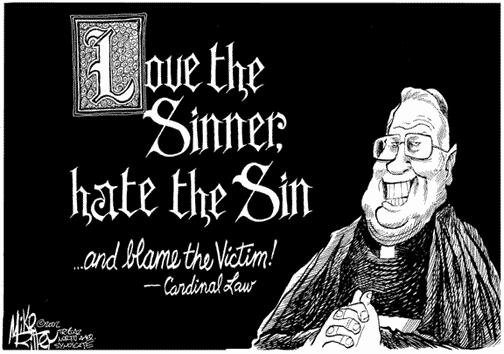
In sum, the institutional Church, its credibility already damaged by careerist, cowardly and criminal bishops, should not now, via its chanceries and lobbyists, attempt to block justice, to block legislative efforts to update outmoded and pragmatic statutes of limitation with respect to the commencement of lawsuits.
—Charles Molineaux
(CMlnx@aol.com)

Charles Molineaux, Esq., is an attorney, a graduate of St. John’s University School of Law. Born in New York, he was educated in public, Catholic, and Jesuit schools in Massachusetts, New York and Washington, D.C. and currently resides in northern Virginia where he serves as an international commercial arbitrator and sometime free-lance writer. His articles and poetry have appeared in The Wall Street Journal, The Georgetown Academy, The Catholic Lawyer and New Oxford Review. He is a member, inter alia, of the Fellowship of Catholic Scholars and of the Knights of Malta. The opinions expressed here are those of the author alone and do not necessarily represent those of any organizations of which he is a member.