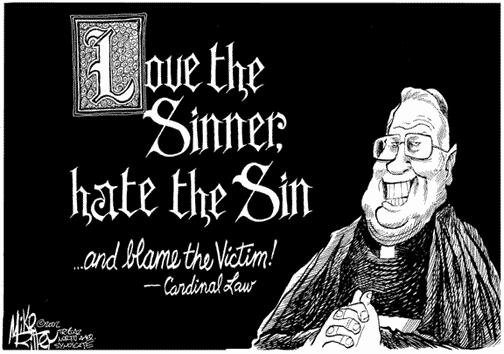
Catholic Church pays abuse compensation from grant interest
CHILD sex abuse victims are being
compensated out of interest the Catholic Church earns from investing the
billions of dollars it receives in government grants for schools.
The Royal Commission into Institutional Responses to Child Sexual
Abuse has received evidence from a church whistleblower suggesting at
least one Catholic diocese ultimately profits from interest received on
state and commonwealth government education grants.
The Australian
has also confirmed that the practice, under which the grants are
compulsorily invested in accounts held within each diocese’s “internal
treasury” or development fund, also takes place elsewhere across NSW,
Victoria and Queensland.
Each diocese’s development fund acts like
a bank, repaying an agreed rate of interest on the education funds they
hold to the schools. They also pool this money with other assets
invested with commercial banks at a higher rate of interest, often
generating multi-million-dollar, tax-free surpluses each year.
Part of this money is, in turn, transferred to special funds under
the direct control of each bishop and at least one regional diocese is
understood to have transferred more than $1 million in this way last
year. In some dioceses, these discretionary funds are then used to pay
for the lawyers and compensation payments involved in abuse cases
brought against the church.
Details of the church’s finances are rarely
made public and the existence of this money trail has been criticised,
including by those who have received compensation payments for such
abuse. Chrissie Foster, two of whose daughters were raped by a Catholic
priest, said: “It shouldn’t be the government’s money, nor the
parishioners’ money paying for all of this. It should be the church
coffers, money from Rome or selling assets. Otherwise they’re just
getting away with it. That (financial) loss focuses them to do the right
thing.”
When the royal commission was announced in November 2012,
the leaders of the Australian Catholic Bishops Conference estimated the
church would need to find about $60m to meet the likely legal fees and
increase in compensation payments involved.
While there is nothing
improper about the church’s use of interest payments to meet this cost,
a church source said he had a “moral concern” about how the funds were
managed. “I don’t know of any other organisation whose subordinates
receive hundreds of millions of dollars in government grants and they’re
compelled to transfer that money to a centralised fund which profits
from it,” said the source, who has spent decades working in the church.
The
development fund is also able to use the grant money it holds to lend
money to individual schools to fund specific developments, the source
said — money that is then repaid plus interest.
“That money that
the bishop gets, he can do what he likes with it. He can fund his
diocese or he can fund sexual abuse payments. I’ve got a big moral
concern about it,” the source said.
NSW Catholic Education
Commission executive director Brian Croke said there was an expectation
and a legal requirement that any interest earned on government school
grants was spent on education. “As far as the commission is concerned,
all the funds from state and commonwealth are fully and externally
audited at every level, and are paid and distributed for the purposes
they’re designed, including the interest earned by those funds,’’ he
said.
A NSW Education Department spokesman said it “does not
prescribe to the Catholic system where funds should be held before being
disbursed to the dioceses” but legislation “requires that funds are
used for the running of the school”.
Catholic schools in the state
are audited and the diocesan education system required to certify it
“does not operate for profit within the meaning of” this legislation, he
said. “If there is evidence that funds are not being used for this
purpose or are being withheld or misused, then this would raise
questions about compliance …
Any such evidence should be provided to the
NSW government for investigation.”
As church organisations are
not required to publish accounts, The Australian has not been able to
establish how much revenue many Catholic dioceses generate in interest
paid on education grants. The federal and state governments last year
provided more than $6.3 billion in education funding to dioceses
nationwide. Church sources suggest that after meeting commitments to
schools, individual dioceses retained a likely tax-free margin of up to 2
per cent on their investment of this money. Only a fraction of these
proceeds may be used to meet the dioceses’ liabilities for child abuse,
the bulk of which are often reclaimed from the church’s insurer.
Nor
is every diocese within the church understood to operate in this way.
The Archdiocese of Sydney, whose accounts were publicly revealed for the
first time during last week’s royal commission hearings, does not
insist that all the roughly $615m education funding it receives annually
be invested in its development fund.
The roughly $3m the Sydney
archdiocese last year spent on “Special Issues” and other royal
commission costs was also met from a separate Procurement Fund, which
itself controls more than $426m in assets.
The archdiocese’s
business manager Danny Casey said “The internal treasury, the Sydney
Catholic Development Fund … does generate a surplus. The surplus has not
been used to meet obligations to victims of abuse nor has it been used
to cover the costs of the royal commission.”
Francis Sullivan,
chief executive of the Catholic Church’s Truth, Justice and Healing
Council, defended the wider church’s use of money made from interest
payments on education funding.
“If (it) is about using it for the
purposes that the church is for, which is relieving distress,
disadvantage and people who are underprivileged, then it’s justified.
Certainly, providing compensation payments and repatriation payments for
clerical sexual abuse is justified,” he said.
 |
|
|
Review payments to abuse victims: commissioner
INSTITUTIONS should review all payments made to children in their care that had been sexually abused, according to the head of the royal commission examining the organisations’ responses.
Judge Peter McClellan, who is chairing the royal commission, yesterday told a child protection workers’ conference that the question of whether a national redress scheme should be set up for abuse survivors was challenging but some institutions had already taken “significant” steps.
He pointed to a Salvation Army commitment to review all payments
made to abuse victims to ensure they were fair, and a similar
“opinion” from Cardinal George Pell regarding people abused within
the Sydney Archdiocese.
“I suspect, and the Commissioners are hopeful, that as a result
of the Royal Commission’s focus on this issue other institutions
will respond in a similar manner,” Justice McClellan said.
“It is apparent from the work we have already undertaken that
designing a fair redress scheme, assuming that one should be
created, raises significant and difficult questions.
“We are listening to people whose lives have been damaged and in
some cases destroyed by the perverted actions of adults, people
who both they and their parents had a right to trust.”
Child abuse survivors have pushed for the commission to recommend
a national redress scheme, and the removal of legal barriers that
prevent successful lawsuits against organisations where abuse
occurred.
Justice McClellan gave the Melbourne Childaware conference
updated statistics on the cases brought to the commission, saying
he had referred 141 matters to police.
Analysis of the 1426 private sessions with the commissioners
shows that 62 per cent of people who told their stories were
sexually abused in a faith-based institution.
Almost 35 per cent were abused as children in a school setting
and 30 per cent of people were abused in welfare institutions,
including orphanages, children’s homes and residential facilities.
Justice McClellan said 41 per cent of institutions mentioned in
private sessions were run either by a Catholic order or diocese,
while government-run institutions accounted for 21 per cent.


 The four boys’ homes in this case study were run by the ‘Eastern Territory’ of The Salvation Army and provided homes for boys who were wards of the State. The homes included Indooroopilly and Riverview in Queensland and Gill and Bexley in New South Wales.


 taal en rekentests

 Where there is a significant dispute about the facts,