Posts tonen met het label US algemeen. Alle posts tonen

vrijdag, november 12, 2010

Sinte Maartens kastanjes uit de hangende tuin van de toren van babylon, turning the pages.

De huismeester was een leuke vent kwam uit Kameroen en kon vertellen over prachtige bomen , wat monster 2 diep tevreden maakte, hij hoefde alleen maar fotograaf te worden en naar Kameroen te gaan Een ander monster had het er na het bekijken van dezelfde film wat lastiger mee en vroeg verontrust: "... is er nog wat te ontdekken op de wereld?" daarmee zichzelf in ieder geval de ontdekking van het antwoord op die vraag besparend Voor de zoveelste keer straalverliefd werd ze weer een paar handenvol vreselijke dode danwel levende beesten en andere vliegende kruippotigen uit een pot ergens onder naast of van bovenop de regenboog die ik na een homerun in ontvangst mocht nemen waarna de gezamelijke ceremonie van de eksterogen al dan niet met heksenketels diepvriezers en tandenborstels kon beginnen vergeven.


Revelations November 11, 2010
Recently one of the largest releases of abuse documents ever ordered by a judge occurred in the Diocese of San Diego, after years of stalling by Bishop Brom. Although the diocese has destroyed documents and is still withholding thousands of pages, the San Diego files tell us much about the abuse and the cover-up there. They also up the ante for Cardinal Mahony, who has fiercely resisted the publication of documents in the Los Angeles cases, even after agreeing to their release as part of the 2007 LA settlement.

Bishop Lori in the Diocese of Bridgeport took a similar battle all the way to the U.S. Supreme Court, trying to protect his predecessor, Cardinal Egan. The Bridgeport documents were finally released in December 2009. This weekend, Voice of the Faithful in the Diocese of Bridgeport is offering a dramatic presentation of the Bridgeport files:
Bless Me Father for I Have Sinned

Priestly Sexual Abuse in the Diocese of BridgeportA Dramatic Presentation of Court Documents Saturday, November 13, 2010, at 1:00 p.m.Norwalk Concert Hall125 East AvenueNorwalk, Connecticut

After the dramatic reading, a panel including David Clohessy of SNAP and Terry McKiernan of BishopAccountability.org will discuss the Bridgeport documents.
Bridgeport VOTF does a lot of important work, and they’ve dedicated much time and effort to understanding the Bridgeport documents and presenting them to the public. If you live in New York or New England, please consider coming to this performance. If you live elsewhere, why not stage a similar presentation in your area? The documents revealed in the Catholic abuse crisis offer a unique opportunity to understand the inner workings of the Catholic church.
Here are those links again.
I hope you'll explore the San Diego and Bridgeport documents and see what VOTF Bridgeport is planning:
San Diego Documents
Selected Bridgeport Documents
Information on Bridgeport VOTF’s Dramatic Presentation of the Files

Please forward this to a friend!
Thanks and all best,

donderdag, oktober 28, 2010

Genoeg! A journey for justice


(NECN: Ally Donnelly, Salem, NH) - Clergy sex abuse victims from around the world are making a journey for justice. They are headed for Saint Peter's Square in Rome to take part in Reformation Day events on Sunday. Gary Bergeron and Bernie McDade are two of the people leaving for Rome. Gary Bergeron packs for a trip to Rome. Sunday, the Salem, New Hampshire man will stand in the shadow of the Vatican -- shoulder to shoulder -- with hundreds -- he hopes -- thousands of other survivors of clergy sexual abuse.


As the sexual abuse crisis sweeps through Europe, Bergeron and Bernie McDaid -- of Peabody, Massachusetts, will gather with survivors from 13 countries.


What they're calling Reformation Day


-- lighting candles and observing a 60 second moment of silence.

The men have been at the epicenter of the abuse crisis since it erupted in Boston in 2002. Both men say they were abused as children by Massachusetts priest Joseph Birmingham. He has since died, but stands accused of molesting 40 boys as church leaders allegedly shuffled him from parish to parish.

In a recent meeting with abuse victims in Malta, Pope Benedict promised them the church would do "all in its power" to bring offenders to justice and protect children, but despite an apology from the Pope, all some survivors see are empty promises.

The men say for real change to happen people need to put aside the power of the priesthood -- to not see the crisis as sexual abuse of children by clergymen, but
simply sexual abuse of children by men.

A journey, the men say, which has been and will be long and arduous.

NECN has a crew in Rome and will bring you a report on Sunday.

zondag, juli 18, 2010

Something missing, It is time for some canonical trials of bishops

NCR
Vieuwpoint
Nicholas P. Cafardi
Jul. 16, 2010

The announcement from Cardinal William Levada, Prefect of the Congregation for the Doctrine of the Faith, of the new norms for “more serious crimes” (de gravioribus delictis) was certainly a step forward in the church’s law regarding the sexual abuse of children.

The three helpful changes in the church’s law are

-Now the victim of sexual abuse by a priest has up to the age of 38 to report the crime and have it canonically prosecuted.
-The sexual abuse by clergy of mentally incompetent victims, beyond the years of childhood, is now considered the same crime as abusing a minor.
-And the acquisition, possession or distribution of child pornography is a canonical crime in and of itself.

These are all changes for the good in the church’s universal law, which applies to the church in every country everywhere. Unfortunately, it still leaves the church universal a few steps behind the church in the United States. Missing from the universal norms announced by Cardinal Levada is any mention of the “zero tolerance” policy of the American church, enshrined in the Dallas Norms, adopted by the American bishops and approved by the Apostolic See.

Norm 9 of the Dallas Norms says, quite clearly, “[T]he diocesan bishop shall exercise this power of governance to ensure that any priest or deacon who has committed even one act of sexual abuse of a minor...shall not continue in active ministry.”

This norm has worked well in the United States, and has helped largely to reduce the number of reported cases of abuse by clergy against children. Why, in the changes announced by Cardinal Levada, was it not made part of the church’s universal law? Surely Cardinal Levada, the first American to head the Congregation for the Doctrine of the Faith, is not unaware of the success of the “zero tolerance” norm in the United States. Surely he is not unaware of the statement of Pope John Paul II to the consistory of American cardinals that met in the Vatican in April of 2002, in which the Holy Father said, quite emphatically, speaking not only of America, but of the universal church that he shepherded, “People need to know that there is no place in the priesthood for those who would harm the young.”

The time is long past, in our church, for saying one thing and doing another. If Cardinal Levada stands behind the successor of Peter, these words of John Paul II should have a meaning beyond the rhetorical. They should become a part of the church’s universal legal system. But that opportunity was tragically missed last week.

But that was not all that was missed. Lacking in both the Dallas Norms governing the American church and Cardinal Levada’s announcement of changes in the church’s universal laws was any mention of the fate of bishops who, by ignoring the reported sexual abuse of children by their priests, allow them to victimize yet other children.

This truly is the elephant in the sanctuary.

The Dallas Norms effectively shifted the burden of the abuse crisis from the bishops who ignored the abuse to the priests who perpetrated it. The universal norms announced by Cardinal Levada ignore the problem entirely. And yet, we must come to terms with this part of the problem. Unlike in the American church, in Ireland, the bishops who re-assigned priest abusers, had the courage to resign their bishoprics. But even here, there is a problem. It should not be up to the bishop to dismiss himself. Something in the church’s law should make this happen.

And there is something in the church’s law that does. Canon 1389, §2, says that “A person who through culpable negligence illegitimately places or omits an act of ecclesiastical power, ministry, or function with harm to another is to be punished with a just penalty.” Certainly bishops who have knowingly or negligently re-assigned a known priest child-abuser to yet another parish have performed an act of ecclesiastical power that has caused harm to another, i.e., the additional child victims.

In his announcement, Cardinal Levada re-affirms that “the right, as mandated by the Roman Pontiff to judge...bishops” belongs to the Congregation for the Doctrine of the Faith. It is time for some of those canonical trials of bishops who have re-assigned priests with a known history of child sexual abuse to start. Only then will we laity know that the church has a legal system that really works. It’s up to you, Cardinal Levada, to fill in this missing part of the church’s law.


[Nicholas P. Cafardi is a civil and canon lawyer, and a professor and former dean at Duquesne University School of Law in Pittsburgh.]

(sorry Paddy just couldn't resist, do have a great day anyhow! ;-) )

donderdag, april 08, 2010

Money paved way for Maciel's influence in the Vatican

National Catholic Reporter
Apr. 06, 2010
By Jason Berry
First of Two Parts

In his time, the late Fr. Marcial Maciel Degollado was the greatest fundraiser of the modern Roman Catholic church. He was also a magnetic figure in recruiting young men to religious life in an era when vocations were plummeting. Behind that exalted façade, however, Maciel was a notorious pedophile, and a man who fathered several children by different women. His life was arguably the darkest chapter in the clergy abuse crisis that continues to plague the church.

The saga of the disgraced founder of the Legion of Christ, a secretive, cult-like religious order now under Vatican investigation, opens into a deeper story of how one man's lies and betrayal dazzled key figures in the Roman curia and how Maciel's money and success helped him find protection and influence. For years, the heads of Vatican congregations and the pope himself ignored persistent warnings that something was rotten in the community where Legionaries called their leader Nuestro Padre , "Our Father," and considered him a living saint.

The charismatic Mexican, who founded the Legion of Christ in 1941, sent streams of money to Roman curia officials with a calculated end, according to many sources interviewed by NCR: Maciel was buying support for his group and defense for himself, should his astounding secret life become known.

This much is well established from previous reporting: Maciel was a morphine addict who sexually abused at least 20 Legion seminarians from the 1940s to the '60s. Bishop John McGann of Rockville Centre, N.Y., sent a letter by a former Legion priest with detailed allegations to the Vatican in 1976, 1978 and 1989 through official channels. Nothing happened. Maciel began fathering children in the early 1980s -- three of them by two Mexican women, with reports of a third family with three children in Switzerland, according to El Mundo in Madrid, Spain. Concealing his web of relations, Maciel raised a fortune from wealthy backers, and ingratiated himself with church officials in Rome.

"What I can say about Fr. Maciel is that he was a consummate con artist," Fr. Stephen Fichter, a sociologist and former Legion official, told NCR. "He would use any means to achieve his end, even if that meant lying to the pope, or any of the cardinals in Rome."

When Maciel died on Jan. 30, 2008, the Legion leadership announced that the 87-year-old founder had gone to heaven. While God alone knows Maciel's fate, the Legion's statement stands in hindsight as one final act of deception by a figure whose legacy is still wreaking havoc from the grave. In February 2009, the Legionaries revealed that Maciel had a daughter. Late last month, the Legionaries issued a vaguely worded statement of regret to unnamed victims of Maciel -- four years after Pope Benedict XVI banished him from active ministry to "a life of prayer and repentance" for abusing seminarians.

Maciel left a trail of wreckage among his followers. Moreover, in a gilded irony for Benedict -- who prosecuted him despite pressure from Maciel's chief supporter, Cardinal Angelo Sodano, Vatican secretary of state from 1990 to 2006 -- Maciel left an ecclesiastical empire with which the church must now contend. The Italian newsweekly L'espresso estimates the Legion's assets at 25 billion euros, with a $650 million annual budget, according to The Wall Street Journal .The order numbered 700 priests and 1,300 seminarians in 2008. On March 15 of this year, five bishops, called visitators, from as many countries, delivered their reports to the pope after a seven-month investigation.

A final report is expected by the end of April.

Not in centuries has a scandal in the church had such complexity as this one. A huge financial operation is in the hands of a religious order many critics have likened to a cult, a group whose leadership is suspected of hiding its superior's corrupt life. As the Vatican grapples with the Legion -- and thorny legal questions as to whether the Holy See can intervene in the Legion's far-flung financial operations -- three of Maciel's sons and their mother in Mexico demand compensation, claiming they were cut off by the Legion when Maciel died.

Besides the complex questions of whether to dismantle or "reform" the Legion, Benedict is under pressure from a resurgent sex abuse scandal in Ireland, and cases from years back in Germany, Wisconsin and Arizona, in which he reportedly failed to discipline abusive priests.
The Legion scandal stands out for another reason: The Maciel case and the trail of money he reportedly gave cardinals raises profound ethical questions about how money circulates in the Vatican.

In an NCR investigation that began last July, encompassing dozens of interviews in Rome, Mexico City and several U.S. cities, what emerges is the saga of a man who ingratiated himself with Vatican officials, including some of those in charge of offices that should have investigated him, as he dispensed thousands of dollars in cash and largesse.

Maciel built his base by cultivating wealthy patrons, particularly widows, starting in his native Mexico in the 1940s. Even as he was trailed by pedophilia accusations, Maciel attracted large numbers of seminarians in an era of dwindling vocations. In 1994 Pope John Paul II heralded him as "an efficacious guide to youth." John Paul continued praising Maciel after a 1997 Hartford Courant investigation by Gerald Renner and this writer exposed Maciel's drug habits and abuse of seminarians. In 1998, eight ex-Legionaries filed a canon law case to prosecute him in then-Cardinal Joseph Ratzinger's tribunal. For the next six years, Maciel had the staunch support of three pivotal figures: Sodano; Cardinal Eduardo Martínez Somalo, prefect of the Congregation for Institutes of Consecrated Life and Societies of Apostolic Life; and Msgr. Stanislaw Dziwisz, the Polish secretary of John Paul. During those years, Sodano pressured Ratzinger not to prosecute Maciel, as NCR previously reported. Ratzinger told a Mexican bishop that the Maciel case was a "delicate" matter and questioned whether it would be "prudent" to prosecute at that time.

In 2004, John Paul -- ignoring the canon law charges against Maciel -- honored him in a Vatican ceremony in which he entrusted the Legion with the administration of Jerusalem's Notre Dame Center, an education and conference facility. The following week, Ratzinger took it on himself to authorize an investigation of Maciel.

John Paul's support gave Maciel credibility as he moved with seamless ease among the ultra-wealthy. At a 2004 fundraiser in New York, a video cameraman filmed him running his fingers down the tuxedo lapel of the Mexican billionaire Carlos Slim, a major Legion supporter. Besides donations, Legion schools in Mexico with high tuitions and low salaries subsidized the operations in Rome, say men familiar with the order's finances.

As questions swirl about how Maciel misled so many people, his ability to attract the powerful and influential is beyond dispute. Legion supporters ranged from Steve McEveety, producer of Mel Gibson's "The Passion of the Christ" (Legion priests advised on the film), to Thomas Monaghan, founder of Domino's Pizza and Ave Maria University in Florida. Others who supported the Legion include former Florida Gov. Jeb Bush and former Pennsylvania Sen. Rick Santorum, who spoke at Legion conferences; Spanish opera singer Placido Domingo, who performed at a fundraiser; and the late Fr. Richard John Neuhaus, editor of First Things, who wrote that he believed with "moral certainty" that the charges against Maciel were "false and malicious."

Harvard Law Professor and former U.S. ambassador to the Vatican Mary Ann Glendon taught at Regina Apostolorum Athenaeum, the Legion's university in Rome, and advised in the planning that led to the order's first university in America, University of Sacramento, Calif. In a 2002 letter for the Legion Web site she scoffed at the allegations against him and praised Maciel's "radiant holiness" and "the success of Regnum Christi [the order's lay wing] and the Legionaries of Christ in advancing the New Evangelization."

Author and conservative activist George Weigel also endorsed the Legion in 2002 on its Web site: "If Fr. Maciel and his charism as a founder are to be judged by the fruits of this work, those fruits are most impressive indeed." Weigel has since called on the Vatican to investigate the order.

CNN commentator William Bennett spoke at Legion gatherings and also said: "I am fortunate enough to know and trust the priests of the Legionaries of Christ. ... The flourishing of the Legionaries is a cause for hope in a time of much darkness." Former CNN religion correspondent Delia Gallagher spoke at a Legion fundraiser, and William Donohue, president of the New York-based Catholic League for Religious and Civil Rights, defended Maciel in a letter to the Hartford Courant , after a 1997 article that exposed Maciel's history of pedophilia.

Two Legion priests are TV news celebrities: Jonathan Morris on FOX, and Tom Williams, a theology professor at the Legion university in Rome, for NBC during Katie Couric's coverage of the 2005 conclave and again with Couric at CBS.

Consequences came late
In April 2005, Ratzinger was elected pope. In 2006, as Benedict, he banished Maciel from ministry to a "life of prayer and penitence." Maciel left Rome in disgrace, though the Legionaries mounted a defense of his innocence.

In the last week of January 2008, Maciel's 21-year-old daughter and her mother reportedly traveled from Spain to the Miami hospital where he lay dying. That pleased him, while jarring several Legionaries; but the women did not go on to Mexico for the funeral. His three sons and their mother in Mexico avoided the funeral too. His chosen Legion successors gathered in his remote hometown, Cotija de la Paz, for burial at a family crypt, far from his previously designated tomb at Rome's Our Lady of Guadalupe Basilica, which he built in the 1950s.

Besides Fichter, who has a parish in New Jersey, two priests still serving the church who left the Legion several years ago drew on detailed knowledge of Maciel's financial practices in lengthy interviews, answering questions in continuing telephone calls and e-mails. These priests -- and two priests in Rome who are members of the Legion -- spoke on background, fearing repercussions to their careers were they to be identified.

This story also relies on international press accounts, works by Spanish and Mexican researchers, and attorneys who are piecing together information on Maciel's financial strategy and his families.

NCR made repeated efforts to seek comment from the three cardinals who allegedly received substantial payments under Maciel's auspices, by speaking with Vatican spokesman Fr. Federico Lombardi on the telephone and via follow-up e-mails. Besides calls to the residences of the two cardinals in Rome, the paper made an extensive effort to contact now-Cardinal Dziwisz, in Krakow, Poland. Iowana Hoffman, a Polish journalist in New York, translated a letter with questions for the cardinal, faxed it to Dziwisz's press secretary, but was told that the cardinal "does not have time for an interview."

Sodano, the former secretary of state and now dean of the College of Cardinals, and Martínez Somalo, former papal chamberlain, did not respond to messages left with Lombardi. A receptionist who answered Sodano's residential number said to call the Vatican. The woman answering Martínez Somalo's phone, when asked in Spanish if he would speak with a journalist, said emphatically, " No entrevista! " -- "No interview."

Had Sodano, Martínez Somalo and Dziwisz responded, the cardinals might have answered one question that hovers over this baroque financial drama: How do Vatican officials decide what to report, and to whom, if they are given large sums of money? The Vatican has no constitution or statutes that would make such transactions illegal. But those familiar with the strategy say it was Maciel's goal to insulate himself from the Vatican's archaic system of secret tribunals by making friends with men in power.

For most of his life, it worked.

Making friends in the right places
The Vatican office with the greatest potential to derail Maciel's career before 2001 -- the year that Ratzinger persuaded John Paul to consolidate authority of abuse investigations in his office – was the Congregation for Religious, which oversaw religious orders such as the Dominicans, Franciscans and Legionaries, among many others.

According to two former Legionaries who spent years in Rome, Maciel paid for the renovation of the residence in Rome for the Argentine cardinal who was prefect of religious from 1976 to 1983, the late Eduardo Francisco Pironio. "That's a pretty big resource," explains one priest, who said the Legion's work on the residence was expensive, and widely known at upper levels of the order. "Pironio got his arm twisted to sign the Legion constitution."

The Legion constitution included the highly controversial Private Vows, by which each Legionary swore never to speak ill of Maciel, or the superiors, and to report to them anyone who uttered criticism. The vows basically rewarded spying as an expression of faith, and cemented the Legionaries' lockstep obedience to the founder. The vows were Maciel's way of deflecting scrutiny as a pedophile. But cardinals on the consultors' board at Congregation for Religious balked on granting approval.

"Therefore, Maciel went to the pope through Msgr. Dziwisz," said the priest. "Two weeks later Pironio signed it."

Dziwisz was John Paul's closest confidante, a Pole who had a bedroom in the private quarters of the Apostolic Palace. Maciel spent years cultivating Dziwisz's support. Under Maciel, the Legion steered streams of money to Dziwisz in his function as gatekeeper for the pope's private Masses in the Apostolic Palace. Attending Mass in the small chapel was a rare privilege for the occasional head of state, like British Prime Minister Tony Blair and his family. "Mass would start at 7 a.m., and there was always someone in attendance: laypeople, or priests, or groups of bishops," Dziwisz wrote in a 2008 memoir, A Life With Karol: My Forty-Year Friendship With the Man Who Became Pope.

When the guests came in (there were never more than 50)," Dziwisz wrote, "they often found the pope kneeling in prayer with his eyes closed, in a state of total abandonment, almost of ecstasy, completely unaware of who was entering the chapel. ... For the laypeople, it was a great spiritual experience. The Holy Father attached extreme importance to the presence of the lay faithful."

One of the ex-Legionaries in Rome told NCR that a Mexican family in 1997 gave Dziwisz $50,000 upon attending Mass. "We arranged things like that," he said of his role as go-between. Did John Paul know about the funds? Only Dziwisz would know. Given the pope's ascetic lifestyle and accounts of his charitable giving, the funds could have gone to a deserving cause. Dziwisz's book says nothing of donations and contains no mention of Maciel or the Legion. The priest who arranged for the Mexican family to attend Mass worried, in hindsight, about the frequency with which Legionaries facilitated funds to Dziwisz.

"This happened all the time with Dziwisz," said a second ex-Legionary, who was informed of the transactions.

Fr. Alvaro Corcuera, who would succeed Maciel as director general in 2004, and one or two other Legionaries "would go up to see Dziwisz on the third floor. They were welcomed. They were known within the household."

Struggling to give context to the donations, this cleric continued: "You're saying these laypeople are good and fervent, it's good for them to meet the pope. The expression is opera carita -- 'We're making an offering for your works of charity.' That's the way it's done. In fact you don't know where the money's going." He paused. "It's an elegant way of giving a bribe."

Recalling those events, he spoke of what made him leave the Legion. "I woke up and asked: Am I giving my life to serve God, or one man who had his problems? It was not worth consecrating myself to Maciel."

What's a bribe?

In terms of legal reality, does "an elegant way of giving a bribe" add up to bribery? The money from Maciel was given to heads of congregations in the early 1990s and the newspaper exposure of Maciel did not occur until 1997, and the canon law case in 1998.

Further, such exchanges are not considered bribes in the view of Nicholas Cafardi, a prominent canon lawyer and the dean emeritus of Duquesne University Law School in Pittsburgh. Cafardi, who has done work as a legal consultant for many bishops, responded to a general question about large donations to priests or church officials in the Vatican.

Under church law (canon 1302), a large financial gift to an official in Rome "would qualify as a pious cause," explains Cafardi. He spoke in broad terms, saying that such funds should be reported to the cardinal-vicar for Rome. An expensive gift, like a car, need not be reported.

"That's how I read the law. I know of no exceptions. Cardinals do have to report gifts for pious causes. If funds are given for the official's personal charity, that is not a pious cause and need not be reported."

Because the cardinals did not respond to interview requests, NCR has been unable to determine whether they reported to Vatican officials the money they allegedly received from the Legion.

"Maciel wanted to buy power," said the priest who facilitated the Mexican family's opera carita to Dziwisz. He did not use the word bribery, but in explaining why he left the Legion, morality was at issue. "It got to a breaking point for me [over] a culture of lying [within the order]. The superiors know they're lying and they know that you know," he said. "They lie about money, where it comes from, where it goes, how it's given."

When Martínez Somalo, a Spaniard, became head of the congregation overseeing religious in 1994, Maciel dispatched this priest to Martínez Somalo's home. The young priest carried an envelope thick with cash. "I didn't bat an eye," he recalled. "I went up to his apartment, handed him the envelope, said goodbye. ... It was a way of making friends, insuring certain help if it were needed, oiling the cogs."

Martínez Somalo did not respond to NCR interview requests.

Glenn Favreau, a Legionary in Rome from 1990 to 1997, and today an attorney in Washington, D.C., recalled: "Martínez Somalo was talked about a lot in the Legion, always in the context of 'our superior' because he was our friend. Un amigo de Legion." Favreau, who knew nothing of the donation to Martínez Somalo, continued: "There were cardinals who weren't amigos. They wouldn't call them enemies, but everyone knew who they were. Pio Laghi did not like the Legion." Cardinal Laghi, former papal nuncio to the United States, was then prefect of the Congregation for Catholic Education.

Martínez Somalo's office took a new name: Congregation for Institutes of Consecrated Life and Societies of Apostolic Life. But the job description stayed the same. From 1994 to 2004, the Spanish cardinal's duties included investigating any complaints about religious orders or their leaders.

In the files of that congregation, according to several former Legionaries, sat letters that dated back many years, accusing Maciel of abusing seminarians. When the wrenching accounts of nine seminary-victims of Maciel made news in the 1997 Hartford Courant, Martínez Somalo did nothing. That was the reaction throughout the Roman curia.

John Paul named Martínez Somalo to the post of carmelango, or chamberlain, the official in charge of the conclave when a pope is elected.

Today, the cardinal in charge of the congregation that oversees religious orders is Franc Rodé.
He lavished praise on Maciel, the Legion and its lay wing, Regnum Christi, for years.

One cardinal who rebuffed a Legion financial gift was Joseph Ratzinger.

In 1997 he gave a lecture on theology to Legionaries. When a Legionary handed him an envelope, saying it was for his charitable use, Ratzinger refused. "He was tough as nails in a very cordial way," a witness said.

Maciel's modus operandi
Maciel traveled incessantly, drawing funds from Legion centers in Mexico, Rome and the United States. Certain ex-Legionaries with knowledge of the order's finances believe that Maciel constantly drew from Legion coffers to subsidize his families.

For years Maciel had Legion priests dole out envelopes with cash and donate gifts to officials in the curia. In the days leading up to Christmas, Legion seminarians spent hours packaging the baskets with expensive bottles of wine, rare brandy, and cured Spanish hams that alone cost upward of $1,000 each. Priests involved in the gifts and larger cash exchanges say that in hindsight they view Maciel's strategy as akin to an insurance policy, to protect himself should he be exposed and to position the Legion as an elite presence in the workings of the Vatican.

Fichter, the former Legion member, is today pastor of Sacred Heart Parish in Haworth, N.J. He has been a diocesan priest for a decade, and serves in the Newark archdiocese. He coordinated the Legion's administrative office in Rome from February 1998 until October 2000.

"When Fr. Maciel would leave Rome it was my duty to supply him with $10,000 in cash -- $5,000 in American dollars, and the other half in the currency of the country to which he was traveling," explained Fichter. "I would be informed by one of his assistants that he was leaving and I would have to prepare the funds for him. I never questioned that he was not using it for good and noble purposes. It was a routine part of my job. He was so totally above reproach that I felt honored to have that role. He did not submit any receipts and I would have not dared to ask him for a receipt."

Fichter was reluctant to be interviewed, expressing concern that his views be fully reflected. "As Legionaries our norms concerning the use of money were very restricted," he began. "If I went on an outing I was given $20 and if I had a pizza I'd return the $15 to my superior with a receipt. The sad thing is that we were so naive. We were scrupulously trying to live our vow of poverty and yet never questioned [Maciel's] own fidelity to the same.

"So many of my old classmates are still in the Legion and I feel that they are going through such a hard time right now. I don't want to have my words misconstrued. ... Maciel hoodwinked everyone. In hindsight I regret that I and so many others were so gullible. Thankfully, for me that was many years ago."

Since earning his doctorate in sociology from Rutgers University, Fichter has worked as a research associate for the Center for Applied Research in the Apostolate (CARA) at Georgetown University in Washington.

"I am very happy as a pastor and in the research work I am doing for the good of the church. At this stage of my life, having collaborated with the Vatican investigation of the Legion, I pray each day for those who are still Legionaries. If I can help them in any way I will."

Justice delayed
After the ex-Legion victims filed a canonical case in 1998 against Maciel in the Congregation for the Doctrine of the Faith, Sodano as secretary of state -- essentially, the Vatican prime minister -- pressured Ratzinger, as the congregation's prefect, to halt the proceeding. As NCR reported in 2001, José Barba, a college professor in Mexico City and ex-Legionary who filed the 1998 case in Ratzinger's office, learned from the canonist handling the case, Martha Wegan in Rome, of Sodano's role.

"Sodano came over with his entire family, 200 of them, for a big meal when he was named cardinal," recalled Favreau. "And we fed them all. When he became secretary of state there was another celebration. He'd come over for special events, like the groundbreaking with a golden shovel for the House of Higher Studies. And a dinner after that."

The intervention of a high Vatican official in a tribunal case illustrates the fragile nature of the system, and in the Maciel case, how a guilty man escaped punishment for years.

"Cardinal Sodano was the cheerleader for the Legion," said one of the ex-Legionaries. "He'd come give a talk at Christmas and they'd give him $10,000." Another priest recalled a $5,000 donation to Sodano.

But in December 2004, with John Paul's health deteriorating by the day, Ratzinger broke with Sodano and ordered a canon lawyer on his staff, Msgr. Charles Scicluna, to investigate. Two years later, as Benedict, he approved the order that Maciel abandon ministry for a "life of penitence and prayer." Maciel had "more than 20 but less than 100 victims," an unnamed Vatican official told NCR's John Allen at the time.

The congregation cited Maciel's age in opting against a full trial.

An influential Vatican official told NCR that Sodano insisted on softening the language of the Vatican communiqué -- to praise the Legion and its 60,000-member lay wing, Regnum Christi -- despite the order's nine-year Web site campaign denouncing the seminary victims. The Legion's damage control rolled into a new phase with its statement that compared Maciel to Christ for refusing to defend himself, and accepting his "new cross" with "tranquility of conscience."

Maciel left Rome, the scandal seemingly over. Internally, the Legion insisted to its members and followers that Maciel was innocent.

In 2009, a year after Maciel's death, the Legion disclosed its surprise on discovering that he had a daughter. The news jolted the order and its lay arm, Regnum Christi. Yet in an organization built on a cult of personality, the long praise from John Paul suggested a legacy of virtue in Maciel. Legion officials scrambled to suppress skepticism.

Two Legion priests told NCR in July that seminarians in Rome were still being taught about Maciel's virtuous life. "They are being brainwashed, as if nothing happened," said a Legionary, sitting on a bench near Rome's Tiber River.

Thanks to Sodano's intervention, the order clung to a shaky defense in arguing that the Vatican never specifically said that Maciel abused anyone.

How much Legion officials knew about Maciel's other life -- the daughter with her mother in Madrid and three sons with their mother in Mexico -- is a pivotal issue in the Vatican inquiry underway.

How much money did Maciel use to support his families? How much did he siphon off for other purposes behind the guise of a religious charity?

Behind these questions loom others about money in the Vatican. Are envelopes with thousands of dollars in cash given to cardinals when they say Mass, give talks or have dinner in a religious house mere donations? The Legion of Christ raises money as a charity. How does it record such outlays? Does anyone in the Vatican have access to Legion financial records?
When Dziwisz became a bishop in 1998, the Legion covered the costs of his reception at its complex in Rome. "Dziwisz helped the Legion in many ways," said a priest who facilitated payments. "He convinced the pope to celebrate the 50th anniversary of the Legion."

In a book on Maciel published in Spain, journalist Alfonso Torres Robles calls an event on Jan. 3, 1991, "one of the most powerful demonstrations of strength by the Legion ... at St. Peter's Basilica in Rome, when John Paul II ordained 60 Legionaries into the priesthood, in the presence of 7,000 Regnum Christi members from different countries, 15 cardinals, 52 bishops and many millionaire benefactors."

Maciel had the event filmed and a sequence used in a video the Legion sold until 2006. John Paul was a strategic image in Legion mass mailings and the video shown to potential donors when seminarians accompanied priests to their homes. The Legion no longer circulates the video.

The Legion has a presence in 23 countries, with dozens of elite prep schools, religious formation houses, and several universities.
Maciel's strategy of buying influence unrolled over five decades.

NCR contributor Jason Berry is the author of Lead Us Not into Temptation and coauthor, with the late Gerald Renner, of Vows of Silence . Berry's film documentary "Vows of Silence" explores the saga of the Vatican and Maciel. A grant from the Investigative Fund from The Nation Institute supported research for this article. http://www.jasonberryauthor.com/]

Next: How the empire was built.

dinsdag, september 15, 2009

Tom Doyle on NY senate bill S-5893

September 9, 2009

Dear Senator,

I am writing in support of the proposed legislation, S-5893, the Child Victims Act. I am a Catholic priest. I have worked intensely with victims of sexual abuse for 25 years. Most of my experience has been with the victims of Catholic clergy. In time I became involved with victims of clergy of other denominations and victims of other classes of perpetrators including teachers, Scout leaders and family members.

The legislation is essential for a number of cogent reasons including the fact that it will serve to expose perpetrators from all professions who have escaped any form of accountability due to the protection of the statute of limitations. In California the passage of similar legislation was instrumental in identifying approximately 300 child sexual abusers who otherwise would have gone unchecked and ruined the lives of countless more children.

I believe the legislation is essential as well because unlike the victims of certain other crimes, those who have been violated sexually as children or as adolescents are so scarred emotionally and psychologically that they cannot disclose their abuse for many years after until they feel safe. The intense feelings of guilt, shame, isolation and fear trap these people inside a cocoon of terror. The limitations on the Statute of Limitations are based on grossly inaccurate information about the effects of childhood sexual abuse. The experts from the behavioral sciences who have both worked with victims and have researched the issue are in agreement as to the overpowering impact of sexual violation. It is ironic that the information offered by these experts, information based on experience and hard scientific evidence, is often challenged by private and public institutions that have hidden or otherwise enabled sexual abusers from their ranks. These institutions prefer to protect their financial security, their corporate image and the reputations of members over the welfare of the children whom they have tragically harmed for life.

Children who are violated sexually are robbed of their formative years, their adolescence and often of any meaningful adulthood. In many instances I have seen that the civil process whereby the victims are validated and believed has a profound healing effect. The primary and most important outcome is not a significant monetary award for a victim but the validation by the community which is a major impetus to recovery. Equally important is the identification of perpetrators who have escaped justice and the message to other potential perpetrators that the law will no longer protect them.

The Catholic bishops of New York have waged a brutal campaign to defeat any legislation that would help future victims of childhood sexual abuse. They have framed the issue as though it were an attack on the Catholic Church aimed at crippling its financial base. They have tried to deflect the issue by claiming that legislation will single out the Catholic Church while it ignores abuse in other institutions. One bishop even threatened to close churches in the districts of legislators who voted for the bill. All of the Catholic bishops’ extreme efforts are self-serving and grounded in false information.

Child sexual abuse is not exclusively a Catholic issue. However the revelations of extensive clergy sexual abuse and the blatant cover-up by Church leaders have provoked a sharply increased awareness of the almost unbelievable extent of child sexual abuse in our society. Demanding accountability of Catholic Church leaders or those of any other denomination certainly does not amount to discrimination against the denomination. No Church or Church official is allowed to harm children or to aid those who harm children, simply because he or she is a member of a Church. That clearly is not what the First Amendment is all about.
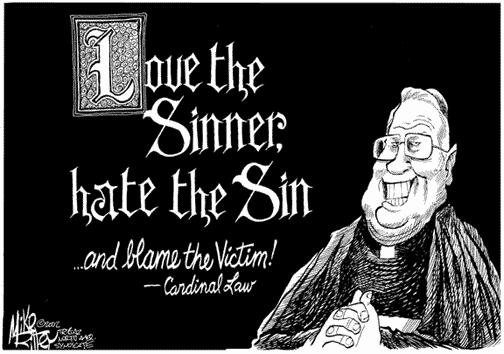
The Catholic bishops who claim that passage of the bill will result in a flood of cases which will bankrupt the Church are using untruthful scare tactics. Several dioceses in other States have filed for Chapter 11 protection yet none has claimed insolvency and all are financially secure. The passage of a similar bill in California did not have any negative impact on the Church’s financial base. In the time between the passing of the California bill and the year 2007 three of the dioceses with the greatest number of cases, Los Angeles, Orange and Oakland, all constructed new cathedral Churches at costs of $129 million, $115 million and $126 million respectively. None of the threats issued by the New York bishops or their highly paid lobbyists and attorneys are grounded in even a shred of reality.

I have worked with thousands of victims of childhood sexual abuse. I have experienced first-hand what it does to a victim and to the victim’s family because my youngest niece was severely assaulted at age 14 and still suffers the devastating after-effects seven years later. It is scandalous and outrageous that organized Churches or any other public or private institution in our country should actively campaign to deny present victims their right to justice and hopefully a meaningful life. It is equally outrageous that such institutions should fight so viciously to deny a secure future for the children of tomorrow.


Sincerely,
(Rev.) Thomas P. Doyle, J.C.D., C.A.D.C.

maandag, december 31, 2007

En alweer een bisschop die kinderen nodig had. de Filipijnen

Je vraagt je af hoelang die kerk en hun prinsen eigenlijk nog verstoppertje willen spelen, wanneer over de hele wereld heen het meer dan duidelijk is dat er inderdaad dergelijke wantoestanden zijn geweest.

Of deze bisschop misbruik heeft gepleegd?
Gezien de rapportages en onderzoek over de Filipijnen, kinderen en de Kerk daar, valt dat zeker niet uit te sluiten.

Hij hoeft alleen de raportages van zijn eigen bisschoppenconferentie maar serieus te nemen.

Dat er kinderen op die kamers en in de bedden van die mannen hebben gelegen?
Geen enkele twijfel over mogelijk!!
Over die hele wereld heen staat dat als een paal boven water! Daarvoor zijn daarover veel te veel getuigenissen, zeker vanuit al die tehuis situaties.

Ook in Nederland.
Zelfs ik kreeg ze de afgelopen jaren van kerkelijk functionarissen van toen en nu te horen. En van een aantal van hen neem ik ook nog eens aan ook dat dat niet eens is gebeurd met die zgn. pedofiele bedoelingen ook. Soms zelfs integendeel. Integere kerels die zich die nu moeten stellen.

Zoals ik bij integere en blije ervaringen vraagtekens moest zetten of ze van anderen wel kreeg.

De smerigheid, de hypocrisie en de seksuele verkniptheid van die Kerk heel wat meer voor vragen heeft opgeleverd. En daarmee integere mensen en ervaringen beschadigd en beschadigd heeft.

De hypocrisie en de verkniptheid in en van die Kerk heeft functionarissen tot daders gemaken, ook hen die geen daders van seksueel misbruik waren.
Mensen gedwongen tot vraagtekens zetten bij ervaringen die geen seksueel misbruikervaringen waren.

Maar het heeft vooral laten zien wat het betekent wanneer kinderen afhankelijk waren en zijn van een hypocriet systeem die die Rooms Katholieke Kerk was en is.

Met prinsen in paleizen, prinsjes en prinsesjes likkend naar paleisjes, die zichzelf en hun macht beschermen, verraad plegend aan dat evangelie.
Volwassenen, prinsjes en prinsesjes likkend naar en in paleisjes die het wisten, zagen en hun mond hielden uit angst, verraad plegend aan dat evangelie.

De incestueuze Kerk

"the bisschop is very very angry"

Tja, dat zal dan best. Weinig schokkends aan!
Net zo min als er aan het hele verhaal weinig schokkends is.
Dat is inmiddels standaard!

Daar zou die bisschop maar beter eens very very angry over kunnen worden.
En de keuzes maken die andere bisschoppen, in toenemende mate maken!
Gedwongen door slachtoffers en zelfs daders, die hun mond open deden en onderzoek eisten en mogelijk maakten.
Dat evangelie serieus nemend!

Een bisschop die jongetjes in zijn bed nodig had omdat hij niet kon slapen?
Moge hij er slapeloze nachten van hebben.

Een bisschop die nu pas kwaad wordt is daar jaren en jaren te laat mee!
Die heeft veel te veel jongetjes en meisjes in handen en in bedden laten belanden waarin ze niet hoorden of horen!

Een bisschop die nu pas kwaad wordt is een levensgevaarlijke vent!
Waar dan ook.

Biliran bishop accused of sexual molestation
A former missionary in Biliran, Leyte has accused the bishop of Naval town of sexually molesting boys.

Ging Reyes,
ABS-CBN News North America bureau chief, reported that Stephen Michael Greinke, an ex-missionary who worked for the diocese of Naval in the Visayas, said he has been calling for the ouster of Catholic Bishop Filomento Bactol for the last seven years.

Greinke alleged that Bactol abused his power and sexually molested young boys.

"I lived with the bishop at his palace. And at night he would have young men sleeping in his bedroom - kids who were under the age of 16 sleeping with him at night. Again I thought that was very inappropriate and it became very 'gossiping, chismoso, around about the bishop's behavior with the children,'" Greinke told Reyes.

Greinke said he has written a sworn statement to detail his allegations. Copies of the testimony was given
to the Vatican, American bishops and Manila Archbishop Gaudencio Rosales.

He, however, admitted he never saw Bactol actually molesting the boys whom the priest invited to sleep with him in his bed.

"I never saw anything inappropriate. I did not see the bishop sexually molest (the boys). But the doors would be closed, his bedroom doors would be closed and the young men would be sleeping inside the room," the ex-missionary said.

Greinke said he confronted Bactol about this and the bishop told him: "Brother I cannot sleep, I need to have the boys with me."

Bactol invited Greinke to set up a community of brothers in Biliran in 1991. But Greinke said he did not get any support from the diocese.

"Lack of support totally. And the only way we could get him to come out and visit our monastery was bribing. I brought out chalices from America, I brought out chalices or vestments so he could come out and say mass for our monastery," Greinke said.

In 1993, Greinke was arrested for allegedly sexually molesting members of their congregation. The charges were later dismissed by the human rights commission.

Greinke also faced deportation after several complainants surfaced and accused him of being a pedophile in 1999.
He said the complaints were merely in retaliation for criticizing Bactol.

In March 2000, the former missionary voluntarily left the Philippines. He is now on the list of blacklisted aliens.

Though Bactol refused to comment on the charges, a spokesman of the diocese denied Greinke's accusations. "These accusations are all lies...the bishop is very very angry...the crimes this Greinke is accusing the Bishop of are the same accusations against him," the spokesman

woensdag, december 19, 2007

Indrukwekkende recenscie van Leon Podles, Sacrilege: Sexual Abuse in the Catholic Church « Oak Leaves

Hohoho!

Publisher: Crossland Press
Pub. Date: January 2007
ISBN-13:
9780979027994
Sales Rank: 96,864
676pp


En een indrukwekkende recenscie op een vaker verassend en interessant blog .
En dat is, vlak voor de kerstboom, bij een niet zo makkelijk verkrijgbare studie (TIP) van maar liefst haast 700 pagina's natuurlijk nooit weg. En dat op een blog waarvan ook de reacties, alweer, ook interessant zijn.

Net als Podles eigen weblog, orthodox katholiek met een aantal zeer uitgesproken meningen wo over kerk en politiek en zeker over man/vrouw en de op zijn weblog beschikbare artikelen
dat zeker doen.

Hohoho Steeds meer goed nieuws vanaf het groeiend-front-misbruik-'t-is-welletjes-geweest!

It’s not a sin to be angry. This is evident from the scriptural injunction to “Be angry and sin not” (Eph. 4:26), as well as references to God being angry. For Thomas Aquinas, anger is a necessary element of the virtue of fortitude—fortitude isn’t a matter of just putting up with evil, or of enduring sorrow, but includes actively resisting evil, bravery in the struggle, and anger at the evil which has led to sorrow. Summa Theologica, IIa-IIae, Q. 123, Art. 10.

Leon Podles is angry, and wants us to be angry, too. He wants us to be angry at the sin of sexual abuse of children by Catholic clergy. But more than that, he also wants us to be angry at the bishops and pope for not being angry at that same sin. That’s what irks him about this crisis more than anything else—never have the bishops or popes expressed any anger that priests molested kids or that other bishops covered it up and transferred the predators to new hunting grounds.

Podles had done his work well—as I read, I felt a surge of anger at both the system and my own participation in it as a chancery bureaucrat for nine years. I decided I needed to take a breather before writing this review. I wanted to get some perspective.
I read two other books on the sexual abuse crisis, Jason Berry’s 1992 chronicle of the Gilbert Gauthé case in Lafayette, Louisiana, Lead Us Not into Temptation: Catholic Priests and the Sexual Abuse of Children, and Berry’s 2004 book with Gerald Renner, Vows of Silence: The Abuse of Power in the Papacy of John Paul II, which concentrates on the Legion of Christ.

I’m still angry, but I’m now better able to see what is unique about Podles’ book.

These other authors give us great detail about particular epicenters of the crisis and their own journeys as they covered the stories, but Podles’ work stands out as a masterful portrayal of the big picture, linking the stories Berry and Renner reported with stories from other times and places. He paints with broad strokes in places, but gets into some very fine detail in others to help us to grasp the magnitude of some truly horrendous cases. Podles also gives us analysis of the abusers and the victims, and of how each was treated by bishops, and what went wrong.
The bishops are clearly the focal point of his anger:
...
But he goes further, seeing the crisis as about more than the bishops and the priests they coddled: Catholic culture is implicated; specifically a narcissistic clericalism in which the laity, including police and judges and prosecutors colluded.

“The abuse is far more widespread, goes back farther, and is far worse” than has been recognized to date. (9)


A canonized saint tolerated abuse. Rings of abusers go back at least to the
1940s in America, and abuse involved sacrilege, orgies, and probably murder (and
perhaps even worse). Bishops knew about the abuse and sometimes took part in it.

Those who complained were ignored or threatened, and the police refused to
investigate crimes committed by clergy. (10)

Podles reveals some of the reasons for his personal connection to the subject, and these revelations give us some insight into how he came to target clericalism. He recounts an experience of physical abuse at the hands of a Christian Brother in high school—”He walked to my desk and slugged me so hard on the face that he broke my glasses.” The teacher went to the principal, and Podles was expelled for having objected to an injustice. This served as a lesson for the boys who remained. But it is also for Podles an example of how the Christian Brothers ruled their schools by intimidation, and he sees what happened to him as one instance of a pattern of physical abuse at Christian Brothers schools extending from Ireland to the US and Canada. Many of these same schools had problems of sexual abuse as well, and Podles sees a clear connection: “An atmosphere of physical abuse had prepared the way for sexual abuse.” The Brothers got the point across that you were to do what they asked without question or complaint. (4-5)

Podles, like many Catholic young men of the period, considered the priesthood; he went to Providence College in Rhode Island, which was run by the Dominicans, and lived in Guzman Hall, a dorm for those considering priesthood. There was an undercurrent of homosexuality there, however, and when a roommate “made a sexually aggressive move” on Podles in his sleep, he fled. (6)

Over the years, he began to wonder about the Catholic Church’s relationship with men. What is it about the Catholic Church—and the priesthood in particular—that attracts such a high percentage of homosexuals and drives off heterosexuals? This question led him to write his 1999 book, The Church Impotent: The Feminization of Christianity:.........

“I had been puzzled by the lack of men in Catholic activities, and I was
surprised that my circle of acquaintances included a large number of
homosexuals. I realized that I had met these men through Catholic activities,
through Mass and the charismatic renewal. My research soon revealed that men had stayed away from all the branches of Western Christianity for centuries. Men had doubts about the masculinity of those men who were closely involved with the Church (such as the clergy) and sometimes those doubts were justified. I decided
there was a centuries-old misunderstanding of
masculinity and femininity, a
misunderstanding that led men to distance themselves from the Church and that
relegated women to a role of passive obedience.” (7-8; see also pp. 350ff)

.....
The revelations of 2002 should not have caught anyone by surprise. The Gauthé case involved all the same factors of abuse and cover-up, and had brought national attention upon the subject twenty years before. It brought together three unlikely allies, Fr. Thomas Doyle, OP, who was working for the Apostolic Nunciature, Gauthé’s attorney, Ray Mouton, and Fr. Michael Peterson of the St. Luke Institute, who together wrote a report for the US bishops in 1985, “The Problem of Sexual Molestation by Roman Catholic Clergy: Meeting the Problem in a Comprehensive and responsible Manner.” They submitted it to a committee chaired by Bernard Law. They warned of what could happen if the bishops didn’t change their ways. But their report was ignored, Doyle was sent into exile, and the bishops continued doing what they had always been doing.

But the Gauthé case wasn’t the beginning, either. Neither was Davenport. In fact, says Podles, “there is a centuries-old underground in the Church that perpetrates a tradition of abuse,” (68) and this underground is protected and is made possible because of clericalism.

While abuse exists among the laity and outside of Catholicism, among clergy of other denominations as well as scout leaders and teachers, the Catholic crisis is unique. Catholicism makes claims about its priesthood that are made by no other institution (412), exemplified by the statement of Pope Pius XI, “The priest is indeed another Christ, or in some way he is himself a continuation of Christ.” Clericalism is the idea that the clergy really are “the church,” that the role of the laity is to be quiet, give generously, pray faithfully, and, above all, to obey. Clericalism has created a vision of the church where bishops are seen as divinely appointed shepherds whose voice should be heard by both church and state on all issues, spiritual and civil, as evidenced by the plethora of letters on matters such as economics, war, immigration and criminal justice. (416)

Podles sees clericalism as just an institutional variety of narcissism, which is a psychological disorder defined by DSM-IV as a “pervasive pattern of grandiosity (in fantasy or behavior), need for admiration, and lack of empathy.” The narcissist “has a grandiose sense of self-importance,” “believes that he or she is ‘special’ and unique and can only be understood by, or should associate with, other special or high-status people (or institutions),” “has a sense of entitlement, i.e., unreasonable expectations of especially favorable treatment or automatic compliance with his or her expectations,” “is interpersonally exploitative,” and “lacks empathy: is unwilling to recognize or identify with the feelings and needs of others.”

That last point, the lack of empathy, is especially important for considering the reaction of the hierarchy to abuse.

The victims were invisible to everyone. The abusers were narcissists
who had no empathy for the sufferings of their victims. The priests,
officials, and bishops of the Davenport diocese were all caught up in a
clerical narcissism, in which only repercussions that affected them had any
meaning. The laity too were afflicted by a Catholic narcissism that idolized
the clergy. (70)

Narcissism pervades Catholic clerical culture, as Podles portrays it. It creates a vision of priesthood characterized by a sense of performance. It leads to a preoccupation with reputation and appearances at all levels (299ff). It requires an audience who adore the performer, lay accomplices who grant clerics deference and privilege. They, in turn, have reacted in anger when bishops have disclosed the faults of their favorite priests and suspended them. The laity also joined the bishops in seeing court cases and newspaper articles as attacks on the church—which is why newspapers didn’t stay with the story after the Gauthé case. (p. 423 ff)

Clericalism also affects the society as a whole, as was seen in the past willingness of cops and judges to overlook the crimes of priests in the belief that bishops were better able to deal with the problem. Even in the wake of the scandals, some defend this system of privilege; Podles points to an article by Michael Orsi, “Bishops Sacrifice Accommodations, Privileges and Rights: Everybody Loses,” Homiletic and Pastoral Review, 2002. (418)

Narcissism isn’t the only psychological disorder affecting priests. Podles summarizes studies done with seminarians and priests over the past six decades indicating that psychological illnesses pervade the priesthood. Already in 1948 William Bier noted that seminarians were more likely to answer questions as women generally did. A 1968 study showed that 70% candidates for religious life were “psychosexually immature, exhibiting traits of heterosexual retardation, confusion concerning sexual role, fear of sexuality, effeminacy and potentially homosexual dispositions.” (93) A 1972 report by Eugene Kennedy said priests tended to have the emotional maturity of adolescents, and not only had sexual difficulties but problems relating to adults. (94) A 1971 study by Conrad Baars found that 60-70% of priests were emotionally immature, and as many as 25% of priests had “serious psychiatric difficulties.” In particular, they did not properly understand the role of human emotions. (95)
...........
If they read Podles’ book, maybe they might begin to understand why people are angry. Maybe then, things might change. That’s his hope. I can’t share it. I think the narcissism, the clericalism, and the emotionally repressed culture go too deep. How do you change an ancient culture? How do you change people who have been selected because they fit a certain profile and whose basic disposition has been reinforced by training and conditioning?

For me, the narcissism and authoritarianism of the Catholic clericalist system reveals the working of “the mystery of iniquity.” It illustrates how the Catholic system as a whole is corrupted by principles that are contrary to the spirit of Christ. Catholic teaching refers to “structures of sin.”

Podles is not about to abandon the Catholic Church, despite all he has related and concluded. He thinks it can be saved, and proposes a series of reforms. A policy of zero tolerance is essential, he argues, as it not only removes individuals but disrupts networks of abusers. The Vatican must extend it worldwide (495). Canon law must be changed to give bishops authority over all priests in their diocese, religious or diocesan, to hold bishops accountable, and to make it possible for bishops to discipline each other (496). The laity must be more directly involved in governance, and should be consulted in all matters that concern them; parishes and dioceses should be audited annually and the audits made public. He suggests care should be taken in ordaining homosexuals—but he goes further, and advocates the barring of abuse victims from seminary. This may well be his most controversial recommendation, but he sees it is necessary because so many abusers were abused themselves. The cycle of abuse must be ended.

Finally, he calls for a renewed ethic which restores the place of righteous anger and the fear of God. “Righteous anger is a forgotten concept, zeal is condemned as disruptive.” (507) “The bishops fear bad publicity; they need to remember the fear of God, if in fact they believe in Him.” (508)
....
That’s his hope. I can’t share it. I think the narcissism, the clericalism, and the emotionally repressed culture go too deep. How do you change an ancient culture? How do you change people who have been selected because they fit a certain profile and whose basic disposition has been reinforced by training and conditioning?

For me, the narcissism and authoritarianism of the Catholic clericalist system reveals the working of “the mystery of iniquity.” It illustrates how the Catholic system as a whole is corrupted by principles that are contrary to the spirit of Christ. Catholic teaching refers to “structures of sin.”


… [S]in makes men accomplices of one another and causes concupiscence,
violence, and injustice to reign among them. Sins give rise to social situations
and institutions that are contrary to the divine goodness. “Structures of sin”
are the expression and effect of personal sins. They lead their victims to do
evil in their turn. In an analogous sense, they constitute a “social sin”
(Catechism 1869).
I’d suggest that the Catholic understanding of the papacy and the episcopacy is just such a “structure of sin”; it is “the expression and effect of personal sins,” especially narcissism. These structures that have developed from human sin, and that in turn perpetuate sin, are now seen as constitutive of the Church for Catholicism. Reformation is not possible without undoing what Catholicism sees as of its esse. This reinforces for me the urgency of the prophetic call, “Come out of her, my people, that you be not partakers of her sin.”

zondag, december 09, 2007

Women abused as youths by priests deserve equity

Women abused as youths by priests deserve equity
By PAT KINNEY,
Courier Business Editor

WATERLOO --- A victim of child sex abuse by clergy in the Roman Catholic Church says women in her position deserve as much attention as their male counterparts.

Rosalyn Zieser believes society tends to focus on male victims of clergy sex abuse --- possibly because such reports have been more prevalent. She also thinks some may consider the thought of male priests abusing boys more aberrant than priests abusing girls.

Zieser was born in Iowa but lives in Unity, Wis. She said she is glad she went through the claim and settlement process in her own case.
"I gained through it. I wouldn't have otherwise. It helped me think things through. I remembered a lot more things."

Zieser, an author in her early 70s with six grown children, has lived in Wisconsin since 1976. She said she was abused at age 10 by the Rev. Patrick McElliott in the late 1940s when he was at St. Patrick Catholic Church in Monti in Buchanan County.

After leaving that congregation, McElliott served as pastor of St. John's Catholic Church in Waterloo from 1954 to 1963. More recently, he has been the subject of suits alleging abuse during his tenure there, many of which were settled over the past two years. McElliott died in Waterloo in 1987.

"I know I did all I could to fix this for myself," Zieser said following her settlement last spring.
"I hope it'll give some courage to others. It opened up all the old wounds. But now, they'll heal better."

Having gone through therapy provided by the Archdiocese of Dubuque as part of her settlement, and looking back, Zieser believes women may be able to take additional steps to make the process less difficult.
"I would not go through the litigation process again without having been in therapy already and remaining in therapy during the process," she said.

Some women also may feel more comfortable having a female therapist, attorney or other professional help.
"Maybe not all women would feel they need that," Zieser said.

Attorneys
Two Waterloo attorneys who worked for many people making claims within the Dubuque archdiocese said they helped draw attention to the suffering of female as well as male abuse victims.

Tom Staack and Chad Swanson represented a comparatively high proportion of female clients in two sizable settlements. By comparison, in other regions of the country an overwhelming portion of cases reportedly involved male victims.
"I think we did a lot to change the perception, in this area, that the problem was just one that dealt with boys. From that perspective, I thought we were doing a good thing," Staack said.

Swanson said 12 of the 29 victims involved in the two settlements were women.
"In our first settlement we had eight females and in the second group we had four," he said.
Swanson said he and Staack are pursuing additional abuse claims with male and female clients.

"We do recognize the individual needs that can be specific to a person's sex," Swanson said.

The portion of abuse cases reported by women in the Dubuque archdiocese is significantly higher that even an adjoining diocese.

Attorney Craig Levien in the Quad Cities has represented victims in a number of abuse cases in the Davenport diocese and was involved in a major settlement recently. He said the overwhelming majority of the nearly 100 individuals he worked with are men.

In the area of clergy sex abuse in general, Levien said, the victimization of women has been "even more underreported" than abuse of men.
"And it's been significantly underreported by men," he said.

Other views
Others say women deserve attention.
"Every other female victim I've spoken to indicated there is a definite difference in the way female victims are treated in comparison to male victims," said Heather Smith of Waterloo, co-founder of the Northeast Iowa chapter of the Survivors Network of those Abused by Priests, or SNAP.

Her conversations have been with victims involved in other settlements in other states. Her own abuse occurred in another state.
"I think society as a whole, whether it's clergy abuse, whether it's by incest, or whether it's by rape, it's perceived as more horrific if it's a male victim," Smith said.

Despite that perception on a wider scale, officials within the Archdiocese of Dubuque say they have not heard other clergy sex abuse survivors here complain of disparate treatment based on gender. Those officials also note Dubuque Archbishop Jerome Hanus has had a policy of appointing women to leadership positions on the issue. The archdiocese has male and female victim assistance coordinators; the two directors of archdiocesan Office for the Protection of Children have been women; and six of the 12 members of the Archdiocesan Review Board on clergy child sex abuse are women, including its chair.

Archdiocesan officials point out victims pursuing claims always have the option of choosing their own attorney, male or female. They also noted psychologists used for testing and evaluating victims as part of the claims process are cleared with victims' attorneys.

Three nationally recognized figures on clergy sex abuse can't pinpoint whether clergy sex abuse victims of one gender are systematically treated better than the other. But they acknowledge differences exist in the circumstances and handling of cases with male and female victims.

"I'm not sure about disparate treatment in the judicial system, but there's certainly the feeling that female clergy sex abuse victims tend to get considerably less attention than males," said Dave Clohessy, national director of SNAP.

"I think male-on-male sex crimes are viewed as inherently more salacious, titillating, outrageous. I'm not saying they are. I'm saying they're viewed that way."

Tahira Khan Merritt, an attorney in Dallas, says the majority of cases involve male victims. She has represented a number of clergy sex abuse victims and also served as a special prosecutor in a major criminal proceeding against a priest.

"I would say 90 percent of them are male victims," she said, though she doesn't think they are handled particularly differently.
Merritt, though, notes "jury bias in every case," which may reflect society as a whole.

For example, Merritt said she is representing one of several teenage victims impregnated by a priest and must overcome biases in that case.
"It's kind of like, did they seduce him? All those kinds of things you don't have to deal with if it's male-on-male," she said.

Meanwhile, Merritt said homosexual abuse may be considered more of a taboo and more terrible, especially in the view of different ethnic cultures.

Gender issues
Dave Lewcon, a clergy sex abuse survivor from Massachusetts, provides counseling and support as a victim advocate with Merritt's clients. He says support group meeting attendance indicates the number of actual abuse incidents may be more evenly divided by gender than actual suits indicate.

"I would say the overwhelming majority of those attending were women, definitely," Lewcon said.
Clohessy reports in his group a 50-50 split between male and female victims.

"The bishops claim it's 80 percent boys, but I think those figures are highly suspect," Clohessy said.
"I think, among some older Catholic parents, if Sally has been assaulted by a priest as a girl, dad puts his arm around her and says, 'I'm sorry,'" Clohessy said.

"If Johnny is sexually assaulted, there's a slightly higher chance that the dad puts his arm around Johnny and says, 'We're going to do something about this.'"

Some pastors receiving abuse reports may have acted similarly, Clohessy suggests. He also notes that, nationally, male victims have received some of the larger settlements.

The settlements are "all fundamentally far from perfect" and can be judged with a variety of standards, Clohessy said.

Smith, with the Survivors Network in Northeast Iowa, said how damages are determined in group settlements can raise difficult questions.

"How can they walk a mile in my shoes? How can they live with devastation, and the changes in personality, and the effect it has on my daily life?" she asks.
"No one else can know that. And how can they say what happens to me is less damaging than what happens to whomever?"

Similarly, Smith suggests a perception exists that women in general can be victims, but not abusers --- despite the fact many boys were abused by nuns.
"Whether the victim is male or female, the effects on males and females are just as devastating," Smith said.
Contact Pat Kinney at (319) 291-1484 or pat.kinney@wcfcourier.com.

woensdag, december 05, 2007

Katholiek Kleuren Coloring and Comic Books Take Aim at Sexual Abuse


Een laatste Sinterklaas cadeautje nodig?


Al een katholiek kleurboek overwogen?
Hohoho.


December 4, 2007, 12:57 pm
By Sewell Chan

New York Post

A program by the Roman Catholic Archdiocese of New York to distribute educational materials — a coloring book and a comic book — to children to help them avoid becoming victims of sexual abuse has drawn attention in Newsweek and The New York Post. An independent expert said that the books could send the wrong message if not accompanied by proper context and guidance from adults.


In one page of the coloring book — for students in the first through fifth grades — a smiling angel tells an altar boy who is putting on a vestment: “For safety’s sake, a child and an adult shouldn’t be alone in a closed room together. If a child and an adult happen to be alone, someone should know where they are and the door should be open or have a big window in it.”

The angel adds, “Remember, it’s always safer with a group of people you know, but if you are alone with an adult, make sure others know where to find you.”

The comic book, for schoolchildren from the sixth through eighth grades, tells the stories of a girl and a boy who have been victims of sexual abuse in separate incidents, and how they handled the situations. The comic book urges children to tell a trusted adult if they have been abused. The books were illustrated by Charles Barnett, an artist in Lake Katrine, N.Y.

While the books carry messages that are widely echoed in other educational programs for children, they also arise from the context of the sexual abuse scandals that have roiled the Catholic Church.
“It is sad, but it is a reflection of the times,” said Edward T. Mechmann, a former federal and state prosecutor who was hired in 2005 to direct the archdiocese’s Safe Environment Program. “We have to protect the kids and make sure when they deal with adults that it’s within the proper boundaries.”

Mr. Mechmann said his office’s mandate was to implement the Dallas Charter issued by the United States Conference of Catholic Bishops in 2002.
The New York archdiocese covers Manhattan, the Bronx and Staten Island, as well as six suburban counties to the north. (The Diocese of Brooklyn covers Brooklyn, Queens and part of Long Island.)

Mr. Mechmann’s responsibilities include background checks for clergy and lay people who work with children, and an educational program used in parochial schools and religious education programs.
In an interview today, Dr. Eli H. Newberger, a pediatrician at Harvard Medical School and a leading expert on child sexual abuse, warned in an interview that young children may misinterpret well-intended messages.

“With regard to kids, any such simple message as, ‘Don’t be alone with an adult in the room,’ is susceptible to multiple interpretations children are going to place on it given their age, their previous experience with caring adults and with the person and the medium from whom the message comes,” he said.
He also cautioned that the books, coming from the Catholic Church, may inspire mistrust in some parents aware of the various abuse scandals.

Dr. Newberger added:
Conversations with very young children need to be carried out by the people closest to those kids, whom the children trust and who can talk about what this means. With first graders, very often these kids don’t easily go into the mode of thinking that enables them to deal with contingencies, the kind of what-if questions, which doesn’t develop until age 10 or 11. The worry I have is that for younger children, the simple unadorned message, “Don’t go into any room alone with an adult,” carries with it implicitly a sense of danger and of fear. I think it is naïve to assume that a child is going to get the intended message without experiencing a measure of distress or doubt.

Dr. Newberger, who has studied sexual abuse prevention and treatment efforts for decades, added: “Research on these prevention initiatives is incomplete and not wholly convincing. What these various initiatives frequently do, however, is enable children to talk about and disclose that have been worrying them, things that have happened to them. Parents and others have to be prepared for these unanticipated conversations, which inevitably follow.”

Told about Dr. Newberger’s comments, Mr. Mechmann said that the coloring and comic books are integrated as part of a larger curriculum, that the materials are taken home and that parents and guardians should discuss the materials with their children.

Mr. Mechmann emphasized that the curriculum is only one part of the archdiocese’s child protection efforts. He said the archdiocese had separate codes of conduct for clergy members and for lay people, which make it clear that adults should never be alone with a child in an unsupervised setting. The code includes narrow exceptions in settings like confession and pastoral counseling.