maandag, februari 15, 2010

Nuncio criticised over Oireachtas invitation. Het antwoord van de rebbe.

PhotobucketEen van die my kingdom for a horse, Soetelieve-Gerritje-waar-is-mijn-leesbril? berichten.

Irish Times February 15, 2010, 20:31
ÉANNA Ó CAOLLAÍ

A decision by the Papal Nuncio not to attend an Oireachtas committee meeting where issues relating to the Murphy report on child sexual abuse in the Dublin archdiocese were to be discussed has been sharply criticised by one of the committee members.

In a letter addressed to Dr Michael Woods, who is committee chairman, and released tonight by Fine Gael TD Alan Shatter, Papal Nuncio Archbishop Giuseppe Leanza said it was "not the practice" of the Holy See that Nuncios appear before Parliamentary Commissions.

Mr Shatter, who proposed the invitation, said the Archbishop's refusal to attend was "deeply regrettable" and "incomprehensible".

Archbishop Leanza said he was ''always'' available to discuss matters of ''mutual interest'' through contacts with the Ministery of Foreign Affairs.

"Constructive transparent dialogue and a change of approach is essential with regard to the manner in which the church has dealt with the issue of clerical child abuse and the failure of the Vatican to provide to the Murphy Commission the assistance sought by it," Mr Shatter said.

The Fine Gael TD said the victims of abuse, their families and the general public, are "entitled to expect that all available information that could inform the deliberations and conclusion of the Murphy Commission will be furnished to it."

He said there was a "solemn duty" on the Papal Nuncio and on Vatican authorities to co-operate.

"It is not only scandalous that such cooperation is not forthcoming but that the Vatican’s Ambassador to Ireland is unwilling to publicly discuss with elected Members of the Irish Parliament the stance taken to date or to indicate any willingness to overcome the current impasse", he said.

"This issue should be urgently addressed by members of the hierarchy who are engaged presently in extensive meetings in Rome,” Mr Shatter concluded.


Dank U, voor een Bijlmerramp!Wat stinkt het


Zegt de melkboer:"Nu komt het natüurlijk wel eens voor dat hij hem een paard verkocht en 'm een ezel leverde"

"Het was een paard"
"Ezel"
"Paard"
"Ezel"

"Maar, Rebbe, ze kunnen niet alle twee gelijk hebben"
Zegt de Rebbe:
"

Scope of latest clerical sex abuse begins to emerge

10. maar as die oue nie skuldig is nie
nie skuld bely nie
kan die nuwe natuurlik ook nie skuldig wees nie
en nooit voor stok gekry word
as hy die oue herhaal nie
alles begin dus van voor af aan
dié slag anders ingekleur

Antjie Krog

(down to my last skin)


The Irish Times
Monday, February 15, 2010
PADDY AGNEW in Rome

GERMAN SCANDAL: EVEN IN the short time since Pope Benedict summonsed the Irish bishops to Rome, reports of a burgeoning clerical sex abuse scandal in the Pope’s native Germany have begun to emerge.

The German reports are all the more alarming since, at least initially, they have concerned elite Jesuit boarding schools in Berlin, Hamburg, Bonn and other cities. Last week, Fr Theo Schneider resigned his position as principal of a Jesuit school in Bonn after two former pupils claimed to have been abused at the school.

The dimensions of the burgeoning German scandal are unclear. A group called “Round Table For Care in Children’s Homes” recently published an interim report which claimed that more than 150 victims of sexual abuse had come forward during the course of its own investigations into children’s homes, half of which in Germany are run by the Catholic Church.

The news magazine Der Spiegel last week reported that, following a survey of Germany’s 27 dioceses, at least 94 priests were suspected of sexual abuse of children.

Jesuit Hans Langendoerfer, secretary of the German bishops conference, told Der Spiegel : “The revelations show a dark side of the church that
scares me . . . We expressly want an investigation.”

There seems little doubt but that the German Catholic Church is just at the beginning of a long and painful process, all too familiar to Irish and American Catholics.

The German bishops conference is due to discuss the sex abuse question next week, whilst the Jesuit order in Germany will be conducting its own investigation into the scandal. Significantly, Fr Stefan Dartmann, head of the Jesuit order in Germany has said that “an immense tragedy is now becoming apparent”.

Clearly, Pope Benedict will be more than well informed of developments in the Catholic Church in his native land, a church that is second only to the US Catholic Church in terms of its contributions to Holy See coffers.

Several Vatican insiders have speculated that these latest disturbing reports in one of the oldest and most prestigious Catholic churches will most likely prompt the pope to take an ever harder line on the need to confront and clean up the clerical sex abuse crisis, worldwide.

The emergence of a German church crisis also prompts the intriguing consideration that the two Irish clerical sex abuse reports of last year, the Ryan report and the Murphy report, may well have served as an alarm call for the universal Catholic Church.

In the specifically Irish context, all of this may mean that the pope may largely endorse the findings of the Murphy report, which along with the Ryan report will be the main focus of this two-day meeting.

Furthermore, it may well mean a reprimand for those Irish church figures who have expressed reservations about the Murphy report’s findings, especially in relation to the allegations of the Dublin arch-diocese’s systematic “cover-up” policy.

zondag, februari 14, 2010

De constitutioneel parlementaire republiek Ierland: Hi-ha-honderiem we gaan naar Rome toe


We did what we were told.
We were happy, obedient.
We had come through much.

I know -- we know --
Who that tortured child was.


Tentoonstelling "en dat, Vrouw Lap, is nu wat men een kaffer noemt"

jaren 40 geheim huis voor immorele clerus

The Servants of the Paraclete, a ministry to troubled priests in Jemez Springs

Vows of Silence


Dear Pope Benedict: Timeline Ireland

1987

Insurance taken out by dioceses around the country to cover them against allegations of clerical child sex abuse.

The State publishes its first set of guidelines on child abuse.

1988

Desmond Connell appointed Archbishop of Dublin.

1990

Irish Catholic Church establishes internal committee (chaired by Bishop of Ossory Laurence Forristal) to assess legal implications for Irish priests of child abuse revelations in the future. No Irish case has yet been made public.

1994

JUNE – The scandal breaks. Fr Brendan Smyth (right) is sentenced to four years in prison for abuse of children in Northern Ireland.

OCTOBER – Irish Catholic Bishops’ Conference refuses to comment on reports that two Kerry priests were removed from their duties on foot of allegations of child sexual abuse.

NOVEMBER – Government falls over divisions between coalition partners Fianna Fáil and Labour over attorney general’s handling of extradition requests for Fr Brendan Smyth to Northern Ireland.

1995

APRIL – Andrew Madden is the first victim of clerical child sex abuse to go public. The Irish Press reports that he has received a compensation payment in respect of his abuse as a child.

MAY – Archbishop Desmond Connell announces that the archdiocese has never paid compensation to any victim of clerical child abuse. He later explains that the money used to compensate Andrew Madden was a “loan” from the archdiocese to Ivan Payne.

JUNE – A Dublin priest receives 12-month sentence for child sex abuse; Belfast priest Daniel Curran sentenced to seven years for child sex abuse. A number of other priests charged with abuse during following months.

SEPTEMBER – RTÉ Prime Time programme names Ivan Payne as abuser of Andrew Madden. Archbishop Connell threatens to sue over suggestions that he facilitated the compensation payment to Andrew. No case is ever taken.

OCTOBER – The Irish Times reports that another Dublin priest paid £50,000 compensation to a man he abused as a child.

NOVEMBER – Bishops issue fullest apology to date. Wexford priest Fr Sean Fortune charged with child sex abuse.

1996

JANUARY – Bishops publish new guidelines on child sex abuse cases – The Framework Document, otherwise known as ‘the green book’.

1997

JUNE – A Dublin priest received an 18-month jail sentence for sexually abusing a young girl during the 1970s.

JULY – Fr Brendan Smyth jailed in Dublin for 12 years for abusing children south of the Border.

1998

FEBRUARY – Taoiseach Bertie Ahern announces that mandatory reporting of child sex abuse will be introduced within lifetime of current government. (To date, this has still not happened.)

JUNE – Irish priest Fr Patrick Maguire (Columban) jailed in London for child abuse (18 months).

– Fr Ivan Payne jailed for sexual abuse of eight young boys. His two-year sentence is criticised for being too light.

JULY – Fr Gus Griffin (Holy Ghost Fathers) sentenced to seven years for abusing young boys.

– Fr Thomas Naughton sentenced to three years for abusing four young altar boys.

1999

MARCH – Fr Sean Fortune commits suicide on the eve of his trial on multiple charges of child abuse.

JUNE – Pope John Paul II rejects any linkage between child sexual abuse and priestly celibacy.

2001


SEPTEMBER – Retired judge Gillian Hussey appointed by hierarchy to chair Church’s Child Protection Committee. Audit of all dioceses announced.

2002

MARCH – BBC television broadcasts Suing the Pope on the abuse of boys in the Ferns diocese by Fr Sean Fortune.

APRIL – Bishop of Ferns Brendan Comiskey resigns in response to evidence that he covered up child sex abuse in his diocese.

– Government announces establishment of independent inquiry into child abuse in the Ferns diocese.

JUNE – Maynooth trustees announce inquiry into allegations of improper behaviour by its former vice-president, Msgr Micheál Ledwith.

OCTOBER – RTÉ’s Prime Time broadcasts Cardinal Secrets on the handling by a number of bishops of clerical child sex abuse allegations in the archdiocese of Dublin.

NOVEMBER – Government pledges to establish full independent judicial inquiry into Dublin archdiocese’s handling of abuse allegations.

DECEMBER – Hierarchy disbands its own national audit committee.

2003

JANUARY – Mervyn Rundle, abused by Fr Thomas Naughton, receives one of largest settlements to date, reported to be more than € 300,000.

MAY – Diarmuid Martin named as successor to Desmond Connell as Archbishop of Dublin.

2004
APRIL – Cardinal Desmond Connell steps down as Archbishop of Dublin.

2005

OCTOBER – Ferns Report is published, detailing extensive child abuse and cover-up.

NOVEMBER – Judge Yvonne Murphy appointed to head up Commission of Investigation into the Dublin archdiocese.

2008

JANUARY – Cardinal Connell seeks to refuse access by the Commission of Investigation to over 5,000 documents which he claims are confidential. He eventually drops his challenge.

MARCH – Bishop Magee of Cloyne steps aside from his duties after it is revealed he did not follow proper child protection guidelines. Government extends remit of Dublin Commission of Investigation to examine the diocese of Cloyne.

2009

MAY – Publication of Ryan report on widespread abuse of children in Ireland’s institution.

NOVEMBER – Murphy report published
DECEMBER - announcement by Pope Benedict in December that he planned the rare step of issuing a pastoral letter to Irish Catholics.


TWENTY-FOUR Irish Catholic bishops travel to Rome this weekend for what is believed to be the first meeting of its kind at the Vatican on clerical child sex abuse.
The meeting involves Pope Benedict, senior curial figures and an entire Bishops’ Conference. They are scheduled at three sessions over Monday and Tuesday, beginning at 8am each day, continuing to 1pm on Monday before resuming after lunch and continuing to 8pm that night.

The final session on Tuesday morning will end at lunchtime. It is believed that each bishop may speak for up to seven minutes during these sessions, with questions and comments from the pope and the curial cardinals. After the final session on Tuesday, it is believed some Irish bishops will host a press conference
In 2002, the US cardinals were invited to a similar meeting in Rome on the issue of of clerical sexual abuse but not all of the American Bishops’ Conference.

The announced letter had been expected by next Wednesday, Ash Wednesday, but is not now likely for some weeks..


(paus 13 mei naar Fatima!)

zaterdag, februari 13, 2010

vrijdag, februari 12, 2010

Colombia Na 10 jaar de eer aan Señor Fernando Piñeros Rocha, de eerste veroordeelde te zijn.

En ook in Bogotá, Colombia, heeft het Hoogste Gerechtshof na 10 jaar besloten dat

de inmiddels bijna 80 jarige Señor Fernando Piñeros Rocha, aartsbisschoppelijk directeur van de pauselijke missiewerken sinds 1997 Director Regional para Colombia de la Adoración Perpetua al Santísimo Sacramento, na eerder
te zijn benoemd tot Vicario Cooperador de Nuestra Señora de La Paz (1954-1959), toegewezen aan de parochie Santa Isabel de Hungría (1959-1969) en die van Cristo Maestro (1971-1972), kapelaan van het Colegio Santa Francisca Romana (1969) en het Gimnasio Moderno (1970); van de Universidad la Gran Colombia (1976) en het Colegio Mayor de Cundinamarca (1990, Notario de la Sala III del Tribunal Eclesiástico Regional de Bogotá (1972) en Conjuez para las Causas de Nulidad (1986), nombrado Canónigo de Merced del Capítulo Metropolitano (6-2-1973)gevolgd door Canónigo IV
(16-12-1976 en Canónigo Teologal (2 -10-1987) en Arcediano (20 -12-1995) te zijn geweest,

met zijn
na zijn studie (1947-1953) aan het Seminario Mayor de Bogotá
door Kardinaal Crisnato Luque Sánchez (6-11-1853,Bogotá) gezalfde poten
van kinderen onder de 14 van het dormitorio de Niños Desamparados,
waarvan hij sinds 1973 directeur was,
af had dienen te blijven.

donderdag, februari 11, 2010

Over die pink op de naad van die broek. Serenity prayer: Dear Pope Benedict


Irish Independent
February 11 2010

In her column in this newspaper last Saturday, Mary Kenny chose to make reference to my spiritual life. She pitied me for having no spiritual element in my life, assuming it consisted only of the material and was therefore bland and unimaginative.


vlierefluiten royalty tussen haakjes


grant me the strength
To accept the things I cannot change;
The courage to change the things that I can
And the wisdom to know the difference.


en dan lagen er vreemde prinsen in het gras
en moest je iedere keer weer kijken
hoe laat (en) of dat het was

Bishops' meeting with Pope

The Irish Times
Thursday, February 11, 2010

Madam – Next week the Irish bishops are going to Rome for a crucial meeting with Pope Benedict XVI and senior members of the Curia. They must not allow the Roman Curia to present clerical child sexual abuse as an “Irish” problem.

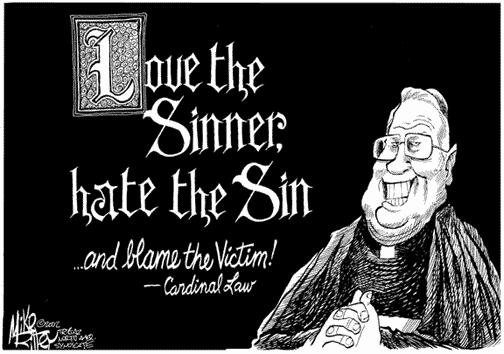
The bishops must have the courage to remind Rome that it has a lamentable record in the area of dealing with clerical child sexual abuse. In a letter to this paper (December 22nd, 2009), I pointed out that Rome had got it wrong at both ends of the abuse spectrum. On the one hand, it promoted Cardinal Bernard Law to the office of archpriest of St Mary Major even though there was extensive abuse of children by priests while he was archbishop of Boston. On the other hand, it failed to pursue credible accusations of sexual abuse against Fr Marcial Marciel, the founder of the Legionaries of Christ who had powerful allies in Rome.

Furthermore, officials of the Dublin archdiocese such as Monsignor Dolan, told the Murphy commission that they “did not feel that Rome was supporting them in dealing with the issue (child sexual abuse).” (4.23).

Addressing the clerical abuse of children without examining the wider reality of ministry and clericalism in the Catholic Church would be a major mistake. There is an enormous need for new forms of ministry in the Catholic Church.

For the past few decades, the Catholic community has been praying to the Holy Spirit to resuscitate the current form of ministry, with little results. Could this not be the Holy Spirit’s way of nudging the Catholic Church to look elsewhere for suitable leaders for Christian communities? Since the 1970s, individual bishops and Bishops Conferences have been calling for major change in the structure and form of ministry, but to no avail. Rome seems to be in denial, which is why bishops’ conferences from around the world must challenge it on this vital issue.

The Irish bishops are pastors in their own right, and not local branch managers, Walmart-style, of the chief executive in Rome. I hope they will have the courage to tell the Pope and other members of the Curia, that the current model of ministry in the Catholic church is imploding right around the globe.

As a missionary I have witnessed examples of this disintegration in many churches in Asia, Australia, New Zealand, Europe, Africa, north and south America. Access to the Eucharist, which, according to the Second Vatican Council is the source and summit of the Christian life, is becoming less available to Christian communities. New ministries ought to be shaped in response to the gifts that the Holy Spirit is giving to the contemporary church and not the medieval one. Naturally, these new ministries must be open to everyone, male and female, married and single. – Yours, etc,

Fr SEÁN McDONAGH

Pope:" I'll rid Church of pervert priests" To meet Pope in Rome over abuse scandal

But critics say more direct action is needed.

Saturday May 23 2009

POPE Benedict has assured Catholics that he is determined to rid the Church of paedophile priests, according to his personal representative in Ireland.

The assurance was conveyed last night by the Apostolic Nuncio, Archbishop Giuseppe Leanza, who told the Irish Independent that people needed to remember Pope Benedict's "forthright and constant condemnation of child abuse in all its forms".

Archbishop Leanza pointed to the meeting between Pope Benedict and the Irish bishops in Rome in 2006 after the publication of the damning Government report into child clerical abuse in the diocese of Ferns. At the meeting, the Pope instructed them to clean up the Irish Church of any vestiges of abuse.


However, weaknesses in adhering to a zero tolerance policy against pervert priests were revealed in the failure of Bishop John Magee to follow child protection guidelines in the diocese of Cloyne.

When the disgraced Bishop Magee refused to resign several times, Pope Benedict intervened and removed him from office and appointed the Archbishop of Cashel, Dermot Clifford, as apostolic administrator.

Despite Archbishop Leanza's comments, pressure continued to mount last night for the Pope to make a more direct intervention.


Mgr. Leanza jan.2010

Murphy’s commission...
team wrote to the Congregation for the Doctrine of the Faith (CDF) in September 2006 asking for information about the promulgation of its crimen sollicitationis (solicitation within the confessional) document and any information about child abuse it received from Dublin. The CDF did not reply. Instead, the office, headed by Cardinal Joseph Ratzinger until he became Pope Benedict XVI in 2005, contacted the Department of Foreign Affairs to complain that the commission had not gone through the appropriate diplomatic channels.

“The commission is a body independent of government and does not consider it appropriate to use diplomatic channels,” last week’s report states.

The following year, in February 2007, the commission wrote to the papal nuncio, the Vatican’s ambassador to
Ireland, requesting all documents in his possession relevant to its terms of reference. Again, no reply.

The commission tried once more. Earlier this year, it wrote to the papal nuncio enclosing extracts from its draft report which referred to him and his office, as it was required to do. That letter too met with silence.

Kardinale Gotspe head Congregation Clerics


Church abuse fund won't even cover
€140m bill for legal fees
>
May 23 2009

Maynooth 2009:
... The message from the Cardinal and the Archbishop was that the Pontiff had entrusted them with a three-fold task:
finding out the truth of what happened,


taking steps to prevent any repeat of such abuse and

ensuring victims got justice.

Three significant clues as to how the bishops might accomplish this papal mission were elicited in a brief question session. Cardinal Brady had met representatives of religious orders on Sunday evening on his return from Rome to give them the first account of Pope Benedict's wishes.

Firstly, and pointedly, Archbishop Martin dismissed the public's perception of deep differences between the bishops and 18 religious congregations over additional financial contributions to abuse victims.

Secondly, Archbishop Martin indicated there was likely to be a follow-up intervention by the Pope once he had digested the reports being assembled by heads of six departments of the Roman Curia with whom he and the cardinal met in Rome. The driving force will be Cardinal Bertone, the pope's prime minister.

Thirdly, as part of what Archbishop Martin called "soul-searching", the Irish Church will accelerate its installation of a unified child-protection system and embark on a period of analysis of how the Irish Church is now notorious worldwide for the sheer scale of abuse.

To do so comprehensively and transparently will involve academics, psychiatrists and other scientific experts, as well as the abused -- and members of the Oireachtas, the clergy and the Catholic laity -- in the diagnosis of what is now called "the Irish disease".

This will require an opening up of the closed clericalist doors of Maynooth.
But before this can be accomplished, the bishops know that the fuller and grimmer picture is yet to come, with the even more shocking revelations of the abuse and cover-ups that will be contained in the Dublin Archdiocese report.The many bishops I spoke to yesterday did not know when this report would be published, though many of them suspect it may be before the end of June.

And after that there will be the Cloyne diocese report.

The absence of Bishop John Magee from their ranks was a ghostly reminder to them that in the post-Ryan climate of public distrust of the Church, the position of no Lord Bishop is now secure or life-long


    Quitting bishop to meet Pope in Rome over abuse scandal
    By John Cooney Religion Correspondent
    February 10 2010

    THE outgoing Catholic Bishop of Kildare will be among a delegation of 24 diocesan bishops attending next week's summit talks at the Vatican with Pope Benedict on the child clerical abuse crisis.

    Bishop Jim Moriarty offered to resign two months ago, and Pope Benedict's delay in accepting the resignation came under renewed criticism last night from victim Marie Collins.

    Bishop Moriarty formerly served as an auxiliary bishop in the Dublin archdiocese which acknowledged collective responsibility for cover-ups.

    Accepting Bishop Moriarty's sincerity, Ms Collins last night questioned why the Pope had delayed so long in confirming this resignation compared with how quickly he accepted the stepping-down of Donal Murray -- another Dublin auxiliary -- as Bishop of Limerick.

    Ms Collins also called on Pope Benedict to demand the resignation of the embattled Bishop of Galway, Martin Drennan, for having been part of the church culture of cover-ups operating in the Dublin archdiocese when he was an auxiliary bishop there from 1997 to 2004.

    Bishop Drennan, who was named in the Murphy Report, has become a divisive figure in the episcopal ranks after telling Archbishop Diarmuid Martin that he did no wrong and was not resigning.

    Summit

    "My hope is that Pope Benedict backs the position of Archbishop Martin," said Ms Collins. "If not, there will be no way forward to recovery for the Irish Church. It will be a disaster."

    Meanwhile, the Irish Independent last night learned that the Irish Catholic Bishops have retreated to the west of Ireland to seek spiritual guidance ahead of next week's crisis showdown with Pope Benedict. The bishops, led by Cardinal Sean Brady and Archbishop Martin, gathered unannounced yesterday afternoon at the Marian Shrine in Knock, Co Mayo.

    Last night, the spokesman for the Bishops' Conference, Martin Long, said the annual two-day retreat was arranged well in advance of the Rome summit. But informed senior church sources told the Irish Independent that the spiritual retreat was also being used by the bishops to prepare for the meeting.

    Twenty-four of the 26 heads of dioceses will attend the unprecedented Rome summit.

    But absent will be the former Bishop of Limerick, Donal Murray, whose resignation has already been accepted by Pope Benedict; and the former Bishop of Cloyne, John Magee, who last year was removed from office by the Pope after being found not to have applied agreed national child protection rules in his Cork diocese.

    Aacher Optimist:«Die Problematik wird kirchlicherseits viel ernster genommen als früher. Jeder Verdachtsfall wird konsequent geprüft und verfolgt»,

    .Bistum Aachen untersucht neue Verdächtigungen gegen Geistliche
    Von Robert Esser 09.02.2010, 09:46

    Verdachtsfälle sofort melden

    Wer den Verdacht hat, dass Minderjährige von einem Geistlichen missbraucht werden, sollte dies sofort der Kommission von Hans-Willi Winden unter Telefon 02151/561394 oder 02181/48217 melden. Auch entlastende Zeugenaussagen zu bekannten Fällen oder Selbstanzeigen von Tätern werden unter diesen Nummern entgegengenommen.


    Zo, da's nog eens een uitnodiging!
    Aan goed-gelovigen. Niet aan misbruik slachtoffers.

    Ich bitte Sie um Ihre Hilfe!

    In der Sakristei, nach der Generalprobe der Erstkommunion, wurde ich als Erstkommunikantin 1973 von Pfarrer Gebhard N. sexuell missbraucht.

    In der Gemeinde St. Kolumban, Südwest-Deutschland.

    Wer war auch noch „Pfarrers Liebling“ – bis hin zur Vergewaltigung?

    Ich suche MitstreiterInnen, um das Verbrechen anzuzeigen. Gegebenenfalls können Sie mit mir Kontakt aufnehmen unter:
    nicht-die-einzige@web.de

    Ich habe den Täter bei der Kirche angezeigt, in meiner Naivität erhoffte ich eine ernsthafte Untersuchung und auch seelische Unterstützung. Nun bin ich einer der Fälle, die man laut Spiegel als „gleich am Anfang entkräftet“ führt.

    Irish Catholics Call For Cardinal Law’s Resignation, Following Clergy Abuse Report

    Published February 10, 2010

    BOSTON — Ireland’s clergy sex abuse scandal erupted last year after two government-ordered reports documented decades of clergy child abuse and a church cover up of the abuse. Four Irish bishops said they’ll resign for not reporting the abuse. Some in Ireland say another Catholic leader should resign — former Boston Archbishop Cardinal Bernard Law.

    “To keep Cardinal Bernard Law in the position he holds would suggest the papacy does not understand the principles of accountability,” said Sean O’Conaill, acting coordinator of Voice of the Faithful in Ireland.

    O’Conaill said Pope Benedict XVI is expected to release a pastoral letter to Ireland’s four million Catholics after next week’s meeting with the bishops. But O’Connail said the letter is meaningless if Cardinal Law remains in his Vatican position helping to select new bishops.

    Earlier Report: Abusive Priests With Ireland Ties Worked In Boston“Many people find it difficult to understand why if a person was found to be as wanting in his duties, care for children, as Cardinal Bernard Law was — and that was comparable to what happened in Dublin — we find it difficult to understand why such a man would have been promoted,” O’Connail said. “It seems to us to be symbolically strange that he would have that role at all. What Bernard Law did was endanger the lives and souls of children.”

    complete artikel

    woensdag, februari 10, 2010

    Dear Pope Benedict

    OPEN LETTER TO POPE BENEDICT XVI ON BEHALF OF MARIE COLLINS, ONE IN FOUR, ANDREW MADDEN

    Dear Pope Benedict,

    As the Irish bishops gather in Rome for their meeting with you, we are writing to ensure that the voices of the survivors of abuse by Catholic priests have a place in your deliberations.
    Survivors find in incomprehensible that the Vatican and your representative in Ireland, the Papal Nuncio, saw fit to hide behind diplomatic protocols to avoid co-operating with the Murphy Commission.

    Bishops Donal Murray, James Moriarty, Eamon Walsh, Raymond Field and Martin Drennan were all bishops in the Archdiocese of Dublin during some of the period investigated by the Commission. When the Report was published each of these Bishops attempted to remain in office by insisting that the findings of the Report did not warrant their resignations. They initially took no responsibility for either their actions or their failure to challenge a culture of cover up which they instead became a part of. Since then Bishop Murray has resigned and his resignation has been accepted by you. We understand that Bishops James Moriarty, Eamon Walsh and Raymond Field have offered their resignations too, which we urge you to accept without any further delay. We would also urge you to remove Bishop Martin Drennan who still refuses to accept any responsibility for his part in supporting a culture of cover up during his time in Dublin.

    The core finding of the Murphy Report was that the sexual abuse of children by priests was covered up by the Archdiocese of Dublin and other Church authorities over much of the period 1975 – 2004. Furthermore it found that the Dublin Archdiocese’s pre-occupations in dealing with cases of child sexual abuse, at least until the mid 1990s, were the maintenance of secrecy, the avoidance of scandal, the protection of the reputation of the Church, and the perseveration of its assets. All other considerations, including the welfare of children and justice for victims, were subordinated to these priorities.

    This finding was rightly accepted by the Irish Catholic Bishops in their December 2009 statement where they said that they were shamed by the extent to which child sexual abuse was covered up in the Archdiocese of Dublin. They also said that they recognised that this indicated a culture that was widespread in the Church. We also now request that other bishops throughout Ireland who engaged in this culture of cover up in their own dioceses should resign from their positions instead of waiting to see the extent to which they are criticised in any future Reports should the Commission of investigation be expanded to include their dioceses.

    Responsibility for child protection properly rests with the civil authorities. We ask you now to instruct the Irish bishops to comply fully with civil child protection guidelines, including the mandatory reporting of all concerns or complaints to the civil authorities for investigation.

    The lives of thousands of Irish people have been devastated by sexual abuse by priests. We ask you to write, not only to Irish Catholics, but to all people of Ireland, accepting fully the harm that has been caused by the acts of omission and commission of the Catholic Church and its priests and bishops in Ireland.

    Yours sincerely,

    Marie Collins, survivor of Clerical Abuse, Maeve Lewis, One In Four, Andrew Madden, survivor of Clerical Abuse

    Ierse Kerk let inmiddels op de kleintjes: Brady to hand deliver requesting abuse payout


    Nu maar bidden dat ze in Rome een goede vertaler hebben,
    die weet wat ze nu eigenlijk willen, want het resultaat daarvan
    zou de ierse belastingbetaler ook wel weer eens een paar nullen kunnen schelen. Wat, nu ook de Congregaties hun rekeningen naar het door hen gepleegde misbruik denken in te kunnen leveren bij de Ierse Staat, nooit weg is.


    Tuesday February 09 2010

    A LETTER calling on the Vatican to provide a €1bn compensation package for survivors of clerical child abuse in Ireland is to be hand delivered to Pope Benedict by Cardinal Sean Brady, when the Irish bishops hold summit talks with the Pontiff.


    gepikt van en wat bezuinigd op LEN Trouw.


    The letter from Irish survivors will also contain a request for a meeting with the Holy Father during his visit to England in September.

    The breakthrough came at private talks in St Patrick's College, Maynooth, yesterday involving four survivors' groups, Cardinal Brady and bishops.

    Archbishop of Dublin Diarmuid Martin, who on Sunday told the Irish Independent that he was engaged in his own consultations with survivors abused by diocesan priests, did not attend the Maynooth meeting because of other engagements.

    But Dr Martin was present at the first meeting last December in Maynooth between the four groups representing survivors of abuse in residential institutions run by religious orders, and has voiced his support for a bigger compensation deal.

    A statement after yesterday's meeting said that four bishops -- Colm O'Reilly of Ardagh and Clonmacnoise, John McAreavey of Dromore, John Buckley of Cork and John Fleming of Killala -- would liaise with the survivors' representatives.

    Attending the Maynooth talks were representatives of the Alliance Support Group, Irish SOCA, and the Right to Peace and Right of Place groups.

    Summit

    The statement added that the talks were part of a process of informing the bishops of the views of survivors in their preparations for their summit in the Vatican next Monday and Tuesday with Pope Benedict.

    Bishop McAreavey said the meeting was constructive and focused on the ongoing concerns of survivors.

    "We intend to relay these concerns to Pope Benedict, both verbally and in the form of written submissions, which were presented to us by survivors and which directly represent their views," added Bishop McAreavey, a former professor of Canon Law.

    Michael O'Brien, of the Right to Peace support group, said it was now time for the Vatican and the religious orders to match the money paid by the Irish State. The orders paid just €128m of the total compensation bill of €1.2bn.

    "He (the Pope) must come up with a substantial amount of money to help the victims of the institutions," added Mr O'Brien. "The Vatican is as much to blame because the religious orders were under their auspices."

    Tom Hayes, secretary of the Alliance Support Group and a former inmate of St Joseph's Industrial School in Glin, Co Limerick, said survivors wanted a face-to-face meeting with the Pope in September.

    "We will be pointing out that when he visited America, he met with some of the victims," Mr Hayes added. "Although he met them in private, it was a gesture universally well received and we hope he will do the same when he visits England."

    - John Cooney and Breda Heffernan

    It. Alassio " Don Lu "

    Emilio Fois, the judge for preliminary investigations of the Savona Tribunal, has rejected a request to release from jail the Rev. Luciano Massafero, pastor of Alassio. He was arrested Dec. 19 on charges of sexual assault on a 12-year-old parishioner. To justify the decision, the judge cited danger of tampering with evidence and re-offending. An initial request for release advanced by defense lawyers was dismissed on Jan. 18 at the Court of Review in Genoa.

    Brood en Roosjes tot ik sterretjes zien; San Marco here I come!


    De fout van Ierse uitgeverijen.
    Maar Ierland schijnt nog steeds een Jumbo hoop geld over te hebben!
    Zou het dan toch waar zijn dat ze als katholieken nog steeds niks snappen over bloemetjes en bezige bijtjes? Of Calcoenen bij Thanksgiving?
    Hoog tijd dat het Rijksmuseum open gaat dus!


    En ik stoppen met rollen van het lachen temidden van omlaag donderende stukken strak blauwe Oostenrijkse lucht en bakken vol geraniums. Poets de leeuwen maar vast op: ik kan eindelijk naar dat San Marco plein.


    Mocht ik daar nog 'ns ooit écht behoefte aan en zin in krijgen!

    dinsdag, februari 09, 2010

    Priests are guilty by association for conforming to 'abuse system' Why were we so silent on child abuse? Why didn’t we speak up?

    The Irish Times
    Tuesday, February 9, 2010
    DEREK SMYTH

    RITE & REASON: Why were we so silent on child abuse? Why didn’t we speak up?

    IN ORDER to respond appropriately to those who were abused by priests, we need to explore clerical culture, since research attests that it does contribute to the promotion of immaturity, arrested development and irresponsibility.

    For example, early research by Conrad Baars and Anna Terruwe on priesthood within western Europe and North America in 1971 revealed that only 10-15 per cent of priests were mature; 60-70 per cent suffered from a degree of emotional immaturity; and 20-25 per cent had serious psychiatric difficulties. Ironically, these findings were never acted on.

    Culture is defined as a shared system of beliefs and values. It has within it a cognitive, emotional and behavioural dimension.

    Clerical culture influences the way a priest or bishop may think about a certain issue, feel about it and respond to it. However, like any culture, its ills cannot be addressed solely from within. Think of Northern Ireland. It was with the support of outside sources, particularly George Mitchell, that the road towards peace began.

    For clerical culture, new structures are not sufficient, as there appears to be an innate “abuse system” within this culture. Even though it may now be forced to address the issue of sexual abuse, “abuse” may rear its ugly face in other forms.

    One disturbing aspect for me is what I call a “convenient silence”. Why were we so silent? Why didn’t we speak up?

    It is also the question asked by the Lutheran theologian Dietrich Bonhoeffer of the churches during the second World War. Bonhoeffer came, like most of us, from one of the mainline churches. However, as a result of a visit to the storefront churches in New York he would be changed forever.

    Here he witnessed the spirit-filled worship of African- Americans. He was deeply moved as he remembered how they were captured, tortured, enslaved and here they were full of passion and hope in contrast to the sedate and passive ritual of his own church.

    Despite being asked to stay in the safety of New York, he felt he had to return home to confront the Nazi movement in Germany.

    He joined the Resistance and eventually was captured and executed by the Nazis.

    For Bonhoeffer, one big question was: “Why were the churches so silent?”

    I have observed the same silence, as in my time I have witnessed theologians being marginalised as Vatican II has been dismantled, and as the innocent in Ireland were sexually abused by brother priests. I am also part of this silence.

    What causes this muteness that allows evil to flourish? It is my belief that people of my generation were conditioned by the church to distrust themselves.

    Take, for example, a non-Catholic neighbour who died 40 years ago.

    His/her Catholic friends were unable to pray in church with his grieving family. For most people at the time, this didn’t make sense.

    Their own integrity was telling them that it was absurd.

    However, such personal thoughts and beliefs were dismissed even to the point that people considered them sinful. In other words, we distrusted our own integrity and conformed with the directions of the church. And since we were made keep our thoughts to ourselves, we remained silent.

    This behaviour was reinforced in our seminary training. We were conditioned to surrender to the institution, to the teachings, structures and disciplines of the church. Upon ordination we made a promise of obedience to the local bishop, and even our own letter of acceptance of a diocesan post was scripted for us.

    Think of the docility of priests. A new bishop is appointed to a diocese and he decides to change direction.

    The priests follow until another incumbent arrives and they are ready to go again in whatever direction he decides.

    Tragically, it is within this culture that the governance of the church takes place and we are all guilty by association. It may be convenient to suggest that the auxiliary bishops must step down, but surely it is more honest to ask all of our generation to step down, ensuring a new beginning for all.

    Dr Derek Smyth is a priest in Foxrock parish, Co Dublin. Prior to that he had been director of Emmanuel House, Santa Ana, California, where he worked as a psychotherapist. He has co-authored two books, Being There and Defusing the Bomb

    Leading Jesuit calls for synod to address Murphy report

    The Irish Times Tuesday, February 9, 2010
    PATSY McGARRY Religious Affairs Correspondent

    The former Jesuit provincial Fr Gerry O’Hanlon has called for a national synod of the Catholic Church in Ireland in the context of fallout from the Murphy report.

    “It will not do any more for priests, bishops, cardinals, the pope to simply tell us what to think, what to do. People rightly want to have a say,” he has written in the current edition of the Furrow magazine.

    “Now would also seem to be a good time to call into question the reality that certain narrow grounds of orthodoxy are a sine qua non of episcopal appointments at present, and to call for more transparent, representative and accountable local, including lay, participation in the appointment of bishops.

    “It’s instructive to note that as recently as 1829, of 646 diocesan bishops in the Latin Church, only 24 had been appointed by the pope: often we forget how new many of our ‘traditions’ are.

    “It would seem that we need in Ireland to renew our own understanding of church, along the more participative lines envisaged by Vatican II, and, in particular, with a greater role for women and without any veto on the kinds of issues that might emerge in the consultative process that will be required.

    “Why not, then, envisage going down the road of the oft-proposed national synod or assembly, well prepared in each diocese, touching into the experience of believers and disaffected alike?”

    More generally, he observed, “one gets the sense that we are at a watershed moment in Irish Catholicism, with repercussions for Catholicism worldwide. There is an institutional dysfunctionality at the heart of our church which goes beyond any simple notion of governance or management reform and which needs to be tackled.”

    In the same issue retired Dublin priest Fr Pádraig McCarthy challenged the findings of the Murphy report, how the media has dealt with it and how Dublin’s Catholic archdiocese has responded to it.

    “Media coverage of the report may have given the impression that the report is a catalogue of unrelieved disaster. It is good to be aware, therefore, that of the 45 cases in which the report gives an assessment, handling by the church in 25 cases receives some sort of approval from the commission; 20 cases receive varying degrees of criticism.”

    He found it “extraordinary that I have found not one journalist or commentator who has done the kind of review of the report which would otherwise be normal. The commission, I am sure, would not wish to be burdened with any claim to infallibility; nor do I. We must not make the report the final and absolute word.”

    Among the Murphy report findings, each of which he disputes in detail, is “that child sexual abuse by clerics was widespread throughout the period under review”. That, he said, “does not accord with the facts”. He also criticises the report’s lack of “precision” in saying that while “some priests were aware that particular instances of abuse had occurred . . . the vast majority simply chose to turn a blind eye”.

    He pointed out that “the report does not specify what ‘some’ means” and that “vast majority” seemed to imply a very large number.

    “What was (and still is) missing . . . is a considered diocesan response” to the report, he added.
    Shame and Fear
    02/08/2010
    Spiegel Online

    The Catholic Church in Germany has been shaken in recent days by revelations of a series of sexual abuse cases. Close to 100 priests and members of the laity have been suspected of abuse in recent years. After years of suppression, the wall of silence appears to be crumbling.
    By SPIEGEL Staff.


    This is what it looks like, the document of a conspiracy: 24 pages, with appendix, in Latin, published by the Congregation for the Doctrine of the Faith at the Vatican. A "norma interna," or confidential set of guidelines for all bishops, who were required to keep it a secret for all eternity, in the name of the Father, the Son and the Holy Ghost.

    The guidelines, issued in the year of our Lord 1962, address a sensitive subject: sex in the confessional. The Vatican doesn't put it quite that directly, preferring to use more guarded terminology to describe what happens when a priest leads a member of his flock astray before, during or after the confession -- in other words, when he provokes a penitent "toward impure and obscene matters" through "words or signs or nods of the head (or) by touch."


    According to the instructions from Rome, the bishops were to deal very firmly with each individual case -- so firmly, in fact, that everything would remain within the confines of the Holy Church. After all, the Congregation for the Doctrine of the Faith -- formerly known as the Inquisition -- has centuries of experience in conducting internal investigations. The Vatican has always filled all the positions in such investigations -- prosecutors, defendants, judges -- from within its own ranks, while the investigation files have been kept in the secret archives of the Roman Curia.

    Rest, flink uitgebreid, artikel

    maandag, februari 08, 2010

    Defiant Martin shrugs off his critics in clergy
    By John Cooney Religion Correspondent
    Monday February 08 2010
    Irish Independent

    A DEFIANT Archbishop of Dublin has shrugged off mounting criticism from priests of him being "a divisive" figure for fully accepting the Murphy report's damning findings of cover-ups of paedophile priests.

    Archbishop Diarmuid Martin was responding publicly for the first time to criticism that has been building since a meeting of priests in Dublin only days after the publication of the report on November 26 last.

    "I believe my reaction was to recognise something terrible happened on our watch," Dr Martin said in an exclusive interview with the Irish Independent yesterday.

    "We got it spectacularly wrong," he added. "We have to admit that, and admit it unconditionally."

    The archbishop also broke his self-imposed silence to speak about his expectations of the outcome of next week's summit meeting in Rome of the Irish Episcopal Conference with Pope Benedict XVI and leading members of his Curia -- the papal government or civil service.

    "I hope it is a time when the Bishops' Conference will be united about a programme for the future so that we can really have an Irish Church that is very different from the one we have experienced," he said.

    Referring to the extraordinary summit, which will be held next Monday and Tuesday, February 15 and 16, Dr Martin said that on Monday morning each bishop will have a seven-minute private audience with the Pope before meeting the heads of the main departments in the Roman civil service. But he revealed he had "no idea of the agenda" for the Rome summit.

    "I have received nothing since the beginning," he said, a reference to the original summons to Rome issued by Pope Benedict in early December to discuss the fall-out from the Murphy report and to chart a reform programme of change for the Irish Church.

    And Dr Martin emphatically dismissed media reports that he had been heavily involved in the drafting of a Lenten Pastoral letter that Pope Benedict will address to the Catholic community in Ireland.

    "I am certainly not drafting the letter," he said.

    Summit

    Dr Martin also revealed he had been busily engaged in low-key consultations ahead of the Rome special summit.

    "I have consulted with victims of clerical child sex abuse," he said, declining to give details about these contacts and their advice on the way forward.

    "They have been private conversations," said the former Roman diplomat, who took over the scandal-ridden diocese from Cardinal Desmond Connell in 2004.

    "I have been holding meetings with priests and various people, too, but I'm not doing it in a huge, open way.

    "I have also encouraged parishes and pastoral councils in the archdiocese to put in writing to me (about reform and change) and I am analysing the responses.

    "If we had more of that, we would have a Church that would be strong," he added.

    Asked if he was ruling out, in this reform process, the convening of a national pastoral assembly or synod of bishops, priests and laity, he said: "Let's get to see what the aim of the renewal is and find the best means when we are clear about the type of renewal we want."

    Dr Martin said he had been heartened by the spirit of the lay organisation Viatores Christi -- Travellers for Christ -- whose 50th anniversary he celebrated yesterday at a Mass in their headquarters on New Cabra Road, Phibsboro, Dublin, which he also blessed.

    Founded in 1960 by UCD students who had participated in volunteer work during their summer holidays, this lay missionary movement has sent more than 2,000 Irish Catholics to take up longer-term voluntary work overseas.

    "I think that Viatores Christi is an example of how, when people put the care of Christ in first place, you will attract the idealism of young people," said Dr Martin.

    "As I said in my homily, when Jesus calls to conversion he does so not by threatening nor by punishing, but by allowing us to experience the lavishness of his love."

    Among those whom the archbishop met was Maeve Bracken, a former adviser to then Agriculture Minister Joe Walsh, who was on assignment with Viatores Christi in Haiti when the earthquake struck. She told Dr Martin of her wish to return to an orphanage close to Port-au-Prince once she has received paramedical training.

    - John Cooney Religion Correspondent