woensdag, juli 04, 2007

Zou je dan toch getikt moeten zijn....?

Hi Mack!
Enige tijd terug besloot ik dat je niet perse harstikke getikt hoeft te zijn om katholiek te zijn.Maar of die conclussie nu wel zo terecht is???
Ik wou dat ik snapte van welke planeet je dan in hemelsnaam moet komen....

Boek presentatie van
A. van Heyst op uni Tilburg 2003, mijn eerste ontmoeting na tientallen jaren met een kudde zusters;
zwaar geschokte zaal met toch niet echt de eerste de besten:de avond ervoor blijkt de NCRV Heilig Vuur uitzending plaats te hebben gevonden, Roos die terug ging naar de Goede
Herder. Zwaar geschokt publiek: Roos was boos, zusters ontsteld.
De zaal met hen. Mijn overste blijkt heel wat beter katholiek getraind te zijn dan ik handiger in zowel vriendelijk lachen als ontwijken.

Volgende schok in gedeeld lijden:

Een van de aanwezige oversten, dus niet zuster-portier of haar collega zuster belast met het toezicht op de emmers en dweilen, verteld over de vreselijke ervaringen die zij op had gedaan met de vreemdelingendienst; de IND man die zij had gebeld had inkomens-papieren willen zien tbv. de garantverklaring. "maar mijnheer, wij zijn een klooster....een zuster klooster. Zwaar aangeslagen, flink deel van de zaal met haar: de lijdende Kerk.
Heer, laat deze beker.......
Ik vol ongeloof naar het beste mens, een leuke, mooie, imponerende vrouw die een aantal zinnige opmerkingen had gemaakt, zitten kijken, volstrekt verbijsterd over haar volstrekte verbijstering. Jammer dat in het geheel die kop van de IND-man ontbrak. 't Had wel 'ns een verhelderend en fascinerend triootje kunnen zijn geweest.

Maar die academiezaal was niet gevuld met patienten op zeilverlof, en al die grijze koppies zaten ook niet op groene lijfjes.
Hi Mack!

Pater Jeroen (82) voelt zich in eigen land als vreemdeling behandeld
Geplaatst door Ben Lange opwo 4 jul '07 om 11:34u (Bron: gpd)

HAASTRECHT (RKnieuws.net) - Pater Jeroen (82) wil zich na 54 jaar missie- en ontwikkelingswerk in Indonesië weer in Nederland vestigen, om uiteindelijk in zijn geboortegrond begraven te worden. Maar het is hem niet gegund. Van de vreemdelingendienst IND moet hij na zijn vakantie terug naar Indonesië.

"Het is hier nog groener dan in Indonesië", zegt pater Jeroen (82), wijzend over de polders bij Gouda, waar de sloten kaarsrecht zijn en veel boerderijen onderaan de dijk met riet bedekt. Het passionistenklooster Sint Gabriël is het vakantieadres van de missionaris, die eind mei van Indonesië overkwam naar zijn geboorteland.
Jeroen werd geboren in Schoorl. Daar stond hij in het bevolkingsregister ingeschreven als Kees Stoop. Pater Jeroen is zijn kloosternaam. Vanaf 1953 verbleef hij op Kalimantan, het vroegere Borneo. De passionisten hebben daar hun missiegebied.
"Het is voor vijftig procent ontwikkelingswerk. We hebben ons ingezet om de jeugd onderwijs te geven. Anders hadden ze dat gewoonweg niet gekregen."

Op tafel in de ontvangstkamer van het klooster in Haastrecht ligt, naast een kopje koffie en schaaltje met koekjes, zijn Indonesische paspoort. Indonesiër is Jeroen vanaf 1982. In dat jaar veranderde hij op verzoek van de Indonesische bisschoppen van nationaliteit.
......rest staat hier

Reacties: In drie woorden: Nederland schaam je ! Zo behandel je toch niet je beste mensen. Kadaver bureaucratie, noem ik het ! De MP zou zulke domme besluiten zelf moeten kunnen terugdraaien nu hij de hete adem van Mevr. Verdonk niet meer in zijn nek voelt. Gepost vandaag om 12:26u

Och arme! Die Pater vergeet dat het leven de mooiste gave is op aarde. Dat wij allen, die wezenlijk vreemdelingen zijn op aarde, hier alleen enkele dagen kunnen en mogen leven, in de verwachting van de onvoorstelbare beloning die God in het vooruitzicht heeft gesteld van allen die Hem tot het einde toe trouw zijn gebleven........... Gepost vandaag om 12:49u

Pater Provinciaal doe er wat aan. U laat toch een collega van de Heilige Karel Houben niet in de kou staan! Gepost vandaag om 12:49u Dana Ellyn

Behandelt Nederland nu zó zijn kinderen die in dienst van de Heer het mooiste van hun leven hebben gegeven en aan het einde daarvan hun gebeente in Nederlandse bodem willen laten rusten?Van zóveel rechtlijnigheid bij de IND val ik bijna van mijn stoel. Het is om te huilen! Gepost vandaag om 14:55u

Wee, hun gebeente! (Alie en Ali, Fassbinder: Angst frisst die Seele) ,

Kamp Vught, Lunetten.

DE IND is door de vorige minister van vreemdelingenzaken goed naar rechts gericht en daar is deze pater het slachtoffer van geworden. Economische vluchtelingen, die liegen en bedriegen, krijgen een verblijfsvergunning, maar een arme pater, die heel zijn leven in Indonesië gesappeld heeft mag de hemel op zijn blote knieën danken dat hij bij de Gratie Gods een visum voor maximaal 90 dagen krijgt. Dit is werkelijk afschuwelijk. Gepost vandaag om 15:47u

Deze pater verdient een grote steun van ons allen. Het is toch schandelijk hoe IND met deze"geestelijke" ontwikkelingswerker omgaat. Zelf een illegallen krijgen pardon-regeling. Iemand die in dit land geboren is, en meer dan een halve eeuw ergens anders ten behoeve van zijn medemensen dienstbaar zijn geweest,laat je toch niet op deze manier behandelen? Gun hem een rustige oudedag !! Het is het minste wat wij voor hem kunnen doen. Over normen en waarden gesproken? Of kent dit land geen fatsoen meer? Het is om te huilen. Wat doen de Nederlandse kerken voor deze pater? Gepost vandaag om 19:21u

Wij zijn in Nederland steeds huiveriger geworden t.o.v. buitenlanders.Wij worden geconfronteerd met hun cultuureigen(aardig)heden en daar kunnen wij in Nederland kennelijk niet tegen.Sterker nog: om de Islam hier buiten deur te houden is hier zelfs steniging al eens als optie opengehouden...Nu wij dus lekker ons eigen veilige plekje aan het creeëren zijn, is deze goede pater niet meer welkom hier.Aan wie geven wij nu de schuld: de overheid? Of durven ook wijzelf, als Rorateleden en -lezers, als inwoners van Nederland, de hand in eigen boezem te steken?Bidden we voor een positieve wending in de zaak voor deze pater, onze eigen willetjes aan de kant zettend. Gepost vandaag om 21:05u

Ik hoop dat alle Nederlandse bisschoppen een brief schrijven aan de Minister-President of aan Hare Majesteit! Ik denk dat zelfs Mevr. Verdonk, zich tot een voorstander zal kunnen verklaren om deze pater missionaris een verblijfsvergunning te verlenen! Het zal immers geen gevolgen kunnen hebben, ook al wordt daarmee een precedent geschapen.Er zal waarschijnlijk nooit meer iemand komen die exact dezelfde omstandigheden als ex-Nederlander zal kunnen aanvoeren! Die als vreemdeling toch in Nederland is geboren, Nederlander is geweest, op verzoek van Indonesische bisschoppen de Nederlandse nationaliteit heeft ingewisseld tegen de Indonesische en daardoor zijn Nederlanderschap is verloren, die In Nederland nog Nederlandse familieleden heeft en de Nederlandse taal nog machtig is. Deze zaak lijkt in vergelijk met illegalen die wel voor een generaal-pardon regeling in aanmerking komen uiterst schrijnend! Meer dan afschuwelijk, om op hoge leeftijd zo te worden behandeld!De vraag dringt zich op: "Welke Nederlander zal zich hier niet voor kunnen schamen?" Gepost vandaag om 21:44u

we kunnen nu wel allemaal verontwaardigd blijken. Maar wie bindt de kat de bel aan. Ik stel voor een handtekeningen actie waarvoor ik mij wil inzetten. Het lijkt mij niet zo gek onm te vragen of de redactie van Rorate dit wil coordineren. Gepost vandaag om 21:44u

prima idee..misschien kunnen we ook lijsten in de kerk leggen voor handtekening..Gepost vandaag om 22:10u

Iedereen is gelijk voor de wet. Als je een buitenlandse nationaliteit hebt en je wil naar een ander land, is het voor iedereen zo dat je maar een verblijfsvergunning krijgt van 3 maanden. Ik vind het niet meer dan rechtvaardig dat dit ook voor geestelijken geldt. Misschien kan de pater onderduiken zoals veel illegalen doen! Blijkbaar kandidaten genoeg die hem willen helpen. Gepost om 22:56u

Het is altijd goed gebruik geweest dat zulke missionarissen gewoon in het vaderland hun oude dag konden slijten. Ik heb het nog geen vijf jaar geleden nog meegemaakt dat de bisschop van de streek waar ik gewerkt heb naar Limburg kwam om er te sterven. Maar er is iets veranderd dat al lang in de lucht hing. Missionaris is een vies woord geworden. De nieuwe heidenen bekijken dit met Schadenfreude.Het is niet eens zozeer het strikte toepassen van de regeltjes maar het verloren gegane respect, ja de afkeer van alles wat met religie te maken heeft. Het nare is natuurlijk dat deze pater in Nederland pensioenrechten heeft opgebouwd en er een ziektekostenverzekering heeft lopen die in Indonesië niet uitkeert. Ik hoop dat hij op grond daarvan bij de rechter een kans maakt op toch zijn recht te halen. Kaarsje branden, schietgebedje naar O L Heer.

Reactie gevonden in PZC op dit bericht:Er is sinds 2004 een regeling voor buitenlandse kloosterlingen, TBV 2004/2. Die maak een verblijfsvergunning mogelijk. Als oud-Nederlander kan hij dan na een jaar opteren voor het Nederlanderschap, dat binnen drie maanden wordt verleend. Hij moet wel terug voor een speciaal visum (de mvv). Inburgeringsplichtig is hij niet. Hij heeft nl. de jeugdjaren in Nederland doorgebracht. Zie: http://www.pzc.nl/internationaal/binnenland/article1605545.ece Gepost vannacht om 1:00u

Arme, arme 82 jarige Pater Jeroen! Moge hij dan tenminste bij hebben gedragen aan een onderwijs waarin katholieken hun hersens leerden gebruiken!

Eerste verblijfspas uitgereikt aan Congolees gezin
DEN BOSCH (ANP) - Staatssecretaris Nebahat Albayrak (Justitie) heeft woensdag op het stadhuis van Den Bosch de eerste verblijfsvergunningen uitgereikt aan een gezin dat onder de pardonregeling valt.
Het gezin komt uit Congo en is al sinds 1993 in Nederland.

.....
Het pardon geldt voor buitenlanders die onder de oude Vreemdelingenwet (voor april 2001) in Nederland asiel hebben gevraagd en nog altijd hier zijn. De regeling is op 15 juni ingegaan. Mensen die een verblijfsvergunning kunnen krijgen, moeten wel eerst al hun lopende
procedures intrekken. Het kabinet schat dat 25.000 tot 30.000 mensen onder het pardon vallen.

ANP 04-07-2007 13:21:55

dinsdag, juli 03, 2007

Operatie Pedopriester: geband

Operatie Pedopriester: banned
Few days ago, the italian collective Molleindustria decided to remove from its website its last videogame, Operation: Pedopriest, “in order to not worsen the situation of our webspace provider that is legally responsable for all the content“.

This decision was taken after a point of order in the Italian Parliament called “Countermeasures to the religions’ offenses”, in which the leader of the Christian Democratic Party Luca Volontè asked to shut down this website appealing to a 2006 law about child abuse and pornography.

The law includes a chapter about “virtual pedo-pornography” that consider illegal to publish “pictures whose quality of representation makes unreal situations appear real“. So the picture you see above (a screenshot from the game) is ILLEGAL according to the Italian Parliament. If you want to support Molleindustria, spread it over the web (or, if you prefer, take another screenshot from the game, that can be played here.

Paradoxically the christians politicians are exploiting a law against pedophilia to ban a satirical game that point the finger to child abuses committed within the clergy.
Luca @ July 2, 2007

Zolang diezelfde parlementariers zich, gezamelijk met het Vaticaan, lenen tot het trachten te verhinderen van de BBC uitzending: SEX CRIMES AND THE VATICAN ( inmiddels on youtube beschikbaar met de italiaanse vertaling) blijft het kennelijk meer dan noodzakelijk dat dergelijk materiaal de eigen stempels van gelovigen krijgen!

't Is maar waar je bezwaar tegen hebt
toegevoegd 4-7:
Zoals te verwachten: het spel verspreidt zich!
The furore exploded after an Italian MP, Luca Volonte, submitted an emergency parliamentary question on June 26th regarding both the ‘Operation Pedopriest’ game, and a performance, ‘Messiah Game’ (part of the Venice Biennial Art show). The former was accused of being pedophile pornography and he demanded it be shut down:
“The government should act urgently to close the site which allows the download of Operation pedoporiest, a flash game containing simulations of the rape of children by priests, unimpeded by parents who are intimidated and gripped by a mafia-like silence.”
The government took the bait and the security services were wheeled into action.

Molleindustria had already made clear the political intention behind the piece and explained where the inspiration emanated from:

“Inspired by the controversial BB documentary “Sex crimes and Vatican”,
Operation Pedopriest is a strategy game which introduces you to the fascinating emergency management procedures constantly put into practice by the church. It is not recommended to minors and lay-people.”


Obviously this clumsy and ill-advised act of censorship will end up having the very opposite effect to that intended: molleindustria will receive huge amounts of publicity and the game will receive an international audience. Volonte is the parliamentary leader of the Christian Democrats which governed Italy for nearly fifty years until its collapse as part of the anti-corruption investigation known as Tangentopoli. His reasoning as to why the game should be supressed is illuminating:

“Law 38/2006 (dealing with exploitation of minors and paedophile pornography,
trans. note) should be applied: even where virtual… the reproduction and showing
of scnes that represent such abominable events are forbidden. Let no-one seek an alibi in the excuse of freedom of expression for socalled artists thereby offending human and religous sensitivieties. It is necessary that the government take such steps as to avoid that similar cases occur in the future, offensive to religious feeling, confessional religion in general and the catholic faith in particular.”

Inderdaad! Kerkelijk seksueel misbruik is bijzonder crimineel en een belediging van de religie(use gevoelens) en het katholicisme in het bijzonder.
......

uit de verklaring van

In the meantime, we would like to stress that in our opinion Pretofilia has nothing to do with pedopornography and that we deem it a very good satire against children abuses. It could at worst wake up some criticism on how much priest’s abuses are hidden and silenced, but lately satire on the matter has been far from random.

That is why we ask anyone caring for the freedom of speech and satire to mirror the game, knowing that it could imply a fair degree of legal issues and attacks by the Italian government, the Vatican, and their lot. We ask anyone to publish a link to these mirrors in the comments to our blog. de rest van dit artikel staat hier

Informatie over kerkelijk seksueel misbruik o.a. hier en hier en hier natuurlijk ook. En een keuze maken over kinderporno op het internet kun je o.a. hier

En dat er echt niet alleen in Italie geprobeerd om hierover het zwijgen op te leggen, ook via het internet blijkt hier en hier en hier en natuurlijk hier zeker ook! Maar daarover is op dit blog meer dan genoeg te vinden.

vrijdag, juni 29, 2007

Sexual Abuse Cases That Have Gone to Trial

Sexual Abuse Cases That Have Gone to Trial
Last Updated June 27, 2007

Thousands of civil suits have been filed in the United States relating to alleged sexual abuse by Catholic priests, but very few have gone to trial.

BishopAccountability.org has reviewed the evidence and documented 33 civil suits that have been tried since the mid-1980s.

Short statutes of limitations in many states and delaying tactics by dioceses have combined to severely limit the number of civil suits that could come to trial.

The small number of trials among eligible cases reflects the bishops' fear that juries might award significant compensatory or punitive damages, as in the landmark 1997 Kos trial, and even more, their abiding concern that information might become public in a trial, either by release of documents or through testimony by the bishop himself or his managers.

Whenever dioceses have filed for bankruptcy, upcoming civil trials have been a factor in the decision, and one case was settled after weeks of trial, shortly before a retired bishop was to take the stand (cf. the Freitas case).
Legal scholar Marci Hamilton suggests that a trial offers survivors a chance for vindication within their community and places the responsibility for the abuse "exactly where it belongs." This outcome is one that the bishops have avoided wherever possible.

The table below lists the trials in order by the date on which a verdict was rendered or the trial was otherwise concluded. Clicking the accused priest's name in the list below will bring you directly to the table entry on that trial.

Please let us know of other trials that should be included on this list, if possible with a link to a news story describing the verdict.

donderdag, juni 28, 2007

De zoveelste zelfdoding

De zoveelste zelfdoding; het zoveelste slachtoffer van de tientallen jaren van leugens en de minachting voor leven in de Rooms Katholieke Kerk
Accused priest jumps to death
By Phil Ray,
A 64-year-old priest under investigation by the Diocese of Altoona-Johnstown for child sexual abuse dating back 36 years jumped to his death off the McNally Bridge in Richland Township, Cambria County.

William A. Rosensteel died from multiple injuries caused by the 190-foot drop from the bridge on Route 219 over Stonycreek River, Cambria County Coroner Dennis Kwiatkowski said.
Rosensteel was not dressed as a priest at the time of his death at 7:43 p.m. Sunday, Kwiatkowski said.

Although Rosensteel, whose last station was at Holy Rosary Parish at 900 Fourth St., Juniata, Altoona, did not leave a note, Kwiatkowski said he believed the suicide “has to do with what he was experiencing.”
Rosensteel was placed on administrative leave from Holy Rosary March 6, a little more than a month after the child molestation charges were made against him.
The man who made the accusations said the incidents occurred from 1971-72 when he served as an 11-year-old altar boy for Rosensteel at St. Patrick’s Parish in Johnstown.

The diocese, through a statement from Bishop Joseph V. Adamec, informed its 80,000 parishioners Sunday of the charges against Rosensteel.
That statement, published in the weekend’s Catholic Register, said the accuser followed protocol by meeting with the Diocesan Allegation Review Board.
The board was created by Adamec several years ago in response to the mounting allegations against priests, as indicated by more than 20 lawsuits filed in the Blair County Courthouse.

Civil authorities were informed about the charges. Adamec, in his statement, said the charges were sent to Holy See’s Congregation for the Doctrine of the Faith for final determination.“The Faithful are asked to remember Father Rosensteel in their prayers and to withhold judgment until the investigations are completed. He continues on leave, not functioning in any public ministry,” the statement read.

Diocesan priests Sunday asked parishioners to come forward if they also had been abused by Rosensteel or others.

Blair County attorney Richard Serbin said the review board found the charges against Rosensteel credible, and an out-of-court settlement was reached.
Adamec Monday issued a statement concerning Rosensteel’s death through Catholic Register Editor Father Tim Stein.“Bishop Joseph is deeply saddened by the news about Father William Rosensteel. It is difficult to comprehend a priest taking the action that he did.

“While Father Rosensteel was facing allegations from the past, those allegations were being processed through appropriate channels and in a way consistent with the Charter for the Protection of Children and Young People.

“There was hope that the final determination would allow him to retire with some type of ministry,” Adamec’s statement read.
Serbin said he was saddened to hear Rosensteel had taken his life, but he praised the diocese for its response to the latest child sexual abuse charge.
The diocese notified the public and authorities about the situation, steps that in the past would not have occurred, Serbin said.

No one from Holy Rosary Parish was available Monday for comment. Rosensteel also served at St. Patrick Parish in Gallitzin, St. Patrick Parish in Newry and St. Mary Parish in Altoona.

woensdag, juni 27, 2007

Child sex abuse victims protest


Child sex abuse victims protest
The males argue females receive disproportionate funding and attention.
By JOE BELANGER, SUN MEDIA

Male victims of child sexual abuse are outraged over funding and attention being given to female victims of a Chatham priest.

"I'd say their anger is closer to rage," said John Field, a London counsellor who specializes in male victims of childhood sexual assault.
"It's a re-injuring of them at a core level."


Last month, Ontario's Victim Services Secretariat approved $80,000 for a program in support of the 47 female victims of Charles Sylvestre when he was a priest in the Roman Catholic church's London diocese.

The diocese also is providing $44,000 and a private donor another $20,000 for the From Isolation to Action program (FITA) established by the woman abused by Sylvestre.

In comparison, male victims of childhood sexual abuse are getting $30,000 from the diocese to spend across Southwestern Ontario in Windsor Chatham-Kent and London for group counselling.

The funding for male survivors is a fraction of what is going to women, despite the fact experts estimate 75 per cent of the victims of sexual abuse by clergy are male.

That money and attention the women are getting has angered the men, says the counsellor hired to co-ordinate the diocese's funding.
"It's a further insult, a further indication their pain is not valid and, because of gender, they're not provided services," said Tom Wilken, of Hope and Healing Associates.


"If women hurt, society has to do something about it; if men hurt, they don't."

The male victims don't begrudge the funding to help the Sylvestre victims, said Field and Wilken. But they're tired of waiting for the government and church to do more.
"There has really been no recognition by the church, the community or senior governments of the need," Field said.
The province spends about $140 million a year on supports for abused women. In comparison, funding to help male victims of child sexual abuse totalled about $3 million over the last three years.


"Violence against anyone is unacceptable," said Brendan Crawley, spokesperson for Attorney General Michael Bryant.
"We recognize we can improve services for male and female victims and we're looking at ways to improve," he said.


Field said shame keeps men from seeking help for the abuse they suffered and the lack of supports further discourages them.
Instead, many male victims end up in prisons for violent or drug-related crimes, or hospitals for drug and alcohol abuse.

Regardless, Wilken and Field, who will provide counselling for men in London through the Silence to Hope and Healing project, were pleased with the funding "It's not a lot of money, but it's a start," said Wilken, author of the book Rebuilding Your House of Self-Respect: Men recovering in group from childhood sexual abuse.

"It's a step in the right direction (for the church) . . . But it's time the government stepped up to the plate as well."
Diocese spokesperson Ron Pickersgill said he's aware of the frustration of male victims.
"I think we can all agree it's never enough money," he said, adding the diocese does offer counselling for victims.


FOR MALE VICTIMS
What: The Silence to Hope and Healing project provides group counselling for male survivors of childhood sexual abuse.
Where: London, Chatham-Kent and Windsor.
How to register: Contact Tom Wilken at Hope and Healing Associates, 519-676-7613 or toll-free, 1-877-676-7613, or by e-mail at silencetohope@hotmail.com. Londoners can contact John Field at 519-284-2263.


Kan de collecteschaal weer even door?

maandag, juni 25, 2007

Ich bin zwei Berliner; sex in a very very cold war

Forum: Actuele zaken. Geplaatst op 24/6 '07 23:11u.
Onderwerp: Poolse tweeling zwicht voor EU (posts: 13, views: 0)


Het is nu éénmaal zo dat de geallieerden de genocide op de joden al onmiddellijk
’gewroken’ hebben.

Miljoenen duitsers kwamen om in onzinnige bombardementen die heelder steden in de as legden. De barbaarsheid van het Rode Leger wordt ook langzamerhand onthuld : Tienduizenden vrouwen vanaf 12 jaar werden verkracht door de communistische barbaren uit het oosten!

De schande van wat men Duitsland na de ’bevrijding’ heeft aangedaan is ongezien in
de moderne geschiedenis...


Ich bin zwei berliner
bolletje, bolletje


...


Op 17 januari opende Pater Goossens is in Marienfelde in het klooster 'De Goede Herder' een keuken van grote capaciteit. Ruim 500 meisjes van deze inrichting, bestuurd door zusters, bereiden de warme maaltijden, die verstrekt worden op kaarten , uitgegeven in samenwerking met de Duitse Caritas....


"...... dit is een geschenk van dwangarbeidsters.Wie zal het naar waarde kunnen schatten?"


O Starrenburg, heb ik het geheim van de strik op je buik ontdekt?
altaartriptiek, collectie Rijksmuseum!

zaterdag, juni 23, 2007

Valse priester aangehouden

Valse priester aangehouden tijdens doopplechtigheid
Geplaatst door Theo Borgermans opvr 22 jun '07 om 19:49u


LISSABON (RKnieuws.net) - De politie heeft in een kapel in Areias, nabij Santo Tirso, in het noorden van Portugal een man, die zich voor priester uitgaf, gearresteerd tijdens een doopplechtigheid. Dat hebben de Portugese media vrijdag gemeld.


De 34-jarige man liet zich al twee jaar voor priester doorgaan. Hij droeg geregeld missen op en ging voor in kerkelijke uitvaarten en -) huwelijken.De arrestatie gebeurde zaterdag. Omdat de pastoor van de parochie bezet was, besloot een echtpaar voor de doop van hun kindje een beroep te doen op een andere ’priester’, die goed gekend is in de streek.


In volle doopplechtigheid viel de politie binnen en arresteerde de man. Hij werd ondervraagd en vervolgens in vrijheid gesteld tot het gerechtelijk onderzoek is afgerond.


Volgens de moeder van de dopeling was de arrestatie van de valse priester net een scène uit een film. ’Hij deed alles wat een normale priester deed’, aldus de vrouw.


Zij had helemaal niet door dat het om een valse priester ging ’want hij leest al vier jaar de mis in een naburig dorp’. (tb)

vrijdag, juni 22, 2007

Thomas Doyle reactie op Wetsvoorstel 29 Maryland

Recent Columns

Should we put a time limit on justice?
- 06/17/2007
Extend, don't eliminate, the statute of limitations on crimes from the past -
06/17/2007


Posted by: Vatican2Catholic- Sun Jun 17, 2007 1:48 pm

About victims of childhood sexual abuse, giving the church's history, why would anyone go to the church first when we know that,

Bishop Michael A. Saltarelli's release of the names of twenty known clergy sexual abusers belonging to the Diocese of Wilmington in November of 2006, was not done out of any altruistic motivation.

No, the names of known clerical sex offenders were released to the newspaper only after after another Delaware miscreant, Fr. Francis DeLuca, was arrested in his home town in New
York on sex abuse charges.

Bishop Michael Saltarelli obviously received the scare of his life when DeLuca was arrested.

Saltarelli's action appears to have been done more out of fear of what DeLuca's arrest might mean in legal terms for the Wilmington Diocese than out of any desire to encourage additional victims of those men to come forward.

After all, the USCCB mandate for transparency and accountability had been put forward almost five years earlier back in 2002.

Saltarelli resisted releasing the names until November of 2006 when he was forced to do what should have been done in 2002.

Francis DeLuca was permitted to retire with full benefits by former Bishop Mulvee in 1992. The receiving bishop did not know the true reasons for his "retirement" nor did the people.

In 2002, current Bishop Michael Saltarelli was required by the sex abuse mandates promolgated by the USCCB, to inform the bishop up in New York as to the true reasons for DeLuca's retirement.
Again, the people were not told about DeLuca's predatory nature.

Francis DeLuca had been out of the Diocese of Wilmington. Out of sight, out of mind and,
hopefully, out of trouble. All that went out the window when DeLuca was arrested in 2006.

There is the very real possibility that Saltarelli and Mulvee will be called to give testimony and produce diocesan records on DeLuca.

If Senate Bill 29 is passed, as it should be, it will be truth telling time about what church authorities knew, when they knew it, what they did to protect and cover-up for pedophiles and what they did not do for the children who were victimized.


Posted by: Vatican2Catholic- Sun Jun 17, 2007 12:53 pm
PROPOSED LEGISLATION TO PROTECT CHILDREN FROM SEXUAL ABUSE
Objections and Response
Thomas P. Doyle, O.P., J.C.D., C.A.D.C.

A. Among the objections to a legislative change that would allow victims of sexual abuse to come forward even though previously barred by a Statute of Limitations are the following:

1. An organization such as the Catholic Church cannot defend itself adequately if the alleged perpetrators are dead. Presumably this argument would hold also for members/employees of other private or even public institutions.

2. If a ““window”” is opened, there will be a deluge of claims, many of which would be false. This would unduly burden the courts and the institutions accused.

3. A flood of clams would put intense financial pressure on private institutions such as churches, forcing bankruptcies. In the case of the Catholic Church, a significant number of claims would put the dioceses in
severe financial positions thus preventing them from carrying out their mission to the faithful but especially to the poor and needy.

4. Since the most vocal proponents of such bills are victims of Catholic clergy, the passage of such legislation would be blatantly anti-Catholic and prejudicial.

B. Misinformation about the Church, Victims and the Effects of Sexual Abuse

The legislation proposed in Maryland and many other States will protect children and minors from sexual abuse by persons employed by or affiliated with both public and private institutions and not only Churches.

Nevertheless the most active proponents of such legislation have been, in the past few years, victims of Catholic clergy sexual abuse. Contrary to the distorted views of Catholic Church officials and lobbyists for State Catholic Conferences, the proposed legislation is not aimed solely at the Catholic Church. This is certainly not an organized plot by disgruntled Catholics and above all, is not Catholic bashing.

The media has focused on Catholic clergy sexual abuse for the past 24 years but with special intensity since 2002. Why? Because of the objective revelations that Catholic bishops and cardinals throughout the U.S. and in
several other countries had knowingly not only covered up reports of sexual violation, rape and other forms of abuse by clergy and religious, but had intentionally transferred the accused clerics to other assignments without regard for civil law reporting statutes that might have been present, criminal law considerations but above all, with total disregard for the fact that such clerics would continue to violate children. The cover-up and intentional mishandling of accusations and the disregard of victims and their families is not a matter of opinion. Several grand jury reports from around the U.S. have verified these unfortunate actions by Church leaders.

There have also been thousands of civil court actions based on such mishandling as well as several hundred criminal actions against accused clerics. Above all, the U.S. Bishops own appointed National Review Board
verified this institutionalized neglect in its report, issued in February 2003.

The Maryland Catholic Conference sent out a letter, dated March 7, 2007, which contained various misleading and erroneous information. Among the most egregious misleading statements is: ““The Church responded as it should, removing predator priests from service and ensuring that they faced criminal charges, asking forgiveness of victims and providing counseling and material support, and taking aggressive steps to protect
children.””

1. Catholic Church officials, especially bishops, had known about predator priests for decades and generally did nothing. The bishops only responded after they were forced to by intense media pressure, outrage from the laity and general public and hundreds of lawsuits. Although pressure had been mounting since 1985 it became most effective after the Boston Globe revelations in January 2002.

2. The public apologies of bishops and Cardinals only came after the media had exposed the cover-ups and mishandling from 2002 on. There had been no public much less private and personal apologies prior to this.
Even now, although there are tens of thousands of victims of clergy abuse, only a minuscule number have received personal apologies from bishops and in most cases these apologies are a required part of court
settlements.

3. The aggressive steps to protect children have been taken only after intense pressure was applied. The catholic bishops were well aware of the serious danger from 1985 at least and did nothing.

C. Dead Predators

First, it has been demonstrated by medical professionals that the average age of sexual molestation of a child by an adult is 12 and the average age at which victims come forward is 40. They generally are controlled by guilt, shame, fear and a variety of other symptoms from Post Traumatic Stress Disorder.

Sexual abuse victims are terribly devastated and simply cannot operate according to the time tables that may be convenient to others.

Most people do not understand the complex nature of sexual abuse and its effects and understandably so. But know knowing of these effects does not mean they don’’t exist.

Some have argued that statutory change will bring forth ““old cases”” against dead perpetrators about which there is little if any credible information. In the case of the Catholic Church, clergy and religious personnel files contain a vast amount of detailed information, often including memos, letters and other written documentation that verifies the abuse. Over the past several years a significant number of cases have been brought forward in which the perpetrator has been dead. The documentation produced by the Church was more that sufficient to
prove to the courts that the abuse took place. In short, the ““dead perpetrator”” excuse is simply a smokescreen and not a valid argument.

Some have attempted to minimize adult victims by referring to their claims as ““old cases.”” What happened to them is still a crime and the damage done years ago is still a cause for trauma and ruination of victims’’ lives.

Allowing them to bring a case to court is a right and not a privilege. If there is no evidence, no witnesses and no means of defense for the accused, the courts will decide this, not the lobbyists or the legislators.

Sexual abuse of a child is just as vicious and devastating as the rape or maiming of an adult. The effects don’’t fade away with time.

D. A Deluge of False Claims?

Over the past few years there have been thousands of reports accusing clergy of several denominations of sexual abuse. The majority of accusations of child and minor sexual abuse have been made against Catholic clergy and religious. This directly relates to the statistical evidence that most victims of Catholic clergy are children or adolescents and of these, most are male.

There is no evidence from any quarter of a significant number of false claims. Even Patrick Schiltz, an attorney who has defended dioceses in several hundred cases, according to his own estimation, admitted that here have been hardly any false claims......less than 10 out of 500 cases he had been involved in (cf. New York Times, Aug. 28, 2002).

There have been a few, very few, isolated incidents of unscrupulous individuals who tried to take advantage of the situation by claiming abuse that probably never happened. In all of the cases I know of, the attorneys whom they contacted listened to their stories and then refused to represent them.

I have served as a pastoral minister to victims of clergy sexual abuse and their families for nearly 24 years. I have been a consultant and expert witness on well over a thousand cases since 1988 and have been contacted for input on countless more. Of these I have refused to assist in only two cases that I believed were fraudulent. The attorneys in turn also discouraged the persons from moving forward. I have worked with hundreds of plaintiff attorneys and discussed false claims with many of them. All have assured me that they put prospective plaintiffs through a very rigorous screening precisely to preclude the possibility of a false claim which of course would mean a significant waste of time, effort and money by the lawyer.

E. Driving the Churches to Bankruptcy

The threat and actual filings for bankruptcy protection by several U.S. dioceses have been among the most widely misunderstood and at the same time devious tactics used by the official Church.

Some bishops have claimed that large payments to victims of sex abuse is potentially devastating to the church’’s ability to provide pastoral and educational services and services to the poor. This is an even more
dishonest smokescreen that the one involving dead predators.

No Catholic diocese has had to curtail or limit any services whatsoever because of monetary awards which were justly paid to victims. Catholic Charities, the church related organization that provides outreach and support in a variety of areas, receives 80% of its monetary support on average from government funding. In many dioceses the amount the diocese contributes is less than 10% of Catholic Charities’’ budget.

Even more disturbing have been revelations that dioceses have had more extensive holdings in securities, cash and properties than had been disclosed. For example, an investigation into the Archdiocese of Philadelphia by the District Attorney’’s office revealed the archdiocese held non-church related properties with a combined assessed value slightly more than $276,000,000.00.

Dioceses that have filed for bankruptcy protection have not done so because they were threatened with financial problems. In every case the filings were made to forestall impending trials and thus put at least a hold on the discovery process. The real reason behind the filings is not money but the fear that the trial process will cause more files to be revealed and more duplicity to be uncovered.

On the other side of the coin are the financial realities of the Catholic Church in the U.S. Some dioceses and certainly some parishes are very poor. But in general no one on the outside knows the true state of Church
finances, and recent events in connection with the clergy abuse issue have shown this to be true.

Consider Philadelphia, the 4th largest archdiocese in America. A grand jury has found that 171 priests there have been accused of molesting kids. At a bare minimum, there must be hundreds, or more likely, thousands of victims. Yet the Archdiocese admits having spent a total of $200,000 compensating victims. Remember, this is the archdiocese with 275 million in property, including an 8 million dollar home on the Jersey shore.

Consider Orange County California. The largest settlement in Catholic history was in Orange County California. About 84 victims got about $100 million. Two things you should know: a) The diocese took out a loan to pay that settlement. They repaid the loan in six months.

b) Just a few weeks later, the diocese started to build a new $300 million cathedral.

Historical fact: The Churches have provided financial help to victims and paid compensation only when forced to. Prior to the days of civil litigation, no diocese is known to have ever done anything for a victim. The common practice was to urge, coerce, intimidate and even threaten the victims to keep silence.

F. The Churches Have Made Changes

Due to the massive pressure from the media, the public and the courts, the official Catholic Church as well as some other denominations, have created policies and procedures for responding to sex abuse reports. The
Catholic Church has removed from ministry or defrocked in excess of 200 clerics. The lay review boards of many dioceses have received generally poor reviews with a few notable exceptions. Victim outreach officials from many dioceses have reported frustration at the lack of cooperation by diocesan officials. Many have come to believe that the boards and the outreach offices are window dressing, put in place to create the illusion of concern and action. The Catholic Church has responded largely with administrative and bureaucratic solutions to a systemic and pastoral problem that requires much, much more.

The changes over the past three to five years don’’t matter as far as the past is concerned. For decades, even centuries, the official Catholic Church did nothing to protect children or curb clergy abuse. In some cases the perpetrators are still in ministry and could well still be abusing children. Retroactive legislation would provide an avenue for justice and healing for victims but more important, it would serve to expose more sexual abusers thus protecting the children of today and tomorrow.

Historical fact: All of the steps taken by the official church from awareness programs to review boards to offices for child protection to suspending and defrocking priests have been forced on the Church by outside pressures from the media and the courts.

G. Catholic Bashing?

The knee-jerk reaction of many State Catholic Conferences to the attempts to change legislation has been accusations of Catholic Bashing. There is no question that the responses of Catholic Church officials to reports of clergy sexual abuse have ranged from bungled to irresponsible to deceptive to criminal. The grand juries and the courts have shown this. It is not rumor or exaggeration of religious prejudice.

The Catholic Church, like any other denomination or secular organization, is not above civil law and not entitled, because it is an organized religion, to special treatment or exemption from ordinary civic responsibilities. In the area of protecting the vulnerable from sexual abuse, the official Catholic Church (as well as some other denominations) has failed miserably. Calling the Church to accountability is a far cry from Catholic bashing.

The letter from the Maryland Catholic Conference, mentioned above, is a good example of such empty and even irrational accusations. It cites the fact that the sponsor of a Maryland bill called forth about 30 witnesses who
criticized the Catholic Church (““...excoriated the Church for permitting child-abusing predators to have their sinful way with youngsters.””) . The witnesses were reciting facts and telling painful stories about the Church
permitting sexual abusers to violate children. The letter further distracts by calling sex abuse a ““sinful way”” which it is in a religious sense, but it is also a felony crime punishable by imprisonment. The witnesses in
Maryland and elsewhere have leveled well-deserved criticism at the institutional Church for its failure to protect the innocent. To accuse these people of Catholic bashing is not only totally erroneous, but also immoral. It is a deplorable attempt to devalue the victims of sexual abuse and to trivialize the tragic accounts of their suffering.

H. Sexual Abuse is not only a ““Catholic”” Problem

One approach used to distract from the core issue of sexual abuse has been to claim that it exists to a greater degree in schools and in other private organizations. The legislation proposed does not single out the Catholic Church nor any other denomination or organization. It recognizes that organizations of all types tend to focus on self-preservation when threatened with serious internal problems that could threaten their stability. This is true of Churches, businesses, governments and educational institutions. Unfortunately Churches have been able to get away with various forms of abuse more than secular organizations. In schools, the careers of teachers who sexually abuse students are ended once they are uncovered. In Churches, known sexual abusers have traditionally been transferred to other assignments with no warning given to the new parish and no pastoral care given to victims. Everything was covered with a thick blanket of secrecy and fear.

The Catholic Church is not being signaled out and targeted by disgruntled Catholics or by anti-Catholic forces. It is not being attacked by greedy attorneys looking for more cases and more deep pockets. The leadership in working for legislative change has been victims and their supporters who know from experience that the institutional Church will not change unless forced to do so by powers greater than itself. The victims know that
historically there was no recognition of their suffering and no hope for justice or the curtailment of abusing clerics until the civil courts were drawn into the fray. The Churches did nothing but cover, deny and ignore
victims. It was the civil laws of our States and or court system that brought hope for support, recognition and justice to the victims.

The spotlight that has been fixed on the Catholic Church has drawn needed attention on the wider societal problem of sexual abuse of children and vulnerable adults. The Catholic dioceses in the U.S. and in several other countries have led the way in creating child protective measures and procedures for dealing with abusers.

They have been forced to do so but nevertheless they have come up with ways to protect children now and in the future. These administrative and bureaucratic responses are certainly worthwhile but unless they are applied by men and women who are committed to change and aware of the tremendous damage that comes from sexual abuse, they are practically useless.

I. The Threat of Child protective legislation

Catholic Bishops in the United States have been the most vociferous opponents of any advancement in child protective legislation, which includes mandatory reporting laws, elimination or lengthening of statutes of limitations for criminal and civil cases and the suspension of present statutes of limitations. They have claimed that any legislative changes will be harmful to the Church, in violation of the First Amendment, a challenge to the privileged communications enjoyed between clergy and clients or a threat to financial stability. All of these shallow arguments have been credibly challenged in several of the States where legislative changes are in process. Yet the passage of child protective legislation remains a serious threat to any Church or other institution that puts abuse employees or office holders above the welfare of children.

Church and institutions loom large in our society and, too often appear to be above the laws that ordinary men and women must obey. Such institutions have much to hide. Blind justice for the most vulnerable in our midst will deflate the exaggerated importance of the Churches and any other institution the leaders of which believe that they are above the law. Churches especially fear the loss of privileges and the deference that often allows them to escape accountability. They fear the discovery of records and files that might reveal a culture of abuse and irresponsibility.

J. The Up-Side

Churches are not just priests, ministers, pastors and governmental structures. Churches are essentially people and not buildings. Yet all too often the buildings, the governmental structures and the financial security become more important than the people. When that happens the Churches have lost their way. The present clergy sexual abuse phenomenon is unspeakably tragic yet if there is an upside it will be the fact that our society, especially through our governmental structures, will help Churches to find their true focus again and to remember that the most important in their midst are not the office holders, but the vulnerable, the neglected, and the forgotten.

donderdag, juni 21, 2007

die eeuwige stad Rome

Na 10 jaar
Vaticaan vernietigt nietigverklaring huwelijk Sheila en Joe Kennedy
Geplaatst door Ton Huitink do 21 jun '07 om 10:25u

VATICAAN (RKnieuws.net) - Het heeft tien jaar geduurd, maar afgelopen woensdag heeft de eerste echtgenote van Joe Kennedy, Sheila Kennedy, bericht gekregen dat het Vaticaan de nietigverklaring van het huweljk ongeldig heeft verklaard

Joe en Sheila Kennedy gingen twaalf jaar geleden uit elkaar. Sinds 1996 wacht Sheila al op een uitspraak, nadat zij bezwaar had aangetekend tegen de nietigverklaring van het huwelijk, dat door de Katholieke kerk was uitgesproken. Vorige maand kwam zij erachter dat de nietigverklaring, uitgesproken door de kerkelijke rechtbank van het aartsbisdom Boston, door het Vaticaan niet werd geaccepteerd.

Sheila Kennedy zegt hierover: ’Toen ik me meer had verdiept in de hele procesgang en tot de ontdekking kwam dat het er allemaal zeer oneerlijk aan toe ging, werd ik gesterkt in mijn overtuiging om hiertegen in het geweer te komen’.

Sheila zocht de publiciteit op door een boek te schijven "Shattered Faith’ (Geloof aan gruzelementen), waarin de familie Kennedy scherp wordt bekritiseerd. Het aartsbisdom Boston, zo ontdekte ze, heeft haar nooit verteld dat er een mogelijkheid bestaat om de nietigverklaring aan te vechten. ’Gek genoeg is het hun beleid: ’niks vragen, niks vertellen’.

Als mensen geen vragen stellen dan hoef je hen ook niets uit te leggen.

Sheila denkt dat de afwijzing van de nietigverklaring door het Vaticaan het gevolg is van het feit dat de kerkelijke rechtbanken, zoals die van het aartsbisdom Boston, huwelijken te gemakkelijk nietig verklaart.

Joe Kenney is inmiddels hertrouwd voor de wet, Voor een kerkelijk huwelijk moest hij wachten op de uitslag van het beroep dat Sheila had ingediend. Nu het beroep is toegewezen is het voor Joe Kennedy niet mogelijk om opnieuw kerkelijk te trouwen. Bovendien is het voor hem niet mogelijk om tegen deze uitspraak weer in beroep te gaan.


Nog niet zo heel lang terug zou ze voor dergelijke uitspraken een proces van de Rota hebben gehad. En iets langer terug een brandstapel.

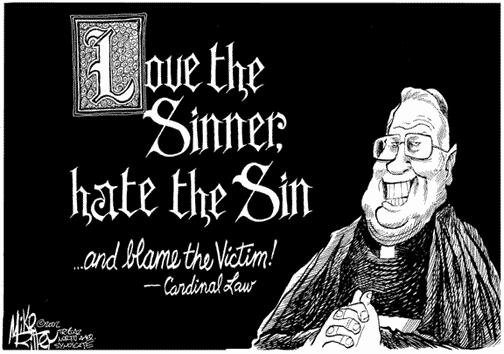
Zou kardinaal Law de brief persoonlijk zijn gaan overhandigen:

Zeg Eerwaarde , jij kent de weg in Boston toch zo goed? En over shatterd faith schijn je ook het nodige te weten, dus als je toch op missie gaat, kijk eens of je Mahony niet een handje kunt helpen? Want 't gaat ons daar goud geld kosten!

Maar laat ik nu toch nog een berichtje hebben gevonden.


ich bin zwei berliner
bolletje bolletje

dinsdag, juni 19, 2007

Wetsvoorstel Maryland, Staat en de kerk: gelijke monikken, gelijke kappen? En het verleden?

Opponents of S.B. 29 want to let the worst offenders get away with their crimes
By KAREN PETERSON
Posted Sunday, June 17, 2007Read Comments-->PERSPECTIVE

State Sen. Karen Peterson represents the 9th Senatorial District.

In recent weeks, the Catholic Diocese of Wilmington has published a number of articles, letters and editorials purporting to support the objectives of Senate Bill 29, The Child Victims Act, while urging the Legislature to pass amendments that would actually "gut" the bill. The church's claims about the legislation range from misleading to downright false. The purpose of this article is to set the record straight.
First, some facts about the problem:
• 1 in 5 children is sexually abused. It's an epidemic.
• The average age of a child-abuse victim is 9.
• 85 percent of victims are molested by family members or family acquaintances.
• Less than 10 percent of victims are molested by clergymen or teachers.
• The majority of abusers are white, heterosexual, married men who consider themselves "religious."
• Abusers typically molest between 12 and 77 children.


Delaware law gives abuse victims only two years to sue their abuser for damages.

Last year, I was approached by a representative of the Diocese of Wilmington who wanted to talk to me about my efforts on behalf of child sexual-abuse victims. He said, "Do you realize how much money this could cost the diocese?" My response was, "They should have thought of that when they were allowing innocent little kids to be molested."

To the church, S.B. 29 is all about the money and keeping its records of cover-ups secret. It should be about the children.

In diocese after diocese, the church hierarchy not only protected known predators, they actually aided and abetted them in committing their crimes by moving them from one unsuspecting parish to another, setting them loose on a whole new batch of innocent children. As one mother said, "They threw our kids to the wolves." There were the kids at St. Mary Magdalen (two of whom committed suicide), St. Ann's, St. Elizabeth's (my alma mater), Our Lady of Fatima and virtually every parish in our diocese.

Our diocese officials knew that children were being raped, sodomized and otherwise molested and did nothing to stop it. Now they are appealing to us, the Catholic faithful, to help them deny justice to our own children. That is unconscionable.


The diocese claims that S.B. 29 isn't "fair" because it does not allow public employees to be sued. That is absolutely false, and the diocese knows it. Line 12 of the bill specifically includes "public entities" and the state solicitor has confirmed (in writing) that the bill does, indeed, cover public as well as private employees. The diocese has thrown this "red herring" out there in an attempt to garner support from private institutions to gut the bill. Some have fallen for it.

Its argument relies on the notion that people will think that "sovereign immunity" means that public employees cannot be sued. The truth is that public employees are sued all the time (the numerous successful suits against the state police and Department of Correction are evidence of that). The state's "immunity" simply means that if a state employee performs an act that is a) within his/her discretion to do, b) is done in good faith, and c) is not done in a "grossly negligent" manner, they will have immunity from suit.

I cannot imagine that any court would find that a public employee: a) had the discretion to sexually molest a child; b) molested the child in good faith, or c) was not grossly negligent in his/her duties when molesting the child. That is why the church's argument on this point is a "red herring."

The second excuse the church is using is its claim that the bill isn't fair because in older cases, witnesses have died, records have been destroyed, and the accused could not get a fair trial.

First, the burden of proof in proving a case is on the accuser, not the accused. Therefore, if the witnesses are all dead and the records are all gone, the plaintiff will never be able to establish that the abuse occurred and such a case would never get past the courtroom doors. But the truth is that the Catholic Church does, in fact, have the records -- and therein lies their real concern. As Father Tom Doyle testified in the Senate, canon law requires that the church keep such records and, as he said, the Catholic Church is the best record-keeper in the world.

The third excuse the church has used is that the diocese could be "forced into bankruptcy" if this bill passes. Why would the Wilmington Diocese be "forced into bankruptcy" when the church has not been "forced into bankruptcy" anywhere else in the country?

The church is banking on Catholics' not understanding the difference between Chapter 7 bankruptcy (liquidation of assets) and Chapter 11 bankruptcy (reorganization).
The church routinely chooses to file for Chapter 11 bankruptcy at the last minute before a child sexual-abuse case is scheduled for trial. It pulls this legal maneuver to shield its assets and its records of cover-up from the plaintiffs. This maneuver has nothing to do with the church's ability to pay claims -- and not one diocese in this country has been "forced" into bankruptcy.


During a public forum on child sexual abuse in the Archdiocese of Philadelphia, District Attorney Lynne Abraham said that the reason there is no statute of limitations on murder is because murder is so "unspeakably evil." So, too, she said, is child sexual abuse. Child sexual abuse kills children's innocence, their souls, and robs them of their childhood. Its effects last a lifetime.

The diocese would have us believe that this matter is all behind us now and that they are voluntarily "taking care of" the victims. The truth is that this matter is far from over for the "kids" who were raped, sodomized and molested 20, 30, and even 40 years ago. They can tell you every single detail about the molestation, no matter how long ago it occurred.

Those who didn't turn to suicide or drugs to escape the psychological pain are like the "walking wounded" or, as one victim described himself, "the walking dead." They fill our prisons, our mental-health clinics, our Alcoholics Anonymous meetings, and our divorce courts in disproportionate numbers.

Allowing the diocese to decide how to compensate its victims would be like the courts allowing the convicted criminal to decide his own sentence.

The law needs to change and it needs to change drastically. Those who preyed upon our children and those who were complicit in those crimes need to be identified and brought to justice.

Right now, child molesters in Delaware are "home free" two years after their crime. Senate Bill 29 would make it clear that child molesters will never again be "home free" in Delaware.


Delaware should be held to the same standard on child abuse
By GREGORY F. LAVELLE
Gregory F. Lavelle is the state representative from the 11th District

The current two-year civil statute of limitations for childhood sexual abuse is unacceptable and needs to be changed. Senate Bill 29 is an effort to do just that. The bill creates a two-year window for past cases of sexual abuse to be brought into court and before a jury for consideration. The alleged abuser and the institution the individual worked for could be held liable for damages. The bill also completely eliminates the statute of limitations for future cases of abuse against children. Again, the alleged abuser and the institution the individual works for could be held liable for damages.

This is a strong bill to address a very serious issue. Understandably, few things shock us more than the sexual abuse of a child. The ability of a victim to face his or her abuser in court is important. To hold institutions accountable for their actions, or failed actions, past, present and future, is also important. For the institution, the possibility of being found liable in such a case should be more than enough to institute policies and procedures to ensure that corrective actions are taken immediately at the first hint that such an offense could be taking place.


Shut your eyes for a moment and then open them. Imagine that before you stand two victims of childhood sexual abuse who are seeking access to the courts. Their stories of abuse at the hands of individuals are the same. The institutions charged with each child's care have also failed to adequately protect them and end the abuse. You would assume that they would both have equal access to the courts to tell their stories and state their facts. The accused would have an opportunity to defend themselves, as would the institutions who may not have acted adequately to stop or prevent the abuse.

You are wrong.

As it stands today, agencies of the state of Delaware and public schools "enjoy" a defense called sovereign and limited immunity that no other institutions in Delaware can utilize.

Essentially, a victim cannot sue the state of Delaware for its failure to properly protect them from abuse. Public schools have defenses available to them that other institutions do not have, making it more difficult for a victim to prevail.

I believe that this is wrong today and it will be just as wrong tomorrow. We should not have two classes of victims based upon who employs their abuser.

We should not limit access to courts and hold the state of Delaware to a lower standard of care than we would be requiring of every other institution that cares for children in our state.

House Amendment 2 to S.B. 29 explicitly and without question ensures that Delaware is held to the same level of accountability and responsibility for the care and protection of our children that S.B. 29 demands of other organizations by waiving the state's sovereign and limited immunity for past and future abuses.

That way, lawyers will not be in a position to argue with the "intent" of the law at some point in the future. The will and intent of the General Assembly will be clear and unmistakable: We expect the state to rise to the same level of accountability that we are demanding of every other institution that takes care of our children.
Expecting anything less would be unreasonable.

In the past year alone, four public school employees have been arrested and charged with the rape and sexual assault of children in their care. One of these children was a special-needs student who was assaulted by a 60-year-old white male.

Statistical evidence on pedophiles would indicate this was not an isolated assault by the alleged abuser. Another assault involved the multiple rapes of a middle-school student. While we would prefer that this did not happen at the hands of state employees or others, it has, it does and it will.

House Amendment 2 does not kill S.B. 29 as some might argue.
It makes it stronger. It ensures access to the courts for all -- not for some. It demonstrates beyond any doubt that we will not tolerate sexual abuse of our children by individuals, and we will not turn a blind eye toward any institution involved in that abuse, including the one the General Assembly should be most responsible for overseeing, the state of Delaware.
We should not be fooled by the argument that the state's immunity issue should be dealt with in the future or in a separate bill.

We should not be misled that the state has this immunity "privilege" with other torts and should therefore be able to preserve it when abetting the sexual abuse of children. We should set the standard for this issue and apply it equally to all, including the state.
Demanding anything less would be unreasonable.

Imagine those two victims again. The private-school student would have complete access to the courts if S.B. 29 were to be enacted today without amending the bill.
Only with H.A. 2 would the public-school student have that same access to court to face the abuser and the institution that may have failed to protect them.

Amending S.B. 29 with H.A. 2 is the right thing to do. It is the only thing to do. Anything less would create a double standard and two classes of victims with the public-school student not only victimized by the abuser but also by being denied access to the courts.

The General Assembly should be sure that this does not happen and that every victim is treated equally and fairly.


By ROBERT G. KREBS
Robert G. Krebs is the spokesman for the Diocese of Wilmington
Posted Sunday, June 17, 2007


The Catholic Diocese of Wilmington supports changing Delaware's statute of limitations for lawsuits by victims of child sex abuse. Victims of child abuse are uniquely damaged, and typically require a very long time, many years into their adulthood, to come to grips with their abuse. Last year, the General Assembly agreed that the statute of limitations should be extended, from two years from the date of the abuse to 25 years after a victim turns 18, and the Diocese of Wilmington supported that change. The Diocese of Wilmington also supports the extension of the statute for future claims contained in S.B. 29 even though there are logical and legal reasons not to abolish the statute of limitations completely.

But Senate Bill 29 not only abolishes the statute of limitations, it also opens a window allowing lawsuits to be filed at any time, regardless of when the abuse occurred. Under S.B. 29, lawsuits could be brought concerning events that occurred decades ago.

There is no precedent, in Delaware or in any other state, for completely eliminating the statute of limitations, forward and backward. Statutes of limitations are designed to enable claims to be investigated and decided fairly, while facts are fresh, memories are vivid, and relevant evidence is still available. Limitations periods also guarantee that judges and juries will not be so far removed in time from the circumstances surrounding a case that they cannot interpret the evidence in light of those circumstances. S.B. 29 completely undermines these essential purposes of statutes of limitations.

If S.B. 29 is to have some retroactive application, there are numerous ways to address these due process, fairness and other concerns.

For examplem rest ...


The Diocese of Wilmington is not looking for a pass on its legal obligation to victims, and the changes to S.B. 29 we propose will not shield the diocese from liability. What we are looking for is some recognition in the legislation of the legal and practical problems with an unlimited lookback provision. It seems to us that the needs and concerns of victims, of institutions and of Delaware's judicial system all can be addressed if there is some reasonable balancing of these needs and concerns, in the form of some reasonable limitations period on lawsuits based on child sex abuse.
The bill also should be amended so that it affords the same rights to all victims, including those children served by public institutions, and that all institutions, public and private, are held equally accountable.

maandag, juni 18, 2007

Eufrasia's annalen


bron: Heilige Maria Eufrasia Pelletier, Stichteres van de Zusters van O.L.V. van Liefde van de Goede Herder 1796 -1868, Moederhuis van de Goede Herder, Angers, Frankrijk

cadeautje van de congregatie.

Pope obstructed sex abuse inquiry

Pope 'obstructed' sex abuse inquiry
Confidential letter reveals Ratzinger ordered bishops to keep allegations secret
Jamie Doward, religious affairs correspondentSunday April 24, 2005
The Observer

Pope Benedict XVI faced claims last night he had 'obstructed justice' after it emerged he issued an order ensuring the church's investigations into child sex abuse claims be carried out in secret.
The order was made in a confidential letter, obtained by The Observer, which was sent to every Catholic bishop in May 2001.
It asserted the church's right to hold its inquiries behind closed doors and keep the evidence confidential for up to 10 years after the victims reached adulthood. The letter was signed by Cardinal Joseph Ratzinger, who was elected as John Paul II's successor last week.

Lawyers acting for abuse victims claim it was designed to prevent the allegations from becoming public knowledge or being investigated by the police. They accuse Ratzinger of committing a 'clear obstruction of justice'.

The letter, 'concerning very grave sins', was sent from the Congregation for the Doctrine of the Faith, the Vatican office that once presided over the Inquisition and was overseen by Ratzinger.

It spells out to bishops the church's position on a number of matters ranging from celebrating the eucharist with a non-Catholic to sexual abuse by a cleric 'with a minor below the age of 18 years'. Ratzinger's letter states that the church can claim jurisdiction in cases where abuse has been 'perpetrated with a minor by a cleric'.

The letter states that the church's jurisdiction 'begins to run from the day when the minor has completed the 18th year of age' and lasts for 10 years.

It orders that 'preliminary investigations' into any claims of abuse should be sent to Ratzinger's office, which has the option of referring them back to private tribunals in which the 'functions of judge, promoter of justice, notary and legal representative can validly be performed for these cases only by priests'.

'Cases of this kind are subject to the pontifical secret,' Ratzinger's letter concludes. Breaching the pontifical secret at any time while the 10-year jurisdiction order is operating carries penalties, including the threat of excommunication.

The letter is referred to in documents relating to a lawsuit filed earlier this year against a church in Texas and Ratzinger on behalf of two alleged abuse victims. By sending the letter, lawyers acting for the alleged victims claim the cardinal conspired to obstruct justice.

Daniel Shea, the lawyer for the two alleged victims who discovered the letter, said: 'It speaks for itself. You have to ask: why do you not start the clock ticking until the kid turns 18? It's an obstruction of justice.'

Father John Beal, professor of canon law at the Catholic University of America, gave an oral deposition under oath on 8 April last year in which he admitted to Shea that the letter extended the church's jurisdiction and control over sexual assault crimes.

The Ratzinger letter was co-signed by Archbishop Tarcisio Bertone who gave an interview two years ago in which he hinted at the church's opposition to allowing outside agencies to investigate abuse claims.

'In my opinion, the demand that a bishop be obligated to contact the police in order to denounce a priest who has admitted the offence of paedophilia is unfounded,' Bertone said.

Shea criticised the order that abuse allegations should be investigated only in secret tribunals. 'They are imposing procedures and secrecy on these cases. If law enforcement agencies find out about the case, they can deal with it. But you can't investigate a case if you never find out about it. If you can manage to keep it secret for 18 years plus 10 the priest will get away with it,' Shea added.

A spokeswoman in the Vatican press office declined to comment when told about the contents of the letter. 'This is not a public document, so we would not talk about it,' she said.

(ingevoegd 17-6-07)

zondag, juni 17, 2007

Order called to account - Mainlander - The Press


MICHELLE MULVIHILL: ``I promised them that I would continue to ensure that they received an enduring relationship with the order, if that was what they wanted. Many did. I now feel very bad that I cannot deliver on that promise. That decision was basically denied me.''

After nine years as complaints manager for a deeply troubled Catholic order, psychologist Michelle Mulvihill has quit in disgust.
YVONNE MARTIN reports.

Consultant psychologist, former nun and corporate shaker Michelle Mulvihill is the most unlikely whistleblower.
For nine years she worked behind the scenes advising the beleaguered Catholic Order of St John of God on how to deal with an avalanche of serious sexual complaints against its brotherhood.

In New Zealand, Mulvihill sat with the Australasian head of the order, Brother Peter Burke, listening to stories of abuse from dozens of former boys from a St John of God residential school in Christchurch and advised him how to proceed. They visited jails, hospitals, psychiatric wards, family homes, doss houses and the streets – wherever these sad and often destitute men washed up.
More than almost anyone, Mulvihill knows the magnitude and gravity of complaints against more than 30 St John of God brothers over a 40-year period on both sides of the Tasman.

She has never spoken publicly about those meetings and how the order responded to the complaints, until now. Today, Mulvihill tells of a pervasive culture of sexual abuse within the order, the denials among the brotherhood of any problem and the "pastoral offers" grudgingly handed out to the men, while millions of dollars were paid in legal fees to defend accused brothers.
She is talking out of concern for the men she met and that promises she made, along with Burke, of an enduring relationship with the order could not be kept.

In March, upset that four out of five of the order's new leadership team had been or were the subject of complaints of sexual and physical abuse, Mulvihill quit as chairwoman of the professional standards committee. Some allegations had been investigated by the police, others had not.

She alerted the order's Prior General in Rome to her concerns and that despite the committee's best efforts, the order would not take the problem seriously.
"My impression is that there is a culture of collusion inside the province which is deeply ingrained, and which makes it almost impossible for the truth about these matters to be dealt with," she wrote.

Mulvihill believes the problem is so bad, the Australasian order should be shut down and its assets seized by the parent group in Rome.
"I tried to hang on for the sake of the victims, particularly those in New Zealand whom, along with Burke, I promised that they would have an enduring relationship with the order," Mulvihill told The Weekend Press.
"At the end of the day, I had to resign because I could not stand dealing with this any more."

In mid-2002 The Press broke the story of the St John of God order burying a potential child sex-abuse scandal by secretly paying a Christchurch man $30,000.
The 1999 payout followed abuse allegations against a Catholic brother who taught boys with learning disabilities at a Christchurch residential school, Marylands.

That story prised the lid off what has become the biggest church sex-abuse scandal in New Zealand. Over the next two years 121 complaints would be received regarding former Marylands men and four brothers, and a priest, would be arrested.
One former brother, Bernard McGrath, was jailed for five years last year for sexually assaulting boys in the 1970s.
Mulvihill went with Burke on his New Zealand journey to meet 90 of the Marylands men and their families. "We met in hotels and meeting rooms, boardrooms and hostels, hospital wards and mental-hospital rooms, in airport lounges and on the street, the length and breadth of New Zealand. We sat in freezing and filthy council houses.

"Some men were dying. Some visitors arrived drunk or on drugs as they were so afraid of meeting up with agents of this order.
"Some men were on large doses of psychotropic medication. We listened relentlessly, while at the same time a huge police investigation continued."

A former Mercy nun for 13 years and a trained psychologist, Mulvihill was called in by the order to help it deal with a major crisis in 1998. Serious allegations of sexual abuse against former children in their care had emerged in Melbourne. The brothers had no idea what to do.
Mulvihill had expertise in post-traumatic stress disorder and was recommended to the brothers.

In Australia, 54 cases were brought against the order in class actions by lawyers and were settled out of court along traditional, legal lines. No face-to-face contact with complainants took place. Twenty-two brothers were named by complainants and the scandal cost the order more than $6.8 million, plus legal fees.

Victoria police investigated but no charges were laid. Most brothers denied the allegations against victims, who were very disabled, and some brothers declined police interviews.

But the New Zealand complaints were handled differently. In a process designed by Mulvihill, the men were met personally, often several times.
Mulvihill and Burke listened to the stories, apologised to the men and promised to heal their hurts.

Part of that process was compensation, what the order insisted were "pastoral offers", which seemed generous at the time. About 80 men received payouts, totalling about $5m.
But Mulvihill says with a few exceptions, the men received very low payouts compared to their Australian counterparts – averaging $67,850 "and in New Zealand dollars, not Aussie dollars".
In contrast, Australian victims got paid an average $NZ125,000 each. Some payouts were as high as $NZ275,000 and $NZ388,000, including costs.

Some men died before their cases were resolved; some committed suicide. Others laid complaints with the police, but did not approach the order. But equally as important in the healing process, Burke and Mulvihill promised that the order would have ongoing relationships with the men. That like a friend, the order would always be there to help when they needed a hand.

Back in Sydney, their benevolent approach was lambasted by some members of the brotherhood. They were criticised for believing the allegations, apologising to the men and for handing over money without getting them to sign a deed of release.

"You would not meet a more genuine man than Peter Burke. He genuinely wanted to help the guys and their families. He was crucified by the group for doing just that," says Mulvihill. "He had to suffer the indignity of being constantly attacked by a group of men, his own brothers. In the end he had to give in to the legal processes which I know he detested.
"Despite his perceived `power' there were many competing interests pressurising him."

Mulvihill was also vilified. Every idea she put up – a trust fund for the men, a drop-in centre and financial support for Christchurch's cash-strapped Male Survivors of Sexual Abuse Trust – was ignored. "The leadership team under Burke agreed to these things but then would not act on these decisions," she says.

As an organisational consultant and educator, Mulvihill is used to analysing corporate culture and turning companies around. In the last few years, as chief executive of hair-removal company Nad's, she led an aggressive global-expansion strategy. She rebranded the company, dumped non-performing contracts, and introduced new products, including one cashing in on the Brazilian-style bikini-waxing craze.
Mulvihill, who has her own consultancy, is known for her take-no-prisoners management style.

The new St John of God leader, Brother Timothy Graham, who replaced Burke, has described Mulvihill as a "highly respected and trusted adviser" to the order for many years.
Brother Timothy is the only member of the new leadership who has not faced and is not facing allegations.

But Mulvihill found that enlightening the order about the problems within proved a near impossible task, when the prevailing culture was one of denial and shoot-the-messenger.

"There was some acknowledgement that there were some extremely disturbed men in the order who were rampant paedophiles," she says.

"There is also acknowledgement that when complaints were made in the past, they should have been acted upon differently. There is still widespread denial.

"As one of the old self-declared paedophiles said to me directly: `Oh Michelle, why don't we all just hold hands and ask for forgiveness and put it all behind us and get on with our lives'."

Many brothers spoke disparagingly about the victims, believing that the scandal was a smear campaign against the order, and that the sooner the problem went away the better.

"The very culture of the order is such that they make a joke out of who the victims really are – `oh Johnny? He's complained? He was a liar as a child and he is still lying. Don't you know that he is a liar?' Comments like this were the norm."

When a Christchurch complainant, Justin Richardson, was proven to have lied about his claim and received more than $100,000 compensation fraudulently, the brothers jeered.

"Those who did not believe in what we were doing seized on this one mistake as being the opening they were waiting for to discredit the entire process," says Mulvihill.

The role of complaints manager became increasingly vexed. "It is one of the most difficult positions to hold. There are competing interests, there are deals done on the side, there is information that is kept from you, there is access to many dreadful stories and there is no road map."

Mulvihill summed up her view of the problem in a report to the order like this: "The high level of denial within the order in relation to victimisation, cover-up, collusion with events, and the general lack of co-operation with outside bodies, smacks of systemic corruption."

By far the most difficult issue faced, she wrote, was the extent to which three brothers charged by the New Zealand police on sexual counts had gone to defend themselves against extradition from Australia. She believes the decision to resist extradition lacked credibility.
A suspension of the pastoral process, while two of the accused, Brother Rodger Moloney, 71, and Father Raymond Garchow, 59, face a total of 32 historic sex-abuse charges, is a disgrace, says Mulvihill.

"These men (victims) have already been abandoned by some of those brothers who were meant to care for them and look after them. Some were abandoned originally by parents. Now the withdrawal of any real ongoing relationship with these men means they are being abandoned again."

But the final straw for Mulvihill was the election of four brothers as councillors to lead the province with Brother Timothy when each of the four had either previously been or were the subject of allegations.

In one brother's case, Burke had hired a private investigator in January to investigate allegations of sexual abuse made against him.
"It must be very difficult to find five men who have not had complaints laid against them to lead this order," says Mulvihill.

"Unfortunately the chapter at which the leadership was elected did not seem to consider the implications of electing leaders who were or still are subject to serious complaints."
On Tuesday The Press emailed 20 questions to Brother Timothy, through his public relations officer. Brother Timothy responded with a letter on Thursday night saying he had just seen the questions and would not be answering them in time for The Press's deadline.

"It is not my practice, nor will it become my practice, to deal with, at short notice, issues as serious as some of those raised in the list of 20 questions you have submitted to me (which I have seen for the first time today, Thursday) and to which you have required answers by day's end.
"I will take the issues on board immediately and urgently."
Brother Timothy has offered to meet with The Press, once he has had time to consider the issues.

Mulvihill says the trauma of "holding" the men's stories and the continual criticism from within the order became too much and she quit.
"The constant attacks on me and on others on the committee were eventually unbearable. I don't need this in my life."

Mulvihill believes the order should be closed down, its multi-million-dollar assets seized, and a trust fund set up to support victims for the rest of their lives.

"The hardest thing for me is that I have the images of the faces of each of the 90 men I have met seared onto my heart. I remember each and every one of them. I know their story.
"I promised them that I would continue to ensure that they received an enduring relationship with the order, if that was what they wanted. Many did. I now feel very bad that I cannot deliver on that promise. That decision was basically denied me.
"But at the end of the day we did our best. We ignored the advice of lawyers and police to take the black-and-white legal route. Instead we met these people eyeball to eyeball, with compassion and respect and openness to learning. And for me that has made all the difference.
"Although I am no longer a formal part of this process since my resignation, I shall continue to work for the rights of victims. This needs standing up to."