The Annual Remembrance Day service for Former Residents of Institutional Care in Queensland will be held on Wednesday September 9 2009 


foto's: MicahInc
HAN


foto's: MicahInc
HAN

 Clan Care Leavers Australia Network
...
By the end of 2009 the Australian Government will issue a formal statement of acknowledgement and apology, on behalf of the nation, to Forgotten Australians and former child migrants. In the spirit of the bipartisan nature of the Senate Inquiry reports, the Government will work with the Opposition to develop the remembrance event.
This is a significant national step in the healing process for Forgotten Australians and former child migrants.
Many former child migrants and other children who were in institutions, their families and the wider community have suffered from a system that did not adequately provide for, or protect children in its care.
In June this year, a further Senate Inquiry reported on progress since the 2001 and 2004 reports. This report said more needed to be done. The apology will address recommendations 1 and 2 of this recent report and the Government will table a full, formal response in coming months.
To further help the healing process, the Government is also providing $300,000 each to both the Alliance for Forgotten Australians (AFA) and the Care Leavers Australia Network (CLAN), over the next two years. We will work with these organisations to make sure that care leavers can get the practical support and information they need.
We will also be consulting broadly with state and territory governments, past care providers and those affected by these practices to develop the apology and the path ahead.
We have also begun a dialogue with mothers and children separated by past adoption practices which were inappropriate or unethical. The Government recognises that the pain and suffering of these women also endures.
We will work with the National Library of Australia, the National Museum of Australia and those who have suffered in the past on how to best to record, for the historical record, the experiences of the Forgotten Australians, former child migrants, and women and children affected by past adoption practices.
This is a significant national step in the healing process for Forgotten Australians and former child migrants.
Many former child migrants and other children who were in institutions, their families and the wider community have suffered from a system that did not adequately provide for, or protect children in its care.
In June this year, a further Senate Inquiry reported on progress since the 2001 and 2004 reports. This report said more needed to be done. The apology will address recommendations 1 and 2 of this recent report and the Government will table a full, formal response in coming months.
To further help the healing process, the Government is also providing $300,000 each to both the Alliance for Forgotten Australians (AFA) and the Care Leavers Australia Network (CLAN), over the next two years. We will work with these organisations to make sure that care leavers can get the practical support and information they need.
We will also be consulting broadly with state and territory governments, past care providers and those affected by these practices to develop the apology and the path ahead.
We have also begun a dialogue with mothers and children separated by past adoption practices which were inappropriate or unethical. The Government recognises that the pain and suffering of these women also endures.
We will work with the National Library of Australia, the National Museum of Australia and those who have suffered in the past on how to best to record, for the historical record, the experiences of the Forgotten Australians, former child migrants, and women and children affected by past adoption practices.
Redress to pay deceased victims $5K
8th September 2009
ABC News
The West Australian Government has announced ex gratia payments of $5,000 will be made to victims of child abuse in state care who have died before their application was finalised.
Redress WA was set up under the previous Labor government to compensate people who suffered abuse in Australia's orphanages, children's homes and in foster care.
Last month, the State Government cut the maximum payment for victims from $80,000 to $45,000.
The Minister for Community Services, Robyn McSweeney, has now announced payments of $5,000 will be made to the estates of deceased victims.
Ms McSweeney says Redress WA has identified 21 cases where victims have died before their claim was finalised.
She says victims who are terminally ill can apply for an interim payment of up to $10,000.
This afternoon a West Australian Federal Liberal MP joined about 100 people at State Parliament protesting against the Barnett government's changes to the Redress WA scheme.
Today's protest was the second in two months.
The Federal Member for Swan, Steve Irons, told the crowd his state Liberal colleagues had made the wrong decision.
"As I said before I am a Liberal and a strong supporter of the Barnett Government, however they have got this one wrong," he said.
"I ask Colin Barnett to reconsider.
"I will continue to support the remembered Australians in pursuing a positive outcome."


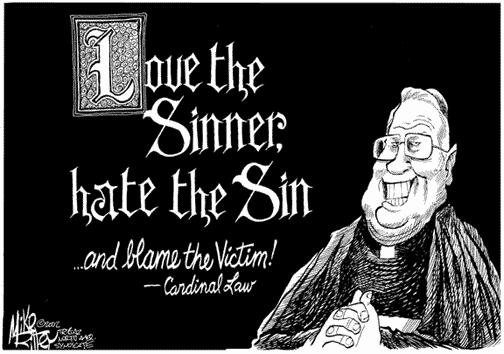
 In his previous post as bishop in Bridgeport, Conn., he let some priests keep working after they were accused of sexual abuse. In closed testimony in a 1997 lawsuit, he expressed doubt about the veracity of most allegations, saying that "very few have even come close to having anyone prove anything." One priest he supported was the Rev. Raymond Pcolka, who had been accused as far back as 1966. Father Pcolka's alleged victims included more than a dozen boys and girls - some as young as 7 - who described being spanked and forced into oral and anal sex. Cardinal Egan kept him on the job until 1992, when another accuser came forward and the priest refused orders to remain at a treatment center. The diocese has since settled lawsuits against Father Pcolka, who refused to answer lawyers' questions during the litigation. Another priest protected by Cardinal Egan was the Rev. Laurence Brett, who had first admitted abuse in 1964 - biting a boy's genitals. After Cardinal Egan became Bridgeport's bishop in the late 1980s, he met Father Brett and endorsed him for continued ministry. "In the course of our conversation," he wrote, "the particulars of his case came out in detail and with grace." Further accusations led to Father Brett's suspension in 1993. In a recent letter to New York parishioners, Cardinal Egan said his policy in Bridgeport was to do a preliminary investigation of accused priests, then send them for psychiatric evaluation and heed doctors' advice. The Connecticut Postlater showed that the policy wasn't followed in the case of the Rev. Walter Coleman, who stayed on the job for more than a year after the Bridgeport diocese concluded in early 1994 that he had abused the son of a woman with whom he had an affair and bought a house. In early June, the pope appointed Cardinal Egan to the Vatican's highest court. In mid-May, the Westchester County district attorney convened a grand jury to investigate New York archdiocesan leaders' handling of sex-abuse allegations.