Religie residentieel nonnen 25 Augustus 2006 03:20:24
Een misschien wel knap ingewikkelde uitspraak in N-Zeeland. De eeuwige achterstand van van het gestichtskind: ze was al kapot voor ze bij ons kwam.....nu kennelijk overgenomen door een rechter. Welke tegelijkertijd niet uitsluit dat er een grond van waarheid zit in de beschuldigingen, maar de bewijslast ontbreekt. En arme nonnen.....
Er zit vooralsnog een knap visluchtje in ieder geval aan dit artikel.
Niet onwaarschijnlijk opnieuw andere vrouwen (en mannen) in problemen door de gebruikte argumenten. Hoelang duurt het nog voor dat ook dat deel kan uitmaken van de informatie.
Dan kunnen dergelijke opmerkingen over die arme nonnen met hun stress en hun benodigde therapie tenminste realistisch worden. Want nú, in combinatie met die generous providing homes ...yeah.... Hoewel er een grond van waarheid niet uitgesloten geacht kan worden mist dát ieder geval iedere bewijskracht.
Dergelijke dankbaarheidsheidschantage vanuit een burgerlijke rechtbank is zonder meer schandalig!
Die nonnen deden hun werk en kozen daar vrijwillig voor. Vonden ze kennelijk plezierig en werden hiervoor betaald door de overheid, verantwoordelijk voor deze kinderen.
Hoog tijd om met dit soort chanterende onzin op te houden! Dat heeft in ieder geval meer dan genoeg slachtoffers gemaakt. Die nonnen hebben tenslotte ook geen dank je wel gezegd tegen deze kinderen, die zij net zo hard nodig hadden voor de idealen die zij hadden!
Maar, tadadaadaaaaaaa
in de VS is voor de allereerste keer een claim toegekend voor sexueel misbruik in een justitiele kinderbeschermings tehuis en scholen van de Zusters van Liefde van Nazareth. Zorg-ontvangers, meer dan 20 in deze claim, misbruikt door de inpandige kapelaan van het tehuis.
Anderen door verschillende nonnen en 2 leken.
Hulde aan de moed van deze vrouwen. Heel wat van hen zijn al heel lang bezig. Hopelijk komen hierdoor ook anderen over hun drempels van angst en schaamte om hun mond open te doen over wat hen als kind is aangedaan En inspireert dit resultaat andere vrouwen die net als zij al zo lang bezig zijn tot vólhouden!
Orphanage abuse claim rejected
12 August 2006
A woman who sued Catholic nuns for $550,000 claiming they were negligent in caring for her and thus caused her physical and emotional abuse has lost her case.
In the High Court at Wellington, Justice Marion Frater has rejected claims that the woman, whose name is suppressed, was sexually abused by a priest while at St Joseph's Orphanage Upper Hutt. She had also claimed a nun slapped the side of her head so hard that her eardrum burst.
Some discipline and control at the orphanage was "borderline – and certainly unacceptable by today's standards", but at the time it was seen as an excellent standard of care, Justice Frater said.
However, she said she did not believe the woman, 46, a mother of two living in Australia, had deliberately made up allegations about her time in Catholic care in the 1960s and 70s.
"I accept most if not all her allegations have a basis in fact."
Justice Frater had no doubt the woman was sexually abused, but could not be sure of the details.
She could not be certain which of the woman's memories were soundly based and which were not.
The woman had been volatile giving evidence, often screaming so much that the court had to adjourn.
The judge rejected a claim from the woman's sister that she had been "exorcised" at the orphanage.
Some of the people accused in the case of having committed various forms of abuse are now having counselling for stress.
Former director of Catholic Social Services John Consedine, a counsellor, said yesterday the stress of being falsely accused had taken its toll on people who had been generous providing homes for young children.
"I think she has had a very unfortunate life and had awful trauma, but what we believe is that it was not our fault and we did not contribute to it."
The nuns' spokeswoman, Sister Clare Vaughan, said the period since 2001, when the woman filed her claim, had been a time of anxiety for all the sisters. They were relieved the case was over.
Justice Frater found the woman's troubled childhood – she and her six siblings were put into care when her parents separated – was a significant contributor to her current mental state. That early fragility probably influenced her later experiences.
But Justice Frater said Catholic Social Services took adequate steps to address her needs, and given the lack of knowledge about the signs of sexual abuse,they could not be criticised for failing to recognise that she may have been abused.
http://www.stuff.co.nz/stuff/0,2106,3762930a12855,00.html
Sisters of Charity settle 45 abuse suits for $1.5 million
By Peter Smith
psmith@courier-journal.com
The Courier-Journal
An order of Catholic nuns based in Nelson County has agreed to pay $1.5 million to settle lawsuits by 45 plaintiffs who alleged they were sexually abused at orphanages and schools.
The settlement ends the bulk of two years of litigation involving the Sisters of Charity of Nazareth.
The plaintiffs alleged they were abused as children at orphanages and schools supervised by the nuns between the 1930s and 1970s. More than 20 of the plaintiffs accused a priest who was a longtime orphanage chaplain, and others accused several nuns and two laymen.
Attorneys Jennifer Kincaid Adams, representing the Sisters of Charity, and William McMurry, representing the plaintiffs, confirmed they had agreed to the settlement. But McMurry added that it needs to be completed with delivery of the check from the order, scheduled for Friday.
Under the agreement, the Sisters of Charity did not acknowledge any guilt, but the order did agree not to use the term “alleged victims” but rather “plaintiffs.”
Two other plaintiffs represented by a different lawyer did not participate in the settlement, Adams said. Their cases remain pending.
Adams said the nuns “are relieved and very comforted to have this behind them so that the healing process for their community, the plaintiffs and the church as a whole can begin.”
McMurry said the settlement marks “the first time in United States history any victims of a Catholic orphanage have recovered (a payment due to) childhood sexual abuse.”
He said all other cases have been dismissed on the grounds they were filed too long after the alleged abuse.
reageer bewerk geef kudos verstuur kopieer bekeken x 49
zaterdag, augustus 26, 2006


dinsdag, juli 11, 2006
Geheim huis voor immorele clerus in de 40-jaren!
Secret house for 'immoral' clergy set up in the 1940s
Monday July 10th 2006 Irish Independent
THE Irish Catholic bishops were so appalled 60 years ago by evidence of immoral behaviour among priests, that they secretly authorised the setting up of a 'House for Clergy Under Correction'.
A previously unpublished document reveals that the bishops were so alarmed at the scale of the clerical scandals that they went to the extraordinary step of deliberately concealing from the faithful the true purpose for which inmates were sent to the detention centre in Waterford.
In the confidential document, endorsed by the bishops at their private meeting in Maynooth in 1946, they agreed that the proposed House "be given a name which will not have a defamatory connotation."
Inmate
A recommendation from an Episcopal Committee appointed at the June Maynooth meeting in 1945 suggested that the House should be called either St Joseph's Home for Priests or St Joseph's Convalescent Home for Priests.
The four archbishops and 22 bishops from all 26 dioceses North and South pledged themselves to contribute €2 for each priest in their diocese who was sent as an inmate to the House.
"While the House is intended primarily for priests who through their own fault have rendered themselves unfit for missionary or other priestly work, the Superior may also admit priests who are incapacitated through non-culpable causes," it states.
Intriguingly, it does not specify the vices indulged in by errant clerics.
But in 1944 the Dublin City Medical Officer reported a sharp increase in venereal disease, a symptom of a marked growth of public 'immorality' in Ireland during World War II.
The confidential document is contained in the papers of the Archbishop of Dublin, Dr John Charles McQuaid, the son of a doctor who at that time was using his enormous influence to persuade the Sisters of Mercy to open the first VD clinic in Ireland.
The immediate post-War years saw a surge in emigration to Britain of unmarried young women, many of them leaving home to conceal illegitimate pregnancies, some of them from illicit sexual relations with or rapes by priests.
Grave
At a time when childbirth out of wedlock was deemed a grave social sin, unmarried mothers were being sent to Magdalene Homes to work in laundries, where later testimonies have shown that they were abused sexually by priests.
In an era of high unemployment and pervasive poverty, pressure was mounting on the religious orders to cater for children who were being sent by the courts to industrial schools and reformatories.
In view of this the House of Correction may also have been a location for bishops to send paedophile priests. The bishops were also worried by a general rise in public intemperance had been identified as a curse of the Irish priesthood.
Whatever the exact nature of the peccadilloes of the clergy, the initiative for establishing the House came from the Brothers of Charity, who were based at Belmont in Waterford.
Literally, the Brothers were pushing an open door.
Their proposal was granted by the Hierarchy in June 1945. The sub-committee formed to work out rules governing the House. consisted of the Coadjutor Archbishop of Cashel, Jeremiah Kinane, along with the Bishop of Ossory, Patrick Collier and the Bishop of Waterford, Daniel Cohalan.
They recommended that a chaplain representative of the whole Hierarchy should be appointed.
While the chaplain had faculties to hear the inmates' confessions, provision was made for an external confessor to visit the House at least once a week. for the discharge of his functions.
The rules further provided that there should be disciplinary regulations for the inmates with appropriate sanctions drawn up by the Superior after consultation with the chaplain. Among the disciplinary regulations was one forbidding inmates to leave the precincts without the express permission of the Superior.
Consultation
This was to be given only for a grave cause and after consultation with the chaplain.
A clause was inserted giving Bishop Cohalan the right to make whatever disciplinary regulations in connection with the House and its inmates he might deem necessary for the preservation of good order and good morals in his diocese.
Admission to the House was open to not only priests attached to the Irish dioceses but also priests attached to dioceses in Britain, and Irish priests generally, whether secular or religious.
No priest whose admission the Superior, after due investigation and consultation with the chaplain considered likely to be a serious danger to the good order or good morals of the House, was to be admitted.
The disciplinary regulations specified dismissal for "conduct calculated to interfere seriously with the good order or good morale of the House.
John Cooney© Irish Independent
Monday July 10th 2006 Irish Independent
THE Irish Catholic bishops were so appalled 60 years ago by evidence of immoral behaviour among priests, that they secretly authorised the setting up of a 'House for Clergy Under Correction'.
A previously unpublished document reveals that the bishops were so alarmed at the scale of the clerical scandals that they went to the extraordinary step of deliberately concealing from the faithful the true purpose for which inmates were sent to the detention centre in Waterford.
In the confidential document, endorsed by the bishops at their private meeting in Maynooth in 1946, they agreed that the proposed House "be given a name which will not have a defamatory connotation."
Inmate
A recommendation from an Episcopal Committee appointed at the June Maynooth meeting in 1945 suggested that the House should be called either St Joseph's Home for Priests or St Joseph's Convalescent Home for Priests.
The four archbishops and 22 bishops from all 26 dioceses North and South pledged themselves to contribute €2 for each priest in their diocese who was sent as an inmate to the House.
"While the House is intended primarily for priests who through their own fault have rendered themselves unfit for missionary or other priestly work, the Superior may also admit priests who are incapacitated through non-culpable causes," it states.
Intriguingly, it does not specify the vices indulged in by errant clerics.
But in 1944 the Dublin City Medical Officer reported a sharp increase in venereal disease, a symptom of a marked growth of public 'immorality' in Ireland during World War II.
The confidential document is contained in the papers of the Archbishop of Dublin, Dr John Charles McQuaid, the son of a doctor who at that time was using his enormous influence to persuade the Sisters of Mercy to open the first VD clinic in Ireland.
The immediate post-War years saw a surge in emigration to Britain of unmarried young women, many of them leaving home to conceal illegitimate pregnancies, some of them from illicit sexual relations with or rapes by priests.
Grave
At a time when childbirth out of wedlock was deemed a grave social sin, unmarried mothers were being sent to Magdalene Homes to work in laundries, where later testimonies have shown that they were abused sexually by priests.
In an era of high unemployment and pervasive poverty, pressure was mounting on the religious orders to cater for children who were being sent by the courts to industrial schools and reformatories.
In view of this the House of Correction may also have been a location for bishops to send paedophile priests. The bishops were also worried by a general rise in public intemperance had been identified as a curse of the Irish priesthood.
Whatever the exact nature of the peccadilloes of the clergy, the initiative for establishing the House came from the Brothers of Charity, who were based at Belmont in Waterford.
Literally, the Brothers were pushing an open door.
Their proposal was granted by the Hierarchy in June 1945. The sub-committee formed to work out rules governing the House. consisted of the Coadjutor Archbishop of Cashel, Jeremiah Kinane, along with the Bishop of Ossory, Patrick Collier and the Bishop of Waterford, Daniel Cohalan.
They recommended that a chaplain representative of the whole Hierarchy should be appointed.
While the chaplain had faculties to hear the inmates' confessions, provision was made for an external confessor to visit the House at least once a week. for the discharge of his functions.
The rules further provided that there should be disciplinary regulations for the inmates with appropriate sanctions drawn up by the Superior after consultation with the chaplain. Among the disciplinary regulations was one forbidding inmates to leave the precincts without the express permission of the Superior.
Consultation
This was to be given only for a grave cause and after consultation with the chaplain.
A clause was inserted giving Bishop Cohalan the right to make whatever disciplinary regulations in connection with the House and its inmates he might deem necessary for the preservation of good order and good morals in his diocese.
Admission to the House was open to not only priests attached to the Irish dioceses but also priests attached to dioceses in Britain, and Irish priests generally, whether secular or religious.
No priest whose admission the Superior, after due investigation and consultation with the chaplain considered likely to be a serious danger to the good order or good morals of the House, was to be admitted.
The disciplinary regulations specified dismissal for "conduct calculated to interfere seriously with the good order or good morale of the House.
John Cooney© Irish Independent
vrijdag, juni 16, 2006
Aansprakelijkheid Vaticaan. Oogjes toe en snaveltjes dicht!
Aansprakelijkheid Vaticaan. Oogjes toe en snaveltjes dicht! Maatschappij media 16 Juni 2006 I punt.nl
COLLECT CALL


Zo nu eerst een Bavaria. Tijd dat mannen weer mannen worden.
Kinderkruis tocht
News reports last week suggested that a U.S. district court in Oregon had
opened the door to legal action against the Holy See in a case related to the
sexual abuse of minors. If that ruling were to hold up, it would mark an
important blow to the immunity the Holy See generally enjoys as a sovereign
entity under international law.
In fact, legal experts stress this was merely a preliminary decision, and that we're a long way away from any American
court actually agreeing to hear a lawsuit seeking damages against the Vatican.
Nonetheless, the Oregon ruling raises anew what some Vatican officials
have long regarded as a nightmare scenario -- the specter of American courts assessing massive financial penalties against the Holy See.
Such concern was behind a request made by Cardinal Angelo Sodano, the most powerful Vatican official after the pope himself, to the U.S. Secretary of State Condoleeza Rice in a Feb. 8, 2005, meeting.
Vaticaan II !
Paus ontvangt Britse premier Blair in privé-audiëntie
Overleg over interreligieuze dialoog
Geplaatst op 3/6 '06 om 13:37u Door Theo Borgermans (Bron: ANSA)
VATICAANSTAD (RKnieuws.net) - Paus Benedictus XVI heeft zaterdagmorgen de Britse premier Tony Blair in privé-audiëntie ontvangen. Dat heeft het Italiaanse persagentschap ANSA gemeld.
Tony Blair, anglicaan, was vergezeld van Cherie, zijn katholieke vrouw, en zijn kinderen.
Tijdens het onderhoud werd er gesproken over de interreligieuze dialoog en vooral over de dialoog met de gematigde islam, zo liet het Vaticaan weten.
Downing Street had eerder laten weten dat Blair bij de paus ging aandringen op de noodzaak dat de religieuze leiders gezamenlijk strijden tegen het extremisme en het terrorisme.
Na het onderhoud met de paus was er een ontmoeting met de Vaticaanse staatssecretaris kardinaal Sodano voorzien.
Het laatste bezoek van de Britse premier aan het Vaticaan dateert van 22 februari 2003. Blair had er toen een ontmoeting met Johannes Paulus II. (tb)
Paus krijgt van Hans Blix rapport massa-vernietingswapens
’Benedictus XVI kan als morele autoriteit grote rol spelen’
Geplaatst op 14/6 '06 om 15:28u Door Theo Borgermans
VATICAANSTAD (RKnieuws.net) - Naar aanleiding van de algemene audiëntie van de paus woensdag heeft Hans Blix, oud hoofd van de VN-inspecteurs in Irak, paus Benedictus XVI zijn rapport gegeven over de massa-vernietigingswapens.
Bij zijn aankomst in Rome dinsdag onderstreepte Blix de rol die de leider van de katholieke Kerk kan spelen "als morele autoriteit erkend door gans de wereld" ter vermindering van het aantal massa-vernietigingswapens.
Blix kondigde ook aan dat hij zijn rapport zal bezorgen aan de Wereldraad van Kerken ih Genève.
Het rapport kwam er op verzoek van Zweden. Het betreurt dat de internationale inspanningen voor de nucleaire ontwapening zijn verminderd. Het rapport bevat onder meer 60 concrete aanbevelingen. (tb)

Hier zijn géén massa-vernietigings wapens,
 Dus nu lieve kindertjes: oogjes dicht en snaveltjes toe!
COLLECT CALL


Zo nu eerst een Bavaria. Tijd dat mannen weer mannen worden.
Kinderkruis tocht
News reports last week suggested that a U.S. district court in Oregon had
opened the door to legal action against the Holy See in a case related to the
sexual abuse of minors. If that ruling were to hold up, it would mark an
important blow to the immunity the Holy See generally enjoys as a sovereign
entity under international law.
In fact, legal experts stress this was merely a preliminary decision, and that we're a long way away from any American
court actually agreeing to hear a lawsuit seeking damages against the Vatican.
Nonetheless, the Oregon ruling raises anew what some Vatican officials
have long regarded as a nightmare scenario -- the specter of American courts assessing massive financial penalties against the Holy See.
Such concern was behind a request made by Cardinal Angelo Sodano, the most powerful Vatican official after the pope himself, to the U.S. Secretary of State Condoleeza Rice in a Feb. 8, 2005, meeting.
Sodano asked Rice for an intervention by the State Department in a sex abuse lawsuit in Kentucky, where the Holy See had been named as a defendant.
What Sodano wanted was for the State Department to assert the Holy See's immunity from liability as a sovereign state, something the State Department has done before when the Holy See has been sued. In the end, the Kentucky court upheld the Holy See's sovereign status, as American courts invariably have up to this point.
Sources told NCR this week that in subsequent meetings with American officials, Sodano has repeatedly expressed consternation over lawsuits against the Holy See in American courts.Until the 20th century, foreign states enjoyed more or less blanket immunity from legal action under American law. As states came to engage in a variety of commercial activities, however, and as the presence of foreign agents
in the United States increased, a theory of "restrictive immunity" began to emerge, which held that states should not enjoy immunity when engaged in non-sovereign activity, meaning the kind of activity that private firms or individuals could also perform.
In 1976, Congress adopted the "Foreign
Sovereign Immunities Act," which codified this restrictive principle. It reflected a distinction between de jure imperii, referring to governmental activities for which immunity remains intact, and de jure gestionis, meaning commercial or private activity for which states can be sued like anybody else.
For example, American courts will now hear cases against foreign
governments under two "commercial activity" exceptions, such as a case in which
a state-operated enterprise has defaulted on a contract, or wrongfully deprived
someone of their property.
There's also a "tort exception," to cover a case in which an agent of a foreign state causes harm to someone in a private capacity, such as running into their car. The mere fact of being a foreign agent, the theory runs, should not get that person off the hook for paying for the damages.
In the wake of the sexual abuse scandals in the United States, attorneys have tried repeatedly to invoke these exceptions to name the Holy See as a defendant. Some have argued that the Vatican is engaged in "commercial activity" in the United States, since some portion of American collections end up in Rome; others have argued that clerics are "agents" of the Vatican, and hence the Vatican is liable for their misconduct under the tort exception.
The Oregon case concerns an Irish priest named Fr. Andrew Ronan of the
Friar Servants of Mary, who died in 1992.The lawsuit alleges that Ronan engaged in sexual abuse in the 1950s while serving in an Irish priory, and was then transferred to St. Philip's High School in Chicago, run by the Friar Servants, where he again abused youths in 1963-64. In 1965, Ronan was moved again to St. Albert's Church in Portland, Oregon, where the suit alleges that he abused the plaintiff, identified only as "John Doe."
The lawsuit names the Portland archdiocese, its archbishop, the archbishop of Chicago, and the Order of the Friar Servants of Mary, along with the Holy See, as defendants.
In effect, the lawsuit argues that Ronan was an "agent or employee" of the Holy See, and hence that the Holy See is responsible for damages arising from the sexual abuse he is alleged to have committed. Judge Michael Mosman of the Oregon court held that while the commercial activity exceptions did not apply in his case, there could be a basis for proceeding under the tort exception. The court did not make any finding as to facts, and left open the question as to the next step.
Berkeley-based attorney Jeffrey Lena, who has represented the Holy See in most such cases, has filed a notice of appeal with the 9th Circuit Court of Appeals. In various press interviews, Lena also said that other barriers to jurisdiction, such as First Amendment issues, have not even been reached, as well as purely legal questions such as the statute of limitations.
Most legal experts say it's a long shot that the court will eventually take jurisdiction, among other things because it's a stretch to argue that every Catholic priest, brother and sister in the world is an "agent" of the Vatican.
(That would suggest a corps of more than 1.2 million Vatican "agents" in every nook and cranny of the planet).
Normally an "agent" or "employee" is defined as someone whose day-to-day activities are directed by the employer, who is supervised by the employer, and whose paycheck is signed by the employer.It would be difficult, experts say, to show that such was the case with Ronan.
Further, it would have to be shown that the "sovereign," meaning the Holy See, caused the abuse in Oregon to take place, or that it knew of the abuse and failed to stop it.
One would have to prove that someone in the Vatican tracked Ronan's affairs, and hence in theory should have known what he was up to.
Aside from the Oregon and Kentucky cases, there's one other lawsuit currently making its way through American courts that seeks to establish jurisdiction over an agency of the Holy See -- the Institute for the Works of Religion, popularly known as the "Vatican Bank." Alperin v. Vatican Bank deals with the Vatican's alleged role in recycling loot stolen by the pro-Nazi Ustasha regime in Croatia during World War II (the Franciscan Order is also named as a defendant).
To date, the wall of sovereign immunity in American courts has held up where the Vatican is concerned.
As with floods and hurricanes, however, the problem with lawsuits is that it only takes one.
En dát zijn dus verdacht interessante vragen over die RKK en het Vaticaan c.q. die Heilige Vader!
Zeker niet pas op tafel gelegd door slachtoffers van seksueel misbruik.
Daar zo'n 1000 jaar Europeese geschiedenis eens op nakijkend onder het kopje investituurstrijd zou getuigen van een heel wat volwassener omgaan met waar men zegt voor te staan dan al die dociele infantiele ontkenning

waardoor directe slachtoffers opnieuw slachtoffer gemaakt kunnen worden zoals de rest van die kerk dat is.rorate:
Forum: Actuele zaken. Geplaatst op 17/6 '06 6:59u. Onderwerp:
Franse priester met 20.000 pedofiele foto’s aangehouden (posts: 16, views:
311)
--------------------------------------------------------------------------------
Kan het niet zijn dat deze priester juist tegen pedofilie zou zijn, en een
dossier aan het aanleggen was om dit euvel aan de kaak te stellen?
Vaticaan II !
Afgedwongen door misbruikte kinderen........ in plaats van koningen, prinsen en mijters met hun clientela's.
En de vraag: wat geloof jij?
Paus ontvangt Britse premier Blair in privé-audiëntie
Overleg over interreligieuze dialoog
Geplaatst op 3/6 '06 om 13:37u Door Theo Borgermans (Bron: ANSA)

VATICAANSTAD (RKnieuws.net) - Paus Benedictus XVI heeft zaterdagmorgen de Britse premier Tony Blair in privé-audiëntie ontvangen. Dat heeft het Italiaanse persagentschap ANSA gemeld.
Tony Blair, anglicaan, was vergezeld van Cherie, zijn katholieke vrouw, en zijn kinderen.
Tijdens het onderhoud werd er gesproken over de interreligieuze dialoog en vooral over de dialoog met de gematigde islam, zo liet het Vaticaan weten.
Downing Street had eerder laten weten dat Blair bij de paus ging aandringen op de noodzaak dat de religieuze leiders gezamenlijk strijden tegen het extremisme en het terrorisme.
Na het onderhoud met de paus was er een ontmoeting met de Vaticaanse staatssecretaris kardinaal Sodano voorzien.
Het laatste bezoek van de Britse premier aan het Vaticaan dateert van 22 februari 2003. Blair had er toen een ontmoeting met Johannes Paulus II. (tb)
Paus krijgt van Hans Blix rapport massa-vernietingswapens
’Benedictus XVI kan als morele autoriteit grote rol spelen’
Geplaatst op 14/6 '06 om 15:28u Door Theo Borgermans
VATICAANSTAD (RKnieuws.net) - Naar aanleiding van de algemene audiëntie van de paus woensdag heeft Hans Blix, oud hoofd van de VN-inspecteurs in Irak, paus Benedictus XVI zijn rapport gegeven over de massa-vernietigingswapens.
Bij zijn aankomst in Rome dinsdag onderstreepte Blix de rol die de leider van de katholieke Kerk kan spelen "als morele autoriteit erkend door gans de wereld" ter vermindering van het aantal massa-vernietigingswapens.
Blix kondigde ook aan dat hij zijn rapport zal bezorgen aan de Wereldraad van Kerken ih Genève.
Het rapport kwam er op verzoek van Zweden. Het betreurt dat de internationale inspanningen voor de nucleaire ontwapening zijn verminderd. Het rapport bevat onder meer 60 concrete aanbevelingen. (tb)

Hier zijn géén massa-vernietigings wapens,
 Dus nu lieve kindertjes: oogjes dicht en snaveltjes toe!
 Fijn, dat je met Rexona het beest weer in jezelf los laat......
vrijdag, juni 09, 2006
Kinderbescherming ?
Kinderbescherming ? Maatschappij Residentieel Ierland 09 Juni 2006 12:05:46
Een van die avonden dat ik blij ben met slachtoffers die de moed hadden en hebben hun mond open te doen!
Professor Vlaardingenbroek vanavond: "vreselijk voor die kinderen, voor die ouders, voor die samenleving eigenlijk."
Netwerk donderdag 8-6: Ondanks toezeggingen van de regering zijn er nog steeds te weinig opvangplekken in de jeugdzorg. Sommige jongeren met gedragsproblemen worden daarom uit nood in jeugdgevangenissen ondergebracht.
De 13-jarige Melissa is een van hen. Zij zit al zeven maanden onterecht in een gevangenis, omdat er elders geen plek voor haar was. Melissa was het slachtoffer van een groepsverkrachting en moest naar een gesloten inrichting voor behandeling en voor haar veiligheid. Omdat in de reguliere opvangplekken geen plaats was, kwam ze terecht tussen jeugddelinquenten die onder meer overvallen op hun kerfstok hebben. Ook kreeg ze niet de behandeling die ze nodig had.
Melissa is geen uitzondering. Jaarlijks komen ongeveer 2000 jongeren in jeugdgevangenissen terecht omdat ze elders niet kunnen worden geplaatst. Voor de kinderen en de ouders is dat vaak een traumatische gebeurtenis.
Eind april trok het kabinet 130 miljoen euro extra uit om de wachttijden in de jeugdzorg en de jeugd-ggz te verkorten. Het doel is dat vanaf 2007 jongeren niet langer dan negen weken op jeugdzorg hoeven te wachten. Ook maakte staatssecretaris Ross van Volksgezondheid afspraken met de jeugdzorg om meer jongeren te helpen.
In Netwerk aandacht voor de wachtlijsten voor behandeling in jeugdinrichtingen en de gevolgen daarvan. In de uitzending het verhaal van Melissa, die al meer dan een half jaar in een gevangenis zit en wacht op een behandeling.
Rondom 10 donderdag 8-6 Het loopt uit de hand in de Nederlandse jeugdgevangenissen.
De personeelsleden kunnen de, vaak zwaar gestoorde, jonge criminelen niet meer aan.
Geweld, seksuele intimidatie en een voortdurende gezagscrisis bepalen het dagelijks leven in de jeugdgevangenissen. Jongeren die nog baat hebben bij behandeling, krijgen dat niet of nauwelijks meer.
De afgelopen maanden kwam de crisis in de justitiële jeugdinrichtingen Harreveld en Den Engh naar buiten.
Maar in bijna alle jeugdgevangenissen dreigt het helemaal mis te lopen.
Justitie en politiek Den Haag koesteren ondertussen nog steeds de illusie dat de duizenden jongens en meisjes wél te behandelen en te verbeteren zijn.
Is dat een terecht geloof in een humane aanpak van probleemjongeren? Of vragen de extreme problemen van deze gestoorde jongeren om een andere aanpak? En bestaat die andere aanpak wel?
Daarover in Rondom Tien een live debat met ouders, jongeren die in de jeugdgevangenissen hebben gezeten, gevangenis-medewerkers en gevangenis-directeuren.
Church denial of truth over abuse must end
By Tom Hayes, June 06, 2006 06/06/2006
Tijd voor de Katholieke Kerk en degene die haar voortdurend verexcuseren erkennen
van wat er gebeurd is op Daingean en Lusk, schijft Patsy McGarry, Religious Affairs Correspondent
Vandaag komt de Congregatie van de Oblaten van Mary Immaculata voor de Staatscomissie van onderzoek naar het kindermisbruik. De Congregatie welke zich het felst tegen beschuldigingen van misbruik te weer heeft gesteld dreven St Conleth's in Daingean, Offaly en Scoil Mhuire in Lusk, Dublin.
Er zijn 322 misbruik klachten ingediend door vroegere bewoners van beide instellingen.
Bij zijn verhoor voor de Staatcomissie in mei 2005 verwiep Fr. Michael Hughes met grote nadruk iedere beschuldiging van serieus seksueel misbruik of fysiek geweld in Daingean.
Over beschuldigingen van seksueel misbruik door de staf zei hij:
"immoreel, onrein gedrag, wat strikt verboden was, was een probleem tussen de jongens.."
En het fysiek misbruik? " De straffen waren erg, erg streng, maar het zou onjuist zijn naar de mensen uit die tijd om te zeggen dat het misbruik was"
Niets van de door de wet vereiste bestraffingsadministratie heeft het overleefd.
Hij wist niet waarom.
Van de bezorgdheid zoals uitgedrukt door het Kennedy Comitee, na hun inspectie in 1968 van Daingeain
door het mbt de administratie van lijfstraffen op de blote kont van de jongens en het feit dat de toenmalige manager Broeder McGonagle deze beschouwde als " vooral kleinerend" was hij op de hoogte.
Br. McGonagle, zo zei hij, had de toegevoegde waarde van een dergelijke vernedering ontkent (God, mag ik even kotsen), hoewel hij niet ontkende dat de gestrafte jongens inderdaad naakt waren met hun shirts naar boven opgetrokken.
Br. Hughes accepteerde als "een eerlijke verklaring van wat was waargenomen" een rapport uit 1966 waarin werd gezegd dat lijfstraf in Daingean " frequent werden gebruikt. Wanneer deze werden gebruikt waren zij zeer zwaar en in mijn opinie onder geen omstandigheden te rechtvaardigen"
Hij ontkende dat de jongens niet voldoende werden gevoed en was het niet eens met een interne memo van het departement van Onderwijs waarin werd gesteld dat het onderwijs van de jongens schaamteloos verwaarloosd werd en dat zij gebruikt werden als arbeidskrachten
.....
Tijdens de hearing werd ook gesproken over 6 Oblaten aan Daingean, welke tussen 1964 en 1969 geestelijk instortten. Br. Hughes was het ermee eens dat mensen onder zulke stress door het lint konden gaan en misbruik konden plegen , hoewel hij het gevoel had dat "zij (nu) zeer oneerlijk behandeld werden".
Hughes weet het falen van Daingean aan de gebrekkige Staat subsidiering.
Dit hoewel in 1955, na een bezoek, de staatsecretaris van het ministerie van Onderwijs Daingean beschreef als "Dickensiaans" en zei dat de situatie voor de koeien welke er gehouden werden aanzienlijk beter waren dan die van de jongens. Hij voegde hieraan toe: "Ik ben ervan overtuigd dat er flinke winsten gemaakt worden op de boerderij, maar ik kan geen bewijs vinden dat iets van deze winst ten goede komt aan de jongens ."
Je zou kunnen zeggen dat met zo veel gedocumenteerde en duidelijke bewijzen broeder Hughes nog al misleid is. Dat is aan de onderzoekscommissie om te beslissen.
Maar, mocht dat het geval zijn, is Hughes daarin niet uniek.
Bij sommige bischoppen, priesters en velen onder de „blijf van onze kerk af " -brigade heerst diezelfde tendens.
Waar bij bijvoorbeeld graag gebruik gemaakt wordt van statistiek uit het SAVI Rapport (Seksueel Misbruik en Geweld in Ierland) gepubliceerd in 2002 door het Centrum van de Crisis van de Verkrachting van Dublin.
Het bekende "slechts 3 procent van het seksueel misbruik wordt gepleegd door kerkelijk fuctionarissen. Waarom niet meer aandacht op die overige 97 %? "
Nu is die "3 per cent" feitelijk 3.2 per cent. Hetzelfde Savi Report bericht dat 2.5 % van het misbruik wordt gepleegd door vaders.
Dat betekent dat kerkelijke functionarissen als groep ( priesters en broeders ) 1.25 maal waarschijnlijker misbruik plegen dan biologiosche vaders.
Uit datgene wat er bekend is lijkt geen andere sociale groep - leraren of maatschappelijk werkers - bereikt die cijfers met betrekking tot misbruik.
Het, bewust of om andere redenen, ontkennen hiervan kan niet meer getolereerd worden, zeker niet na de welkome beslissing vorige maand van paus Bendictus over broeder Marciel Maciel Degollado na tientallen jaren beschuldigingen van seksueel misbruik.
Een nieuw voorbeeld waar het Rome aangaat.
Toen de beslissing werd bekend gemaakt gaven de legionairs en hun leken beweging Regnum Christi een buitengewone verklaring uit . Waarin wordt gezegd dat Maciel, de pauselijke beslissing volgend, zijn onschuld had verklaard en -het voorbeeld van Jezus Christus volgend, had besloten zichzelf op geen wijze te verdedigen. Een schandalige zogeen blasfemische vergelijking.
Er kan nauwelijks sprake zijn van grotere misleiding, maar in dit geval is die in ieder geval uiteindelijk aangepakt.
Terwijl sommige leidende figuren in de katholieke kerk hierover prijzenswaardig leiderschap hebben laten zien wordt het hoog tijd dat ook anderen , en die voortdurend vergoeilijkers, dat ook doen.
Tijd dat zij het voorbeeld van paus Benedictus volgen in de erkenning van de olifant in die sacristie waarmee afgerekend moet worden.
----------------------------------------------------------
Na zoveel jaar - een dag later:
Dramatic U-turn for order on abuse in boys' reformatory
Order apologises to former residents
The Irish Times Patsy McGarry07/06/2006
Een van die avonden dat ik blij ben met slachtoffers die de moed hadden en hebben hun mond open te doen!
Professor Vlaardingenbroek vanavond: "vreselijk voor die kinderen, voor die ouders, voor die samenleving eigenlijk."
Netwerk donderdag 8-6: Ondanks toezeggingen van de regering zijn er nog steeds te weinig opvangplekken in de jeugdzorg. Sommige jongeren met gedragsproblemen worden daarom uit nood in jeugdgevangenissen ondergebracht.
De 13-jarige Melissa is een van hen. Zij zit al zeven maanden onterecht in een gevangenis, omdat er elders geen plek voor haar was. Melissa was het slachtoffer van een groepsverkrachting en moest naar een gesloten inrichting voor behandeling en voor haar veiligheid. Omdat in de reguliere opvangplekken geen plaats was, kwam ze terecht tussen jeugddelinquenten die onder meer overvallen op hun kerfstok hebben. Ook kreeg ze niet de behandeling die ze nodig had.
Melissa is geen uitzondering. Jaarlijks komen ongeveer 2000 jongeren in jeugdgevangenissen terecht omdat ze elders niet kunnen worden geplaatst. Voor de kinderen en de ouders is dat vaak een traumatische gebeurtenis.
Eind april trok het kabinet 130 miljoen euro extra uit om de wachttijden in de jeugdzorg en de jeugd-ggz te verkorten. Het doel is dat vanaf 2007 jongeren niet langer dan negen weken op jeugdzorg hoeven te wachten. Ook maakte staatssecretaris Ross van Volksgezondheid afspraken met de jeugdzorg om meer jongeren te helpen.
In Netwerk aandacht voor de wachtlijsten voor behandeling in jeugdinrichtingen en de gevolgen daarvan. In de uitzending het verhaal van Melissa, die al meer dan een half jaar in een gevangenis zit en wacht op een behandeling.
Rondom 10 donderdag 8-6 Het loopt uit de hand in de Nederlandse jeugdgevangenissen.
De personeelsleden kunnen de, vaak zwaar gestoorde, jonge criminelen niet meer aan.
Geweld, seksuele intimidatie en een voortdurende gezagscrisis bepalen het dagelijks leven in de jeugdgevangenissen. Jongeren die nog baat hebben bij behandeling, krijgen dat niet of nauwelijks meer.
De afgelopen maanden kwam de crisis in de justitiële jeugdinrichtingen Harreveld en Den Engh naar buiten.
Maar in bijna alle jeugdgevangenissen dreigt het helemaal mis te lopen.
Justitie en politiek Den Haag koesteren ondertussen nog steeds de illusie dat de duizenden jongens en meisjes wél te behandelen en te verbeteren zijn.
Is dat een terecht geloof in een humane aanpak van probleemjongeren? Of vragen de extreme problemen van deze gestoorde jongeren om een andere aanpak? En bestaat die andere aanpak wel?
Daarover in Rondom Tien een live debat met ouders, jongeren die in de jeugdgevangenissen hebben gezeten, gevangenis-medewerkers en gevangenis-directeuren.
Church denial of truth over abuse must end
By Tom Hayes, June 06, 2006 06/06/2006
Tijd voor de Katholieke Kerk en degene die haar voortdurend verexcuseren erkennen
van wat er gebeurd is op Daingean en Lusk, schijft Patsy McGarry, Religious Affairs Correspondent
Vandaag komt de Congregatie van de Oblaten van Mary Immaculata voor de Staatscomissie van onderzoek naar het kindermisbruik. De Congregatie welke zich het felst tegen beschuldigingen van misbruik te weer heeft gesteld dreven St Conleth's in Daingean, Offaly en Scoil Mhuire in Lusk, Dublin.
Er zijn 322 misbruik klachten ingediend door vroegere bewoners van beide instellingen.
Bij zijn verhoor voor de Staatcomissie in mei 2005 verwiep Fr. Michael Hughes met grote nadruk iedere beschuldiging van serieus seksueel misbruik of fysiek geweld in Daingean.
Over beschuldigingen van seksueel misbruik door de staf zei hij:
"immoreel, onrein gedrag, wat strikt verboden was, was een probleem tussen de jongens.."
En het fysiek misbruik? " De straffen waren erg, erg streng, maar het zou onjuist zijn naar de mensen uit die tijd om te zeggen dat het misbruik was"
Niets van de door de wet vereiste bestraffingsadministratie heeft het overleefd.
Hij wist niet waarom.
Van de bezorgdheid zoals uitgedrukt door het Kennedy Comitee, na hun inspectie in 1968 van Daingeain
door het mbt de administratie van lijfstraffen op de blote kont van de jongens en het feit dat de toenmalige manager Broeder McGonagle deze beschouwde als " vooral kleinerend" was hij op de hoogte.
Br. McGonagle, zo zei hij, had de toegevoegde waarde van een dergelijke vernedering ontkent (God, mag ik even kotsen), hoewel hij niet ontkende dat de gestrafte jongens inderdaad naakt waren met hun shirts naar boven opgetrokken.
Br. Hughes accepteerde als "een eerlijke verklaring van wat was waargenomen" een rapport uit 1966 waarin werd gezegd dat lijfstraf in Daingean " frequent werden gebruikt. Wanneer deze werden gebruikt waren zij zeer zwaar en in mijn opinie onder geen omstandigheden te rechtvaardigen"
Hij ontkende dat de jongens niet voldoende werden gevoed en was het niet eens met een interne memo van het departement van Onderwijs waarin werd gesteld dat het onderwijs van de jongens schaamteloos verwaarloosd werd en dat zij gebruikt werden als arbeidskrachten
.....
Tijdens de hearing werd ook gesproken over 6 Oblaten aan Daingean, welke tussen 1964 en 1969 geestelijk instortten. Br. Hughes was het ermee eens dat mensen onder zulke stress door het lint konden gaan en misbruik konden plegen , hoewel hij het gevoel had dat "zij (nu) zeer oneerlijk behandeld werden".
Hughes weet het falen van Daingean aan de gebrekkige Staat subsidiering.
Dit hoewel in 1955, na een bezoek, de staatsecretaris van het ministerie van Onderwijs Daingean beschreef als "Dickensiaans" en zei dat de situatie voor de koeien welke er gehouden werden aanzienlijk beter waren dan die van de jongens. Hij voegde hieraan toe: "Ik ben ervan overtuigd dat er flinke winsten gemaakt worden op de boerderij, maar ik kan geen bewijs vinden dat iets van deze winst ten goede komt aan de jongens ."
Je zou kunnen zeggen dat met zo veel gedocumenteerde en duidelijke bewijzen broeder Hughes nog al misleid is. Dat is aan de onderzoekscommissie om te beslissen.
Maar, mocht dat het geval zijn, is Hughes daarin niet uniek.
Bij sommige bischoppen, priesters en velen onder de „blijf van onze kerk af " -brigade heerst diezelfde tendens.
Waar bij bijvoorbeeld graag gebruik gemaakt wordt van statistiek uit het SAVI Rapport (Seksueel Misbruik en Geweld in Ierland) gepubliceerd in 2002 door het Centrum van de Crisis van de Verkrachting van Dublin.
Het bekende "slechts 3 procent van het seksueel misbruik wordt gepleegd door kerkelijk fuctionarissen. Waarom niet meer aandacht op die overige 97 %? "
Nu is die "3 per cent" feitelijk 3.2 per cent. Hetzelfde Savi Report bericht dat 2.5 % van het misbruik wordt gepleegd door vaders.
Dat betekent dat kerkelijke functionarissen als groep ( priesters en broeders ) 1.25 maal waarschijnlijker misbruik plegen dan biologiosche vaders.
Uit datgene wat er bekend is lijkt geen andere sociale groep - leraren of maatschappelijk werkers - bereikt die cijfers met betrekking tot misbruik.
Het, bewust of om andere redenen, ontkennen hiervan kan niet meer getolereerd worden, zeker niet na de welkome beslissing vorige maand van paus Bendictus over broeder Marciel Maciel Degollado na tientallen jaren beschuldigingen van seksueel misbruik.
Een nieuw voorbeeld waar het Rome aangaat.
Toen de beslissing werd bekend gemaakt gaven de legionairs en hun leken beweging Regnum Christi een buitengewone verklaring uit . Waarin wordt gezegd dat Maciel, de pauselijke beslissing volgend, zijn onschuld had verklaard en -het voorbeeld van Jezus Christus volgend, had besloten zichzelf op geen wijze te verdedigen. Een schandalige zogeen blasfemische vergelijking.
Er kan nauwelijks sprake zijn van grotere misleiding, maar in dit geval is die in ieder geval uiteindelijk aangepakt.
Terwijl sommige leidende figuren in de katholieke kerk hierover prijzenswaardig leiderschap hebben laten zien wordt het hoog tijd dat ook anderen , en die voortdurend vergoeilijkers, dat ook doen.
Tijd dat zij het voorbeeld van paus Benedictus volgen in de erkenning van de olifant in die sacristie waarmee afgerekend moet worden.
----------------------------------------------------------
Na zoveel jaar - een dag later:
Dramatic U-turn for order on abuse in boys' reformatory
Confession marks dramatic U-turn for order on abuse in boys' reformatory-------------------------
Wednesday June 7th 2006
The Oblate Order yesterday confessed that
"excessive" physical abuse occurred in a boys' reformatory.
The order said it unreservedly condemned any sexual abuse perpetrated by some priests and
brothers in Daingean, Co Offaly.
The dramatic U-turn, in the wake of previous denials, took place just before lunchtime when its representative at the commission to Inquire into Child Abuse read out an apology.
Order apologises to former residents
The Irish Times Patsy McGarry07/06/2006
In his evidence to the investigation committee of the
Commission to Inquire into Child Abuse yesterday, Father Michael Hughes, for the Oblate congregation, acknowledged shortcomings in their management at Daingean reformatory and apologised "unreservedly" for suffering caused to former residents there by excessive physical punishment and some sexual abuse.
He said: "It is now clear that there were management failures.
In very many cases those failures were because we did not have sufficient resources at our disposal.
"Perhaps with hindsight we should have faced the fact and withdrawn from participation in the institution."
The congregation "operated a system put together and sponsored financially by the State. They did their best with the meagre resources available to them. The resources were seriously deficient," he said.
"The school buildings were old and unsuitable.
The school lacked elementary facilities such as decent classrooms. It was starved of capital and income. As a consequence, education and training programmes were very limited."
He continued: "Failures at management level did not impact only on the boys. They also seriously affected the Oblates working in the school.
"It is a tragedy that men who gave so much of their lives to this work should in the last decade have been characterised in such a blanket way as abusers."
On complaints of physical and sexual abuse, he said it was for the commission to make its findings but the Oblates "condemn without reservation any such acts. We point out, however, the very serious difficulties in coming to conclusions in this regard."
Accused staff still living deny any wrongdoing while many accused staff were dead and could not defend themselves, Father Hughes said.
"If the commission makes findings that there were instances of sexual abuse, we acknowledge that the consequences for the boys affected are incalculable. Based on the facts presented we do not believe there was evidence of widespread sexual abuse.
"The infliction of excessive corporal punishment would have had serious psychological effects for the boys. We accept and do not contest that the punishment as described by some of the complaints in Phase 2 (the private hearings) was unreasonably severe," Father Hughes said.
"We acknowledge that punishment for activities such as attempting to escape from the reformatory was excessive. Corporal punishment was, however, standard practice in primary and secondary schools for much of the 20th century."
He pointed out that "the State not only sanctioned corporal punishment with straps and birches, but also provided regulations for its use.
"Corporal punishment did not become illegal in Irish schools until 1982, more than a decade after its total abolition by the Oblates in Daingean reformatory."
He said the boys at Daingean stood very low in the State's priorities. The poverty at the reformatory was a choice society made, he added.
---------------------------------------
En in Texas? Kijk zelf maar
zaterdag, mei 27, 2006
27-5-06 Maciel Marciel Degollado
Father Maciel suspended: New allegations against other Legionary priests on the horizon?
Brian Mershon
May 25, 2006
[Brian Mershon is a commentator on cultural issues from a classical Catholic perspective. His trade is in media relations, and his vocation is as a husband to his beloved wife Tracey and father to his six living children. He attempts to assist his family and himself in attaining eternal salvation through frequent attendance at the Traditional Latin rite of Mass, homeschooling, and building Catholic culture in the buckle of the Bible Belt of Greenville, South Carolina.]
"And He (Our Lord Jesus Christ) said that whoever receives one such little child in my name, receives me. But he that shall scandalize one of these little ones that believe in me, it were better for him that a millstone should be hanged around his neck, and that he should be drowned in the depth of the sea.Woe to the world because of scandals. For it is necessary that scandals come: but nevertheless, woe to that man by whom the scandals come." (Mt. 18: 5-7)
On the morning of May 19, the Holy See issued a short statement on the status of Father Macial Marciel, L.C., founder of the Legionaries of Christ."Beginning in 1998, the Congregation of the Doctrine of the Faith (CDF) received accusations, already partly made public, against Fr. Marcial Maciel Degollado, founder of the Congregation of the Legionaries of Christ, for crimes that fall under the exclusive competence of the congregation. In 2002, Fr. Maciel published a declaration denying the accusations and expressing his displeasure at the offense done him by certain former Legionaries of Christ.
In 2005, by reason of his advanced age, Fr. Maciel retired from the office of superior general of the Congregation of the Legionaries of Christ."All these elements have been subject to a mature examination by the Congregation for the Doctrine of the Faith and — in accordance with the Motu Proprio 'Sacramentorum sanctitatis tutela,' promulgated on April 30, 2001, by Servant of God John Paul II — the then prefect of the Congregation for the Doctrine of the Faith, Cardinal Joseph Ratzinger, authorized an investigation into the accusations. In the meantime, Pope John II died and Cardinal Ratzinger was elected as the new Pontiff.
"After having attentively studied the results of the investigation, the Congregation for the Doctrine of the Faith, under the guidance of the new prefect, Cardinal William Joseph Levada, decided — bearing in mind Fr. Maciel's advanced age and his delicate health — to forgo a canonical hearing and to invite the father to a reserved life of penitence and prayer, relinquishing any form of public ministry. The Holy Father approved these decisions.
"Independently of the person of the Founder, the worthy apostolate of the Legionaries of Christ and of the Association 'Regnum Christi' is gratefully recognized.
"Msgr. Charles Scicluna, the CDF's promoter of justice, reportedly had received signed affidavits and/or conducted in-person, or telephone, interviews with more than 100 ex-seminarians and/or priests of the Legion of Christ, with essentially corroborating stories about alleged violations, including sex abuse, by Father Maciel.
News outlets from National Public Radio, The New York Times and the major network news stations have reported the news. There will be no public ministry for Father Maciel any longer. He has accepted a request by the Holy See to a life of penitence and prayer for the rest of his days. There will be no canonical trial, nor official ruling on his guilt or innocence.
New Accusations Against Other Legionary Priests?
However, one of Father Maciel's original accusers, Paul Lennon, M.A., dropped the following bombshell in what may be yet another nuclear bomb for the Legion of Christ and its Regnum Christi apostolates in this exclusive interview with The Wanderer: Since the May 19 statement on Father Maciel from the Holy See, more alleged victims have come forward claiming sexual abuse, not only by Father Maciel, but from other priests of the Legion of Christ.
He said that due to the stigma attached particularly to male sexual abuse, the new accusers wish to remain anonymous at this time. Lennon was with the first class of Legionary priests ordained from Ireland back in 1969.
What Does It All Mean?
"Among canon lawyers, there is an expression, where there is smoke, there is fire," said Pete Vere, J.C.L. "As more and more allegations come forward, it is very difficult to believe that something may not have happened," he said.
However, Vere added that while he personally believes that based upon the actions of the Holy See with Father Maciel, "many of the allegations have been substantiated," he was quick to caution that that he "did not have access to the evidence."
"Inviting Fr. Maciel to live the remainder of his days as a penitent, without the public exercise of his ministry has a twofold effect: it affirms that the Church takes the charges seriously, considers them to be credible and punishable; secondly, it attempts to affect the ultimate salvation of Fr. Maciel by urging him to repentance," said Timothy Ferguson, J.C.L., a 38-year-old canonist from Clair Shoals, Michigan.
"It is more than a mere slap on the wrists," he said, "as it affects the one thing most people hold very dear, his reputation."
"Since this is referred to as an 'invitation' rather than an 'imposition,' it doesn't fall under canon 1342.2, which forbids the declaration of perpetual penalties without a judicial process," Ferguson said. As an invitation, there would seem to be no means for recourse or appeal against it," he said.
In other words, if Father Maciel had refused the Holy See's invitation to serve the rest of his life suspended from public ministry in penitence and prayer, Ferguson said he believed it "would necessitate the initiation of a penal process."
"I think what we're seeing with Benedict XVI's papacy, he is standing for what is not popular, but what is right," said canonist Vere. "With someone like Fr. Maciel and his stature, it is going to be cleared through the Pope, and this is just another example of him showing he will do the right thing even when it is very painful," he said.
What does the future hold for the Legion of Christ and the Regnum Christi movement whose "charism" is so tied to the person of "Nuestro Padre," Father Marcial Maciel?
Repeated requests for an interview with Father Anthony Bannon, L.C., superior for North America, or Father Owen Kearns, L.C., publisher of National Catholic Register, went unanswered by the Legion of Christ.So in lieu of receiving answers to specific questions, the official media statement by the Legion of Christ (found here http://www.legionariesofchrist.org/eng/index.phtml ) reaffirmed that Father Maciel continues to deny any allegations brought forward by at least 100 accusers. However, the statement does make the following admonition, perhaps revealing more about the Legion of Christ and Regnum Christi's "spirit of obedience and faith" through their "spiritual" lens than perhaps they intended to reveal.
One particular part of the statement read: "Facing the accusations made against him, he declared his innocence and, following the example of Jesus Christ, decided not to defend himself in any way," read the second point of the Legion's media statement.
One Interpretation: The Church is Sanhedrin; Pope is Pilate; Maciel is Jesus
For those "with eyes to see and ears to hear," it appears the Legion's statement is at the least implying that Father Maciel is living a dry martyrdom, somewhat similar to the real martyrdom as Our Lord Jesus Christ, by not defending himself against made-up and false charges, except that one of the charges against Jesus Christ He was condemned for was true. He claimed to be the Messiah.
This analogy to Jesus Christ Himself is apparent upon reading the simple words of the statement. But who is the judge and who is the jury? Canonically speaking, due to Father Maciel's "advanced age and frail health," there will be no judge and jury. But effectively, based on the media statement from the Legion, who is Pontius Pilate and who is the jury, the Sadducees and the Pharisees in this "spiritualized" scenario?
"New Catholic" at http://rorate-caeli.blogspot.com/ wrote the following commentary on the Legion of Christ's response to the Holy See's ruling on Saturday, May 20.
"Now, the imitation of Christ is a duty of every Christian — but this proclamation of Christ-like qualities surpasses every measure of virtue. For here, the accusers are the victims (or even the supposed victims) of most horrendous crimes. Even if the accusations were false, which does not seem to be the case, is it appropriate to compare a man accused of these most grievous offenses to the Spotless Lamb? The Lord was accused of specific points of law, not of offenses committed against specific victims: and was convicted for the "blasphemy" of declaring that He was, indeed, the Son of God and, thus Divine."
Yet, that is not all: By comparing Maciel Degollado to Christ under trial, the 'official response' makes clear the indirect reference it wishes to make. Maciel is Christ; the competent Church authorities — the Congregation for the Doctrine of the Faith and the Holy Father himself — are the Sanhedrin and Pontius Pilate (and Herod, the only one before whom Christ was actually completely silent).
"The man was accused of serious misdeeds. The investigations led to 'results' — this means (let no one be fooled by the Vatican's diplomatic words!) actual results, tangible results, which could have led to much harsher measures. Yet, in his exercise of Petrine authority and Christian charity, the Holy Father guided his ministers "to invite the father to a reserved life of penitence and prayer, relinquishing any form of public ministry" and gave his approval to this charitable measure.
"It is certainly fair to call this 'invitation' a 'cross': even fair punishments are crosses we are to bear. Yet, here once again, the 'official response' crosses the boundary of appropriateness: 'He [Father Marcial Maciel] has accepted this communiqué with faith, complete serenity and tranquility of conscience, knowing that it is a new cross that God, the Father of Mercy, has allowed him to suffer and that will obtain many graces for the Legion of Christ and the Regnum Christi Movement.' The troubling messianic aspects of this paragraph are evident."
Instead of remaining silent (which one would expect from a "obedient" son) or of THANKING [emphasis in original] the competent ecclesiastical authorities for the unbound concern they showed for the health and age of the man, and for the future fortunes of the movements he founded, the 'official response' even presents the 'suffering' as a privileged means of grace for the Legion of Christ and Regnum Christi.
This, while the Holy See itself was careful to distinguish the person of the founder from the Legion of Christ and Regnum Christi.
"'Salus animarum suprema lex' (Can.1752): it was wonderful to watch the Holy See apply this overarching principle of law once again. What a misfortune that such a beautiful spirit had to be squandered by sectarian gall. This official response only deepened the links between the Founder and his movements, which the Holy See had been careful to separate; and instead of the spirit of a Saint Joan of Arc, was filled with the spirit of self-righteousness. There may have been Pharisees in this succession of events — but they were not in the Vatican," New Catholic concluded his exegesis.
The influential Lutheran convert Father Richard John Neuhaus has previously strongly backed Father Maciel, the Legion of Christ and the Regnum Christi movement.
"It is reasonable to believe the CDF and the Holy Father that he did something wrong or it is nearly impossible to defend the decision," Neuhaus said.
In fact, Father Neuhaus had previously written that he was morally certain the initial charges against Father Maciel were false.
"Moral certainty is not absolute or metaphysical certainty," he said, while adding that he had been publicly supportive of Fr. Maciel and the Legion of Christ and Regnum Christi.
Father Neuhaus said that he had read the Legion of Christ's official statement regarding the suspension of Father Maciel's public ministry and offered the following interpretation:"Obviously, they view this as a cross that a holy man is bearing in a Christ-like manner, and they solidly affirm solid Catholic teaching that one is purified through suffering," he said. "There are many instances in Church history where actions taken by the Church's leadership turned out to be unjust,
"And seemingly offering Pope Gregory the Great as a possible analogy to the Father Maciel situation, Father Neuhaus, quoting Pope Gregory, said, "I loved righteousness, and I hated iniquity so I die in exile.""That is obviously the spiritual interpretation I expect most members of the Legion or Regnum Christi will have, with which I have no formal connection; that is their interpretation," he said.
When questioned about whether a contrarian perspective might be that this suspension of Father Maciel's public ministries might never have occurred under the pontificate of Pope John Paul II, Father Neuhaus opined that it was "reasonable speculation" to hold.
He also admitted that this news would most likely not be beneficial to the robust and aggressive recruitment efforts and fundraising engaged by the Legion of Christ throughout the world.
Another prominent canon lawyer, who wished to stay on background, explained the real meaning behind the carefully worded Vatican statement. "The mere fact that the CDF assumed jurisdiction over the case is because there was sufficient evidence, approximating probable cause," he said.
Also, he continued, "There was enough evidence of probable cause specifically regarding the crimes against either the sacrament of Holy Penance [the absolution of an accomplice in a mortally sinful action] or the abuse of minors," he said.
So many are still questioning whether the measure taken by the CDF, with direct authorization by the Holy Father, is essentially an act of caution with an undecided verdict. This indeed seems to be the interpretation given by the Legion of Christ's media statement.
"As there is no full exoneration, it is presumed that Maciel is guilty of at least one delict reserved exclusively to the CDF under the instruction Sacramentum Sanctitatis Tutela since he has been 'invited' to fulfill penance as a result of a canonical investigation into heinous crimes for which there exists serious evidence of wrongdoing," the canonist concluded.
What About the Victims?
One key perspective seemingly lost in all of this "spinning" of the facts is that a priest who has been entrusted by thousands of parents with the futures of their sons and daughters quite possibly sexually abused as many as a hundred of them. What about the victims?
Paul Lennon, M.A., one of the original accusers of Maciel, and the founding teacher at the Legion's original School of Faith, said that the original eight victims "are disappointed with the Vatican statement as it seems to leave them hanging."
"They are disgusted with the Legion's attempt to cast Maciel, the perpetrator, as a martyr. Dr. Jose de Jesus Barba said that "by wrapping themselves in the flag of orthodoxy and hiding behind Pope John Paul II's white cassock, in an astute juxtaposition of 'holiness by association,' Maciel and the Legion have been shielded against the legitimate complaints of their victims."
"The victims hope the Vatican statement may reveal the true abusive nature of this pseudo-Catholic Movement and free more victims to come forward, tell the truth, and continue their healing and recovery," Lennon said.
Extreme Secrecy, Psychological and Spiritual Coercion in SeminaryA young home-schooled high school graduate, who asked to remain anonymous, was excited about testing the call of God and his possible vocation when he entered the Legion of Christ's seminar in Cheshire, Connecticut, in the autumn of 1989.
He said he had to work all summer after graduating from high school in order to be able to afford to pay for a cassock prior to entering the order to "test his call" as the Legion literature dubs it.
He had experienced a visit from Father Anthony Bannon, and was impressed by the Legion's orthodoxy and dedication to the Church and Pope John Paul II. But as the young man soon learned, orthodoxy does not necessarily mean solid human or spiritual formation, at least in 1989 based upon his experience.
He was at the seminary for 6 weeks "because they wouldn't let me leave sooner," he said.
"I was told repeatedly that I could not leave from Cheshire," he said.
Now a devout Catholic husband and father, the former Legionary of Christ seminarian said the seminarians were exposed to daily psychological manipulation when he attended. He said the techniques were "powerfully psychologically coercive." He relayed that the Legion priests opened all seminarians' incoming and outgoing mail, as well as listened in on telephone conversations with family members.
"Absolutely," he said. "They read all of my letters; they were listening to telephone calls; I have no doubt," he said.
"I kept asking to leave and they wouldn't let me," he said.
"I told them I didn't feel comfortable taking the cassock, and I met with the novice master more than one occasion and said I didn't understand why they did the things they did"
After six weeks, in desperation one evening, he stayed up late and penned a 14-page letter of questions and presented it to his superior the next day.
"At 10 a.m. the next day, they said I was lying about them and said I need to retract everything I said," he said. After he refused to comply with their demands, he said they finally allowed him to go home the next day.
The elements of extreme secrecy were apparent throughout, he said. Although he said in his six weeks in the Cheshire seminary, he did not witness any sexual abuse, he did watch as one brother was on his way to a total mental breakdown, he said. "They preyed on some guys' insecurities, but I did witness the beginning of the breakdown of one of the brothers," he said."He was an eloquent speaker and a really good guy, but 10 months later after he left, he was a completely different guy," he said.
"Later, I found out he had suffered a total mental breakdown and had left," he said. "The level of psychological pressure was always there."
Advice to Current Regnum Christi Parents: Buyer Beware!
Lennon advises extreme caution should be exercised by parents when contemplating sending their sons to boys activities, camps, "test your call" weekends and/or the Legion's apostolic school. "Catholic Kids Net," summer camps for boys and girls, "Familia" and other such Regnum Christi apostolates are designed as "capturing" grounds for first parents, and then eventually their children, particularly boys for possible early "formation" in the Apostolic School.
Lennon said that if he were a parent with children, "I would demand that the credentials of all Legion of Christ priests working at these activities, including the Apostolic School, be made available to parents. and that they see these documents," he said. According to Lennon, if parents decide to send them, this extra precaution is necessary because "the Legionaries lie through their teeth to a degree that Americans do not even suspect," he said.
Lennon also cautioned against the Legionaries tactic of control at early ages through "spiritual direction," so-called. "I would not allow my children to have 'spiritual direction' with people who are not trained spiritual directors," he said. Especially in light of the fact that most young children, and even teenagers, are just learning how to pray, the actual need for spiritual direction is questionable, both spiritually and psychologically.
"I don't believe children who are so young need spiritual direction," he said. "Isn't confession enough?" Lennon asked.
When asked what advice he would give to current members of Regnum Christi with sons in seminary, the apostolic school or daughters in the Rhode Island girls' school discerning the consecrated life, the now father and husband, anonymous former seminarian said, "Legionaries don't just leave their families, they [are taught] turn their backs on their families."
"It broke down into disparaging comments about their fathers and mothers and their families," he said. "It was shocking."
Finally, the former seminarian said that some of the young men in seminary [often from Mexico] had been shipped off to Legionary school in Spain when they were 6 and 7, and when they came back to the U.S. seminary,
"They hated their parents and their families.""These folks who are very invested in the Legion — they need to investigate how much the Legion is invested in them."
[Editor's note:Both anonymous sources quoted here asked not to be named due to fear of future reprisals from the Legionaries of Christ. Other potential interviewees who said they would like to be interviewed to relay their personal testimonials with the Legion of Christ, and particularly their seminary experiences, refused to be interviewed to avoid suspected possible reprisals from the Legionaries of Christ.]
© Copyright 2006 by Brian Mershon
Brian Mershon
May 25, 2006
[Brian Mershon is a commentator on cultural issues from a classical Catholic perspective. His trade is in media relations, and his vocation is as a husband to his beloved wife Tracey and father to his six living children. He attempts to assist his family and himself in attaining eternal salvation through frequent attendance at the Traditional Latin rite of Mass, homeschooling, and building Catholic culture in the buckle of the Bible Belt of Greenville, South Carolina.]
"And He (Our Lord Jesus Christ) said that whoever receives one such little child in my name, receives me. But he that shall scandalize one of these little ones that believe in me, it were better for him that a millstone should be hanged around his neck, and that he should be drowned in the depth of the sea.Woe to the world because of scandals. For it is necessary that scandals come: but nevertheless, woe to that man by whom the scandals come." (Mt. 18: 5-7)
On the morning of May 19, the Holy See issued a short statement on the status of Father Macial Marciel, L.C., founder of the Legionaries of Christ."Beginning in 1998, the Congregation of the Doctrine of the Faith (CDF) received accusations, already partly made public, against Fr. Marcial Maciel Degollado, founder of the Congregation of the Legionaries of Christ, for crimes that fall under the exclusive competence of the congregation. In 2002, Fr. Maciel published a declaration denying the accusations and expressing his displeasure at the offense done him by certain former Legionaries of Christ.
In 2005, by reason of his advanced age, Fr. Maciel retired from the office of superior general of the Congregation of the Legionaries of Christ."All these elements have been subject to a mature examination by the Congregation for the Doctrine of the Faith and — in accordance with the Motu Proprio 'Sacramentorum sanctitatis tutela,' promulgated on April 30, 2001, by Servant of God John Paul II — the then prefect of the Congregation for the Doctrine of the Faith, Cardinal Joseph Ratzinger, authorized an investigation into the accusations. In the meantime, Pope John II died and Cardinal Ratzinger was elected as the new Pontiff.
"After having attentively studied the results of the investigation, the Congregation for the Doctrine of the Faith, under the guidance of the new prefect, Cardinal William Joseph Levada, decided — bearing in mind Fr. Maciel's advanced age and his delicate health — to forgo a canonical hearing and to invite the father to a reserved life of penitence and prayer, relinquishing any form of public ministry. The Holy Father approved these decisions.
"Independently of the person of the Founder, the worthy apostolate of the Legionaries of Christ and of the Association 'Regnum Christi' is gratefully recognized.
"Msgr. Charles Scicluna, the CDF's promoter of justice, reportedly had received signed affidavits and/or conducted in-person, or telephone, interviews with more than 100 ex-seminarians and/or priests of the Legion of Christ, with essentially corroborating stories about alleged violations, including sex abuse, by Father Maciel.
News outlets from National Public Radio, The New York Times and the major network news stations have reported the news. There will be no public ministry for Father Maciel any longer. He has accepted a request by the Holy See to a life of penitence and prayer for the rest of his days. There will be no canonical trial, nor official ruling on his guilt or innocence.
New Accusations Against Other Legionary Priests?
However, one of Father Maciel's original accusers, Paul Lennon, M.A., dropped the following bombshell in what may be yet another nuclear bomb for the Legion of Christ and its Regnum Christi apostolates in this exclusive interview with The Wanderer: Since the May 19 statement on Father Maciel from the Holy See, more alleged victims have come forward claiming sexual abuse, not only by Father Maciel, but from other priests of the Legion of Christ.
He said that due to the stigma attached particularly to male sexual abuse, the new accusers wish to remain anonymous at this time. Lennon was with the first class of Legionary priests ordained from Ireland back in 1969.
What Does It All Mean?
"Among canon lawyers, there is an expression, where there is smoke, there is fire," said Pete Vere, J.C.L. "As more and more allegations come forward, it is very difficult to believe that something may not have happened," he said.
However, Vere added that while he personally believes that based upon the actions of the Holy See with Father Maciel, "many of the allegations have been substantiated," he was quick to caution that that he "did not have access to the evidence."
"Inviting Fr. Maciel to live the remainder of his days as a penitent, without the public exercise of his ministry has a twofold effect: it affirms that the Church takes the charges seriously, considers them to be credible and punishable; secondly, it attempts to affect the ultimate salvation of Fr. Maciel by urging him to repentance," said Timothy Ferguson, J.C.L., a 38-year-old canonist from Clair Shoals, Michigan.
"It is more than a mere slap on the wrists," he said, "as it affects the one thing most people hold very dear, his reputation."
"Since this is referred to as an 'invitation' rather than an 'imposition,' it doesn't fall under canon 1342.2, which forbids the declaration of perpetual penalties without a judicial process," Ferguson said. As an invitation, there would seem to be no means for recourse or appeal against it," he said.
In other words, if Father Maciel had refused the Holy See's invitation to serve the rest of his life suspended from public ministry in penitence and prayer, Ferguson said he believed it "would necessitate the initiation of a penal process."
"I think what we're seeing with Benedict XVI's papacy, he is standing for what is not popular, but what is right," said canonist Vere. "With someone like Fr. Maciel and his stature, it is going to be cleared through the Pope, and this is just another example of him showing he will do the right thing even when it is very painful," he said.
What does the future hold for the Legion of Christ and the Regnum Christi movement whose "charism" is so tied to the person of "Nuestro Padre," Father Marcial Maciel?
Repeated requests for an interview with Father Anthony Bannon, L.C., superior for North America, or Father Owen Kearns, L.C., publisher of National Catholic Register, went unanswered by the Legion of Christ.So in lieu of receiving answers to specific questions, the official media statement by the Legion of Christ (found here http://www.legionariesofchrist.org/eng/index.phtml ) reaffirmed that Father Maciel continues to deny any allegations brought forward by at least 100 accusers. However, the statement does make the following admonition, perhaps revealing more about the Legion of Christ and Regnum Christi's "spirit of obedience and faith" through their "spiritual" lens than perhaps they intended to reveal.
One particular part of the statement read: "Facing the accusations made against him, he declared his innocence and, following the example of Jesus Christ, decided not to defend himself in any way," read the second point of the Legion's media statement.
One Interpretation: The Church is Sanhedrin; Pope is Pilate; Maciel is Jesus
For those "with eyes to see and ears to hear," it appears the Legion's statement is at the least implying that Father Maciel is living a dry martyrdom, somewhat similar to the real martyrdom as Our Lord Jesus Christ, by not defending himself against made-up and false charges, except that one of the charges against Jesus Christ He was condemned for was true. He claimed to be the Messiah.
This analogy to Jesus Christ Himself is apparent upon reading the simple words of the statement. But who is the judge and who is the jury? Canonically speaking, due to Father Maciel's "advanced age and frail health," there will be no judge and jury. But effectively, based on the media statement from the Legion, who is Pontius Pilate and who is the jury, the Sadducees and the Pharisees in this "spiritualized" scenario?
"New Catholic" at http://rorate-caeli.blogspot.com/ wrote the following commentary on the Legion of Christ's response to the Holy See's ruling on Saturday, May 20.
"Now, the imitation of Christ is a duty of every Christian — but this proclamation of Christ-like qualities surpasses every measure of virtue. For here, the accusers are the victims (or even the supposed victims) of most horrendous crimes. Even if the accusations were false, which does not seem to be the case, is it appropriate to compare a man accused of these most grievous offenses to the Spotless Lamb? The Lord was accused of specific points of law, not of offenses committed against specific victims: and was convicted for the "blasphemy" of declaring that He was, indeed, the Son of God and, thus Divine."
Yet, that is not all: By comparing Maciel Degollado to Christ under trial, the 'official response' makes clear the indirect reference it wishes to make. Maciel is Christ; the competent Church authorities — the Congregation for the Doctrine of the Faith and the Holy Father himself — are the Sanhedrin and Pontius Pilate (and Herod, the only one before whom Christ was actually completely silent).
"The man was accused of serious misdeeds. The investigations led to 'results' — this means (let no one be fooled by the Vatican's diplomatic words!) actual results, tangible results, which could have led to much harsher measures. Yet, in his exercise of Petrine authority and Christian charity, the Holy Father guided his ministers "to invite the father to a reserved life of penitence and prayer, relinquishing any form of public ministry" and gave his approval to this charitable measure.
"It is certainly fair to call this 'invitation' a 'cross': even fair punishments are crosses we are to bear. Yet, here once again, the 'official response' crosses the boundary of appropriateness: 'He [Father Marcial Maciel] has accepted this communiqué with faith, complete serenity and tranquility of conscience, knowing that it is a new cross that God, the Father of Mercy, has allowed him to suffer and that will obtain many graces for the Legion of Christ and the Regnum Christi Movement.' The troubling messianic aspects of this paragraph are evident."
Instead of remaining silent (which one would expect from a "obedient" son) or of THANKING [emphasis in original] the competent ecclesiastical authorities for the unbound concern they showed for the health and age of the man, and for the future fortunes of the movements he founded, the 'official response' even presents the 'suffering' as a privileged means of grace for the Legion of Christ and Regnum Christi.
This, while the Holy See itself was careful to distinguish the person of the founder from the Legion of Christ and Regnum Christi.
"'Salus animarum suprema lex' (Can.1752): it was wonderful to watch the Holy See apply this overarching principle of law once again. What a misfortune that such a beautiful spirit had to be squandered by sectarian gall. This official response only deepened the links between the Founder and his movements, which the Holy See had been careful to separate; and instead of the spirit of a Saint Joan of Arc, was filled with the spirit of self-righteousness. There may have been Pharisees in this succession of events — but they were not in the Vatican," New Catholic concluded his exegesis.
The influential Lutheran convert Father Richard John Neuhaus has previously strongly backed Father Maciel, the Legion of Christ and the Regnum Christi movement.
"It is reasonable to believe the CDF and the Holy Father that he did something wrong or it is nearly impossible to defend the decision," Neuhaus said.
In fact, Father Neuhaus had previously written that he was morally certain the initial charges against Father Maciel were false.
"Moral certainty is not absolute or metaphysical certainty," he said, while adding that he had been publicly supportive of Fr. Maciel and the Legion of Christ and Regnum Christi.
Father Neuhaus said that he had read the Legion of Christ's official statement regarding the suspension of Father Maciel's public ministry and offered the following interpretation:"Obviously, they view this as a cross that a holy man is bearing in a Christ-like manner, and they solidly affirm solid Catholic teaching that one is purified through suffering," he said. "There are many instances in Church history where actions taken by the Church's leadership turned out to be unjust,
"And seemingly offering Pope Gregory the Great as a possible analogy to the Father Maciel situation, Father Neuhaus, quoting Pope Gregory, said, "I loved righteousness, and I hated iniquity so I die in exile.""That is obviously the spiritual interpretation I expect most members of the Legion or Regnum Christi will have, with which I have no formal connection; that is their interpretation," he said.
When questioned about whether a contrarian perspective might be that this suspension of Father Maciel's public ministries might never have occurred under the pontificate of Pope John Paul II, Father Neuhaus opined that it was "reasonable speculation" to hold.
He also admitted that this news would most likely not be beneficial to the robust and aggressive recruitment efforts and fundraising engaged by the Legion of Christ throughout the world.
Another prominent canon lawyer, who wished to stay on background, explained the real meaning behind the carefully worded Vatican statement. "The mere fact that the CDF assumed jurisdiction over the case is because there was sufficient evidence, approximating probable cause," he said.
Also, he continued, "There was enough evidence of probable cause specifically regarding the crimes against either the sacrament of Holy Penance [the absolution of an accomplice in a mortally sinful action] or the abuse of minors," he said.
So many are still questioning whether the measure taken by the CDF, with direct authorization by the Holy Father, is essentially an act of caution with an undecided verdict. This indeed seems to be the interpretation given by the Legion of Christ's media statement.
"As there is no full exoneration, it is presumed that Maciel is guilty of at least one delict reserved exclusively to the CDF under the instruction Sacramentum Sanctitatis Tutela since he has been 'invited' to fulfill penance as a result of a canonical investigation into heinous crimes for which there exists serious evidence of wrongdoing," the canonist concluded.
What About the Victims?
One key perspective seemingly lost in all of this "spinning" of the facts is that a priest who has been entrusted by thousands of parents with the futures of their sons and daughters quite possibly sexually abused as many as a hundred of them. What about the victims?
Paul Lennon, M.A., one of the original accusers of Maciel, and the founding teacher at the Legion's original School of Faith, said that the original eight victims "are disappointed with the Vatican statement as it seems to leave them hanging."
"They are disgusted with the Legion's attempt to cast Maciel, the perpetrator, as a martyr. Dr. Jose de Jesus Barba said that "by wrapping themselves in the flag of orthodoxy and hiding behind Pope John Paul II's white cassock, in an astute juxtaposition of 'holiness by association,' Maciel and the Legion have been shielded against the legitimate complaints of their victims."
"The victims hope the Vatican statement may reveal the true abusive nature of this pseudo-Catholic Movement and free more victims to come forward, tell the truth, and continue their healing and recovery," Lennon said.
Extreme Secrecy, Psychological and Spiritual Coercion in SeminaryA young home-schooled high school graduate, who asked to remain anonymous, was excited about testing the call of God and his possible vocation when he entered the Legion of Christ's seminar in Cheshire, Connecticut, in the autumn of 1989.
He said he had to work all summer after graduating from high school in order to be able to afford to pay for a cassock prior to entering the order to "test his call" as the Legion literature dubs it.
He had experienced a visit from Father Anthony Bannon, and was impressed by the Legion's orthodoxy and dedication to the Church and Pope John Paul II. But as the young man soon learned, orthodoxy does not necessarily mean solid human or spiritual formation, at least in 1989 based upon his experience.
He was at the seminary for 6 weeks "because they wouldn't let me leave sooner," he said.
"I was told repeatedly that I could not leave from Cheshire," he said.
Now a devout Catholic husband and father, the former Legionary of Christ seminarian said the seminarians were exposed to daily psychological manipulation when he attended. He said the techniques were "powerfully psychologically coercive." He relayed that the Legion priests opened all seminarians' incoming and outgoing mail, as well as listened in on telephone conversations with family members.
"Absolutely," he said. "They read all of my letters; they were listening to telephone calls; I have no doubt," he said.
"I kept asking to leave and they wouldn't let me," he said.
"I told them I didn't feel comfortable taking the cassock, and I met with the novice master more than one occasion and said I didn't understand why they did the things they did"
After six weeks, in desperation one evening, he stayed up late and penned a 14-page letter of questions and presented it to his superior the next day.
"At 10 a.m. the next day, they said I was lying about them and said I need to retract everything I said," he said. After he refused to comply with their demands, he said they finally allowed him to go home the next day.
The elements of extreme secrecy were apparent throughout, he said. Although he said in his six weeks in the Cheshire seminary, he did not witness any sexual abuse, he did watch as one brother was on his way to a total mental breakdown, he said. "They preyed on some guys' insecurities, but I did witness the beginning of the breakdown of one of the brothers," he said."He was an eloquent speaker and a really good guy, but 10 months later after he left, he was a completely different guy," he said.
"Later, I found out he had suffered a total mental breakdown and had left," he said. "The level of psychological pressure was always there."
Advice to Current Regnum Christi Parents: Buyer Beware!
Lennon advises extreme caution should be exercised by parents when contemplating sending their sons to boys activities, camps, "test your call" weekends and/or the Legion's apostolic school. "Catholic Kids Net," summer camps for boys and girls, "Familia" and other such Regnum Christi apostolates are designed as "capturing" grounds for first parents, and then eventually their children, particularly boys for possible early "formation" in the Apostolic School.
Lennon said that if he were a parent with children, "I would demand that the credentials of all Legion of Christ priests working at these activities, including the Apostolic School, be made available to parents. and that they see these documents," he said. According to Lennon, if parents decide to send them, this extra precaution is necessary because "the Legionaries lie through their teeth to a degree that Americans do not even suspect," he said.
Lennon also cautioned against the Legionaries tactic of control at early ages through "spiritual direction," so-called. "I would not allow my children to have 'spiritual direction' with people who are not trained spiritual directors," he said. Especially in light of the fact that most young children, and even teenagers, are just learning how to pray, the actual need for spiritual direction is questionable, both spiritually and psychologically.
"I don't believe children who are so young need spiritual direction," he said. "Isn't confession enough?" Lennon asked.
When asked what advice he would give to current members of Regnum Christi with sons in seminary, the apostolic school or daughters in the Rhode Island girls' school discerning the consecrated life, the now father and husband, anonymous former seminarian said, "Legionaries don't just leave their families, they [are taught] turn their backs on their families."
"It broke down into disparaging comments about their fathers and mothers and their families," he said. "It was shocking."
Finally, the former seminarian said that some of the young men in seminary [often from Mexico] had been shipped off to Legionary school in Spain when they were 6 and 7, and when they came back to the U.S. seminary,
"They hated their parents and their families.""These folks who are very invested in the Legion — they need to investigate how much the Legion is invested in them."
[Editor's note:Both anonymous sources quoted here asked not to be named due to fear of future reprisals from the Legionaries of Christ. Other potential interviewees who said they would like to be interviewed to relay their personal testimonials with the Legion of Christ, and particularly their seminary experiences, refused to be interviewed to avoid suspected possible reprisals from the Legionaries of Christ.]
© Copyright 2006 by Brian Mershon
donderdag, mei 25, 2006
Mary Rafferty en de cristian brothers nav deze week
Brothers' excuses wear thin
By Tom Hayes, May 25, 2006
There is an overwhelming sense of groundhog day about what has been happening at the Commission on Child Abuse during the week, writesMary Raftery.
Eight years after the Christian Brothers' own apology to victims of abuse at their institutions, and seven years after the Taoiseach's apology on behalf of the State, we have again been catapulted backwards into the bad old days of blackening the names of victims.
Br David Gibson, one of the leaders of the Christian Brothers, chose to cast the most serious aspersions on the motivation of those making allegations against his order.
His interpretation of the explosion of complaints (from 12 to 449) concerning St Joseph's, Letterfrack, in the wake of the Taoiseach's apology is that it resulted from an expectation of financial compensation on the part of complainants and was facilitated by the dubious conduct of some solicitors and the Garda.
He produced no evidence to the commission to substantiate these remarkable accusations. In fact, what evidence exists appears instead to contradict Br Gibson's testimony.
A large number of survivors' support groups have now stated that they have no knowledge of meetings in public houses at which solicitors, in order to drum up business for themselves, handed out videos of RTÉ programmes and lists of Brothers who worked in the various institutions.
As to whether people have either fabricated evidence or exaggerated complaints in order to maximise compensation through the redress board, there exist simple and straightforward means for testing this.
The redress board has a mechanism which allows a religious order to contest any allegation made against its members. So far, the board has awarded compensation to over 5,000 victims of abuse, a large proportion of whom suffered at the hands of the Christian Brothers.
Given Br Gibson's views this week that many of them may be making things up in order to get money, one would imagine that the Christian Brothers have been actively challenging the evidence presented to the redress board.
Br Michael Reynolds, who also testified to the child abuse commission this week, was asked about this point.
His answer was revealing. In only two cases have the Brothers mounted any challenge concerning allegations made against them at the redress board.
Pressed on the reasons why there have been so few challenges, particularly in the light of Br Gibson's allegations, Br Reynolds became somewhat incoherent: "Why do you want to - the fact that we didn't challenge them doesn't necessarily mean that - there is a difference."
The scatter-gun denigration of victims is just the latest tactic in the arsenal of excuses which the Brothers have deployed to defend their stewardship of thousands of young boys in industrial schools.
Two main arguments underpin this defence, particularly as regards the extensive allegations of sexual abuse of the boys. Firstly, they contend that they did not understand the nature of child sexual abuse, or the recidivist aspect of the problem.
Secondly, they argue that they did not fully appreciate at the time that these were criminal offences. Br Gibson, for example, had already told the commission that they considered child sexual abuse to be in the category of "moral lapses".
Their contention is that their pattern of moving paedophile Brothers from one school to another and their consistent failure to report anything to the Garda was the result of naivety.
However, their arguments were strongly challenged at the commission during the week. Legal teams for the victims raised case after case where evidence existed of Brothers repeatedly offending against children.
In an excellent piece of forensically precise examination, Karen Fergus SC put to Br Gibson a series of internal Christian Brothers documents which clearly indicated an unambiguous understanding that sexually assaulting a child was indeed a criminal offence.
One incident was even reported in writing to the papal nuncio, who was informed by the Brothers that grave public scandal might ensue were the victims to pursue their entitlement to have the offending Brother summoned before the civilian authorities.
In a highly significant piece of testimony, Br Gibson was forced to concede that his congregation was indeed aware that child abuse was a criminal offence and that this awareness dated back to at least the 1920s.
The repetitive refrain of the Brothers that what occurred in industrial schools must be viewed in the context of the times - times when no one knew anything about child abuse - is finally beginning to wear paper thin, even in their own eyes.
What has now emerged is that they were in fact uniquely knowledgeable about child sexual abuse as a result of the prevalence of abusers among their ranks. That they chose to hide these insights from the rest of society remains one of the great tragedies of 20th- century Ireland.
© The Irish Times
By Tom Hayes, May 25, 2006
There is an overwhelming sense of groundhog day about what has been happening at the Commission on Child Abuse during the week, writesMary Raftery.
Eight years after the Christian Brothers' own apology to victims of abuse at their institutions, and seven years after the Taoiseach's apology on behalf of the State, we have again been catapulted backwards into the bad old days of blackening the names of victims.
Br David Gibson, one of the leaders of the Christian Brothers, chose to cast the most serious aspersions on the motivation of those making allegations against his order.
His interpretation of the explosion of complaints (from 12 to 449) concerning St Joseph's, Letterfrack, in the wake of the Taoiseach's apology is that it resulted from an expectation of financial compensation on the part of complainants and was facilitated by the dubious conduct of some solicitors and the Garda.
He produced no evidence to the commission to substantiate these remarkable accusations. In fact, what evidence exists appears instead to contradict Br Gibson's testimony.
A large number of survivors' support groups have now stated that they have no knowledge of meetings in public houses at which solicitors, in order to drum up business for themselves, handed out videos of RTÉ programmes and lists of Brothers who worked in the various institutions.
As to whether people have either fabricated evidence or exaggerated complaints in order to maximise compensation through the redress board, there exist simple and straightforward means for testing this.
The redress board has a mechanism which allows a religious order to contest any allegation made against its members. So far, the board has awarded compensation to over 5,000 victims of abuse, a large proportion of whom suffered at the hands of the Christian Brothers.
Given Br Gibson's views this week that many of them may be making things up in order to get money, one would imagine that the Christian Brothers have been actively challenging the evidence presented to the redress board.
Br Michael Reynolds, who also testified to the child abuse commission this week, was asked about this point.
His answer was revealing. In only two cases have the Brothers mounted any challenge concerning allegations made against them at the redress board.
Pressed on the reasons why there have been so few challenges, particularly in the light of Br Gibson's allegations, Br Reynolds became somewhat incoherent: "Why do you want to - the fact that we didn't challenge them doesn't necessarily mean that - there is a difference."
The scatter-gun denigration of victims is just the latest tactic in the arsenal of excuses which the Brothers have deployed to defend their stewardship of thousands of young boys in industrial schools.
Two main arguments underpin this defence, particularly as regards the extensive allegations of sexual abuse of the boys. Firstly, they contend that they did not understand the nature of child sexual abuse, or the recidivist aspect of the problem.
Secondly, they argue that they did not fully appreciate at the time that these were criminal offences. Br Gibson, for example, had already told the commission that they considered child sexual abuse to be in the category of "moral lapses".
Their contention is that their pattern of moving paedophile Brothers from one school to another and their consistent failure to report anything to the Garda was the result of naivety.
However, their arguments were strongly challenged at the commission during the week. Legal teams for the victims raised case after case where evidence existed of Brothers repeatedly offending against children.
In an excellent piece of forensically precise examination, Karen Fergus SC put to Br Gibson a series of internal Christian Brothers documents which clearly indicated an unambiguous understanding that sexually assaulting a child was indeed a criminal offence.
One incident was even reported in writing to the papal nuncio, who was informed by the Brothers that grave public scandal might ensue were the victims to pursue their entitlement to have the offending Brother summoned before the civilian authorities.
In a highly significant piece of testimony, Br Gibson was forced to concede that his congregation was indeed aware that child abuse was a criminal offence and that this awareness dated back to at least the 1920s.
The repetitive refrain of the Brothers that what occurred in industrial schools must be viewed in the context of the times - times when no one knew anything about child abuse - is finally beginning to wear paper thin, even in their own eyes.
What has now emerged is that they were in fact uniquely knowledgeable about child sexual abuse as a result of the prevalence of abusers among their ranks. That they chose to hide these insights from the rest of society remains one of the great tragedies of 20th- century Ireland.
© The Irish Times
zaterdag, mei 20, 2006
Kroatie
Geen bewijs van misbruik in rk-weeshuis Kroatië
Geplaatst op 4/5 '05 om 14:22u
Door Theo Borgermans (Bron: AP, KN)
Ex-medewerker Caritas Kroatië veroordeeld wegens pedofilie 6,5 jaar opsluiting
Geplaatst op 31/5 '06 om 19:49u
Door Theo Borgermans
Croatia: ex-janitor in Catholic-run orphanage convicted for sexually abusing
31.05.2006 Source: URL: http://english.pravda.ru/world/81328-orphan-0
TRIAL TO FORMER JANITOR AT CARITAS HOME IN BREZOVICA BEGINS
Geplaatst op 4/5 '05 om 14:22u
Door Theo Borgermans (Bron: AP, KN)
HILVERSUM (RKnieuws.net) - Het Kroatische Ministerie van Gezondheid
heeft geen bewijs gevonden voor de beschuldigingen van kindermisbruik in een
door de rooms-katholieke liefdadigheidsorganisatie Caritas gerund weeshuis.
Het weeshuis kwam vorige maand onder vuur te liggen toen de lokale
media een rapport uit 2002 publiceerden van het ministerie van Arbeid en Sociaal
Welzijn. Daarin staat dat de kinderen in dat tehuis werden geslagen, hardhandig
gestraft en seksueel misbruikt. Jelena Brajsa, het hoofd van het weeshuis, heeft
de beschuldigingen altijd ontkend. (tb)
Ex-medewerker Caritas Kroatië veroordeeld wegens pedofilie 6,5 jaar opsluiting
Geplaatst op 31/5 '06 om 19:49u
Door Theo Borgermans
ZAGREB (RKnieuws.net) - De rechtbank van Zagreb heeft Mario------------------------------
Barlovic, ex-bediende van de Kroatische tak van de katholieke hulporganisatie
Caritas, veroordeeld tot 6,5 jaar celstraf. De 52-jarige man werd ervan
beschuldigd zich meermaals vergrepen te hebben aan een mentaal gehandicapte
jongen.
De feiten gebeurden in 1998 en 1999 in een weeshuis in Brezovica
nabij Zagreb. De man werd in juli 2005 gearresteerd. Sindsdien werd een tweede
bediende van het weeshuis aangehouden wegens soortgelijke feiten. In het
weeshuis verblijven 150 kinderen en adolescenten waarvan de meesten mentaal
gehandicapt zijn.
De directrice van het weeshuis werd in augustus vorig
jaar door de Kroatische kardinaal Bozanic uit haar functie ontheven. Zij had er
35 jaren dienst in het rusthuis opzitten. (tb)
Croatia: ex-janitor in Catholic-run orphanage convicted for sexually abusing
31.05.2006 Source: URL: http://english.pravda.ru/world/81328-orphan-0
Mario Barlovic, 52, was convicted by the Zagreb Court for Minors after a
five-month trial for "forcible sexual intercourse with a disabled child in a
particularly humiliating manner" in 1998-1999, the state-run news agency HINA
reported.
Barlovic was arrested a year ago, when the state prosecution
reopened the case after local media published for the first time a 2002
government report suggesting abuses in the orphanage run by the Catholic charity
Caritas. It cares for about 150 children in the village of Brezovica, outside
Zagreb.
The case had been dropped at the time, but the new investigation
last year revealed more alleged cases of abuse of orphans there. A former
orphanage cook was subsequently also arrested and charged with sexual abuse and
the ex-head of the institution, JelenaBrajsa, is also being tried separately on
charges of covering up the crimes of her employees, the AP reports.
Brajsa
who for decades was hailed in Croatia for her care for orphans insists she knew
nothing about the wrongdoing in the orphanage. The church removed her from the
orphanage following the affair.
The case shocked Croatia, where nearly 90
percent of people are Roman Catholics and where the church, and Caritas, enjoy
wide respect. Many in Croatia believe the case was covered up for years because
authorities hesitated to go up against the influential Catholic church.
TRIAL TO FORMER JANITOR AT CARITAS HOME IN BREZOVICA BEGINS
The former janitor in Caritas's children centre in Brezovica, Mario Barlovic
appeared today before the County Court in Zagreb. He is accused of sexually
abusing then under-aged inmate of the centre between 1995 and 1999. «The accused
entered his plea at the beginning of the hearing and pleaded not guilty», said
judge Mira Tecilazic Basic. Since the Zagreb County Court accuses Barlovic of
sexual intercourse with a child, the trial will be closed to the public in order
to protect the personal and family life of the injured party. Judge Tecilazic
Basic therefore refused to provide any detailed information on the proceedings.
She just said that two witnesses had been heard today and that the trial would
resume tomorrow by hearing some more witnesses.
bekeken x 77
donderdag, mei 18, 2006


maandag, mei 08, 2006
Verkoop en Weleens Willen Weten

Forum: Geloof en cultuur. Geplaatst op 7/5 '06 18:40u. Onderwerp: Thomas Kinkade Faith Mountain. Wie zou zoiets kopen? (posts: 7, views: 92)


Uit nieuwsgierigheid zou ik van X willen weten hoe hij aan deze link gekomen is...

vrijdag, mei 05, 2006
Gezamelijk boek Thomas Doyle,R. Sipe en Wall en Mental Reservation

SEX, PRIESTS, AND SECRET CODES: THE CATHOLIC CHURCH’S 2,000-YEAR PAPER TRAIL OF SEXUAL ABUSE
By Thomas P. Doyle, A.W.R. Sipe and Patrick J. Wall
By Thomas P. Doyle, A.W.R. Sipe and Patrick J. Wall
"Misschien van grotere waarde ïs de uitleg die het boek geeft hoe het
canoniek recht het geheim te bewaren -dit zelfs vereist, om een schandaal te
voorkomen.
Wanneer een bischop vermoedt dat een lid van de clerus bv. seksueel misbruik heeft gepleegd, vereist het canoniek recht dat de bisschop een onderzoek instelt (of een onderzoek laat instellen) en de resultaten hiervan in een geheim archief plaats. Degenen betrokken bij zulk onderzoek zweren geheimhouding en riskeren excommunicatie wanneer die geheimhouding wordt doorbroken, merken de auteurs op.
"mental reservation,” wordt gebruikt, vertellen de auteurs door een persoon die vast zit tussen een verplichting een gehiem te bewaren en de plicht de waarheid te vertellen.
Katholieke moraal theologie staat een persoon in zo'n dilemma toe misleidende woorden te gebruiken om een ander te te misleiden zolang er niet bewust een leugen wordt verteld.
Dit wordt gewoonlijk gebruikt om een grotere schade te voorkomen.
De legitimatie voor mental reservation is ingebouwd in de eed die
kardinalen af leggen "nooit aan iemand, wat dan ook aan mij is toevertrouwnd om geheim te houden en waarvan de openbaring schade zou kunnen veroorzaken aan de Heilige Kerk of haar onteren.
Hierin ligt een belangrijke verklaring waarom de kerkelijke hierarchie liegt , wanneer naar de overtuiging van de schrijvers, eerlijkheid de beste policy is.
Sex, lies, secrecy and abuse
Reviewed by BILL FROGAMENI
Since exposure of clerical sex abuse reached critical mass in 2002, Catholic leaders have sometimes defended their mishandling of the problem by claiming insufficient knowledge. Publicly, some bishops said they didn’t understand that pedophilia is incurable; thus the attempts to “rehabilitate” abusive clerics, then shift them from assignment to assignment.
Fr. Thomas Doyle, A.W. Richard Sipe and Patrick Wall have coauthored a book, Sex, Priests, and Secret Codes: The Catholic Church’s 2,000-Year Paper Trail of Sexual Abuse, that asks, “What did [the Catholic hierarchy] know, and when did they know it?” The answer, the authors emphatically proclaim, is “in a nutshell ... all about it and all along.”
The three authors approach the book as historians but also as advocates of church reform. Fr. Doyle, a canon lawyer, served at the Vatican’s U.S. embassy in the early ’80s. Along with psychiatrist and priest Michael Peterson and church attorney Ray Mouton, he authored a report that predicted the scope of the abuse scandal and recommended methods to meet the challenge. Mr. Wall, a former Benedictine monk and canon lawyer, works for a California law firm that advocates on behalf of alleged victims. Richard Sipe, also a former Benedictine monk, is a practicing therapist who has studied the sexuality of Catholic clergy for many years.
Drawing on their skills as canonists and researchers, the authors construct a compelling forensic account to support their thesis. “From the earliest days, when priests were allowed to marry, we find laws telling them to avoid sex,” they write. “We also find condemnations of homosexuality in the ranks of the clergy, the sexual abuse of minors by members of the clergy, and the solicitations of sex by priests in the confessional. The sexual abuse of children by priests is found condemned over and over again in the unorganized decrees of local churches that were promulgated before the first comprehensive collection of laws and commentaries ... appeared in the middle of the 12th century.”
In fact, from that 12th-century period when church doctrine began to be codified into canon law, the authors find specific references regarding the abuse of young boys, a practice known by the telling Latin term stuprum. (Put stuprum into its verb form and you get the more familiar infinitive “to stup.”)
Perhaps of greater value is the book’s explication of how canon law encourages -- and even requires -- church leaders to engage in secrecy so as to prevent scandal. If a bishop suspects a cleric has committed sexual abuse, for instance, canon law requires the bishop to conduct an investigation (or delegate the investigation) and then place the results into a secret archive. Those privy to such investigations swear secrecy and risk excommunication for violating that secrecy, note the authors.
Then there’s the technique of “mental reservation,” which, say the authors, is “used by a person who is caught between an obligation to keep a secret and a duty to tell the truth.” Furthermore, “Catholic moral theology allows a person caught in such a dilemma to use misleading words to deceive another so long as a deliberate lie is not told. This is commonly employed in order to avoid a greater harm.” Justification for mental reservation is built into the oath cardinals take to “never reveal to anyone whatsoever has been confided in me to keep secret and the revelation of which could cause damage or dishonor to the Holy Church.” This might go a long way toward explaining why church officials lie about scandal when, as the authors contend, honesty is the best policy.
If there’s a downside to Sex, Priests, and Secret Codes, it’s toward the end when the book’s journalistic tone becomes a bit polemical. The authors are angry with the institutional church, but chances are good that anyone curious enough to pick up this book doesn’t need to be reminded there’s cause for anger.
The authors conclude with hope: “The long, sad history of sexual abuse by clergy has been written. Now the church -- priests and people -- have a chance to write a different record -- one of mutual concern and effective protection of the vulnerable, and support for the trustworthiness and integrity of the clergy.”
Bill Frogameni is a freelance writer living in Ann Arbor, Mich.
National Catholic Reporter, May 5, 2006

Reviewed by BILL FROGAMENI
Since exposure of clerical sex abuse reached critical mass in 2002, Catholic leaders have sometimes defended their mishandling of the problem by claiming insufficient knowledge. Publicly, some bishops said they didn’t understand that pedophilia is incurable; thus the attempts to “rehabilitate” abusive clerics, then shift them from assignment to assignment.
Fr. Thomas Doyle, A.W. Richard Sipe and Patrick Wall have coauthored a book, Sex, Priests, and Secret Codes: The Catholic Church’s 2,000-Year Paper Trail of Sexual Abuse, that asks, “What did [the Catholic hierarchy] know, and when did they know it?” The answer, the authors emphatically proclaim, is “in a nutshell ... all about it and all along.”
The three authors approach the book as historians but also as advocates of church reform. Fr. Doyle, a canon lawyer, served at the Vatican’s U.S. embassy in the early ’80s. Along with psychiatrist and priest Michael Peterson and church attorney Ray Mouton, he authored a report that predicted the scope of the abuse scandal and recommended methods to meet the challenge. Mr. Wall, a former Benedictine monk and canon lawyer, works for a California law firm that advocates on behalf of alleged victims. Richard Sipe, also a former Benedictine monk, is a practicing therapist who has studied the sexuality of Catholic clergy for many years.
Drawing on their skills as canonists and researchers, the authors construct a compelling forensic account to support their thesis. “From the earliest days, when priests were allowed to marry, we find laws telling them to avoid sex,” they write. “We also find condemnations of homosexuality in the ranks of the clergy, the sexual abuse of minors by members of the clergy, and the solicitations of sex by priests in the confessional. The sexual abuse of children by priests is found condemned over and over again in the unorganized decrees of local churches that were promulgated before the first comprehensive collection of laws and commentaries ... appeared in the middle of the 12th century.”
In fact, from that 12th-century period when church doctrine began to be codified into canon law, the authors find specific references regarding the abuse of young boys, a practice known by the telling Latin term stuprum. (Put stuprum into its verb form and you get the more familiar infinitive “to stup.”)
Perhaps of greater value is the book’s explication of how canon law encourages -- and even requires -- church leaders to engage in secrecy so as to prevent scandal. If a bishop suspects a cleric has committed sexual abuse, for instance, canon law requires the bishop to conduct an investigation (or delegate the investigation) and then place the results into a secret archive. Those privy to such investigations swear secrecy and risk excommunication for violating that secrecy, note the authors.
Then there’s the technique of “mental reservation,” which, say the authors, is “used by a person who is caught between an obligation to keep a secret and a duty to tell the truth.” Furthermore, “Catholic moral theology allows a person caught in such a dilemma to use misleading words to deceive another so long as a deliberate lie is not told. This is commonly employed in order to avoid a greater harm.” Justification for mental reservation is built into the oath cardinals take to “never reveal to anyone whatsoever has been confided in me to keep secret and the revelation of which could cause damage or dishonor to the Holy Church.” This might go a long way toward explaining why church officials lie about scandal when, as the authors contend, honesty is the best policy.
If there’s a downside to Sex, Priests, and Secret Codes, it’s toward the end when the book’s journalistic tone becomes a bit polemical. The authors are angry with the institutional church, but chances are good that anyone curious enough to pick up this book doesn’t need to be reminded there’s cause for anger.
The authors conclude with hope: “The long, sad history of sexual abuse by clergy has been written. Now the church -- priests and people -- have a chance to write a different record -- one of mutual concern and effective protection of the vulnerable, and support for the trustworthiness and integrity of the clergy.”
Bill Frogameni is a freelance writer living in Ann Arbor, Mich.
National Catholic Reporter, May 5, 2006

Het bekendste voorbeeld van de rooms katholieke moraaltheologie Mental reservation
Cardinal Bernard Law, voormalig aartsbisschop Boston. Met wie de kerkelijke schandalen in 02 in de publiciteit begonnen (Boston Globe). Mede verantwoordelijk voor -naast vele anderen - serie verkrachters als John Geoghan (130+ misbruikten) en James Porter (veroordeelt voor 125 misbruikten ) Waarover hij keihard loog.
Ter voorkoming van de rechtzaken wegen medeplichtigheid -aangespannen door 86 slachtoffers - kreeg Law zijn erebaantje in Rome.
De katholieke moraaltheologie......
Het Vaticaan dacht nog dat het wisselen van de mijter voor Calimero's dophoedje en de beschuldigende vinger naar de media zou helpen.
En liet -oh summum van cynisch katholieke moraaltheologie - deze Law namens de paus de de instructieve inleiding houden over ........
jawel De Biecht en het recht op het de Communie
"Katholieken hebben niet automatisch ‘recht’ om de Eucharistie te ontvangen, zei kardinaal Law op het Internationaal Eucharistisch Congres in het Mexicaanse Guadelajara."
Cardinal Bernard Law, voormalig aartsbisschop Boston. Met wie de kerkelijke schandalen in 02 in de publiciteit begonnen (Boston Globe). Mede verantwoordelijk voor -naast vele anderen - serie verkrachters als John Geoghan (130+ misbruikten) en James Porter (veroordeelt voor 125 misbruikten ) Waarover hij keihard loog.
Ter voorkoming van de rechtzaken wegen medeplichtigheid -aangespannen door 86 slachtoffers - kreeg Law zijn erebaantje in Rome.
De katholieke moraaltheologie......
Het Vaticaan dacht nog dat het wisselen van de mijter voor Calimero's dophoedje en de beschuldigende vinger naar de media zou helpen.
En liet -oh summum van cynisch katholieke moraaltheologie - deze Law namens de paus de de instructieve inleiding houden over ........
jawel De Biecht en het recht op het de Communie
"Katholieken hebben niet automatisch ‘recht’ om de Eucharistie te ontvangen, zei kardinaal Law op het Internationaal Eucharistisch Congres in het Mexicaanse Guadelajara."
De voormalige aartsbisschop van Boston zei dat bij veel katholieken het verkeerde beeld bestaat dat zij bij deelname aan de Heilige Mis, zelfs als zij niet in ‘staat van genade’ zijn, automatisch het “recht” hebben om de Communie te ontvangen. De kardinaal herinnerde zijn toehoorders dat het onwaardig ontvangen van de communie een zware zonde is."
Na hem kwamen de nodige andere kardinalen en de vele bisschoppen , bij wie de boter onder de mijter uitsmelt....., waaronder William Levada, door Benedictus benoemd als zijn opvolger in diens vroegere functie: het hoofd van de de Congregatie voor de Geloofsleer, de nieuwe naam voor de Inquisitie....
“It is fair to say...that society has been on a learning curve with regard
to the sexual abuse of minors. The Church, too, has been on a learning curve. We
have learned, and we will continue to learn. Never was there an effort on my
part to shift a problem from one place to the next. It has always been my
contention that it is better to know a problem and deal with it than to be kept
in ignorance of it... In the final analysis, after we have done all that we
humanly can do to ensure that persons who are a threat to children are isolated
from them, and after we have done all that we can do to bring some measure of
healing psychologically and emotionally to all who have been traumatized by the
sexual abuse of minors, it is only the peace which is the gift of the Risen Lord
that can quiet our minds and hearts.
..........
July 27, 2001:
woensdag, april 19, 2006
Zelfdoding slachtoffers
1 april stierf Peter McClosky. Hij werd 37 jaar.
Hij beeindigde zijn leven, 2 dagen na "mediation" met vertegenwoordigers van de Kerk, over het kerkelijk seksueel misbruik waarvan hij als 10 jarige slachtoffer was geworden.
Van zijn 37 jaren Leven was hij 27 jaar slachtoffer van kerkelijk seksueel misbruik.
Deze misdadige schending van zijn leven heeft hij pas de laatste 4 jaar van dat leven aan anderen, zijn familie, verteld.
Peter McClosky zal 23 van zijn 37 jaar vreselijk eenzaam zijn geweest.
Hij is zonder enige twijfel niet de laatste, bij wie er iets knapte, zoals zijn broer het uitdrukte, en het gevecht om te kunnen blijven leven met het misbruik verleden verloor.
Slachtoffers worden maar al te makkelijk gezien als geldwolven.
Zo worden zij ook al te vaak afgeschilderd door de Kerk, door gelovigen.
Peter McClosksy - en met hem al zovelen - heeft door de houding van die Kerk en de noodzakelijke erkenning van de misdaden gepleegd tegen kinderen waarvan de gevolgen levenslang zijn -
zijn leven verloren.
Een moeder verloor haar zoon,
zijn broers een broer
zijn 3 dochters, 10.11 en 13 jaar, hun vader
zijn vrouw haar partner.
Zijn familie slaat elkaar in de publiciteit onderling de hersens in of de ene helft van de familie hun mond had moeten houden of niet....
Weer een familie naar de kl.....
En heel wat slachtoffers, en hun partners broers, zusters ouders zijn de nachtmerrie van angst weer in.
Ik ben niet ontevreden dat ik, dankzij de manipulatie van rorate.com en wat daarbij -augustus 2005 - bleek over Kerk en Recht mijn 2e poging tot het starten van een procedure wegens seksueel misbruik heb stopgezet.
In die Kerk is nauwelijks respect voor Leven en recht te vinden voor slachtoffers!
Hij beeindigde zijn leven, 2 dagen na "mediation" met vertegenwoordigers van de Kerk, over het kerkelijk seksueel misbruik waarvan hij als 10 jarige slachtoffer was geworden.
Van zijn 37 jaren Leven was hij 27 jaar slachtoffer van kerkelijk seksueel misbruik.
Deze misdadige schending van zijn leven heeft hij pas de laatste 4 jaar van dat leven aan anderen, zijn familie, verteld.
Peter McClosky zal 23 van zijn 37 jaar vreselijk eenzaam zijn geweest.
Hij is zonder enige twijfel niet de laatste, bij wie er iets knapte, zoals zijn broer het uitdrukte, en het gevecht om te kunnen blijven leven met het misbruik verleden verloor.
Slachtoffers worden maar al te makkelijk gezien als geldwolven.
Zo worden zij ook al te vaak afgeschilderd door de Kerk, door gelovigen.
Peter McClosksy - en met hem al zovelen - heeft door de houding van die Kerk en de noodzakelijke erkenning van de misdaden gepleegd tegen kinderen waarvan de gevolgen levenslang zijn -
zijn leven verloren.
Een moeder verloor haar zoon,
zijn broers een broer
zijn 3 dochters, 10.11 en 13 jaar, hun vader
zijn vrouw haar partner.
Zijn familie slaat elkaar in de publiciteit onderling de hersens in of de ene helft van de familie hun mond had moeten houden of niet....
Weer een familie naar de kl.....
En heel wat slachtoffers, en hun partners broers, zusters ouders zijn de nachtmerrie van angst weer in.
Ik ben niet ontevreden dat ik, dankzij de manipulatie van rorate.com en wat daarbij -augustus 2005 - bleek over Kerk en Recht mijn 2e poging tot het starten van een procedure wegens seksueel misbruik heb stopgezet.
In die Kerk is nauwelijks respect voor Leven en recht te vinden voor slachtoffers!
Resign, angry mum tells bishop
Tuesday April 18th 2006
AN angry mother yesterday called on Bishop of Limerick Donal Murray
to resign - and claimed the Catholic Church was directly responsible for her son's death.
Peter McCloskey (37) was found dead an April 1, two days after mediation talks with Catholic Church representatives in relation to his allegations of clerical sex abuse.
His brother Joseph McCloskey yesterday said "something very fine"
inside him "had snapped" after he had talks with a senior priest and nun from the Limerick diocese.
Mr McCloskey had contacted the Church in relation to abuse he
alleged he had suffered in 1980/81 from Fr Denis Daly, an Irish priest who had been ordained in Australia but who had returned to Ireland and who had worked as a supply priest in Limerick from 1978 to 1987.
Mr McCloskey was aged 10 when the alleged abuse began. Fr Daly, who
died in 1987, had been aged 55.
Fr Daly had left Australia under a cloud, having run foul of police
in New South Wales, and had failed to get work as a priest in the diocese of
Down and Connor.
At a press conference yesterday, Mr McCloskey's mother, Mary McCloskey, said she believed her son was "denied compassion, humanity and basic dignity by the diocese of Limerick".
Referring to his death on April 1 last, two days after the meeting with diocesan representatives, she said: "I believe the actions of the Limerick diocese are directly responsible for Peter's death. Where Christian charity humanity and the love of Christ were called for, Peter encountered a litigious response, denial of liability and was threatened with being sued for legal costs. My son Peter paid those costs with his life."
Her comments followed an RTE 'Prime Time' documentary last Thursday
during which Bishop Murray had said he had tried to help Mr McCloskey and that he believed the Church had tried to help him towards some kind of healing "as best we could".
But Mrs McCloskey insisted yesterday that Peter did not receive
"sincere support from the diocese".
"Bishop Donal Murray . . . failed to show proper Christian love or
even basic humanity to my son. I believe if he examines his conscience with real honesty, he will realise that he must step down from his position. He must allow a man who can bring integrity to the office of the Bishop of Limerick to take his place."
Colm O'Gorman of the One in Four organisation - which offers support to victims of clerical abuse - disputed that there had been any suggestion of an apology from the Church and challenged the bishop to produce
any written evidence of such an apology in relation to the alleged abuse.
He also said he felt strict confidentiality imposed by the diocesan legal team should be lifted so the family could effectively challenge the Church's response to Mr McCloskey's allegations. In a statement last night, a spokesman for the bishop said: "
Bishop Murray has been, and will continue to be available to meet
Peter's family and support them in any way he can at this difficult time and to discuss concerns that they have."
© Irish Independenthttp://www.unison.ie/irish_independent/ & http://www.unison.ie/Four in One support group leader Colm O'Gorman expressed shock and dismay at statements made by Bishop Murray. Mr O'Gorman called for the confidentiality agreement Mr McCloskey signed as part of the mediation process to be waived to allow the truth to emerge.
He rejected suggestions that the late Mr McCloskey walked out of the mediation. Mr O'Gorman claimed the bishop was aware Mr McCloskey was travelling to Australia to find out the truth about the priest who abused him and that arrangements were made for him to meet with Australian Church sources.
He said Mr McCloskey travelled to Australia in 2004 and uncovered the offending priest's file held by Sydney diocese.It showed nearly 30 years' of correspondence between Church authorities in Australia and Ireland.
Mr McCloskey had claimed he was abused by Clare-born priest Fr Denis Daly when he served as an altar boy at 10 years of age.
Fr Daly returned from Australia to serve four years in Limerick, having fallen foul of New South Wales police over a "moral lapse" in 1963. He died in 1987. Yesterday, Ms McCloskey said she believed her son's death was preventable.
Bishop Murray and diocesan secretary Fr Paul Finnerty appeared on RTÉ TV's Prime Time programme following Mr McCloskey's death. In her statement, Ms McCloskey vehemently rejected both clerics' comments "that they walked the journey with my son Peter, in their pastoral care. Peter walked his journey without any sincere support from the diocese."
A spokesperson for Bishop Murray said Mr McCloskey's death was deeply upsetting for all who knew him. Bishop Murray had been, and would continue to be, available to meet Peter's family and support them "in any way he can at this difficult time and to discuss concerns that they may have".
They killed my son
Aine Bonner, The Star
Devastated mum Mary McCloskey is blaming Church authorities for the death of her clerical abuse victim son.
Peter McCloskey (37) took his own life two days after mediation talks with the Diocese of Limerick broke down.
Peter would be alive if it wasn’t for them: Mum slams church over abused son who took his own life
The devastated mum of a clerical abuse victim who ended his own life three weeks ago has called on the Bishop of Limerick to resign.
Mary McCloskey claimed last night that her son Peter would still be alive if another cleric had been dealing with his case.
“I believe the actions of the Limerick Diocese are directly responsible for Peter’s death,” she said.“I ask that Bishop Donal Murray now examine his conscience. He failed to show proper Christian love or even basic humanity to my son.
“I believe if he examines his conscience with real honesty he will realise that he must step down from his position.”However the estranged wife of 37-year-old Peter, Cathy McCloskey, told The Star last night that she had not been told that Mary McCloskey and Peter’s brother Joseph would be speaking to the press.
She said: “I’m just devastated that the children aren’t allowed to grieve their
dad. “Why all this had to come out now I don’t know.”
She and Peter had three daughters aged 13, 11 and 10.Yesterday, Bishop Murray released a statement saying Peter’s death was “deeply upsetting for all who knew him” and that he invited abuse victims to contact the diocese.
But Mary McCloskey last night urged people not to go to Bishop Murray for help – because her son went to him and now he is dead.
Peter had battled for years to expose the truth about the evil priest
who abused him.But sick Denis Daly from Killaloe, Co Clare died in 1987 – eight years after subjecting the then 10-year-old Peter to horrific abuse while he was an altar boy at Caherdavin Parish in Co Limerick.
The abusing priest, who was often moved between parishes, was never brought to justice and now tragic Peter will never see the truth emerge as he took his own life on April 1.
Fed up being stonewalled by the bishop and devastated by the breakdown of mediation into his case, Peter ended it all after years fighting for justice.
Colm O’Gorman of victim support group One in Four said yesterday: “What drove Peter more than anything else was to have the truth acknowledged.“He believed that he’d been repeatedly disbelieved and called a liar in relation to his experiences with abuse. He found that very damaging.”
Peter had suffered in silence until he finally told his family about the abuse in 2002.And his brother Joseph believes a breakdown in the mediation process earlier this month was the final straw for his sibling – who took his own life two days later.
“I think something very delicate, something very fine had been crushed in his mind that day,” Joseph said last night.
According to O’Gorman, the Diocese of Limerick sought an extra level of confidentiality in Peter’s case “that went above and beyond the
normal level.”Bishop Murray told Prime Time last Sunday that he did not withhold information about Fr Daly from Peter McCloskey.
But Peter’s family and One in Four both claim that this statement was untrue.And last night Mary McCloskey was determined to find justice for her son. “As a mother, I am responsible for failing to protect my son from the most evil crime that can be perpetrated upon a child.
“I believed my little boy was safe from all harm while in the Church. The Church, which my family believed in so strongly, has betrayed by trust and violated my innocent child.”
Abonneren op:
Posts (Atom)
Neurenberg das Narrenschiff Sebastian Brant

Juergen Weber
Die Moorsoldaten

Couleurs vous etes des larmes

VAN GEKKEN EN DWAZEN

de Limburger

Opvoeders in toog en kap


William Blake Songs of innocence and experience

The Chimney Sweeper Part I
William Blake Songs of innocence and experience

The Chimney Sweeper Part II

denk tenk


mike ritter, arizona tribunbe
and blame the victimes
Hokey Pokey

thats what its all about
LINKS


Blamegames
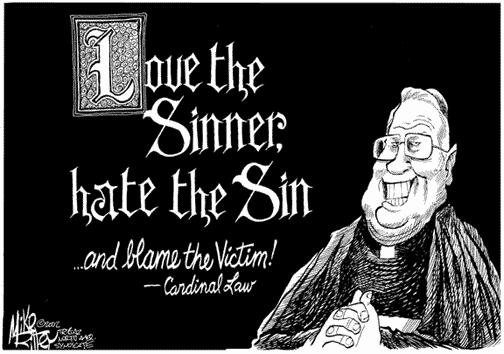
Mike Ritter, arizona tribune