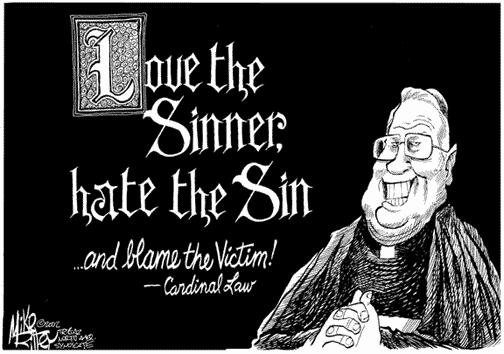
Het ziet er naar uit dat de aartsbisschop van Dublin door Benedictus XVI weliswaar niet tot een van de nieuwe kardinalen benoemd, in ieder geval voldoende integriteit, geloofswaarden of - zo je wilt - hersens heeft om het proces van schoonmaak van die kerk, begonnen met de uitkomsten van de staats-onderzoeken naar het kerkelijk misbruik in de Ierse gestichten en het Ferns rapport, heeft om die Ierse lijn dóór te zetten.
Natuurlijk heeft de man, en die Ierse kerk, alle belang met het zélf naar buiten brengen van de slechte boodschap: jongens (en meisjes!) de shit is nog heel wat erger dan te verwachten viel.....
Wil die kerk nog enige geloofwaardigheid, en dus haar macht, overhouden kan ze natuurlijk maar beter zélf het slechte nieuws brengen.
Daar kun je dus cynisch door worden.
Da's een keuze.
Er is ook de keuze om te gelóven!
Niet in volkomen achterhaalde en dus onzinnige (on)machts-relaties,
maar in de keuze -mogelijkheid van mensen, waarin je kunt geloven dat Geloof
kracht geeft om Leven te behoeden in plaats van macht over het leven van Anderen.
De keuze dat het kán!
Zelfs al betekend dat dan vandaag het nieuws dat het misbruik nog erger was
dan al verwacht werd. Dát is uiteindelijk oud- nieuws. Niks nieuws voor slachtoffers.
De keuze dat het kán is nieuw(s)!
Voor iedereen.
Omdat van kerkelijk (seksueel) misbruik iederéén slachtoffer was.
Abuse probe 'worse than expected'
John Cooney Religious Affairs Specialist Tuesday February 21st 2006
THE Government-appointed Commission of Investigation into allegations of child sexual abuse by priests in the Dublin Archdiocese will be even bigger and its contents more shocking than expected.
Several new complaints of child sexual abuse have been made against already well-known paedophile priests in Dublin since the publication of the Ferns Report last October, the Archbishop of Dublin, Dr Diarmuid Martin, has revealed to the Irish Independent. Dr Martin told this newspaper he was determined there would be no more cover-ups.
He had ordered an extensive trawl nearly two years ago of the Dublin archdiocese's own massive archives in Drumcondra.
This search by two independent assessors has found a number of previously missing files that contain further allegations of molestation of children. While bound by confidentiality not to name those involved, Dr Martin indicated the complaints were against a number of priests whose names were already in the public domain as serious offenders.
The high-profile names of convicted or dead paedophile priests include the notorious marriage annulment advisor, Ivan Payne, now laicised, Crumlin hospital chaplain, Fr Paul McGennis, the defrocked Fr Tony Walsh and the late Fr Noel Reynolds. The complaints are understood to relate to alleged incidents prior to 1990, mainly during the period when Cardinal Desmond Connell was Archbishop of Dublin, but also going into the reigns of his dead predecessors, Kevin McNamara, Dermot Ryan and stretching as far back as the time of Archbishop John Charles McQuaid.
The discovery of the new cases has shown that these paedophile priests had more serial pederast tendencies than was previously recorded. In total, the Garda has examined complaints against between 60 and 70 priests.
Over €5.5m has been paid by the archdiocese in compensation.
The start of the investigation of the four-member Commission under Circuit Court Judge Yvonne Murphy has been stalled for almost three months because of a Government row over the amount of money to be allocated. It is thought this relates to disagreement on the issue between the justice and finance ministers.
When the Commission's terms of reference were announced by the Government last November, it was allocated a budget of €5.7m. Meanwhile, the Commission has begun preliminary work in the probe. It was to report within 18 months and examine a representative sample of complaints against priests from January 1, 1975, to May 1, 2004.
It will also look at how Church authorities and State agencies dealt with complaints.
Cardinal Connell will be called to give evidence to the Commission, which will question him on his handling of complaints when he was archbishop from 1998 until his retirement nearly two years ago.
Archbishop Martin has pledged full co-operation.
It was under Cardinal Connell's stewardship of the country's biggest archdiocese that some of the most appalling cases of priest child-rapes became known.
Last night, in response to the Irish Independent's request for more details about the new files, the Dublin diocese press office:
"The Archdiocese of Dublin has received a number of new allegations of child protection concerns as a result of the ongoing audit of personnel files (of clergy) in the diocese, and following the publication of the Ferns Report.
"The audit, commissioned by Archbishop Martin, following his appointment to Dublin, has involved an extensive trawl of several thousand files in the diocese. That process, carried out by independent assessors, is nearing completion. It has resulted in a number of questions being raised which have required further investigation.
"When this process is completed in the near future, the diocese will, as it has on a regular basis over the past 12 months, give a statement on the information currently available.
"The Archdiocese and its Child Protection Service would again appeal to anyone who has been abused by a priest to come forward to the diocese, the statutory authorities or to any other organisation with whom they feel comfortable speaking to."
© Irish Independent
vrijdag, februari 24, 2006


vrijdag, februari 10, 2006
Ik ben de nonnen en de mensen van Dundalk eeuwig dankbaar

“I am forever grateful to the nuns and the people of Dundalk” Wednesday February 8th 2006 By Margaret Roddy
The Argus
The former St. Joseph’s orphanage in Dundalk and below, Kathleen McShane

Kathleen McShane feels she is a lone voice speaking in the wilderness. At a time when the Commission to Inquire into Child Abuse has been hearing harrowing tales of what it was like for children growing up in Industrial Schools around the country, including St. Joseph’s Orphanage in Dundalk, she cherishes her memory of her years spent in the care of the Sisters of Mercy.
Now sixty-one years of age, Kathleen was just four years old when she placed in St. Joseph’s Orphanage in November 1948 after her mother feel ill with TB which was then rampant in Ireland.
“I went in with my two younger sisters when my mother was dying with TB,” she says. The sisters remained in the orphanage after her mother died the following January, while her father cared for their brother.
“I found in my experience that the nuns did their best for us, really and truly,” she says.
“I never felt any fear, and know of no-one who did.”
“The nuns did their level best for us, their vows which they had to say every night wouldn’t have allowed them to be cruel to us.”
Kathleen (nee Casey) from Hackballscross feels that “people are looking back at the ‘40s and ‘50s and expecting things to be the same then as they are now.”
She points out that times were hard for everyone in those days.
“I sat beside girls at Realt na Mara and knew I had better times than they had,” she says, recalling one girl telling her she was leaving school at fourteen to work in a factory while she was stayed ‘til she was sixteen.
“Remember there was no free education until the ‘60s,” she says. She is grateful for the education she received, pointing out that the girls were also taught household management and cookery.
“We did have to do work, for it was an Industrial School, that’s where the name came from. We had to make our beds and we’d work in the kitchen, dining hall, or dormitory, cleaning and scrubbing and the jobs changed every couple of months.”
“We did have chores to do, but if I had been living at home, I’m sure it would have been the same.”
“We were never starving and I remember Dr McCabe, the Inspector, coming in and telling us that we were in one of the best orphanages in Ireland.”
Kathleen says that the girls were punished if they were bold. “We would get a slap with a stick.
The nun in charge wouldn’t stand for anyone giving cheek to the paid staff or tolerate bullying. She was very fair.” She admits that she got her fair share of punishment as she was a stroppy teenager.
“We grew up there. We went in as children and came out as young ladies, and went through the growing up period of being teenagers.”
She recalls getting into trouble for protesting about the heavy black boots which the girls had to wear in the winter time. “They’d come in boxes and were really boys boots as they’d be sent to all the Industrial Schools.”
Kathleen ended up having to explain her objections about the boots to the Parish Priest, Fr Campbell. He obviously took her views on board, as she recalls him speaking about it at Mass, and after the girls got proper boots donated by the townspeople.
“The people of Dundalk were really good to the orphanage,” she says.
“Supt. McDonough arranged that every orphan got a ‘fairy Godparent’ who had to visit three times a year, at birthdays, Christmas and Easter,” she recalls. “Mrs. McElduff took us to the Lorne Hotel, Nellie Faul brought us to Gyles Quay, and Christy McCoey hired a bus and took us to the zoo every year.
“We went to the Gaelic League Party every year for a Christmas party and we’d get a present from Santa. And on Christmas Day, the nuns would wait on us and we’d have a grand feast.”
“As we got older, we’d go to the nuns summer house in Carlingford, two at a time, and we’d be sent out with our aprons and we’d do chores alongside the nuns. We’d get pocket money and would be able to go to the shop and get ice-cream like anyone else. This was preparing us for moving out.”
“We got to the pictures and the all the musicals, and we did our own musicals and operettas to raise money for the Sunshine home in Port.”
Kahleen says that when the time came for her to leave the orphanage she was given suitcase with proper shop-bought underwear, summer dresses, aprons and stockings.
“We were told that if things didn’t work out right, we could go back.”
She says that many of the girls would continue to go back and visit the nuns over the years.
Those working in England would stay there when they came home on holiday.
Kathleen, like many of the others, also made her way to England, and worked as a nurse, as well as in the hotel business in England. She returned to Dundalk in 1979 and lives on the Dublin Road with her husband and pet dogs.
She is, she says, saddened at the bad publicity which those who ran the orphanage have received in recent times.
“I think the nuns did their best for us. They loved us and still do to this day. We were like their children. They watched us grow up and taught us everything they knew. The nuns worked seven days a week and didn’t get a day off.”
She says that she finds the revelations which have come from the Commission of Inquiry into Child Abuse very difficult to come to terms with.
“I really feel for the nuns, who are now in their twilight years, to have to ask themselves if they did right by us,” she says.
She insists that her memories of her days in the orphanage are happy ones. “I speak as I find things,” she says.
“We got our slaps, yes. There was a lot of bullying but when you get a lot of girls together you’ll get that and it’s still going on as I get anonymous letters and phonecalls because of what I’ve said.”
She says that her views have cost her friendships.
“I was in touch with a lot of girls until the Redress Board was set up but that finished when I spoke out about the good the nuns did.”
“There was a lot of poverty in Ireland at the time we were in the orphanage and we were no better or worse than anyone else. I never had a chip on my shoulder and I knew what my circumstances were. The nuns did their best for us and I feel I have to speak about it.”
She adds that if she had felt she had been abused during her stay in the orphanage, she would have gone back there and confronted the nuns when she had reached adulthood.
“I am forever grateful to the nuns and the people of Dundalk.”
zondag, januari 29, 2006
UK:misbruik en Zwijnstein
Geen herkenning van grenzen en misbruik door voortbestaan Het Geheim: misbruik en Zwijnstein, nu zonder Harry Potter cs.
Eindelijk dan een veroordeling in Engeland van een priester die door zijn (lagere school) leerlingen e op een top- élite school, Ampleforth, destijds al 'pervy Piers' genoemd werd.
Iedereen was van het misbruik (gepleegd tussen '65-'75) op de hoogte, (klik) van de abt -de latere Kardinaal Basil Hume - tot aan de leerlingen aan toe. Desalniettemin kon de man 9 jaar lang zijn gang gaan. Tot hij uiteindelijk na klachten in '75 gestopt werd op deze school om -1978 - overgeplaatst, vervolgens op de nieuwe school, waar hij tot '89 werkzaam is, opnieuw zijn gang te kunnen gaan.
Zelf zegt de man dat hij dacht "oude tradities" voort te zetten; zich nooit gerealiseerd te hebben dat hij zijn slachtoffers kwaad berokkende......
En dat zou, hoe krankzinnig het ook moge lijken inderdaad wel eens de waarheid kunnen zijn geweest. Hij is er, behalve in de openheid van zijn uitspraken,
in die visie ieder geval zeker geen uitzonder in. Het privilege van de geperveteerde macht: criminaliteit die als "normaal", het hoort erbij, gezien wordt.
De politie heeft nogal wat moeite gehad met het onderzoek: de man was kennelijk niet de enige die problemen had bij het door krijgen dat dergelijke 'oude tradities" er niet waren om voortgezet te worden, maar crimineel gedrag is. Ook de leerlingen waren nauwelijks bereid hun mond open te doen.
3,5 duizend verklaringen had zijn advocaat, van oud leerlingen van "pervy Piers":
geweldige vent....
Het voort laten bestaan van Het Geheim betekent immers het niet stellen van grenzen.
Van de zelfde school , Workington, waarheen deze priester werd overgeplaatst zijn eerder mensen veroordeeld. Een van hen , Gregory Carrol, kreeg 1 jaar strafvermindering. Zelfde laken een soutane: ook hij kwam van Ampleforth en werd overgeplaatst en kon vervolgens in Workington zijn gang weer gaan. Inmiddels lopen er nieuwe zaken tegen hem. Van slachtoffers welke eindelijk ook hebben besloten de grens te moeten trekken.
Het zou wel eens het verhaal van de komende jaren kunnen worden.
hier de berichtgeving van The Times
Pervert monk jailed after a decade of abusing young boys
Mark Branagan (bron: klik)
Eindelijk dan een veroordeling in Engeland van een priester die door zijn (lagere school) leerlingen e op een top- élite school, Ampleforth, destijds al 'pervy Piers' genoemd werd.
Iedereen was van het misbruik (gepleegd tussen '65-'75) op de hoogte, (klik) van de abt -de latere Kardinaal Basil Hume - tot aan de leerlingen aan toe. Desalniettemin kon de man 9 jaar lang zijn gang gaan. Tot hij uiteindelijk na klachten in '75 gestopt werd op deze school om -1978 - overgeplaatst, vervolgens op de nieuwe school, waar hij tot '89 werkzaam is, opnieuw zijn gang te kunnen gaan.
Zelf zegt de man dat hij dacht "oude tradities" voort te zetten; zich nooit gerealiseerd te hebben dat hij zijn slachtoffers kwaad berokkende......
En dat zou, hoe krankzinnig het ook moge lijken inderdaad wel eens de waarheid kunnen zijn geweest. Hij is er, behalve in de openheid van zijn uitspraken,
in die visie ieder geval zeker geen uitzonder in. Het privilege van de geperveteerde macht: criminaliteit die als "normaal", het hoort erbij, gezien wordt.
De politie heeft nogal wat moeite gehad met het onderzoek: de man was kennelijk niet de enige die problemen had bij het door krijgen dat dergelijke 'oude tradities" er niet waren om voortgezet te worden, maar crimineel gedrag is. Ook de leerlingen waren nauwelijks bereid hun mond open te doen.
3,5 duizend verklaringen had zijn advocaat, van oud leerlingen van "pervy Piers":
geweldige vent....
Het voort laten bestaan van Het Geheim betekent immers het niet stellen van grenzen.
Van de zelfde school , Workington, waarheen deze priester werd overgeplaatst zijn eerder mensen veroordeeld. Een van hen , Gregory Carrol, kreeg 1 jaar strafvermindering. Zelfde laken een soutane: ook hij kwam van Ampleforth en werd overgeplaatst en kon vervolgens in Workington zijn gang weer gaan. Inmiddels lopen er nieuwe zaken tegen hem. Van slachtoffers welke eindelijk ook hebben besloten de grens te moeten trekken.
Het zou wel eens het verhaal van de komende jaren kunnen worden.
hier de berichtgeving van The Times
Pervert monk jailed after a decade of abusing young boys
Mark Branagan (bron: klik)
27 January 2006A MONK who abused 15 boys as young as eight over a
decade while a master at a leading Roman Catholic boarding school has been
jailed for two years.
Piers Grant-Ferris, 72, son of Tory Peer Lord Harvington, was placed on the sex offenders' register for 10 years and banned from working with children indefinitely.
His conviction yesterday at Leeds Crown Court ends a two-year investigation into abuse at Ampleforth College, in North Yorkshire, following a decision by former Abbot Basil Hume not to involve police in a complaint against Grant-Ferris in 1975.Grant-Ferris worked at Ampleforth's former prep school, Gilling Castle.
The court heard that a number of the boys who had been the subject of
the 20 indecency offences he admitted between 1965 and 1975 were affected in
later life.One victim, who also suffered more serious abuse by a member of the
community now dead, complained that his treatment had "wrecked his life".Judge
Ian Dobkin said: "So we do know what you did was dire in many respects. What you did remains as serious now as then."Earlier James Goss QC, prosecuting, said Grant-Ferris would beat the children on their bottoms with his bare hands and take their temperatures rectally.
Describing one ordeal, he said: "Terrified, the boy pleaded and begged him to stop but was ignored." He said the abuse continued into the boy's second year and he suffered a breakdown aged 19.Another boy said: "The pain was excruciating and seemed to go on for a long
time."
Patrick Cossgrove QC, defending, linked the offences to the "emotional
abandonment" that Grant-Ferris suffered as a child when he was only allowed to
see his parents socially once a week after Sunday lunch. He denied his client
was a predatory offender.
Abbot of Ampleforth Father Cuthbert Madden
said:"The offences were a serious betrayal of his responsibilities as a monk,
teacher and adult member of society."Published on 27/01/2006
A FORMER Workington priest jailed for sexually abusing young boys will be re-interviewed by town detectives following a new complaint.The news comes less than two weeks after Father Gregory Carroll, 66, had his four-year sentence shortened by a year by the Criminal Appeal Court.He was sentenced in September for abusing 10 boys under the age of 15 while he was teaching at the junior house of Ampleforth College in North Yorkshire from 1973 to 1983.
For the first time, allegations are under investigation that he molested a boy in Workington, where he was sent to from Ampleforth by church authorities, which had removed him from teaching.
The man, who lives in the Home Counties, claims he was between eight and 10 when the abuse took place at various locations, including our Lady and St Michael’s RC Church and Carroll’s bedroom.
He said: “It’s taken a long time for me to come forward and there were lots of reasons for that. I am pleased that I have. It’s a huge weight off my mind and everyone has ben so supportive from the police to my closest family and friends.
“When I found out his sentence had been cut by 12 months, it made me feel sick. He was put in a position of trust and he abused that position on a number of occasions and he should be punished for it.
“Three years is not enough for what he put them through.“
If he is a holy man like he has preached for years, then he should be a man and admit it all and do his time.
“It also angers me that a senior official at Ampleforth knew about what he was capable of and still sent him to Workington. This official does not deserve to be called a holy man and should have to answer to me, my family and the people of Workington.”
The man, who still has family in Workington, has spoken at length to detectives in his home area. They have now passed the investigation on to Workington.
The head of West Cumbria CID, Detective Inspector Andy Carter, said this week: “We are in receipt of a complaint and a full investigation is under way.
“At some stage, we need to speak to Gregory Carroll but to comment further on the direction of the investigation would be counter productive.”
The Ampleforth offences were effectively swept under the carpet, to allow Carroll to quietly move out of teaching and into the priesthood in Workington, where he worked among an unsuspecting community from 1987 until he retired in 2001.
His Ampleforth offences and those of another former Ampleforth teacher, Fr Piers Grant-Ferris, came to light when North Yorkshire Police began investigations in 2004.
Grant Ferris had also been moved to the priesthood in Workington after he was identified as one of a nest of paedophiles on the Ampleforth staff who preyed on boys for nine years.He was known to the pupils under his care as ‘pervy Piers’ - yet in Workington he was appointed chaplain to St Joseph’s RC High School, where he took confessions from children in private. He was priest here between 1975 and 1989.
Two years jail for pervert priest
Published on 27/01/2006
Piers Grant-Ferris
A FORMER Workington priest has been jailed for two years after he admitted 20 counts of indecent assault on 15 young boys at a prep school.Father Piers Grant-Ferris, 72, assaulted boys under 12 when he was a teacher at Gilling Castle Preparatory School in Ampleforth, North Yorkshire, between 1966 and 1975. He was sent to serve in Workington three years later in 1978 despite admitting to Ampleforth College that he had abused young boys.
The college admitted it was aware of his behaviour 30 years ago but the matter was not reported to police and Grant-Ferris was sent to Workington to fill a post as an assistant priest. He remained there until 1989.
Leeds Crown Court heard yesterday that he was arrested and charged after a police probe into Ampleforth Abbey, which is attached to the country’s leading independent Roman Catholic School, Ampleforth College.Gilling Castle Prep School was used as a feeder school by the college.
The offences occurred while Grant-Ferris, who the children saw as “a bit of a crackpot”, was a second year form master at the school.Grant-Ferris punished the boys by smacking and fondling them and some of his young victims thought there were occasions when he gained sexual gratification from the punishments, the court heard.
The assaults took place in various places around the school, including the bathroom, the defendant’s bedroom and in woods nearby.
Mr Goss said one boy described Grant-Ferris’s assaults as terrifying and humiliating while another said the defendant had wrecked his life.Another victim said he was left with a feeling of terrible confusion and bewilderment and another boy said he had been left with repressed sexual urges and had experienced difficulties in his marriage.
Patrick Cosgrove QC, defending, said he had received 3,500 letters of support for Grant-Ferris, including one from a victim of the abuse which said the monk had helped him.Mr Cosgrove said there was no way of knowing whether Grant-Ferris had caused all the victims’ problems as at least one of them had suffered much more serious abuse by a member of lay staff at the school who has since died.
Mr Cosgrove said that in his client’s autobiography, Grant-Ferris wrote he suffered severe emotional deprivation in his early years and was indecently assaulted in the same way as he indecently assaulted the boys under his supervision.He thought he was carrying on a timeless set of traditions until the outside world intervened.
In Grant-Ferris’s autobiography, he wrote: “I never had the slightest intent to cause any harm to any of my pupils. I simply failed to understand that my behaviour was so serious and so upsetting to the victims.“I’m very sorry for the harm I have caused to a number of boys in my care and trust.”
Judge Ian Dobkin also ordered Grant-Ferris to be registered on the sex offenders register for 10 years and banned him from working with children until further notice.Seven further offences, which Grant-Ferris denied, will remain on file.

dinsdag, januari 24, 2006
23-1-06 Het Legioen, Mexico de paus en nog steeds Maciel I punt.nl
With elite backing, Catholic order has pull in Mexico
Monday, January 23, 2006
By Jose de Cordoba, The Wall Street Journal
MEXICO CITY -- Two years ago, a handful of Latin American billionaires and some of the world's top financiers gathered at New York's Plaza Hotel. They were honoring Mexican plutocrat Carlos Slim and raising money for schools for poor children run by the Legion of Christ, a fast-growing conservative Roman Catholic order.
Among those giving speeches at the black-tie gala were the Rev. Marcial Maciel, the 85-year-old Mexican founder of the Legion, and Citigroup Inc. Chairman Sanford Weill. Within hours, the diverse group of 500 well-wishers raised $725,000.
The Legion was in its element. Founded in 1941, the order concentrates on ministering to the wealthy and powerful in the belief that by evangelizing society's leaders, the beneficial impact on society is multiplied. Like the Jesuits who centuries ago whispered in the ear of Europe's princes, the Legion's priests today are the confessors and chaplains to some of the most powerful businessmen in Latin America.
"The soul of a trash collector is as important as the soul of Carlos Slim, but if Slim is converted, think of the influence and power for good he would wield," says Luanne Zurlo, a former Goldman Sachs securities analyst who organized the benefit. Mr. Slim, Latin America's richest man with a fortune estimated at $24 billion, says he's not a highly devout Catholic but is helping the Legion create 50 low-cost universities in Latin America.
The Legion has become an important player in promoting the Vatican's social agenda and defending Catholicism's Latin American heartland from inroads made by evangelical Protestant groups. When the church was struggling to find priests in Germany, the Legion recruited German-speaking seminarians from Brazil to fill the gap. In Rome and Mexico City, Legion universities offer advanced degrees in bioethics that stress the limits morality should put on science.
The Legion's critics charge that its focus on the wealthy reinforces the sharp class divides that have long held Latin America back socially and economically. They say the Legion fosters intolerance and social climbing rather than devotion to Christ's gospel. Some in Mexico, instead of referring to the order's followers as Legionnaires of Christ, call them the "Millionaires of Christ."
More troubling for the Legion, Father Maciel, the order's founder, has been dogged for nearly a decade by widely publicized accusations that he sexually molested at least eight teenage seminarians from the 1940s through the early 1960s. Father Maciel denies the accusations. Many Catholic activists, angry with the church over cover-ups in priest sex-abuse cases, believe the Vatican has protected Father Maciel because of the Legion's reach and power.
The Legion operates in some 20 countries, including the U.S., Chile, Spain, Brazil and Ireland, but its influence is greatest in Mexico. Here it runs the country's fastest-growing network of Catholic schools for the well-to-do, and each spring mobilizes 20,000 volunteers to travel to remote towns and urge wavering Catholics to keep the faith.
Catholic orders such as the Legion, the Franciscans and the Jesuits are largely independent of the church's diocesan governing structure and answer to their own directors based in Rome. To be active in a given diocese, however, they must obtain permission from the local bishop and are subject to his authority.
Even as the church struggles to recruit priests, the Legion's nine seminaries have turned out 650 ordained priests, many of whom come from wealthy families. That is up from 210 priests in 1990. The Legion's ranks also include about 2,500 seminarians studying to be priests and 1,000 "consecrated women" -- lay nuns who pledge to remain chaste and poor -- as well as some 65,000 lay supporters, in a group known as Regnum Christi.
Charitable works make up about $50 million of the Legion's $650 million yearly budget. It operates a network of 21 Mano Amiga schools for some 13,000 poor children, whose parents pay about $20 a month in tuition. Regnum Christi members have started many of Mexico's leading charitable efforts, such as a program through which supermarket customers donate money for a national food bank. In El Salvador and Mexico, the order has built small towns for disaster victims complete with schools, churches and medical facilities.
"The Legion is the only Mexican multinational in the world of religion," says Dionisio Garza Medina, chairman of Alfa, a large conglomerate in Monterrey, Mexico, and brother of the Legion's vicar general, the Rev. Luis Garza Medina. A sister of the two men is a consecrated woman.
Controversy often follows the Legion as it expands into new countries. Two years ago, Legion priests were barred from working in the archdiocese of St. Paul and Minneapolis after St. Paul Archbishop Harry Flynn said he worried that the Legion was building a "parallel church" behind the backs of local priests.
In 2004, two Baton Rouge, La., Catholic schools warned parents about the Legion's "questionable methods." Members of Regnum Christi paid for Baton Rouge students to fly to Los Angeles for a screening of Mel Gibson's "The Passion of the Christ" without notifying the schools. A spokesman for the Legion says the incidents were "misunderstandings" caused by the Legion's relative youth and overzealous Regnum Christi members.
The Legion was a favorite of Pope John Paul II, who liked its mix of religious fervor and conservative doctrine. Over the years, the late pontiff often praised Father Maciel's work. "John Paul used to talk about the Legion all the time, holding them up as examples while reading us the riot act," says the Rev. Vincent O'Keefe, a former deputy director of the Jesuits, a prominent order which fell into papal disfavor due to the liberal beliefs of some of its members.
Soon after John Paul II ascended to the papal throne in 1978, he made it known he wanted to become the first pontiff to visit Mexico, the world's second-biggest Catholic country after Brazil but one whose government was stridently anticlerical. Father Maciel wrangled an invitation by appealing to the then-president's devout mother and sisters, according to papal biographer George Weigel. That trip eventually led Mexico to establish diplomatic relations with the Vatican. In recent years, Father Maciel arranged a private audience with John Paul for President Vicente Fox's first wife, who worked in Rome for the Legion for a year.
Mr. Maciel today writes warm letters to Marta Fox, the president's powerful second wife, according to two friends of Marta Fox. One friend says the letters address her as "Mi muy querida Martita," or "My very dear Martita." Marta Fox's office didn't respond to a request for comment.
The Legion's close ties with the elite are most evident in Monterrey, a city of four million that has long been dominated by businessmen in the so-called Group of Ten. For decades, Jesuits played a major role educating the children of the wealthy there, but the order veered leftward and was expelled in 1968 by the local bishop, who accused Jesuits of backing a strike at a local university. Since then,the Legion has set the social and intellectual tone for Monterrey's wealthy through a web of schools, clubs and charitable organizations.
Many of Monterrey's entrepreneurs and executives send their children to single-sex Legion schools where they make connections that last a lifetime. "They are very good educators," says Mr. Slim. "My children studied with them."
Middle-class parents struggle to pay the high tuitions of nearly $900 a month, convinced that their children will benefit from school ties, says David Martinez, a former member of Regnum Christi who studied in Legion schools and is now managing director of the New York-based hedge fund Fintech.
At the Legion's after-school youth clubs, where the catechism is mixed with soccer and games, "vocation hunters" recruit candidates to become priests or consecrated women. As a first step, teenagers are encouraged to donate a year to the Catholic Church by volunteering for the Legion's world-wide operations. Around Monterrey, Legion priests dress in smart double-breasted black suits and sport cufflinks along with a clerical collar. Consecrated women wear ankle-length dresses.
In October, Monterrey's establishment turned out to see a newly ordained priest, the Rev. Benjamin Clariond -- whose father and uncle are former state governors -- celebrate his first mass in the city. The event was amply covered in the society pages of Monterrey's leading newspaper, which put 64 photographs of the event on its Web site.
Like the Clarionds or the Garza Medinas, almost every prominent clan in Monterrey has a son who is a Legion priest or a daughter who is a consecrated woman. Talk at dinner parties of the "movement" or the "kingdom," referring to Regnum Christi, is common. Mr. Martinez, the hedge fund manager, says Father Maciel is "worshipped" by Mexico's upper class because for 60 years he has made Mexico's rich feel as if "Christ loves them more than other people, and is using them as part of a divine plan."
The Legion's influence extends to the workplace, too, where many companies pay for Legion evangelists to lead weekly discussions on Catholic values. At Grupo Novem S.A. de C.V., a water-systems company owned by a family of Legion supporters, employees are urged to attend one-hour seminars on such subjects as marriage and human cloning. Message boards in the building extol the "Moral Value of the Month."
The order's critics say the Legion creates an oppressive climate for those who don't follow orthodox Catholic teaching. Jose Zumaya, a psychiatrist who counsels couples in Monterrey, says some of his upper-class clients suffer from what he calls "Legionary syndrome," referring mainly to a dread of social ostracism if they get divorced. "They feel their children will have to leave school, they will lose all their friends, and there will be consequences for the husband at work as well," says Dr. Zumaya.
In December 2004, the University of Monterrey, a private Catholic institution that isn't affiliated with the Legion, fired five professors and a dean, most of whom taught women's studies. The fired dean blamed Mr. Garza Medina, a strong Legion supporter who in addition to his business interests serves as chairman of the university's board of trustees. Vice Rector Victor Zuniga denies that the chairman played a role and says the dean was fired for poor performance. The Legion says it had nothing to do with the firings. A spokesman for Mr. Garza Medina says the university had no links to the Legion of Christ, and also cites poor performance as the reason for the dean's firing.
Mr. Zuniga says a theology professor was fired around the same time because many parents disliked her questioning such topics as papal infallibility. He defends the decision, saying such questioning was akin to challenging President Bush's patriotism at a Texas university after the terrorist attacks of Sept. 11, 2001.
The Legion points out that it serves more than Latin America's wealthy bastions. One day last summer, in San Francisco, a sweltering thatched-roof hamlet of Maya Indians in the southern Mexican state of Quintana Roo, premedical students from the Legion's Anahuac University, under the direction of a young doctor, examined a long line of children and dispensed medicines. Other college volunteers played with dozens of barefoot children and taught catechism lessons.
"How many sacraments are there?" asked Pablo Orvananos, a bearded tourism major. "Seven," answered a little girl, getting a lollipop as a prize.
When he started the Legion in 1941, Father Maciel was an ambitious 20-year old, the scion of provincial Catholic aristocracy. Three of his uncles were bishops and a fourth led an army of peasants against the Mexican government during the 1926 Cristero War, a struggle over state control of the Catholic Church that raged on and off until 1941 and cost some 250,000 lives. According to the Legion's official history, Pope Pius XII ordered Father Maciel in 1946 to recruit Latin American leaders and said the congregation should be like an evangelizing "army in battle formation."
Constantly traveling, Father Maciel proved to be adroit at raising money from rich Mexicans, in particular Flora Barragan de Garza, the Monterrey widow of one of the wealthiest men in Mexico at the time. One technique: Seminarians would write affectionate letters detailing their financial needs to Mrs. Garza, whom they addressed as their "mother." Mrs. Garza responded generously. She bought a Mercedes-Benz for Father Maciel and land in Mexico City that the Legion used to build its first school, Instituto Cumbres, or "The Heights," in 1952.
From 1956 to 1958, Vatican investigators relieved Father Maciel of his position while they looked into a range of charges about his conduct, although allegations of sexual abuse weren't raised at that time. Absolved by that inquiry, Father Maciel regained command of the Legion in 1959.
In 1997, eight men went public with complaints, made previously through informal church channels to the Vatican,that Father Maciel had abused them when they were seminarians in the 1940s and 1950s. The Vatican unit that investigates such charges -- then under the direction of Cardinal Joseph Ratzinger -- quickly tabled a formal complaint, filed with church authorities in 1998. In Mexico, leading media companies also ignored the allegations. When a small cable-television station ran a documentary about them, leading businessmen organized an advertiser boycott that almost drove the station into bankruptcy.
The investigation into Father Maciel seemed dead until last year, when it emerged that Cardinal Ratzinger had revived the probe in the waning days of Pope John Paul II's reign. In January 2005, soon after the probe began, Father Maciel resigned as head of the Legion, citing his advanced age. In April, a top Vatican investigator went to New York and Mexico to interview Father Maciel's accusers. The same month Cardinal Ratzinger became Pope Benedict XVI.
Today, the investigation remains open. The Legion is under the direction of the Rev. Alvaro Corcuera, a 47-year-old Mexican, who says he'll continue to govern "in the strictest fidelity" to the spirit of the founder.
The accusations against Father Maciel appear not to have damped the fervor of the Legion's well-to-do followers. In November, some 10,000 Regnum Christi members gathered under a huge tent in Guadalajara, Mexico, where they gave Father Corcuera a rock-star's welcome. As a guitar-strumming Legion priest sang a song honoring Father Maciel, Father Corcuera praised the founder's mother, Mama Maurita, whom the Legion is lobbying to be made a saint.
Monday, January 23, 2006
By Jose de Cordoba, The Wall Street Journal
MEXICO CITY -- Two years ago, a handful of Latin American billionaires and some of the world's top financiers gathered at New York's Plaza Hotel. They were honoring Mexican plutocrat Carlos Slim and raising money for schools for poor children run by the Legion of Christ, a fast-growing conservative Roman Catholic order.
Among those giving speeches at the black-tie gala were the Rev. Marcial Maciel, the 85-year-old Mexican founder of the Legion, and Citigroup Inc. Chairman Sanford Weill. Within hours, the diverse group of 500 well-wishers raised $725,000.
The Legion was in its element. Founded in 1941, the order concentrates on ministering to the wealthy and powerful in the belief that by evangelizing society's leaders, the beneficial impact on society is multiplied. Like the Jesuits who centuries ago whispered in the ear of Europe's princes, the Legion's priests today are the confessors and chaplains to some of the most powerful businessmen in Latin America.
"The soul of a trash collector is as important as the soul of Carlos Slim, but if Slim is converted, think of the influence and power for good he would wield," says Luanne Zurlo, a former Goldman Sachs securities analyst who organized the benefit. Mr. Slim, Latin America's richest man with a fortune estimated at $24 billion, says he's not a highly devout Catholic but is helping the Legion create 50 low-cost universities in Latin America.
The Legion has become an important player in promoting the Vatican's social agenda and defending Catholicism's Latin American heartland from inroads made by evangelical Protestant groups. When the church was struggling to find priests in Germany, the Legion recruited German-speaking seminarians from Brazil to fill the gap. In Rome and Mexico City, Legion universities offer advanced degrees in bioethics that stress the limits morality should put on science.
The Legion's critics charge that its focus on the wealthy reinforces the sharp class divides that have long held Latin America back socially and economically. They say the Legion fosters intolerance and social climbing rather than devotion to Christ's gospel. Some in Mexico, instead of referring to the order's followers as Legionnaires of Christ, call them the "Millionaires of Christ."
More troubling for the Legion, Father Maciel, the order's founder, has been dogged for nearly a decade by widely publicized accusations that he sexually molested at least eight teenage seminarians from the 1940s through the early 1960s. Father Maciel denies the accusations. Many Catholic activists, angry with the church over cover-ups in priest sex-abuse cases, believe the Vatican has protected Father Maciel because of the Legion's reach and power.
The Legion operates in some 20 countries, including the U.S., Chile, Spain, Brazil and Ireland, but its influence is greatest in Mexico. Here it runs the country's fastest-growing network of Catholic schools for the well-to-do, and each spring mobilizes 20,000 volunteers to travel to remote towns and urge wavering Catholics to keep the faith.
Catholic orders such as the Legion, the Franciscans and the Jesuits are largely independent of the church's diocesan governing structure and answer to their own directors based in Rome. To be active in a given diocese, however, they must obtain permission from the local bishop and are subject to his authority.
Even as the church struggles to recruit priests, the Legion's nine seminaries have turned out 650 ordained priests, many of whom come from wealthy families. That is up from 210 priests in 1990. The Legion's ranks also include about 2,500 seminarians studying to be priests and 1,000 "consecrated women" -- lay nuns who pledge to remain chaste and poor -- as well as some 65,000 lay supporters, in a group known as Regnum Christi.
Charitable works make up about $50 million of the Legion's $650 million yearly budget. It operates a network of 21 Mano Amiga schools for some 13,000 poor children, whose parents pay about $20 a month in tuition. Regnum Christi members have started many of Mexico's leading charitable efforts, such as a program through which supermarket customers donate money for a national food bank. In El Salvador and Mexico, the order has built small towns for disaster victims complete with schools, churches and medical facilities.
"The Legion is the only Mexican multinational in the world of religion," says Dionisio Garza Medina, chairman of Alfa, a large conglomerate in Monterrey, Mexico, and brother of the Legion's vicar general, the Rev. Luis Garza Medina. A sister of the two men is a consecrated woman.
Controversy often follows the Legion as it expands into new countries. Two years ago, Legion priests were barred from working in the archdiocese of St. Paul and Minneapolis after St. Paul Archbishop Harry Flynn said he worried that the Legion was building a "parallel church" behind the backs of local priests.
In 2004, two Baton Rouge, La., Catholic schools warned parents about the Legion's "questionable methods." Members of Regnum Christi paid for Baton Rouge students to fly to Los Angeles for a screening of Mel Gibson's "The Passion of the Christ" without notifying the schools. A spokesman for the Legion says the incidents were "misunderstandings" caused by the Legion's relative youth and overzealous Regnum Christi members.
The Legion was a favorite of Pope John Paul II, who liked its mix of religious fervor and conservative doctrine. Over the years, the late pontiff often praised Father Maciel's work. "John Paul used to talk about the Legion all the time, holding them up as examples while reading us the riot act," says the Rev. Vincent O'Keefe, a former deputy director of the Jesuits, a prominent order which fell into papal disfavor due to the liberal beliefs of some of its members.
Soon after John Paul II ascended to the papal throne in 1978, he made it known he wanted to become the first pontiff to visit Mexico, the world's second-biggest Catholic country after Brazil but one whose government was stridently anticlerical. Father Maciel wrangled an invitation by appealing to the then-president's devout mother and sisters, according to papal biographer George Weigel. That trip eventually led Mexico to establish diplomatic relations with the Vatican. In recent years, Father Maciel arranged a private audience with John Paul for President Vicente Fox's first wife, who worked in Rome for the Legion for a year.
Mr. Maciel today writes warm letters to Marta Fox, the president's powerful second wife, according to two friends of Marta Fox. One friend says the letters address her as "Mi muy querida Martita," or "My very dear Martita." Marta Fox's office didn't respond to a request for comment.
The Legion's close ties with the elite are most evident in Monterrey, a city of four million that has long been dominated by businessmen in the so-called Group of Ten. For decades, Jesuits played a major role educating the children of the wealthy there, but the order veered leftward and was expelled in 1968 by the local bishop, who accused Jesuits of backing a strike at a local university. Since then,the Legion has set the social and intellectual tone for Monterrey's wealthy through a web of schools, clubs and charitable organizations.
Many of Monterrey's entrepreneurs and executives send their children to single-sex Legion schools where they make connections that last a lifetime. "They are very good educators," says Mr. Slim. "My children studied with them."
Middle-class parents struggle to pay the high tuitions of nearly $900 a month, convinced that their children will benefit from school ties, says David Martinez, a former member of Regnum Christi who studied in Legion schools and is now managing director of the New York-based hedge fund Fintech.
At the Legion's after-school youth clubs, where the catechism is mixed with soccer and games, "vocation hunters" recruit candidates to become priests or consecrated women. As a first step, teenagers are encouraged to donate a year to the Catholic Church by volunteering for the Legion's world-wide operations. Around Monterrey, Legion priests dress in smart double-breasted black suits and sport cufflinks along with a clerical collar. Consecrated women wear ankle-length dresses.
In October, Monterrey's establishment turned out to see a newly ordained priest, the Rev. Benjamin Clariond -- whose father and uncle are former state governors -- celebrate his first mass in the city. The event was amply covered in the society pages of Monterrey's leading newspaper, which put 64 photographs of the event on its Web site.
Like the Clarionds or the Garza Medinas, almost every prominent clan in Monterrey has a son who is a Legion priest or a daughter who is a consecrated woman. Talk at dinner parties of the "movement" or the "kingdom," referring to Regnum Christi, is common. Mr. Martinez, the hedge fund manager, says Father Maciel is "worshipped" by Mexico's upper class because for 60 years he has made Mexico's rich feel as if "Christ loves them more than other people, and is using them as part of a divine plan."
The Legion's influence extends to the workplace, too, where many companies pay for Legion evangelists to lead weekly discussions on Catholic values. At Grupo Novem S.A. de C.V., a water-systems company owned by a family of Legion supporters, employees are urged to attend one-hour seminars on such subjects as marriage and human cloning. Message boards in the building extol the "Moral Value of the Month."
The order's critics say the Legion creates an oppressive climate for those who don't follow orthodox Catholic teaching. Jose Zumaya, a psychiatrist who counsels couples in Monterrey, says some of his upper-class clients suffer from what he calls "Legionary syndrome," referring mainly to a dread of social ostracism if they get divorced. "They feel their children will have to leave school, they will lose all their friends, and there will be consequences for the husband at work as well," says Dr. Zumaya.
In December 2004, the University of Monterrey, a private Catholic institution that isn't affiliated with the Legion, fired five professors and a dean, most of whom taught women's studies. The fired dean blamed Mr. Garza Medina, a strong Legion supporter who in addition to his business interests serves as chairman of the university's board of trustees. Vice Rector Victor Zuniga denies that the chairman played a role and says the dean was fired for poor performance. The Legion says it had nothing to do with the firings. A spokesman for Mr. Garza Medina says the university had no links to the Legion of Christ, and also cites poor performance as the reason for the dean's firing.
Mr. Zuniga says a theology professor was fired around the same time because many parents disliked her questioning such topics as papal infallibility. He defends the decision, saying such questioning was akin to challenging President Bush's patriotism at a Texas university after the terrorist attacks of Sept. 11, 2001.
The Legion points out that it serves more than Latin America's wealthy bastions. One day last summer, in San Francisco, a sweltering thatched-roof hamlet of Maya Indians in the southern Mexican state of Quintana Roo, premedical students from the Legion's Anahuac University, under the direction of a young doctor, examined a long line of children and dispensed medicines. Other college volunteers played with dozens of barefoot children and taught catechism lessons.
"How many sacraments are there?" asked Pablo Orvananos, a bearded tourism major. "Seven," answered a little girl, getting a lollipop as a prize.
When he started the Legion in 1941, Father Maciel was an ambitious 20-year old, the scion of provincial Catholic aristocracy. Three of his uncles were bishops and a fourth led an army of peasants against the Mexican government during the 1926 Cristero War, a struggle over state control of the Catholic Church that raged on and off until 1941 and cost some 250,000 lives. According to the Legion's official history, Pope Pius XII ordered Father Maciel in 1946 to recruit Latin American leaders and said the congregation should be like an evangelizing "army in battle formation."
Constantly traveling, Father Maciel proved to be adroit at raising money from rich Mexicans, in particular Flora Barragan de Garza, the Monterrey widow of one of the wealthiest men in Mexico at the time. One technique: Seminarians would write affectionate letters detailing their financial needs to Mrs. Garza, whom they addressed as their "mother." Mrs. Garza responded generously. She bought a Mercedes-Benz for Father Maciel and land in Mexico City that the Legion used to build its first school, Instituto Cumbres, or "The Heights," in 1952.
From 1956 to 1958, Vatican investigators relieved Father Maciel of his position while they looked into a range of charges about his conduct, although allegations of sexual abuse weren't raised at that time. Absolved by that inquiry, Father Maciel regained command of the Legion in 1959.
In 1997, eight men went public with complaints, made previously through informal church channels to the Vatican,that Father Maciel had abused them when they were seminarians in the 1940s and 1950s. The Vatican unit that investigates such charges -- then under the direction of Cardinal Joseph Ratzinger -- quickly tabled a formal complaint, filed with church authorities in 1998. In Mexico, leading media companies also ignored the allegations. When a small cable-television station ran a documentary about them, leading businessmen organized an advertiser boycott that almost drove the station into bankruptcy.
The investigation into Father Maciel seemed dead until last year, when it emerged that Cardinal Ratzinger had revived the probe in the waning days of Pope John Paul II's reign. In January 2005, soon after the probe began, Father Maciel resigned as head of the Legion, citing his advanced age. In April, a top Vatican investigator went to New York and Mexico to interview Father Maciel's accusers. The same month Cardinal Ratzinger became Pope Benedict XVI.
Today, the investigation remains open. The Legion is under the direction of the Rev. Alvaro Corcuera, a 47-year-old Mexican, who says he'll continue to govern "in the strictest fidelity" to the spirit of the founder.
The accusations against Father Maciel appear not to have damped the fervor of the Legion's well-to-do followers. In November, some 10,000 Regnum Christi members gathered under a huge tent in Guadalajara, Mexico, where they gave Father Corcuera a rock-star's welcome. As a guitar-strumming Legion priest sang a song honoring Father Maciel, Father Corcuera praised the founder's mother, Mama Maurita, whom the Legion is lobbying to be made a saint.
maandag, januari 09, 2006
‘Sekscrisis heilzaam voor Amerikaanse kerk’
Tertio sprak met voorzitter Amerikaanse bisschoppenconferentie
Geplaatst op 6/1 '06 om 1:30u
Door Theo Borgermans (Bron: Tertio)
WASHINGTON (RKnieuws.net) - William Skylstad, de voorzitter van de Amerikaanse bisschoppenconferentie, is bisschop van een failliet bisdom. Toch is hij ervan overtuigd dat de seksschandalen die zijn bisdom ruďneerden, de katholieke kerk uiteindelijk ten goede zullen komen.
De voorzitter van de machtige Ameri-kaanse bisschoppenconferentie, William Skylstad, is thuis een van de armste bisschoppen van de Verenigde Staten (VS). Zijn bisdom Spokane, in de noordwestelijke staat Washington, is een van de drie Amerikaanse bisdommen die het faillissement hebben aangevraagd, nadat het torenhoge schadevergoedingen moest uitbetalen aan de slachtoffers van seksueel misbruik door een diocesaan priester.
Skylstad overweegt nu het bisschopshuis te verkopen. "Ik huur wel een appartementje,’’ zei hij aan Tertio, toen hij onlangs in ons land op bezoek was. Meer nog: "Ik ben ervan overtuigd dat de crisis die in 2002 losbrak, toen allerlei schandalen van seksueel misbruik aan het licht kwamen, uiteindelijk heilzaam zal zijn voor de kerk in de VS.’’
Volgens sommigen is de recente Vaticaanse instructie over homoseksuelen en priesterschap een rechtstreeks gevolg van het seksueel misbruik in de Amerikaanse kerk. Bent u het daarmee eens?
"Het klopt dat er veel is veranderd in de screening van kandidaat-priesters. Vroeger volstonden bij wijze van spreken een gezondheidscertificaat van je huisarts en een aanbeveling van je pastoor. Vandaag wordt van een kandidaat-priester geëist dat hij met iedereen goede pastorale relaties kan aanknopen. Daarvoor moet hij goed in zijn vel zitten. Het is de ambitie van de kerk om goede priesters te vormen en daar waren we soms te laks in.
De Vaticaanse instructie is vijf jaar lang voorbereid. Toch staat er niets radicaal nieuws in. Het specificeert wel een aantal criteria. Dat is nuttig voor bisschoppen, spirituele leidsmannen en voor de kandidaten zelf. Zo kan men beter uitmaken of iemand de juiste kwalificaties bezit voor het dienstwerk.’’
Toch is het de eerste keer dat de kerk zo duidelijk zegt dat ‘iemand met diepgewortelde homoseksuele neigingen’ geen geschikte priester kan zijn.
"Ja, al zijn die ‘neigingen’ niet duidelijk gedefinieerd. Er is dus ruimte voor interpretatie. Dat iemand die er homoseksuele activiteiten op nahoudt, geen goede kandidaat is, was voor mij al langer duidelijk. Het is voor mij ook geen goede zaak als je seksuele geaardheid goede pastorale relaties met anderen in de weg staat. De kerk is op zoek naar priesters die hun hele zelf kunnen geven aan authentieke pastoraal, aan liefdadigheid en aan de kerk. Als je seksualiteit – of die nu homo of hetero is – dat in de weg staat, is er een probleem. Het document focust op homoseksuelen, maar het is evident dat je beter ook geen priester wordt als je een vrouwenloper bent.’’
Legt het document, door te focussen op homoseksuelen, geen band tussen homoseksualiteit en pedofilie? En is die band terecht?
"Er is tot nog toe geen wetenschappelijk bewijs van een verband tussen pedofilie en homoseks. Integendeel, pedofilie gebeurt meest tussen mannen en meisjes. In families zijn het vooral mannen die zich vergrijpen aan meisjes. De ‘John Jay studie’ – het wetenschappelijke rapport dat het seksuele misbruik in de Amerikaanse kerk cijfermatig in kaart bracht –, toont evenwel aan dat het in de kerk meer ging over mannen met jongens: 81 procent van de slachtoffers was een jongen, 19 procent een meisje.
Het misbruik van minderjarigen was dus meer homoseksueel getint. Het is moeilijk uit te maken waarom dat zo is. Misschien was er gewoon meer gelegenheid. Daarom bestelt de bisschoppenconferentie nu een nieuwe studie die verder gaat dan de cijfers. De studie moet ingaan op de context en de redenen voor het misbruik. Het is een grootse studie, die enkele jaren in beslag zal nemen. De resultaten zullen nuttig zijn bij de selectie van priesterkandidaten, maar ook voor allerlei religieuze gemeenschappen.’’
In hogere kerkelijke kringen probeerden sommigen de schandalen aanvankelijk te minimaliseren. Maar kardinaal Joseph Ratzin-ger, nu paus Benedictus XVI, was naar verluidt erg geschokt door de dossiers, die hij als hoofd van de Congregatie voor de geloofsleer persoonlijk heeft ingekeken. Speelt dat een rol in de doortastende reactie?
"De Heilige Vader was ongetwijfeld geschokt, maar dat waren wij allemaal. Ik heb een tijdje samengewoond met iemand die zich geregeld aan kinderen vergreep, en ik wist het niet. Bij sommige bisschoppen was er aanvankelijk enig scepticisme, dat klopt. Maar persoonlijk ben ik blij en dankbaar dat het is uitgekomen, hoe hard en pijnlijk dat ook was. Nu kennen we het probleem, kunnen we eraan werken en het overwinnen.
De bewustwording is heel sterk. De schandalen die nu aan het licht zijn gekomen, vonden vooral in de jaren zeventig en begin de jaren tachtig plaats. Aan het einde van de jaren tachtig zie je de klachten naar beneden gaan. Dat komt omdat heel wat bisschoppen toen al maatregelen begonnen te nemen. Het fenomeen helemaal stoppen is waarschijnlijk onmogelijk, maar je kunt het aantal gevallen wel enorm doen dalen.’’
U suggereert dat de crisis uiteindelijk nuttig zal zijn voor de kerk.
"Dat blijkt nu al. Zo hebben we een massale inspanning gedaan om priesters en andere kerkmensen te trainen en te vormen. De resultaten zijn er al. Onlangs werden twee meisjes op ongepaste wijze benaderd door een priester, nadat ze de mis hadden gediend. Al na enkele minuten vertelden ze het feit aan hun schooldirecteur. Training helpt de signalen snel te ontdekken.’’
Wat met het gevaar dat priesters valselijk worden beschuldigd? Het nultolerantiebeleid van de Amerikaanse bisschoppen werd daarom door Rome wat gemilderd.
"Nee, de nultolerantie is onverminderd van kracht. Wij kunnen niet toestaan dat kinderen opnieuw gevaar lopen. Ook de ouders ondersteunen dat beleid krachtig. Al te vaak dachten bisschoppen dat het maar bij een geval was gebleven, terwijl achteraf bleek dat de ziekte toch was verspreid. Er wordt dus niets meer door de vingers gezien. Elke zaak wordt zorgvuldig onderzocht.
Natuurlijk moeten ook de rechten van de beschuldigden worden beschermd. Valse verdachtmakingen komen inderdaad voor. Dat moeten we goed onderkennen. Bovendien moeten we oppassen om niemand te demoniseren. Ook de misbruiker is iemand die in zijn ziekte moet worden geholpen. Onze aandacht gaat in de eerste plaats naar de slachtoffers, maar in tweede instantie ook naar de daders.’’
En dan zijn er de financiën. De zware schadevergoedingen wegen op de Amerikaanse kerk.
"Tegen wie zegt u het. Mijn bisdom Spokane heeft het faillissement aangevraagd. Ook Portland in Oregon verkeert in die situatie. Wij zijn maar een klein bisdom met weinig middelen. Op dit moment hebben wij twee prioriteiten: zien dat alle slachtoffers gelijk en billijk worden vergoed en er tegelijk voor zorgen dat de schadevergoedingen de missie van de kerk niet in gevaar brengen.’’
U haalde onlangs de internationale pers met uw plannen om uw bisschopshuis te verkopen.
"Zover is het nog niet, maar we overwegen het wel. Om mezelf bekommer ik me niet. Ik vind wel een appartementje bij de kathedraal of een kamer in een centrum voor priesters op rust. Veel heb ik niet nodig. Wat mij vooral ter harte gaat, is dat we onze missie kunnen voortzetten. De kerk in de VS doet veel voor de armen. De zogenaamde ‘faith based initiatives’, die door de staat worden ondersteund, zijn zoveel efficiënter dan wat de staat zelf doet. We doen veel voor daklozen, geesteszieken en armen. Dat bleek bijvoorbeeld nog bij de ramp van de orkaan Katrina in Louisiana. De kerk haalde toen meer dan 120 miljoen dollar op. Daarin zijn we goed en dat moet blijven bestaan.
Voor de rest zullen we misschien een arme kerk zijn. Misschien is dat zo slecht nog niet. Dat zal ons met nieuwe problemen confronteren, maar de Heer zal wel nieuwe wegen voor ons vinden. Dat doet Hij altijd.’’
Wat is de impact van de crisis en de strengere richtlijnen op de nieuwe roepingen?
"Ik merk dat het aantal priesterroepingen niet is teruggelopen. Integendeel. Misschien is het wel normaal dat er in moeilijke tijden ook sterkere antwoorden komen. Mijn bisdom telt 45 priesters voor 90.000 katholieken. Maar het ziet ernaar uit dat ik de volgende drie jaar tien nieuwe priesters kan wijden. Dat is toch heel wat.’’
Heeft de crisis de geloofwaardigheid van de katholieken niet ondergraven? Profiteren daar de evangelicale protestantse gemeenschappen, die zo sterk in opmars zijn, niet van?
"Ik denk het niet. Het dynamisme van de nieuwe protestantse gemeenschappen daagt ons natuurlijk uit. Toch heeft de katholieke kerk veel troeven. Zo hebben wij niet alleen de Schrift, maar ook onze rijke traditie. Voorts hebben de nieuwe protestantse gemeenten ook niet die maatschappelijke inzet voor de armsten die de kerk zo sterk tekent. Onze traditie verzoent ook geloof en rede. Kijk naar heel de discussie over het ‘intelligent design’. Dat is een bijna exclusief protestantse zaak. Die fundamentalistische lezing van de bijbel hebben wij achter ons gelaten. Ik heb zelf als fysicus een positiefwetenschappelijke vorming gekregen en ik kan gerust zeggen dat er voor mij geen enkele contradictie is tussen de schepping en de evolutieleer.’’
Geplaatst op 6/1 '06 om 1:30u
Door Theo Borgermans (Bron: Tertio)
WASHINGTON (RKnieuws.net) - William Skylstad, de voorzitter van de Amerikaanse bisschoppenconferentie, is bisschop van een failliet bisdom. Toch is hij ervan overtuigd dat de seksschandalen die zijn bisdom ruďneerden, de katholieke kerk uiteindelijk ten goede zullen komen.
De voorzitter van de machtige Ameri-kaanse bisschoppenconferentie, William Skylstad, is thuis een van de armste bisschoppen van de Verenigde Staten (VS). Zijn bisdom Spokane, in de noordwestelijke staat Washington, is een van de drie Amerikaanse bisdommen die het faillissement hebben aangevraagd, nadat het torenhoge schadevergoedingen moest uitbetalen aan de slachtoffers van seksueel misbruik door een diocesaan priester.
Skylstad overweegt nu het bisschopshuis te verkopen. "Ik huur wel een appartementje,’’ zei hij aan Tertio, toen hij onlangs in ons land op bezoek was. Meer nog: "Ik ben ervan overtuigd dat de crisis die in 2002 losbrak, toen allerlei schandalen van seksueel misbruik aan het licht kwamen, uiteindelijk heilzaam zal zijn voor de kerk in de VS.’’
Volgens sommigen is de recente Vaticaanse instructie over homoseksuelen en priesterschap een rechtstreeks gevolg van het seksueel misbruik in de Amerikaanse kerk. Bent u het daarmee eens?
"Het klopt dat er veel is veranderd in de screening van kandidaat-priesters. Vroeger volstonden bij wijze van spreken een gezondheidscertificaat van je huisarts en een aanbeveling van je pastoor. Vandaag wordt van een kandidaat-priester geëist dat hij met iedereen goede pastorale relaties kan aanknopen. Daarvoor moet hij goed in zijn vel zitten. Het is de ambitie van de kerk om goede priesters te vormen en daar waren we soms te laks in.
De Vaticaanse instructie is vijf jaar lang voorbereid. Toch staat er niets radicaal nieuws in. Het specificeert wel een aantal criteria. Dat is nuttig voor bisschoppen, spirituele leidsmannen en voor de kandidaten zelf. Zo kan men beter uitmaken of iemand de juiste kwalificaties bezit voor het dienstwerk.’’
Toch is het de eerste keer dat de kerk zo duidelijk zegt dat ‘iemand met diepgewortelde homoseksuele neigingen’ geen geschikte priester kan zijn.
"Ja, al zijn die ‘neigingen’ niet duidelijk gedefinieerd. Er is dus ruimte voor interpretatie. Dat iemand die er homoseksuele activiteiten op nahoudt, geen goede kandidaat is, was voor mij al langer duidelijk. Het is voor mij ook geen goede zaak als je seksuele geaardheid goede pastorale relaties met anderen in de weg staat. De kerk is op zoek naar priesters die hun hele zelf kunnen geven aan authentieke pastoraal, aan liefdadigheid en aan de kerk. Als je seksualiteit – of die nu homo of hetero is – dat in de weg staat, is er een probleem. Het document focust op homoseksuelen, maar het is evident dat je beter ook geen priester wordt als je een vrouwenloper bent.’’
Legt het document, door te focussen op homoseksuelen, geen band tussen homoseksualiteit en pedofilie? En is die band terecht?
"Er is tot nog toe geen wetenschappelijk bewijs van een verband tussen pedofilie en homoseks. Integendeel, pedofilie gebeurt meest tussen mannen en meisjes. In families zijn het vooral mannen die zich vergrijpen aan meisjes. De ‘John Jay studie’ – het wetenschappelijke rapport dat het seksuele misbruik in de Amerikaanse kerk cijfermatig in kaart bracht –, toont evenwel aan dat het in de kerk meer ging over mannen met jongens: 81 procent van de slachtoffers was een jongen, 19 procent een meisje.
Het misbruik van minderjarigen was dus meer homoseksueel getint. Het is moeilijk uit te maken waarom dat zo is. Misschien was er gewoon meer gelegenheid. Daarom bestelt de bisschoppenconferentie nu een nieuwe studie die verder gaat dan de cijfers. De studie moet ingaan op de context en de redenen voor het misbruik. Het is een grootse studie, die enkele jaren in beslag zal nemen. De resultaten zullen nuttig zijn bij de selectie van priesterkandidaten, maar ook voor allerlei religieuze gemeenschappen.’’
In hogere kerkelijke kringen probeerden sommigen de schandalen aanvankelijk te minimaliseren. Maar kardinaal Joseph Ratzin-ger, nu paus Benedictus XVI, was naar verluidt erg geschokt door de dossiers, die hij als hoofd van de Congregatie voor de geloofsleer persoonlijk heeft ingekeken. Speelt dat een rol in de doortastende reactie?
"De Heilige Vader was ongetwijfeld geschokt, maar dat waren wij allemaal. Ik heb een tijdje samengewoond met iemand die zich geregeld aan kinderen vergreep, en ik wist het niet. Bij sommige bisschoppen was er aanvankelijk enig scepticisme, dat klopt. Maar persoonlijk ben ik blij en dankbaar dat het is uitgekomen, hoe hard en pijnlijk dat ook was. Nu kennen we het probleem, kunnen we eraan werken en het overwinnen.
De bewustwording is heel sterk. De schandalen die nu aan het licht zijn gekomen, vonden vooral in de jaren zeventig en begin de jaren tachtig plaats. Aan het einde van de jaren tachtig zie je de klachten naar beneden gaan. Dat komt omdat heel wat bisschoppen toen al maatregelen begonnen te nemen. Het fenomeen helemaal stoppen is waarschijnlijk onmogelijk, maar je kunt het aantal gevallen wel enorm doen dalen.’’
U suggereert dat de crisis uiteindelijk nuttig zal zijn voor de kerk.
"Dat blijkt nu al. Zo hebben we een massale inspanning gedaan om priesters en andere kerkmensen te trainen en te vormen. De resultaten zijn er al. Onlangs werden twee meisjes op ongepaste wijze benaderd door een priester, nadat ze de mis hadden gediend. Al na enkele minuten vertelden ze het feit aan hun schooldirecteur. Training helpt de signalen snel te ontdekken.’’
Wat met het gevaar dat priesters valselijk worden beschuldigd? Het nultolerantiebeleid van de Amerikaanse bisschoppen werd daarom door Rome wat gemilderd.
"Nee, de nultolerantie is onverminderd van kracht. Wij kunnen niet toestaan dat kinderen opnieuw gevaar lopen. Ook de ouders ondersteunen dat beleid krachtig. Al te vaak dachten bisschoppen dat het maar bij een geval was gebleven, terwijl achteraf bleek dat de ziekte toch was verspreid. Er wordt dus niets meer door de vingers gezien. Elke zaak wordt zorgvuldig onderzocht.
Natuurlijk moeten ook de rechten van de beschuldigden worden beschermd. Valse verdachtmakingen komen inderdaad voor. Dat moeten we goed onderkennen. Bovendien moeten we oppassen om niemand te demoniseren. Ook de misbruiker is iemand die in zijn ziekte moet worden geholpen. Onze aandacht gaat in de eerste plaats naar de slachtoffers, maar in tweede instantie ook naar de daders.’’
En dan zijn er de financiën. De zware schadevergoedingen wegen op de Amerikaanse kerk.
"Tegen wie zegt u het. Mijn bisdom Spokane heeft het faillissement aangevraagd. Ook Portland in Oregon verkeert in die situatie. Wij zijn maar een klein bisdom met weinig middelen. Op dit moment hebben wij twee prioriteiten: zien dat alle slachtoffers gelijk en billijk worden vergoed en er tegelijk voor zorgen dat de schadevergoedingen de missie van de kerk niet in gevaar brengen.’’
U haalde onlangs de internationale pers met uw plannen om uw bisschopshuis te verkopen.
"Zover is het nog niet, maar we overwegen het wel. Om mezelf bekommer ik me niet. Ik vind wel een appartementje bij de kathedraal of een kamer in een centrum voor priesters op rust. Veel heb ik niet nodig. Wat mij vooral ter harte gaat, is dat we onze missie kunnen voortzetten. De kerk in de VS doet veel voor de armen. De zogenaamde ‘faith based initiatives’, die door de staat worden ondersteund, zijn zoveel efficiënter dan wat de staat zelf doet. We doen veel voor daklozen, geesteszieken en armen. Dat bleek bijvoorbeeld nog bij de ramp van de orkaan Katrina in Louisiana. De kerk haalde toen meer dan 120 miljoen dollar op. Daarin zijn we goed en dat moet blijven bestaan.
Voor de rest zullen we misschien een arme kerk zijn. Misschien is dat zo slecht nog niet. Dat zal ons met nieuwe problemen confronteren, maar de Heer zal wel nieuwe wegen voor ons vinden. Dat doet Hij altijd.’’
Wat is de impact van de crisis en de strengere richtlijnen op de nieuwe roepingen?
"Ik merk dat het aantal priesterroepingen niet is teruggelopen. Integendeel. Misschien is het wel normaal dat er in moeilijke tijden ook sterkere antwoorden komen. Mijn bisdom telt 45 priesters voor 90.000 katholieken. Maar het ziet ernaar uit dat ik de volgende drie jaar tien nieuwe priesters kan wijden. Dat is toch heel wat.’’
Heeft de crisis de geloofwaardigheid van de katholieken niet ondergraven? Profiteren daar de evangelicale protestantse gemeenschappen, die zo sterk in opmars zijn, niet van?
"Ik denk het niet. Het dynamisme van de nieuwe protestantse gemeenschappen daagt ons natuurlijk uit. Toch heeft de katholieke kerk veel troeven. Zo hebben wij niet alleen de Schrift, maar ook onze rijke traditie. Voorts hebben de nieuwe protestantse gemeenten ook niet die maatschappelijke inzet voor de armsten die de kerk zo sterk tekent. Onze traditie verzoent ook geloof en rede. Kijk naar heel de discussie over het ‘intelligent design’. Dat is een bijna exclusief protestantse zaak. Die fundamentalistische lezing van de bijbel hebben wij achter ons gelaten. Ik heb zelf als fysicus een positiefwetenschappelijke vorming gekregen en ik kan gerust zeggen dat er voor mij geen enkele contradictie is tussen de schepping en de evolutieleer.’’
R.K.Priester
Forum: Actuele zaken. Geplaatst op 8/1 '06 17:24u. Onderwerp: ‘Sekscrisis heilzaam voor Amerikaanse kerk’ (posts: 47, views: 949)
Bepaalde beslissingen zijn echter niet uit te leggen aan de buitenwereld.
Laat de buitenwereld maar eerst de miljoenen slachtoffers van abortus uitleggen, voordat ze ook maar één verwijtende vinger uitsteken.
De verantwoordelijkheid die ik voor de Kerk voel maakt dat ik over bepaalde
onderwerpen niet wil zwijgen.
Wie vraagt je om te zwijgen? Maar de Paus of de kerk in het algemeen aanklagen of meeheulen
met de linkse propaganda is een heel ander verhaal. ---------------------------------------
En da's ook een visie, nietwaar
R.K.Priester
Forum: Actuele zaken. Geplaatst op 8/1 '06 1:10u. Onderwerp: ‘Sekscrisis heilzaam voor Amerikaanse kerk’ (posts: 47, views: 949)
...........OKP, noem ook maar één enkel protest van de koningin tegen de onbeschrijfelijke misdaad van abortus die door haar regering ondersteunt wordt, en ik neem mijn woorden terug.
R.K.Priester
Forum: Actuele zaken. Geplaatst op
7/1 '06 20:52u. Onderwerp: ‘Sekscrisis heilzaam voor
Amerikaanse kerk’ (posts: 47, views: 949)
Onze Kerk is echter ook verloederd.
Onze Kerk is heilig. Mensen binnen de Kerk zijn zondaars. Mensen
in Nederland zijn zondaars. Kardinaal Law was inderdaad veel te passief, hij
moest daarvoor terugtreden en kreeg en zuiver ceremoniële taak. Kardinaal Law is
dus ter derge gestraft vanwege zijn passieve houding als kerkleider. Maar is hij
daardoor een misdadiger? Onze koningin is ook zeer passief in het bestrijden van
abortus. Is ze daarom een misdadiger???
zaterdag, januari 07, 2006
William Levada's geheimpjes.
Ter vermijding van verwarring: YEP! Deze voormalig aartsbisschop van San Francisco, William Levada is inderdaad de Kardinaal het hoofd van de Congregatie van de Geloofsleer, als opvolger van Ratzinger, benoemd door Ratzinger -augustus 2004 - als Bendictus XVI.
De man lijkt er een nogal gecompliceerd aantal geloofswaarden op na te houden over die geloofsleer die op zich toch niet zo gecompliceerd zouden hoeven zijn..... over mannen en vrouwen, en over liegen bv. én over krentebrood. Oude jongenskrentenbrood dus, niet dat Kerst Brood.
Of zou dat nu toch weer aan zijn advocaten liggen en hij zijn handen bijbels wassen?
Of toch gewoon weer aan die slachtoffers?
Toch wel een plezierig idee eigenlijk, dat niet alleen de brandstapels van de inquisitie, de oude naam van die Congregatie voor de geloofsleer, zijn afgeschaft maar óók de methoden van verhoor vóór men op die brandstapel kwam.
Want zodra een spokesman begint te vertellen dat híj van niets weet, maar in het algemeen gesproken..... krijg ik toch wel de neiging om even rond te kijken naar de brandslangen , bij al die rook.
As he prepares to be deposed in San Francisco next week, former S.F. Archbishop William Levada may have to come clean about a priestly child molester he protected in Portland.
By Ron Russell
Published: Wednesday, January 4, 2006
In April 2004, when questioned under oath by lawyers for victims sexually abused by priests, San Francisco's former archbishop, William J. Levada, was asked about Father Joseph Baccellieri, a parish priest accused of child molestation whom Levada removed from ministry in 1992 while archbishop of Portland. Levada restored Baccellieri to his post two years later.
"I believe there was some allegation that occurred while I was there," he said, when asked about Baccellieri's circumstances. A lawyer for the archbishop quickly interrupted to prevent Levada from saying anything more about the priest. A few months later, in a letter from Levada defending his decision to place Baccellieri back in ministry despite knowing that he had molested -- published in the archdiocesan newspaper Catholic San Francisco -- Levada wrote: "With regard to Father Baccellieri, I removed him from ministry in 1992 when I received an allegation of sexual abuse back in the 1970s."
But Levada wasn't telling all that he knew.
SF Weekly has learned that in 1993 -- the year before the archbishop's controversial decision to restore Baccellieri to his priestly duties -- Levada knew about allegations that the priest had abused not one but three male victims, and that Levada authorized secret payments to each of them after they threatened to make the allegations public in a lawsuit.
Sources familiar with the matter, and who spoke on condition of anonymity, tell the Weekly that the men were paid undisclosed sums and agreed not to sue the archdiocese in return for their pledging to keep the payments confidential. One of the victims, who claimed that Baccellieri had sodomized him for several years, insisted on and was granted a private meeting with Levada as a condition of his signing off on the arrangement, sources say.
Bud Bunce, a spokesman for the Archdiocese of Portland, and who has worked there since 1991, says he has no knowledge of any such arrangement. However, Bunce says that "in general, if someone approaches us and wishes not to file a lawsuit and they have an allegation regarding child abuse, those situations can be settled [confidentially]."
Jeffrey Lena, a Berkeley attorney who represents Levada, declined to comment.
Levada left San Francisco for the Vatican last August after being appointed by Pope Benedict XVI as prefect of the Congregation for the Doctrine of the Faith, making him arguably the world's second most powerful Roman Catholic prelate. (He was Portland's archbishop from 1986 to 1995.) His successor, Bishop George Niederauer of the Diocese of Salt Lake City, is to be installed as San Francisco's new archbishop Feb. 15.
Having spent $53 million to settle more than 100 claims of priestly sex abuse, Portland in 2004 became the nation's first Roman Catholic archdiocese to declare bankruptcy. Dozens of other cases are in limbo while a bankruptcy court sorts out the archdiocese's finances. On Jan. 9, Levada is scheduled to be deposed in San Francisco by lawyers for several of those plaintiffs, including some whose alleged abuse occurred during his tenure there.
In his letter in Catholic San Francisco, Levada said that he restored Baccellieri's priestly duties after "extensive therapeutic treatment" and after determining "that he had been truly repentant and could be trusted to engage in limited ministry with proper supervision."
Records show that Baccellieri served as either pastor or associate pastor in four Portland-area parishes between 1994 and 2001, when he went on leave to study canon law. In 2002, after U.S. bishops adopted their so-called "zero-tolerance" sex abuse policy, and long after Levada had come to San Francisco, Baccellieri was once again removed from ministry.
As it turns out, the accusations that Levada knew about before reinstating the priest aren't the only complaints against Baccellieri.
Since 2004, four other men have come forward claiming that Baccellieri sexually abused them as teenagers during the same 1971-1975 period as the men whose secret payments Levada approved. They have filed lawsuits against the Portland Archdiocese.
All seven of Baccellieri's alleged victims fit a similar profile. Each was a member of the band at the same Catholic high school in Portland where Baccellieri taught music from the late 1960s until the mid-'70s. He is alleged to have abused the teenagers both in his residence at a retirement home where he also served as chaplain and at a beach house in Lincoln City, Ore.
David Slader, an attorney for three of the men who have filed lawsuits, says it is "unconscionable" that Levada never bothered to report Baccellieri to law enforcement after learning that the priest was a sex offender. (Bunce, the archdiocese spokesman, says that the church would not have been obligated under state law to turn over Baccellieri for criminal prosecution in the 1990s because by then the alleged victims were adults.)
"All the evidence we've been able to find demonstrates that Archbishop Levada's sole concern was to maintain a veil of secrecy and to continue the false impression that Father Baccellieri was a trustworthy and dutiful priest," Slader says. "His efforts to protect other children from being preyed upon were halfhearted at best."
One of Baccellieri's accusers confronted the priest in a secretly recorded phone call in 2004 (which, unlike in California, is legal under Oregon law). During the call, Baccellieri acknowledged that he had not told Levada about all of the teenagers with whom he had had sex.
During the conversation, a transcript of which was obtained by SF Weekly, Baccellieri said that Levada was "extremely compassionate" in allowing him to resume priestly duties with the proviso that he couldn't be around children and couldn't counsel adults or children, restrictions that he said were sometimes awkward.
He told his alleged victim, who is now in his 40s and lives in the Bay Area, that he had been helped by a sex addicts support group whose meetings he said he had attended continuously since 1992. Baccellieri referred to his time as a priest after Levada reinstated him as "the best years of my life, because I was sober."
Parishioners where he served after Levada reinstated him were never made aware of the sex allegations against him, although fellow priests with whom he lived did know and were "under seal" not to disclose it, Baccellieri said.
Apparently, it was a secret well kept.
In 1995, a warm and fuzzy feature article in the Oregonian, Portland's daily newspaper, extolled Baccellieri's talents as an accordionist -- including his once having formed a dance band with some former students called the Gemtones -- without any hint of the trouble he had been in.
At the time, Baccellieri was playing the instrument at fairs and festivals. He had become known by his stage name: the Swinging Priest.
De man lijkt er een nogal gecompliceerd aantal geloofswaarden op na te houden over die geloofsleer die op zich toch niet zo gecompliceerd zouden hoeven zijn..... over mannen en vrouwen, en over liegen bv. én over krentebrood. Oude jongenskrentenbrood dus, niet dat Kerst Brood.
Of zou dat nu toch weer aan zijn advocaten liggen en hij zijn handen bijbels wassen?
Of toch gewoon weer aan die slachtoffers?
Toch wel een plezierig idee eigenlijk, dat niet alleen de brandstapels van de inquisitie, de oude naam van die Congregatie voor de geloofsleer, zijn afgeschaft maar óók de methoden van verhoor vóór men op die brandstapel kwam.
Want zodra een spokesman begint te vertellen dat híj van niets weet, maar in het algemeen gesproken..... krijg ik toch wel de neiging om even rond te kijken naar de brandslangen , bij al die rook.
As he prepares to be deposed in San Francisco next week, former S.F. Archbishop William Levada may have to come clean about a priestly child molester he protected in Portland.
By Ron Russell
Published: Wednesday, January 4, 2006
In April 2004, when questioned under oath by lawyers for victims sexually abused by priests, San Francisco's former archbishop, William J. Levada, was asked about Father Joseph Baccellieri, a parish priest accused of child molestation whom Levada removed from ministry in 1992 while archbishop of Portland. Levada restored Baccellieri to his post two years later.
"I believe there was some allegation that occurred while I was there," he said, when asked about Baccellieri's circumstances. A lawyer for the archbishop quickly interrupted to prevent Levada from saying anything more about the priest. A few months later, in a letter from Levada defending his decision to place Baccellieri back in ministry despite knowing that he had molested -- published in the archdiocesan newspaper Catholic San Francisco -- Levada wrote: "With regard to Father Baccellieri, I removed him from ministry in 1992 when I received an allegation of sexual abuse back in the 1970s."
But Levada wasn't telling all that he knew.
SF Weekly has learned that in 1993 -- the year before the archbishop's controversial decision to restore Baccellieri to his priestly duties -- Levada knew about allegations that the priest had abused not one but three male victims, and that Levada authorized secret payments to each of them after they threatened to make the allegations public in a lawsuit.
Sources familiar with the matter, and who spoke on condition of anonymity, tell the Weekly that the men were paid undisclosed sums and agreed not to sue the archdiocese in return for their pledging to keep the payments confidential. One of the victims, who claimed that Baccellieri had sodomized him for several years, insisted on and was granted a private meeting with Levada as a condition of his signing off on the arrangement, sources say.
Bud Bunce, a spokesman for the Archdiocese of Portland, and who has worked there since 1991, says he has no knowledge of any such arrangement. However, Bunce says that "in general, if someone approaches us and wishes not to file a lawsuit and they have an allegation regarding child abuse, those situations can be settled [confidentially]."
Jeffrey Lena, a Berkeley attorney who represents Levada, declined to comment.
Levada left San Francisco for the Vatican last August after being appointed by Pope Benedict XVI as prefect of the Congregation for the Doctrine of the Faith, making him arguably the world's second most powerful Roman Catholic prelate. (He was Portland's archbishop from 1986 to 1995.) His successor, Bishop George Niederauer of the Diocese of Salt Lake City, is to be installed as San Francisco's new archbishop Feb. 15.
Having spent $53 million to settle more than 100 claims of priestly sex abuse, Portland in 2004 became the nation's first Roman Catholic archdiocese to declare bankruptcy. Dozens of other cases are in limbo while a bankruptcy court sorts out the archdiocese's finances. On Jan. 9, Levada is scheduled to be deposed in San Francisco by lawyers for several of those plaintiffs, including some whose alleged abuse occurred during his tenure there.
In his letter in Catholic San Francisco, Levada said that he restored Baccellieri's priestly duties after "extensive therapeutic treatment" and after determining "that he had been truly repentant and could be trusted to engage in limited ministry with proper supervision."
Records show that Baccellieri served as either pastor or associate pastor in four Portland-area parishes between 1994 and 2001, when he went on leave to study canon law. In 2002, after U.S. bishops adopted their so-called "zero-tolerance" sex abuse policy, and long after Levada had come to San Francisco, Baccellieri was once again removed from ministry.
As it turns out, the accusations that Levada knew about before reinstating the priest aren't the only complaints against Baccellieri.
Since 2004, four other men have come forward claiming that Baccellieri sexually abused them as teenagers during the same 1971-1975 period as the men whose secret payments Levada approved. They have filed lawsuits against the Portland Archdiocese.
All seven of Baccellieri's alleged victims fit a similar profile. Each was a member of the band at the same Catholic high school in Portland where Baccellieri taught music from the late 1960s until the mid-'70s. He is alleged to have abused the teenagers both in his residence at a retirement home where he also served as chaplain and at a beach house in Lincoln City, Ore.
David Slader, an attorney for three of the men who have filed lawsuits, says it is "unconscionable" that Levada never bothered to report Baccellieri to law enforcement after learning that the priest was a sex offender. (Bunce, the archdiocese spokesman, says that the church would not have been obligated under state law to turn over Baccellieri for criminal prosecution in the 1990s because by then the alleged victims were adults.)
"All the evidence we've been able to find demonstrates that Archbishop Levada's sole concern was to maintain a veil of secrecy and to continue the false impression that Father Baccellieri was a trustworthy and dutiful priest," Slader says. "His efforts to protect other children from being preyed upon were halfhearted at best."
One of Baccellieri's accusers confronted the priest in a secretly recorded phone call in 2004 (which, unlike in California, is legal under Oregon law). During the call, Baccellieri acknowledged that he had not told Levada about all of the teenagers with whom he had had sex.
During the conversation, a transcript of which was obtained by SF Weekly, Baccellieri said that Levada was "extremely compassionate" in allowing him to resume priestly duties with the proviso that he couldn't be around children and couldn't counsel adults or children, restrictions that he said were sometimes awkward.
He told his alleged victim, who is now in his 40s and lives in the Bay Area, that he had been helped by a sex addicts support group whose meetings he said he had attended continuously since 1992. Baccellieri referred to his time as a priest after Levada reinstated him as "the best years of my life, because I was sober."
Parishioners where he served after Levada reinstated him were never made aware of the sex allegations against him, although fellow priests with whom he lived did know and were "under seal" not to disclose it, Baccellieri said.
Apparently, it was a secret well kept.
In 1995, a warm and fuzzy feature article in the Oregonian, Portland's daily newspaper, extolled Baccellieri's talents as an accordionist -- including his once having formed a dance band with some former students called the Gemtones -- without any hint of the trouble he had been in.
At the time, Baccellieri was playing the instrument at fairs and festivals. He had become known by his stage name: the Swinging Priest.
donderdag, november 24, 2005
Het Geheim van Vaticaan, Brasil, verkrachtingen met pedohandboek en video's
Religie Zuid Amerika 23 November 2005 01:01:57
rorate.com:
Kinderverkrachtende priesters hielden dagboek bij
rorate.com:
Kinderverkrachtende priesters hielden dagboek bij
Geplaatst op 22/11 '05 om 15:02u Door Theo BorgermansUTRECHT (RKnieuws.net)
Vertaling van het leidende artikel uit ISTOÉ:
Desvelando a politica do silêncio: abuso sexual de mulheres por padres no Brasil(de politiek dan het zwijgen doorbroken: seksueel misbruik van vrouwen door paters in Brazilie)
Voor veel devote moeders is een zoon dat misdienaartje wordt als een zegenening.En die "gift" ontving Paticia Teixeira dos Reis, 31 jaar uit Goia bij het laatste Paasfeest.In de mis van 27 maart, ging het jochie VRD, een van haar drie zonen naar het altaar vanhet onbevlekte hart van Maria om te worden gewijd.

- Twee Braziliaanse priesters die onlangs zijn veroordeeld voor
seksueel misbruik van minderjarige kinderen, hielden dagboeken bij over hun
ervaringen. Daarin stonden ook vaak gedetailleerde tekeningen en in één geval
bovendien een soort ‘checklist’ voor het selecteren van de slachtoffers: jong,
mannelijk, arm en bij voorkeur vaderloos. Dat meldt de Nederlandse internetsite
Katholiek Nederland op basis van The National Catholic Reporter en het
Braziliaanse tijdschrift Istoè.
Istoè noemt ook de namen van twee andere priesters die onlangs zijn gearresteerd vanwege het misbruik van minderjarigen.
Eén van hen werd begin november aangetroffen in een hotelkamer met vier jonge jongens. De priester in kwestie ontkent dat daarbij sprake was van misbruik. Istoè heeft deze bevindingen op 16 november gepubliceerd. Op 21
november besteedde de Italiaanse krant Corriere della Sera uitgebreid aandacht
aan het Braziliaanse artikel. In die krant is sprake van 10 Braziliaanse
priesters die momenteel gevangen zitten wegens het misbruiken van minderjarigen,
terwijl 40 andere verdachten nog gezocht worden.
-------------------------------------------------------------------------------------
Vertaling van het leidende artikel uit ISTOÉ:
Desvelando a politica do silêncio: abuso sexual de mulheres por padres no Brasil(de politiek dan het zwijgen doorbroken: seksueel misbruik van vrouwen door paters in Brazilie)
Voor veel devote moeders is een zoon dat misdienaartje wordt als een zegenening.En die "gift" ontving Paticia Teixeira dos Reis, 31 jaar uit Goia bij het laatste Paasfeest.In de mis van 27 maart, ging het jochie VRD, een van haar drie zonen naar het altaar vanhet onbevlekte hart van Maria om te worden gewijd.
Patricia kon niet vermoeden dat die ceremonie het begin van een lijdensweg zou worden.Na 5 maanden als hulpje van pater Édson Alves of the Saints, 64 jaar, openbaarde VRD.aan zijn grootmoeder, al 20 jaar cathechiste, alles wat er achter de sacristie gebeurde.
"De pater doet met mij hetzelfde als een man met een vrouw doet. Hij doet mijn kleren uit,doet zijn toog omhoog, neemt mij op zijn arm, zegt dat ik rustig moet blijven en dat dit de praktijk van de penetratie is", vertelde het jochie.De grootmoeder, ontsteld over wat zij te horen krijgt, vertelt het aan Patricia, die directmet hem naar de dokter gaat en naar de politie. Alle onderzoeken bevestigen het:VRD is slachtoffer geworden van seksueel misbruiken.
Nadat het kind het geheim tegen zijn oma heeft verteld, vertelden nog twee kinderen bij de politie hun vergelijkbare verhalen. Desondanks ging pater Edison door met het celebrerenvan de mis, nu alleen in kapelletjes in de rurale regio rond Alexania.
"Ik had nooit gedacht dat dit mogelijk zou zijn. Deze pater verbood nog dat vrouwen in rok ipv een jurk de kerk binnenkwamen" herinnert Patricia zich. En hij zegt tegen die jochies dat alles wat zij doen een geheim is tussen hun en God.Valdivino Clarindo, advocaat van de priester, ontkent het verhaal van de jochies. Pater Edison heeft potentieproblemen, daarom kan hij de misdaden waarvan hij beschuldigd wordt niet hebben bedreven", laat hij weten.Dat is niet wat de politie zegt net zomin als de uitkomsten van de medische onderzoeken op de jongens.
Misdaden zoals deze tegen het kind VRD zijn niet nieuw in de kerk."In de afgelopen 3 jaar steeg het aantal aanklachten voor seksueel misbruik gepleegd door religieusen meer dan 70 procent, aldus Regina Soares Jurkewicz, doutoranda aan de Pauselijke Katholieke Univeriteit van Sao Paulo en auteur van het boek Desvelando a politica do silêncio: abuso sexual de mulheres por padres no Brasil(de politiek dan het zwijgen doorbroken: seksueel misbruik van vrouwen door paters in Brazilie)
Vorige week liet een nieuwe zaak deze wond zien. Pater Félix Barbosa Carreiro, 43 jaar, uit São Luís (MA) werd betrapt in een motel kamer in aanwezigheid van 4 jongeren, gerecruteerd via internet. "Ik weet van nog 12 andere paters die hetzelfde doen" beschuldigde de pater.
Tijdens deze morele crises, stuurde Paus Benedictus XVI, voormalig hoofd van de Congregatie van de geloofsleer -het instituut van het Vaticaan dat de klachten van misbruik binnen de kerkondrzoekt - in september een commissie naar Brazilie om te onderzoekenwat zich ver buiten het zicht van gelovigen afspeelt. Wat de vertegenwoordigers van de H. Stoel aantreffen is niet mis.Er zitten op dit moment zo'n 10 priesters in de gevangenis, veroordeelt voor seksueel misbruik. Daarnaast zijn er ongeveer 40 priesters op de vlucht voor gevangenisstraffen, veel van hen, volgens het Vaticaan ondrzoekonder dekking van de eigen kerk.
Zonde dagboeken.
In minstens twee gevallen, hielden religieuzen dagboeken bij waarin zij hun perversiteiten vertellen. Een daarvan, waarvan ISTOÉ toegang had tot een copie, bevatte een heus "handleiding voor de pedofiele priester" waarin de pater de formulesbeschreef die volgens hem "veilig" waren om kinderen te veroveren. Het dagboekmaakt deel uit van een proces dat achter gesloten deuren plaats vond in de rechtbank van Sao Paulo.Het dagboek kwam in handen van de politie via een non, aan wie de pater per ongelukzijn notitieboek gaf. Omdat er al een aanklacht lag bij justitie, overhandigde de non het dagboek aan Paulo Calil, van het politiestation in Agudos(SP).
"Het was het ontbrekende bewijs dat nodig was om de priester te pakken" zei deze.
In zijn aantekeningen, beschrijft de pater, Tarcísio Tadeu Sprícigo, 48 jaar, uit Agudosinmidels in de gevangenis, veroordeelt voor 15 jaar jaar wegens verkrachtingvan een 5 jarige jongen, een vorm hoe de kinderen zo ver te krijgen.
" Presenteer je als dominant. Wees lief en niet gehaast. Vraag nooit, maar wees zeker. Verzeker je van betrouwbare en afhankelijke jongens, die geen vader hebben en arm zijn.
Geef je nooit af met rijke jongens," onthuld het dagboek.
Voor zijn gevangenname, maar nádat de eerste aanklachten tegen de pater ingediendwaren plaatste de kerk hem over vanuit Sao Paulo naar een parochia in Goiás. Op deze nieuwe standplaats wordt de priester beschuldigd nog 2 jongens te hebben verkracht. Deze beide zaken zijn nog niet voor de rechter geweest."Ik gaf mijn kinderen aan de priester alsof ik ze aan God gaf, huilt Aparecida da Silva,de moeder van een van de slachtoffers.
Een ander dagboek, van pater Alfieri Eduardo Bompani, 45 jaar, is nog walgelijker.Hij is gevangen gezet voor misbruik van kinderen tussen 6 en 10 jaar oud, uit de regio Sorocaba waar hij werkte in een sloppenwijk
Behalve dat hij er een dagboek op na hield, nam de priester de sex welke hij had met de kinderen op video op.
De politie vond in zijn bezit de ruwe opzet van een boek met erotische vertellingen die hij had geschreven, gebaseerd op zijn eigen ervaringen.De priester beschreef, met details sordidos, in wat hij noemde het 5e dagboek
zijn relatie met de kinderen wonend in Nazaré.
"al 2 dagen nimand gehad, Ik heb 2 keer gemasturbeerd gisteren, waarvan een keer met V. (6 jaar). Zij zoog mijn ... Ik heb een pilsje en een wiskhy genomen en F. gegeten (9 jaar)maar ben niet klaar gekomen."
De slachtoffers van deze priester waren straatkinderen, door hem opgevangen, met het excuus hen van de drugs te bevrijden.
Alarmerende getallen
Het werk gedaan door afgezanten van het vaticaan wordt bewaard als het biechtgeheim. Istoe,had echter toegang tot teksten die een verontrustend profiel van religieuse werkers in Brazilie laten zien . Een van de hoofdstukken van deze studie gaat specifiek over de relatie van paters en seminaristen met de sexualiteitsvraag
Het document stelt dat circa 1.7 000 paters, 10 procent van het totaal, in het land betrokken zijn bij slecht sexueel gedrag, waaronder seksueel misbruik van kinderen, net als van vrouwen.
Het onderzoek openbaart bovendien dat circa 50 % van de priesters zich niethoudt aan de celibaatsgelofte.
In de afgelopen 3 jaar, zijn door de pedofilie binnen de katholieke kink in brazilie al meer dan 200 paters in psychologische klinieken van het eigen instituur belandt.
Het probleem is dat de kerkelijke hierarchie in Brazilie de politiek van het zwijgen prefereert, in tegenstelling tot wat er gebeurd is in de vs waar de kerk haar geheimen archieven openden zodat de slachtoffers daders kunnen indentificeren, hulp kunnen zoeken en herstel. Waarmee de beschuldigingen worden geminacht en agressoren beschermd, en dat alles in naam van een wet die voor gegoede heren niet geldt.
16-11-05
Sofrimento: V.R.D., dez anos, uma das vítimas do padre Edson Alves (à dir. ) Capa
Capa
Confissões obscenas
ISTOÉ revela o diário de um padrepedófilo que relata suas experiênciase conta como conquista suas vítimas
Alan Rodrigues
Para boa parte das mães beatas, ver um filho se tornar coroinha é como alcançar uma graça. E essa “dádiva” foi conseguida pela goiana Patrícia Teixeira dos Reis, 31 anos, na última Páscoa. Na missa de 27 de março, o garoto V.R.D., dez anos, um de seus três filhos,subiu ao altar da Paróquia do Imaculado Coração de Maria, em Alexânia (GO), para ser consagrado. Mal sabia Patrícia que aquela cerimônia marcaria o início de um calvário.
Sofrimento: V.R.D., dez anos, uma das vítimas do padre Edson Alves (à dir. ) Depois de cinco meses como auxiliar do padre Édson Alves dos Santos, 64 anos, V.R.D. revelou à sua avó, dona Iraci Teixeira, professora de catequese há 20 anos, tudo o que acontecia atrás da sacristia. “O padre faz comigo igual o homem faz com a mulher”, relatou. “Ele tira minha roupa, levanta a batina, me coloca no colo, fala para eu ficar tranqüilo e diz que aquilo é a prática da penetração”, contou o garoto. A avó, estarrecida com o que ouvira, comunicou o relato a Patrícia, que imediatamente o levou ao médico e à polícia. Todos os exames confirmaram: V.R.D. foi vítima de abusos sexuais.
Depois de o menino contar o segredo para sua avó, outros dois coroinhas fizeram, na polícia, relatos semelhantes. Apesar disso, padre Édson continua celebrando missas, só que em capelas na região rural da cidade de Alexânia. “Jamais imaginei que isso pudesse ocorrer. Esse padre proibia até que mulheres entrassem de saia na igreja”, lembra Patrícia. “Ele diz aos garotos que tudo o que fazem é um segredo entre eles e Deus.” Valdivino Clarindo, advogado do padre, nega a versão dos coroinhas. “Padre Édson tem indícios de disfunção sexual, portanto não poderia cometer os crimes que lhe são atribuídos”, afirma. Não é o que afirma a polícia nem os exames médicos realizados nos garotos.
Crimes como o descrito pelo menino V.R.D. não são novidade no interior da Igreja. “Nos últimos três anos, cresceram em 70% as denúncias de abusos sexuais praticados por religiosos no Brasil”, diz Regina Soares Jurkwicz, doutoranda na Pontifícia Universidade Católica de São Paulo (PUC) e autora do livro Desvelando a política do silêncio: abuso sexual de mulheres por padres no Brasil. Na semana passada, um outro caso expôs essa ferida. O padre Félix Barbosa Carreiro, 43 anos, de São

Sem escapatória: Padre Félix flagrado em orgias regadas a bebidas e drogas
Luís (MA), foi flagrado num quarto de motel acompanhado de quatro adolescentes recrutados pela internet. “Sei que outros 12 padres fazem o mesmo”, acusou o padre. Diante dessa crise moral, o papa Bento XVI, ex-chefe da Congregação da Doutrina da Fé – órgão do Vaticano encarregado de investigar as denúncias de abuso sexual na Igreja –, despachou para o Brasil, em setembro, uma comissão para investigar o que ocorre longe das vistas dos fiéis. O quadro encontrado pelos representantes da Santa Sé não é nada animador. Há, no Brasil, cerca de dez padres na cadeia, condenados pelos crimes de abuso sexual. Há, ainda, aproximadamente 40 religiosos fugindo de mandados de prisão, muitos deles, segundo as investigações do Vaticano, acobertados pela própria Igreja.
Diários do pecado – Em pelo menos dois casos, religiosos chegaram a redigir diários narrando suas perversidades. Um deles, cuja cópia ISTOÉ teve acesso, contém um verdadeiro “manual do padre pedófilo”, no qual o religioso descreve as fórmulas que ele acredita serem “seguras” para conquistar crianças. O diário faz parte de um processo que transita sob segredo no Tribunal de Justiça de São Paulo. O diário chegou às mãos da polícia por intermédio de uma religiosa, a quem o padre havia entregue seu caderno por engano. Como já havia uma denúncia na delegacia, a religiosa encaminhou o diário ao delegado Paulo Calil, na Delegacia de Agudos (SP). “Era a prova que faltava para podermos prender o padre”, diz o delegado.
Em suas anotações, o padre Tarcísio Tadeu Sprícigo, 48 anos, de Agudos,hoje preso e condenado a 15 anos por haver violentado sexualmente um garotode cinco anos, descreve a forma como persuadir as crianças: “Apresentar-se sempre como dominador. Ser carinhoso e não ser apressado. Nunca fazer perguntas, mas ter certezas. Conseguir garotos seguros e carentes, que nãotenham pai e que sejam pobres. Jamais se envolver com garotos riquinhos”, revela o diário. Antes de ser preso, mas depois de já terem sido feitas as primeiras denúncias contra o padre, a Igreja o transferiu do interior paulista para uma paróquia em Goiás. No novo endereço, o padre é acusado de haver violentado outras duas crianças. Nesses casos ainda não há sentença judicial. “Entreguei meu filho ao padre como se estivesse entregando a Deus”, lamenta Aparecida da Silva, mãe de uma das vítimas.
Outro diário, do padre Alfieri Eduardo Bompani, 45 anos, é ainda mais revoltante. Ele foi preso por abusar sexualmente de crianças com idades entre seis e dez anos, em um sítio que mantinha na região de Sorocaba (SP) e que jurava destinar-se a obras sociais. Além do expediente de manter um diário, o padre gravava em vídeo as cenas de sexo que praticava com os meninos. A polícia ainda encontrou em seu poder os rascunhos de um livro de contos eróticos que ele estava escrevendo, baseado em suas próprias experiências. O padre descrevia, com detalhes sórdidos, no que ele chama de “5º diário”, sua relação com os meninos que viviam no sítio Nazaré: “Há dois dias não encoxo ninguém. Me masturbei duas vezes ontem, sendo uma delas com o V. (seis anos). Ele chupou meu c... Tomei cerveja e uísque e comi o F. (nove anos), mas não ejaculei.” As vítimas desse padre eram crianças de rua, recolhidas por ele, com a desculpa de livrá-las das drogas.
 Números alarmantes – O trabalho realizado pelos enviados do Vaticano é guardado como segredo de confessionário. ISTOÉ, porém, teve acesso aos relatórios que mostram um preocupante perfil dos religiosos no Brasil. Um dos capítulos desse estudo trata especificamente das relações de padres e seminaristas com a questão sexual. O documento registra que cerca de 1,7 mil padres – 10% do total – no País estão envolvidos em casos de má conduta sexual, o que inclui abuso sexual contra crianças e também contra
Crueldade: Patrícia com a mãe, Iraci. Fé e referencial católico arrebentados mulheres. A pesquisa revela ainda que cerca de 50% dos padres não mantêm o voto de castidade. Nos últimos três anos, a pedofilia no interior da Igreja Católica no Brasil já remeteu mais de 200 padres para clínicas psicológicas da própria instituição. O problema é que a hierarquia eclesiástica brasileira, ao contrário do que aconteceu nos EUA – que abriu seus arquivos secretos à população para identificar, auxiliar e reparar as vítimas –, prefere manter a política do silêncio. Com isso, abafam as denúncias e protegem os agressores, tudo em nome de uma lei que não é a dos homens de bem. 
dinsdag, november 22, 2005
Het voorbestaan van Het Geheim
Het voort laten bestaan van Het Geheim door slachtoffers of die op de hoogte waren, naast het het ons-soort-mensen (of oude jongens krentenbrood) waardoor stilzwijgen over misbruik wordt bewaard.
In de nieuwste zaak in Engeland opnieuw duidelijk gemaakt in de rechtszaak tegen Grant Ferris.
Een nu 72 jarige benedictijner monnik, gewaardeerd priester en leraar en nu voor de rechter voor 20 zaken waarop hij "schuldig" bekend, 7 anderen ontkende. Seksueel misbruik tussen 1966 en 1975van jongentjes niet ouder dan 12-13 jaar. Niet zomaar een monnik in niet zomaar een abdij. Hijzelf zoon van een kennelijk belangrijke figuur , Tory, uit het House of Commons, conservatief als oorlogsvliegenier een oorlogsheld. Een belangrijke katholiek in een parlement.
Zijn abt Basil Hume, de latere Kardinaal Hume. Die, toen het bekend werd, hoe verbazingwekkend hem dus overplaatst! Basil Hume, het belangrijkste rkk gezicht in de UK. Die zijn mond hield tientallen jaren en zo misbruik mogelijk maakte gepleegd door minimaal 6 anderen. De politie vermoedt dat er nog 3 andere misbruikers zijn geweest, onder wie 2 monikken, die inmiddels zijn overleden.
En natuurlijk, oude zaken. Zoals de huidige abt in alle commentaren benadrukt. Er zou nu een totaal ander beleid zijn. Laten we het hopen.
Maar de politie kon pas iets met de al jaren bestaande verdenkingen nadat in 2003 een psychologe, door de school ingehuurd ter verbetering van de veiligheid en de risico factoren, naar de politie stapte omdat zij vreesde voor de veiligheid van de leerlingen door de weigeracgtige houding vanui schook en abdij.
Anderhalf jaar lang met 30 politiefunctionarissen plu s maatschappelijk werkers onderzoeken. Honderden vroegere leerlingen ondervraagd: die merendeels hun mond hielden, mannen van in de 40....
Minstens zo belangrijk is ook hier weer de bevestiging van het inmiddels overbekende patroon.
In al die landen weer. Zwijgen, overplaatsing, Het Geheim.
Wanneer dat in al die situaties in die al die landen steeds zo is, wat zou dan Nederland zo ongelooflijk anders maken?
In de nieuwste zaak in Engeland opnieuw duidelijk gemaakt in de rechtszaak tegen Grant Ferris.
Een nu 72 jarige benedictijner monnik, gewaardeerd priester en leraar en nu voor de rechter voor 20 zaken waarop hij "schuldig" bekend, 7 anderen ontkende. Seksueel misbruik tussen 1966 en 1975van jongentjes niet ouder dan 12-13 jaar. Niet zomaar een monnik in niet zomaar een abdij. Hijzelf zoon van een kennelijk belangrijke figuur , Tory, uit het House of Commons, conservatief als oorlogsvliegenier een oorlogsheld. Een belangrijke katholiek in een parlement.
Zijn abt Basil Hume, de latere Kardinaal Hume. Die, toen het bekend werd, hoe verbazingwekkend hem dus overplaatst! Basil Hume, het belangrijkste rkk gezicht in de UK. Die zijn mond hield tientallen jaren en zo misbruik mogelijk maakte gepleegd door minimaal 6 anderen. De politie vermoedt dat er nog 3 andere misbruikers zijn geweest, onder wie 2 monikken, die inmiddels zijn overleden.
En natuurlijk, oude zaken. Zoals de huidige abt in alle commentaren benadrukt. Er zou nu een totaal ander beleid zijn. Laten we het hopen.
Maar de politie kon pas iets met de al jaren bestaande verdenkingen nadat in 2003 een psychologe, door de school ingehuurd ter verbetering van de veiligheid en de risico factoren, naar de politie stapte omdat zij vreesde voor de veiligheid van de leerlingen door de weigeracgtige houding vanui schook en abdij.
Anderhalf jaar lang met 30 politiefunctionarissen plu s maatschappelijk werkers onderzoeken. Honderden vroegere leerlingen ondervraagd: die merendeels hun mond hielden, mannen van in de 40....
Minstens zo belangrijk is ook hier weer de bevestiging van het inmiddels overbekende patroon.
In al die landen weer. Zwijgen, overplaatsing, Het Geheim.
Wanneer dat in al die situaties in die al die landen steeds zo is, wat zou dan Nederland zo ongelooflijk anders maken?
Police inquiries into past crimes complicated by school bonds
Mark BranaganPOLICE investigations into crimes from years gone by are never easy – and in
this case were complicated by the setting of one of England's leading Roman
Catholic schools presided over by an order of Benedictine monks.
More than 30 officers, plus social workers, were involved in the 15-month inquiry at Ampleforth.
Ampleforth College – motto God Protect Him – is buried in
the countryside near Helmsley. Old boys include Cardinal Basil Hume, Andrew
Parker-Bowles, Rupert Everett, the Today TV programme presenter Edward Stourton, and Philip Lawrence, the murdered head of St George's RC School in Maida Vale, London.
There had been a case against a monk in 1996, and the school's
former finance chief was jailed in 2000 for downloading child porn, but there
seemed no cause for further concern until 2002 when a complaint was referred to
them about housemaster Christian Shore.
Shore was sacked after admitting, during an internal investigation, sexually abusing a teenage pupil in his care.
The school said in the student's final year there was an incident of "improper
physical contact" of a sexual nature.
Police investigated but there was no evidence to support the complaint and the complainant did not pursue the matter.
Shore was never placed on a Sex Offenders Register because he was never
convicted of a criminal offence.
Police were keeping an eye on the
situation when Elizabeth Mann was engaged as a psychologist by Ampleforth to
look "at people who might have an issue". Both Grant-Ferris and another
child-molesting monk, Gregory Carroll, were referred.
Det Supt Barry Honeysett said: "Elizabeth Mann and her daughter, also a psychologist, came to police as a result of a failure to act by the college on their recommendations."
A fall-out then occurred between Dr Mann and the then Abbot Timothy
Wright over a specific recommendation, which is not being disclosed, in relation
to Grant-Ferris.
Det Supt Honeysett continued: "The college agreed to act but she became concerned about the length of time it was taking. There was a breakdown with the abbot. Her work at the Abbey was curtailed and she thought the authorities should be made aware of the risk situation."
For Det Supt Honeysett the long and difficult inquiry was a learning curve. He said:
"Priests form a lasting bond with pupils. They are like parents to them and keep
that bond later in life and would not entertain the fact they have done anything
wrong.
"Victims tended to be in their early 40s, with families who do not know what happened – and the victims want to keep it that way."
It was
not therefore surprising that trawls of hundreds of former pupils in most cases
produced nothing.
However, enough did come forward to enable police to prepare a case.
Det Supt Honeysett added: "There are those who have seen this as something of a release from something which has been troubling them for many years. They have been able to speak about their feelings of anger about what happened to them.
"There were also those not looking to take the matter forward but who were prepared to give evidence at court to ensure individuals were held to account."
The team was determined to root out all threats to children within the community – they perceived the risk might extend beyond the school itself because of the Ampleforth layout.
The Abbey itself is in the centre of the school, while on the other side are hospitality facilities for retreats and spiritual support, which often attract families with children.
He said police and social services had forged a very good relationship
with the Abbey which had faced its own problems in dealing with members who
might pose a risk.
18 November 2005
vrijdag, november 18, 2005
Rectificaties
RECTIFICATIES Religie media 18 November 2005
Ik heb nogal snel antwoord gekregen van Het Katholiek Nieuwsblad.
Uitdrukkelijk is daarbij gesteld dat die email niet bedoeld was gepubliceerd te worden.
Dat blijft dus achterwege.
Hoewel ik op een aantal zaken hierin geschreven wel in ga, binnen mijn vrijheid.
Maar eerst dient er iets knap stoms mijnerzijds rechtgezet te worden.
In het log, hieronder, getiteld Geheimen en leugens, Hoe gek denk jij dat ik ben? heb ik m.b.t. Het Katholiek Nieuwsblad o.a. gezegd:
Eerlijkheidshalve moet ik erbij zeggen dat ik zéker wanneer het over kerkelijk misbruik gaat erg grote bezwaren heb tegen dat Katholiek Nieuwsblad. Niet alleen omdat zij géén nieuws brengen.
Maar ook omdat Jan Peters daar lid van de redactie is.
En die zelfde Jan Peters, de persman van het bisdom Haarlem, dat was hij herfst 2003 tenminste wel, en heeft mij als zodanig namens het bisdom nogal - laten we het parlementair houden op - in een hoek geprobeerd te trappen en mij tot 2 maal toe geprobeerd emotioneel te chanteren om mijn mond dicht te houden.
Ik heb hierbij, zo is mij duidelijk gebleken uit deze email en nadenken een flink stomme fout uitgehaald.
De betreffende redacteur van het Katholiek Nieuwsblad is Jan Peeters, en niet Wim Peeters, de perschef van het bisdom Haarlem.
Ik ben daarmee duidelijk, door gekwetsheid in een nogal voor de hand liggende valkuil getrapt.
En daarmee De Heer Jan Peeters, redacteur van dat Katholiek Nieuwsblad zowel als persoon -gezien datgene wat ik schreef over het gedrag van een persoon- zowel als in zijn functie van redacteur hartstikke onheus behandeld.
Ik ben daarvan zelf flink geschrokken. Want dat was knap stom!
Het feit dat dit gebeurde in gekwetst zijn ontsloeg mij niet van de verantwoordelijkheid
mijn hersens te gebruiken en aannames te controleren. Waarmee gekwetsheid zijn door de één tot een stom vooroordeel kon worden -openlijk geuit - over een mij onbekend persoon; diens gedrag en diens werk.
Daarom óók op deze wijze mijn zeer gemeende verontschuldigingen hiervoor aan de
Heer Jan Peeters.
Ik heb hierbij bovendien gezegd dat dit Katholieke Nieuwsblad mbt. kerkelijk seksueel misbruik geen nieuws brengt.
In dezelfde email ben ik gewezen dat deze bewering mijnerzijds niet correct zou zijn.
Er zou zelfs vrij veel over gepubliceerd zijn, bovendien op een weinig vleiende manier voor het bisschoppelijk beleid hierover. Zoals er vrij veel aandacht zou zijn bestaad aan Hulp en Recht,
hetzelfde rond de bekende schandalen als rond Groer, Law, Shanley, St Polten. Ook nationale problemen.
Mijn uitspraak is inderdaad een normatieve, géén absolute.
Daarom vind ik het belangrijk het tegengeluid dat ik kreeg ook hier te vermelden.
De site heeft goede zoekmogelijkheden.
Kerkelijk seksueel misbruik gaat ons allemaal aan. Het is een criminele daad met vergaande gevolgen. Die alleen maar slachtoffers kent.
Over kerkelijk seksueel misbruik en hoe daarmee om is en wordt gegaan, hoe de informatie daarover is hoort wat mij betreft, iedere volwassene, zeker in die geloofsgemeenschap, zich zelf een beeld te vormen.
Misbruik bestaat en is een dermate ramp kunnen worden door het in stand houden van en de vermeende belangen bij Het Geheim en leugens.
De zoekmogelijkheid van Katholiek Nieuwsblad biedt daartoe (net als die van rorate overigens) een zinvol instument. Mijn normatieve opmerking is een mening. Ik mis belangrijke ontwikkelingen van de laatste 2 a 3 jaar. De onderzoeken welke inmiddels zijn gedaan en de conclussies, welke bij dragen aan oplossingen.
Inmiddels is de onjuiste informatie in het Katholiek Nederland artikel, het rapport dat door de Kerk en niet door de Staat zou zijn gepubliceerd -het was significant dat het een staatsonderzoek was - onder veronstschuldigingen gecorrigeerd door Katholiek Nederland.
Een mening over de rest van de informatie valt te vormen door naast artikel uit het bronartikel uit The Post te leggen. Het betrof inderdaad hetzelfde blad als waarover ik het had.
Naar een artikel van een gast-schrijver Kieron Wood (klik hier)
Met deze bron erbij lijkt het artikel in Katholiek Nederland (en op rorate) als informatie eerlijk gezegd nog interessanter lijkt te worden. Maar dat hoort niet bij rectificaties.
Wellicht nog elders.
Voor nu rest mijn -onverwachtte- rectificatie van bezwaren tegen dat kennelijk Katholiek Nederland.
Het nlad, dan wel een van haar redactieleden, is wat mij inderdaad een vreemde eend in Katholiek Nederland zoals ik dat heb leren kennen gebleken .
Wat je er over ver van moge denken.
Zij communiceren!
En dat is -krankzinnig genoeg - iets wat ik in katholiek Nederland in de afgelopen jaren nog niet heb meegemaakt, zonder daarvoor eerst een hoop gedonder -met alle gevolgen vandien! te hebben moeten gehad!
Ik vrees echter dat dat meer zegt over die bijt dan over de eend.
Maar dat wordt door mij - gebaseerd op mijn normen en waarden in Nederland anno 2005 -
toch wel bijzonder gewaardeerd. Ook in haar kennelijk - en meer dan mij lief is inmiddels ervaren - uitzonderlijkheid. Waarvoor dus mijn dank!
En nu ben ik toch wel heel nieuwsgierig of ik voor dat laatste ooit een rectificatie zal menen te moeten geven. Zou toch mooi zijn! Maar ik ken mijn eigen illussies over zorgvuldigheid en respect inmiddels steeds beter! Ook dankzij katholiek Nederland.
Ik heb nogal snel antwoord gekregen van Het Katholiek Nieuwsblad.
Uitdrukkelijk is daarbij gesteld dat die email niet bedoeld was gepubliceerd te worden.
Dat blijft dus achterwege.
Hoewel ik op een aantal zaken hierin geschreven wel in ga, binnen mijn vrijheid.
Maar eerst dient er iets knap stoms mijnerzijds rechtgezet te worden.
In het log, hieronder, getiteld Geheimen en leugens, Hoe gek denk jij dat ik ben? heb ik m.b.t. Het Katholiek Nieuwsblad o.a. gezegd:
Eerlijkheidshalve moet ik erbij zeggen dat ik zéker wanneer het over kerkelijk misbruik gaat erg grote bezwaren heb tegen dat Katholiek Nieuwsblad. Niet alleen omdat zij géén nieuws brengen.
Maar ook omdat Jan Peters daar lid van de redactie is.
En die zelfde Jan Peters, de persman van het bisdom Haarlem, dat was hij herfst 2003 tenminste wel, en heeft mij als zodanig namens het bisdom nogal - laten we het parlementair houden op - in een hoek geprobeerd te trappen en mij tot 2 maal toe geprobeerd emotioneel te chanteren om mijn mond dicht te houden.
Ik heb hierbij, zo is mij duidelijk gebleken uit deze email en nadenken een flink stomme fout uitgehaald.
De betreffende redacteur van het Katholiek Nieuwsblad is Jan Peeters, en niet Wim Peeters, de perschef van het bisdom Haarlem.
Ik ben daarmee duidelijk, door gekwetsheid in een nogal voor de hand liggende valkuil getrapt.
En daarmee De Heer Jan Peeters, redacteur van dat Katholiek Nieuwsblad zowel als persoon -gezien datgene wat ik schreef over het gedrag van een persoon- zowel als in zijn functie van redacteur hartstikke onheus behandeld.
Ik ben daarvan zelf flink geschrokken. Want dat was knap stom!
Het feit dat dit gebeurde in gekwetst zijn ontsloeg mij niet van de verantwoordelijkheid
mijn hersens te gebruiken en aannames te controleren. Waarmee gekwetsheid zijn door de één tot een stom vooroordeel kon worden -openlijk geuit - over een mij onbekend persoon; diens gedrag en diens werk.
Daarom óók op deze wijze mijn zeer gemeende verontschuldigingen hiervoor aan de
Heer Jan Peeters.
Ik heb hierbij bovendien gezegd dat dit Katholieke Nieuwsblad mbt. kerkelijk seksueel misbruik geen nieuws brengt.
In dezelfde email ben ik gewezen dat deze bewering mijnerzijds niet correct zou zijn.
Er zou zelfs vrij veel over gepubliceerd zijn, bovendien op een weinig vleiende manier voor het bisschoppelijk beleid hierover. Zoals er vrij veel aandacht zou zijn bestaad aan Hulp en Recht,
hetzelfde rond de bekende schandalen als rond Groer, Law, Shanley, St Polten. Ook nationale problemen.
Mijn uitspraak is inderdaad een normatieve, géén absolute.
Daarom vind ik het belangrijk het tegengeluid dat ik kreeg ook hier te vermelden.
De site heeft goede zoekmogelijkheden.
Kerkelijk seksueel misbruik gaat ons allemaal aan. Het is een criminele daad met vergaande gevolgen. Die alleen maar slachtoffers kent.
Over kerkelijk seksueel misbruik en hoe daarmee om is en wordt gegaan, hoe de informatie daarover is hoort wat mij betreft, iedere volwassene, zeker in die geloofsgemeenschap, zich zelf een beeld te vormen.
Misbruik bestaat en is een dermate ramp kunnen worden door het in stand houden van en de vermeende belangen bij Het Geheim en leugens.
De zoekmogelijkheid van Katholiek Nieuwsblad biedt daartoe (net als die van rorate overigens) een zinvol instument. Mijn normatieve opmerking is een mening. Ik mis belangrijke ontwikkelingen van de laatste 2 a 3 jaar. De onderzoeken welke inmiddels zijn gedaan en de conclussies, welke bij dragen aan oplossingen.
Inmiddels is de onjuiste informatie in het Katholiek Nederland artikel, het rapport dat door de Kerk en niet door de Staat zou zijn gepubliceerd -het was significant dat het een staatsonderzoek was - onder veronstschuldigingen gecorrigeerd door Katholiek Nederland.
Een mening over de rest van de informatie valt te vormen door naast artikel uit het bronartikel uit The Post te leggen. Het betrof inderdaad hetzelfde blad als waarover ik het had.
Naar een artikel van een gast-schrijver Kieron Wood (klik hier)
Met deze bron erbij lijkt het artikel in Katholiek Nederland (en op rorate) als informatie eerlijk gezegd nog interessanter lijkt te worden. Maar dat hoort niet bij rectificaties.
Wellicht nog elders.
Voor nu rest mijn -onverwachtte- rectificatie van bezwaren tegen dat kennelijk Katholiek Nederland.
Het nlad, dan wel een van haar redactieleden, is wat mij inderdaad een vreemde eend in Katholiek Nederland zoals ik dat heb leren kennen gebleken .
Wat je er over ver van moge denken.
Zij communiceren!
En dat is -krankzinnig genoeg - iets wat ik in katholiek Nederland in de afgelopen jaren nog niet heb meegemaakt, zonder daarvoor eerst een hoop gedonder -met alle gevolgen vandien! te hebben moeten gehad!
Ik vrees echter dat dat meer zegt over die bijt dan over de eend.
Maar dat wordt door mij - gebaseerd op mijn normen en waarden in Nederland anno 2005 -
toch wel bijzonder gewaardeerd. Ook in haar kennelijk - en meer dan mij lief is inmiddels ervaren - uitzonderlijkheid. Waarvoor dus mijn dank!
En nu ben ik toch wel heel nieuwsgierig of ik voor dat laatste ooit een rectificatie zal menen te moeten geven. Zou toch mooi zijn! Maar ik ken mijn eigen illussies over zorgvuldigheid en respect inmiddels steeds beter! Ook dankzij katholiek Nederland.
zondag, november 13, 2005
R. hardop
R.,, ik ben dus nu de hele dag bezig geweest met wat je schreef, dank je wel!
Ik verhuis daarom even stukken van dat wat je vannacht schreef hiernaar toe, dat leest makkelijker. Ik heb je op en aanmerkingen, je gedachten hard nodig om door te kunnen denken. En wil ze graag hier ner zetten want misschien is er nog wel iemand die ze ook nodig heeft. Zet dus je verdere reactie hier maar even onder aub. We meten hier eens even een slimmere truc op vinden, maar voor nu maar even zo! Dank je wel voor je heel waardevolle bijdragen! Fantastisch dat jij je mond open doen bent gaan doen! Ik hoop dat je hier nog eens even over door wilt denken hardop!
De overige reacties, hieraan voorafgaand, staan onder het log met de titel
het zwavelbad uit en kerk in (klik) met kerkbelletjes.
Crispina: 2005-11-12 03:12:38
Ik zit nog eens even door te piekeren over wat je zegt over die nietigheidsverklaring. Die priester die zijn mond dicht hield en daarmee in feite dus de situatie hielp voort te bestaan. Waar jij zelf zegt dat je niet toerekeningsvatbaar was door je jeugdervaringen met incest. Het leuke (maar ook het knap griezelige!) daarvan is namelijk dat je daarmee dus precies zegt wat wij op mijn vroegere werk dus inderdaad deden. Seksueel geweld gewoon direct naar vragen bij iedereen. Met hele goede resultaten. Maar er zitten nog wel een paar knap ingewikkelde haken en ogen aan, dame! Dus die zetten we nog even op het sudderplaatje. maar heel interesant dat jij dus hier nu mee aankomt!
R. 2005-11-12
En niemand die echt wilde luisteren. De psychiaters geboden mij om dáár niet over te praten en het misbruik ging gewoon door, omdat ze mijn ex geloofden en mij niet! IK was niet gek, dat was/is mijn ex! wijzig
Crispina: 2005-11-12 03:15:46
Het kan natuurlijk best zijn hoor, dat je harstikke gek bent. Maar zelfs een gek heeft uiteindelijk recht op zorg zonder verkracht te worden!
R.: 2005-11-12 03:19:12 zet die sudderplaat niet te hoog, dan brandt de boel aan, Kom er zeker op terug, :)
R: 2005-11-12 03:25:28
weet ik wel, maar IK ben zeker niet gek, nu niet meer, omdat ik zie wat er gaande is! Namelijk dat de straf op spreken levenslang is!!!!
Crispina:
2005-11-12 05:14:22 Sorry R. ik heb lang zitten piekeren en peinzen over dat laatste wat je hier schreef en even tot heel hartgrondig slikken dwong door die straf op spreken die levenslang is. Je hebt gelaas gelijk. Maar alles wat ik peinzend en piekerend schreef verdween ergens in het all blijkbaar doordat dit ^&%$@!! programma. weg dus! En ik ben te moe nu om dat nog eens op te schrijven. Ik zal in het weekend nog een poging doen. In ieder geval hartstikke bedankt voor die opmerking. Ik heb mij gerealiseerd dat die straf, die hoort bij wat ik meestal aanduid als "de stank van de lepra-kolonie" veel destructiever is dan fysieke verkrachting. Ik weet niet of jij dat ook zo kunt ervaart. Ik wil graag meer van je horen, wanneer je daarover wilt denken. Maar mijn hier geschreven woorden zijn weg en mijn hoofd op slot. Voor nu dus: bedankt! Net als natuurlijk ook voor je andere woorden, ervaringen en gedachten. Wordt vervolgd dus.
Ik verhuis daarom even stukken van dat wat je vannacht schreef hiernaar toe, dat leest makkelijker. Ik heb je op en aanmerkingen, je gedachten hard nodig om door te kunnen denken. En wil ze graag hier ner zetten want misschien is er nog wel iemand die ze ook nodig heeft. Zet dus je verdere reactie hier maar even onder aub. We meten hier eens even een slimmere truc op vinden, maar voor nu maar even zo! Dank je wel voor je heel waardevolle bijdragen! Fantastisch dat jij je mond open doen bent gaan doen! Ik hoop dat je hier nog eens even over door wilt denken hardop!
De overige reacties, hieraan voorafgaand, staan onder het log met de titel
het zwavelbad uit en kerk in (klik) met kerkbelletjes.
Crispina: 2005-11-12 03:12:38
Ik zit nog eens even door te piekeren over wat je zegt over die nietigheidsverklaring. Die priester die zijn mond dicht hield en daarmee in feite dus de situatie hielp voort te bestaan. Waar jij zelf zegt dat je niet toerekeningsvatbaar was door je jeugdervaringen met incest. Het leuke (maar ook het knap griezelige!) daarvan is namelijk dat je daarmee dus precies zegt wat wij op mijn vroegere werk dus inderdaad deden. Seksueel geweld gewoon direct naar vragen bij iedereen. Met hele goede resultaten. Maar er zitten nog wel een paar knap ingewikkelde haken en ogen aan, dame! Dus die zetten we nog even op het sudderplaatje. maar heel interesant dat jij dus hier nu mee aankomt!
R. 2005-11-12
En niemand die echt wilde luisteren. De psychiaters geboden mij om dáár niet over te praten en het misbruik ging gewoon door, omdat ze mijn ex geloofden en mij niet! IK was niet gek, dat was/is mijn ex! wijzig
Crispina: 2005-11-12 03:15:46
Het kan natuurlijk best zijn hoor, dat je harstikke gek bent. Maar zelfs een gek heeft uiteindelijk recht op zorg zonder verkracht te worden!
R.: 2005-11-12 03:19:12 zet die sudderplaat niet te hoog, dan brandt de boel aan, Kom er zeker op terug, :)
R: 2005-11-12 03:25:28
weet ik wel, maar IK ben zeker niet gek, nu niet meer, omdat ik zie wat er gaande is! Namelijk dat de straf op spreken levenslang is!!!!
Crispina:
2005-11-12 05:14:22 Sorry R. ik heb lang zitten piekeren en peinzen over dat laatste wat je hier schreef en even tot heel hartgrondig slikken dwong door die straf op spreken die levenslang is. Je hebt gelaas gelijk. Maar alles wat ik peinzend en piekerend schreef verdween ergens in het all blijkbaar doordat dit ^&%$@!! programma. weg dus! En ik ben te moe nu om dat nog eens op te schrijven. Ik zal in het weekend nog een poging doen. In ieder geval hartstikke bedankt voor die opmerking. Ik heb mij gerealiseerd dat die straf, die hoort bij wat ik meestal aanduid als "de stank van de lepra-kolonie" veel destructiever is dan fysieke verkrachting. Ik weet niet of jij dat ook zo kunt ervaart. Ik wil graag meer van je horen, wanneer je daarover wilt denken. Maar mijn hier geschreven woorden zijn weg en mijn hoofd op slot. Voor nu dus: bedankt! Net als natuurlijk ook voor je andere woorden, ervaringen en gedachten. Wordt vervolgd dus.

Abonneren op:
Posts (Atom)