VATICAN CITY (RNS) The Roman Catholic Church failed to recognize the worldwide reach of clerical sexual abuse, Boston Cardinal Sean O'Malley said Saturday (May 3) at a press conference.
![]() |
| BBC |
Kerkelijk seksueel misbruik. Wat komt er als een verhaal is afgelopen? De start van het volgende verhaal. Ondanks alle verwoede pogingen van en op zowel rorate.com en punt.nl om mij mijn vrijheid van informatie, hardop denken en expressie te ontnemen. Over dit misbruik wordt niet meer gezwegen! Niet door een groeiend aantal mensen, wereldwijd. Ook niet door mij. Over misbruik maak je slechts één keuze: 't is wel welletjes; het is méér dan genoeg geweest!
![]() |
| BBC |
____ Click on (other) topics for more _____


Met dank aan Observatrix

Catholic bloggers aim to purge dissenters
24-10-2010
Pressure is on to change the Roman Catholic Church in America, but it's not coming from the usual liberal suspects. A new breed of theological conservatives has taken to blogs and YouTube to say the church isn't Catholic enough.
Enraged by dissent that they believe has gone unchecked for decades, and unafraid to say so in the starkest language, these activists are naming names and unsettling the church.
- In the Archdiocese of Boston, parishioners are dissecting the work of a top adviser to the cardinal for any hint of Marxist influence.
- Bloggers are combing through campaign finance records to expose staff of Catholic agencies who donate to politicians who support abortion rights.
- RealCatholicTV.com, working from studios in suburban Detroit, is hunting for "traitorous" nuns, priests or bishops throughout the American church.
"We're no more engaged in a witch hunt than a doctor excising a cancer is engaged in a witch hunt," said Michael Voris of RealCatholicTV.com and St. Michael's Media. "We're just shining a spotlight on people who are Catholics who do not live the faith."
John Allen, Vatican analyst for the National Catholic Reporter, has dubbed this trend "Taliban Catholicism." But he says it's not a strictly conservative phenomenon - liberals can fit the mindset, too, Allen says. Some left-leaning Catholics are outraged by any exercise of church authority.
Yet on the Internet and in the church, conservatives are having the bigger impact.
Among Voris' many media ventures is the CIA - the Catholic Investigative Agency - a program from RealCatholicTV to "bring to light the dark deeds of evil Catholics-in-name-only, who are hijacking the Church for their own ends, not the ends of Christ."
In an episode called "Catholic Tea Party," Voris said: "Catholics need to be aware .
and studied and knowledgeable enough about the faith to recognize a heretical nun or a traitorous priest or bishop when they see one - not so they can vote them out of office, but so they can pray for them, one, and alert as many other Catholics as possible to their treachery, two."
The blog "Bryan Hehir Exposed" is aimed at a top adviser to Boston Cardinal Sean O'Malley, the Rev. J. Bryan Hehir, who is the former head of national Catholic Charities and a professor at Harvard University's Kennedy School of Government. Among the bloggers' claims is that Hehir is a Marxist sympathizer who undermines Catholic teaching on abortion and marriage Hehir, who has advised church leaders for four decades, hasn't responded to any accusations and neither has O'Malley, a Capuchin Franciscan friar known for his humility.
However, O'Malley said in April on his own blog that Hehir "inspires us with his compassion, vision and fidelity to the work of the Church."
In August, O'Malley blocked access from archdiocesan headquarters to one of the critical blogs, the anonymously penned Boston Catholic Insider.
"The lack of civility is very disturbing," said Terrence C. Donilon, the archdiocesan spokesman.
The work of the U.S. Conference of Catholic Bishops is another frequent target.
Activists and bloggers, including Bellarmine Veritas Ministry of Texas, have been investigating the bishops' Catholic Campaign for Human Development, a national grantmaking program created in the 1970s to support community organizing and economic development.
The activists concluded that some of the grantees back same-sex marriage, artificial contraception or abortion rights.
As part of the push, activists accused the director of the bishops' national social justice office of serving on the board of a nonprofit while it advocated for gay marriage and abortion.
The claims against him were shown to be unfounded.
Still, the bloggers had an impact.
The bishop who oversees the anti-poverty grants said that a few, but not all, of the accused grantees had indeed taken positions contrary to church teaching and had been defunded.
Since the controversy erupted, 10 of the 195 U.S. dioceses have suspended or dropped annual parish collections for the program, and the bishops are reviewing their
grant policies.
Thomas Peters, who runs the popular "AmericanPapist" blog, said fellow orthodox Catholics have embraced the Web because they feel they finally have a platform that can compete with well-established liberal Catholic publications, such as the National Catholic Reporter.
(Some conservative bloggers call the paper "the National Catholic Destroyer.")
He came to Boston from Spain 15 years ago on a Roman Catholic lay mission, a deeply devout father of seven who forged his faith within a controversial religious movement born of the slums of Madrid.
Now Antonio Enrique is editor of The Pilot, the newspaper of the Boston Archdiocese, and a target of criticism for articles that have opened old wounds for a church trying to move past a decade of turbulence.
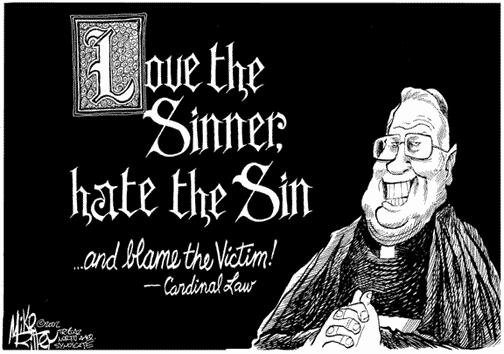
He published a column two weeks ago suggesting that homosexuality is caused by the devil. The uproar had barely faded when, a week later, The Pilot enraged priest abuse victims with a flattering birthday ode to Cardinal Bernard F. Law, the former Boston archbishop and the public face of the scandal.
For the past 10 years, Enrique, a confidant of Cardinal Sean P. O’Malley, has steered The Pilot along the conservative edge of Roman Catholic orthodoxy, in line with his background in the Neocatechumenal Way, a relatively new religious community far more conservative than many American Catholics. Some bishops have embraced the Neocats, as they are often called; other bishops have sought to ban them.
“Many of the opinions voiced [in The Pilot] seem to be pre-Vatican II,’’ said Boston College historian and author, Thomas O’Connor, a regular reader, referring to a more rigid era of the church, before changes made in the 1960s.
Enrique declined to be interviewed and has not answered questions about the paper’s recent controversies.
For his religious mission in the United States, Enrique, now 48, had to quit his job in Spain where he worked in marketing and technology for a General Electric company. He came to Boston in 1996 to fulfill a call from Cardinal Law for mission families to help bring Spanish-speaking immigrants into the local Catholic Church.
Enrique and his wife, Reyes, arrived during a bleak New England winter, with no salary and no job, Enrique said on an archdiocese-sponsored radio broadcast in August.
“We came,’’ he told the radio audience, “in the hands of God.’’
Though he had not worked in journalism, according to the archdiocese, Enrique became an editor at La Vida Catolica, a Spanish-language Catholic publication; Law made him editor of The Pilot in 2001. O’Malley retained him when he became archbishop in 2003.
The archdiocese prints about 23,000 copies of The Pilot, distributed to subscribers and through the parishes. Founded in 1829, The Pilot says it is America’s oldest Catholic paper.
Some priests are open about their irritation toward The Pilot’s unwillingness to represent a wider range of Catholic opinions.
“The Pilot doesn’t help to build community when it causes this much of a division or crisis,’’ said the Rev. Robert Bowers, who works at The Paulist Center in Boston.
The Paulist Center refused to distribute the Oct. 28 edition of The Pilot because of the antigay column, written by Daniel Avila, who was at the time a policy adviser to US Conference of Catholic Bishops. He has since resigned.
The notion that the devil turns people gay is not the position of the Catholic Church, and under a loud backlash the paper apologized for “having failed to recognize the theological error’’ before publication.
Gay Catholics, in response, called for Enrique’s resignation, citing what they call a pattern of hostility. In June 2010, The Pilot offended gay Catholics by publishing a commentary that sought to link gay relationships to pornography, as part of their argument for banning the children of gay parents from Catholic schools.
“Because of the pastoral harm [Enrique] has done, we don’t think he should continue as editor,’’ said Marianne Duddy-Burke, director of DignityUSA, an advocacy group for gay Cat
holics.
Advocates for child victims were equally aghast over the paper’s lengthy Cardinal Law profile of Nov. 4, which mentioned Law’s role in the abuse scandal in two parag
raphs near the bottom, before ending with “Happy Birthday, Your Eminence.’’
“What they ought to publish is an entire issue on the abusers Law sheltered during his administration,’’ fumed Anne Barrett Doyle, a director of the group BishopAccountability.org, which documents cases of clergy sexual abuse.
Despite the criticism, O’Malley offered Enrique an unqualified vote of confidence this week. “He has done an extraordinary job of running the newspaper,’’ the cardinal said Thursday in a statement. O’Malley praised Enrique’s professionalism and credited him with improving the paper’s balance sheet. “I am grateful for his leadership, advice and friendship,’’ said O’Malley, who is very close to Enrique and his wife. He personally baptized their 11th child.
Scot Landry, the archdiocese’s secretary for Catholic media, acknowledged in an interview that The Pilot hews to “more traditional or orthodox’’ Catholic viewpoints, as is its mission. The paper, he said, tries to be careful not to publish “dissent’’ in any way that might confuse readers on the official positions of the Catholic Church.
“Other Catholic newspapers or organizations not tied to a bishop may be more willing to publish dissenting views,’’ he said. “The Pilot is a thoroughly Catholic paper.’’
Opposing viewpoints are often published as letters to the editor, he said.
Tom Shields, a founder of La Vida, hired Enrique at the organization in the late 1990s, and they have been friends ever since. He said Enrique and the writers at The Pilot “are not mean-spirited in any way.’’
“They try to be Christlike in their writings and adhere to Catholic teachings,’’ while often defending the church from those who disagree with its moral message, Shields said.
As a follower of the Neocatechumenal Way, Enrique is part of a community that has earned a reputation for its energetic defense of Catholic doctrine, especially “refuting challenges to controversial Catholic moral teachings,’’ such as opposition to gay relationships, contraception and abortion, said Richard Gaillardetz, a Boston College theology professor. Followers of the group are known to criticize “pastors, bishops, and theologians who fail to meet their rigid standards of orthodoxy,’’ he said.
The Neocatechumenal Way dates back to Madrid around 1963, when Kiko Arguello, an accomplished painter, wandered into poor neighborhoods and started to evangelize. The movement has spread worldwide, often through small communities of several dozen people within parishes.
The Vatican considers the Neocats to be one of the new church movements - along with better-known groups such as Opus Dei - that are valuable for spreading and intensifying the Catholic faith, Gaillardetz said by e-mail.
Some bishops have found the Way disruptive; five bishops in Japan tried to suspend them, though Rome would not allow it.
Enrique told Catholic radio listeners in August that “one thing that happens in the Way is once you start realizing
the love of God, you realize that you are not called to be the only architect of your life, that God has a plan for you.’’
In his family’s case, he said, the plan was to offer themselves as missionaries.
They offered for four years but were not chosen. “Eventually we purchased a house,’’ he said.
“We just decided this was not happening, [so] let’s move on with our lives. Right then and there we were called to this retreat, and by lottery we were sent to come to Boston.
“You learn with lots of mistakes in the process, of course,’’ Enrique explained on the radio. “But you learn that in the mission you let God live your life.’’
Adviser resigns following column linking same-sex attraction with devil
WASHINGTON (CNS) -- A policy adviser to the U.S. bishops has resigned following a controversy over an opinion piece he wrote suggesting that same-sex attraction could be the work of the devil. Daniel Avila, policy adviser for marriage and family to the U.S. bishops' Subcommittee for the Promotion and Defense of Marriage since June 20, offered his resignation Nov. 4 and it was accepted, effective immediately. Avila's opinion piece was published in the Oct. 28 edition of The Pilot, Boston's archdiocesan newspaper. It also was posted online before being removed Nov. 2 and replaced with an apology by Avila who previously worked as associate director for policy and research at the Massachusetts Catholic Conference in Boston. Terrence Donilon, spokesman for the Boston Archdiocese, told Catholic News Service the column was pulled because Avila "retracted it and apologized and because it simply should not have been printed/published in The Pilot." "It is not the position of the archdiocese or the church and is simply wrong," he said in a Nov. 3 email. Avila has written several columns for The Pilot during the past year and has been a contributor to the newspaper for at least seven years, according to Donilon. The most recent column, which generated reaction in the blogosphere was titled: "Some fundamental questions on same-sex attraction." In the column, Avila attempted to answer the question about what causes same-sex attraction. He pointed to possible explanations su
ch as "random imbalances in maternal hormone levels" which he said could have "disruptive prenatal effects on fetal development." But he said Catholics need to look for spiritual answers to this question. And as he sees it, "the ultimate responsibility, on a theological level, is and should be imputed to the evil one, not God," he said. "Applying this aspect of Catholic belief to interpret the scientific data makes more sense because it does not place God in the awkward position of blessing two mutually incompatible realities -- sexual difference and same-sex attraction."
In Avila's retraction and apology statement he said his column did not represent the position of the USCCB and was not authorized for publication. "The teaching of sacred Scripture and of the Catechism of the Catholic Church make it clear that all persons are created in the image and likeness of God and have inviolable dignity. Likewise, the church proclaims the sanctity of marriage as the permanent, faithful, fruitful union of one man and one woman."
He continued: "The church opposes, as I do too, all unjust discrimination and the violence against persons that unjust discrimination inspires. I deeply apologize for the hurt and confusion that this column has caused."
The Pilot also issued an apology on its website for "for having failed to recognize the theological error in the column before publication."
Mercy Sister Mary Ann Walsh, director of media relations for the U.S. Conference of Catholic Bishops, said in a statement: "While the general population has debated whether it's nurture or nature that leads to a homosexual inclination, the church has not posed any theory in that regard."
| bron |
| bron |
| bron |
| bron |
HIER
HIER
HIER
hier
hieren
hier