![]() |
| Simon de Wit, Rede |
vrijdag, maart 08, 2019
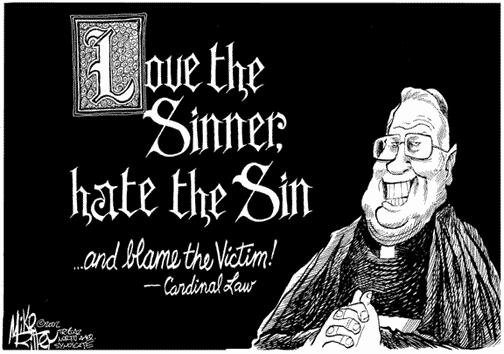
Yes we can ! 8 maart international: Wij zijn net mensen. Vrouwen eisen het Recht te worden erkend als dader
Nationally-recognized Attorney Launches Comprehensive Database of Clergy Accused of Sexual Misconduct in the Diocese of Greensburg
GREENSBURG (PA)
Horowitz Law
March 7, 2019
Adam Horowitz, a nationally-recognized advocate for survivors of clergy sexual abuse, announces the launch of a new database of clergy and lay employees accused of sexual abuse in the Diocese of Greensburg. The database, which includes 23 priests as of today, is believed to be the most comprehensive list of accused offenders in the Diocese of Greensburg available.
For the benefit of survivors and journalists alike, Horowitz and his team have painstakingly prepared individual profiles on more than 500 accused offenders in Pennsylvania to consolidate available information about their backgrounds, alleged crimes, and, in the case of offenders who are still alive, their current locations. Many of these profiles include photographs that are not available anywhere else.
The list was compiled using the names identified in the 2018 Grand Jury report, the Diocese of Greensburg's list of credibly accused individuals, media reports, and court records.
The Greensburg database also includes priests who belong to religious orders, such as the Jesuits and the Oblates. The Diocese of Greensburg fund is one of very few funds that will compensate those victimized by religious Order priests, such as the Benedictines.
Similar funds in the Archdiocese of Philadelphia and across New York State specifically and arbitrarily excluded claims made by anyone abused by non-diocesan priests, nuns, and lay employees.
However, the Diocese of Greensburg recently and unexpectedly announced that it will exclude the claims of anyone who had not reported their abuse to the Diocese of Greensburg before the day the fund opened.The Bishop offered no explanation was offered for this arbitrary exclusion, which does not exist in the overwhelming majority of claims funds in Pennsylvania and elsewhere.
donderdag, maart 07, 2019
The Silence of Others; memoria verdad justicia
![]() |
| KLIK |
Na jarenlang stilzwijgen laten filmmakers Almudena Carracedo en Robert Bahar in deze documentaire de aanhoudende strijd zien van een groep slachtoffers van de Spaanse dictatuur onder generaal Franco. Zes jaar lang worden zij op intieme wijze gevolgd tijdens hun worsteling met het verleden.
In een krachtige en poëtische vertelvorm wordt er ingezoomd op onderwerpen als fascisme en de gevaren die kleven aan het vergeten van het verleden.
Het gevecht duurt voort omdat er nooit gesproken is over de naar schatting nog honderdduizend slachtoffers die in massagraven liggen, tienduizenden baby's die verdwenen uit ziekenhuizen, de ontelbare andersdenkenden die zijn gemarteld en vastgezet.
Twee jaar na de dood van Franco is er in Spanje een amnestiewet aangenomen. Medewerkers van het Franco-bewind kunnen hierdoor niet worden vervolgd. Misdaden van het regime kunnen zo worden weggestopt en veel Spanjaarden lijden onder het onverwerkte verleden, zoals de oude María Martín. Ze hangt een bosje bloemen aan een vangrail langs een weg buiten haar dorp. Dit is de plek van het massagraf waarin haar moeder ligt. Herbegraven mag Maria haar moeder niet.
Zes jaar lang volgt de film een groep mensen die het verleden wel wil vergeten, maar dat niet kan zolang door de amnestiewet het verleden onbespreekbaar blijft.
Dit moet veranderen en de groep probeert daarom in Argentinië via het internationale recht enkele prominente uitvoerders van Franco's schrikbewind voor de rechter te slepen.

6 MAR 2019
El Pais
How heavy rains uncovered Franco’s lost victims in Madrid’s biggest cemetery
A mass grave that is thought to contain the remains of as many as 3,000 people who were executed after the Civil War has been revealed in La Almudena graveyardMadrid ANA MARÍA PASCUAL
A mass grave that is thought to contain the remains of as many as 3,000 people who were executed after the Civil War has been revealed in La Almudena graveyard Madrid
The remains of 3,000 people executed in Madrid by Francoist military courts between between April 1939 and February 1944 have been discovered in the city’s massive La Almudena cemetery, much to the surprise of historians and family members who believed the remains had been cremated. The mass grave was found last year after heavy rains eroded the dirt and exposed the bones.
Work carried out by City Hall’s Human Rights and Historical Memory department, as well as the municipal Funeral Service company, suggests that the discovery is one of La Almudena’s ossuaries, in which the remains of the executed Republicans were most likely buried along with the bodies of thousands of ordinary citizens who died of reasons unrelated to the Spanish Civil War (1936-39) and the subsequent dictatorship of General Francisco Franco.
The finding disproves long-standing claims by the municipal funeral company that the executed Republicans had been exhumed from their tombs in the 1990s and incinerated in the crematorium at Madrid’s Carabanchel cemetery. This version of events was trusted for years by historians, family members and the group Memoria y Libertad (Memory and Liberty), an association that aims to share data and information on the victims of the Francoist regime with family members.
“It was a genuine surprise, because it was thought that the ossuary was empty,” explains Mauricio Valiente, the third deputy mayor of Madrid City Hall and the head of the Human Rights and Historical Memory department. “We are in the process of hiring a specialized company to survey the grave and determine its dimensions and the number of bodies,” he adds. “The resulting report will also help us date the remains.”
Despite the discovery, Valiente doesn’t believe that the victims will be able to be identified. “Whatever happens, this space must be dignified out of respect for the family members. They are about to start a process in La Almudena of building a memorial to commemorate the victims.”
.....
compleet
![]() |
| 28-12-2010 OK, USA |
Het is het klimaat van vandaag
dat aan de bomen van gisteren
de vruchten van morgen bepaald
dinsdag, maart 05, 2019
it takes a village to raise a child: Hochhut op Plein 40-45
![]() |
| Beeldbank Noord Hollands Archief IJmuiden Plein 1945 |
Wij hadden een bibliotheek. En héél véél weekenden.
En een Bonaventura.
Misschien zou dat wel 's een interessante opdracht kunnen zijn, Herr Marx
Europeese bisschopsconferentie verzoekt haar propagandamedia eens een leuke uitzending te maken nu niet met de vraag waar was jij tijdens de Varkensbaai, of toen JFK vermoord werd of desnoods diezelfde man z'n Berliner bollen op de stranden verkocht maar waar was jij toen Hochhut uitkwam ?
Zou een goede zijn voor Jan Bank. Hij zou er wel eens precies de goede leeftijd voor kunnen hebben ook nog 's. En nog een goedkope opdracht ook, hij heeft vast geen half uurtje nodig om tot de conclussie te komen dat er een systeem achter zat dus dat schiet lekker op en tikt mooi aan.Het had ons in ieder geval die buitengewoon genante flauwe kul zondag bespaard van de verkooppraatjes van van den Hende, Rotterdam.
Het zou in ieder geval een - alsnog en veel te laat - een eind hebben kunnen maken aan die meer dan walgelijke besmeuringen van BXVI !!
En wie weet had diezelfde van den Hende ook nog 's wat op kunnen steken over wat hem nu kennelijk ontgaan is in zijn ijver tot imitatie van Frau Antje,
![]() |
| KLIK |
![]() |
| bron wikipedia |
Labels:
betrokkenheid Vaticaan,
de Voorzienigheid,
Nederland
missiewerken
Wat die nonnen, die advocaten, -wisten die veel -
de notuliste en het drietals-gezelschap aan de overkant van mijn hearing van dat meldpunt nooit hebben geweten was dat er onaangekondigd en tot mijn mijn verbijstering - ik had om er uberhaupt te kunnen komen na het lezen van de papieren van die nonnen geen stuk meer gelezen - nog een 4e persoon aanwezig was.
De koffiedame wist 't ook niet: er was geen koffie voor.
Die persoon dacht dat ik een wilg was.Kan je zo hebben in een buurt die barst van de natuurreservaten
Maar pas vandaag snapte ik - en eigenlijk niet tot mijn verbazing en zeker niet tot mijn verbijstering - die was destijds overdonderend genoeg om een leven lang mee te kunnen - dat er nog een vijfde was geweest ook !
Maar ja, in die tijd dronken die geen koffie, niet met mij in ieder geval.
Dus duurde dat wat langer.
En dáár kon geen non, laat staan al dan geen leken bestuursmedewerkster met of zonder in te huren meisjes, tegen op!
Maar goed dat er ook blindengeleidehonden bestaan dus.
naar de gekleurde stukken glas voor Bonefatio's kruisen: graf van de held en de heldin
Nogmaals: mocht iemand weten waar er van haar (gipsen) kruisen nog een bestaat - mag best
gebroken zijn! -
U wacht een vlaFlip
Mocht U een vreemde afwijking hebben dankzij Natuurmonumenten en onderzoek aan de Vrije Univeristeit Amsterdam wacht U de huisarts
Duin en Kruid herbergde (herbergt?) een in Nederland zeer specifieke teek.
Dat kan je zo hebben in natuurreservaten in Wir haben es nicht gewußt -land
de notuliste en het drietals-gezelschap aan de overkant van mijn hearing van dat meldpunt nooit hebben geweten was dat er onaangekondigd en tot mijn mijn verbijstering - ik had om er uberhaupt te kunnen komen na het lezen van de papieren van die nonnen geen stuk meer gelezen - nog een 4e persoon aanwezig was.
De koffiedame wist 't ook niet: er was geen koffie voor.
Die persoon dacht dat ik een wilg was.Kan je zo hebben in een buurt die barst van de natuurreservaten
Maar pas vandaag snapte ik - en eigenlijk niet tot mijn verbazing en zeker niet tot mijn verbijstering - die was destijds overdonderend genoeg om een leven lang mee te kunnen - dat er nog een vijfde was geweest ook !
Maar ja, in die tijd dronken die geen koffie, niet met mij in ieder geval.
Dus duurde dat wat langer.
En dáár kon geen non, laat staan al dan geen leken bestuursmedewerkster met of zonder in te huren meisjes, tegen op!
Maar goed dat er ook blindengeleidehonden bestaan dus.
![]() |
| geplukt |
![]() |
| Duin en Kruid Beeldbank Archief Noord Holland |
naar de gekleurde stukken glas voor Bonefatio's kruisen: graf van de held en de heldinNogmaals: mocht iemand weten waar er van haar (gipsen) kruisen nog een bestaat - mag best
gebroken zijn! -
U wacht een vlaFlip
Duin en Kruid herbergde (herbergt?) een in Nederland zeer specifieke teek.
Dat kan je zo hebben in natuurreservaten in Wir haben es nicht gewußt -land
maandag, maart 04, 2019
Deetman en Franciscus: bijdage aan Neerlands annalen Veni creator spiritus
Goddank, die meer dan dikke week is afgelopen! bedacht zij en raapte een knol op.
Bedankt, Moisés
Ik denk dat jij het beste boek schreef wat ik mij ooit aanschafte, sorry Zé.
Mijn vader had nu eenmaal geen tuinpad.
Ik heb geen flauw idee of dat Mechelen inmiddels al op de wereldranglijst erfgoederen staat, zoniet moeten we daar bij de volgende Europeese verkiezingen maar eens een prioriteit van maken!
Toch wel handig wanneer de archieven zelfs ook op youtube staan
Met buiging aan Archbishop Mark Coleridge of Brisbane , die misschien ook wel 's een nacht niet heeft geslapen
> ---------- Oorspronkelijk bericht ----------
For the first time since they shared the St Alipius presbytery at Ballarat in the 1970s, George Pell will be back under the same roof as the worst of the worst. He and Gerald Ridsdale will have so much to catch up on."
Bedankt, Moisés
Ik denk dat jij het beste boek schreef wat ik mij ooit aanschafte, sorry Zé.
Mijn vader had nu eenmaal geen tuinpad.
Ik heb geen flauw idee of dat Mechelen inmiddels al op de wereldranglijst erfgoederen staat, zoniet moeten we daar bij de volgende Europeese verkiezingen maar eens een prioriteit van maken!
![]() |
| Klik |
![]() |
| klik |
![]() |
| bron |
en een zoen van Femke Halsema, burgemeester Gemeente Amsterdam
![]() |
| bron |
> Van: "Archief.Amsterdam Archiefbank NOREPLY"
> Aan: "......nl>
> Datum: 4 maart 2019 om 10:10
> Onderwerp: [3N-Ht8kUigNS] Aanvraag tot digitalisering #68766 afgerond
>
> Geachte ......
>
> Uw aanvraag tot digitalisering is afgerond. De scans staan online en
> kunnen vanaf nu geraadpleegd en gedownload worden.
>
> Voor meer informatie over het digitaliseringsproces, zie onze website:
>
![]() |
| KLIK |
Pell will be in one of the prisons where Victoria houses paedophiles. He will know so many of the faces, so many priests and brothers who have done what he continues to deny having done himself. What reunions there will be.
Labels:
Australia,
belgenmop,
betrokkenheid Vaticaan,
Nederland,
nonnen
zondag, maart 03, 2019
Headcoaching: en toch draait ie
en dat vrolijk kun je van die leerlingen en hun leraar dus ook worden
maar of je dat nou van die AOb moet worden ??
hoewel.......ach die bestaat natuurlijk ook pas sinds 1997
Getrix en Fix:
acuut die leerlingen het ere-lidmaatschap aanbieden dus maar
| KLIK |
![]() |
| bron |

zaterdag, maart 02, 2019
schietende krokussen: recept voor een goed weekend van zo'n meid wordt je dus helemaal vrolijk!
![]() |
| KLIK |
en mag wat mij betreft zelfs die [aarts?]bischop de camera even gebruiken om door een camera te zwaaien: kijk mam!! Ik vond hem schattig.... en hopelijk vind z'n moeder dat ook ,
over een jaar of 20 of zo....
En omdat ik nu eenmaal geen professor dr. ben had ik dus wat langer nodig dan eeen half uurtje om te weten dat deze dame dus voortaan gewoon een Mevr. Dr. is
En da's héél goed nieuws: hoera we sterven uit en moe-je nou toch 's kijken!
Dank U wel, Mevr. dr, , da's ongetwijfeld heel hard werken geweest.
En mijn ouwe-taart gevoelens bevallen me uitstekend, met dank aan mijn monsters, op de burgerlijke stand keurig als mijn kinderen betiteld, uitstekend, hun kennelijk ook al genetisch bepaalde mogelijkheid tot mij zeer vernietigend - jij bent hartstikke gek! - beschouwen inclusief.
Die lach is - net als ontzag - nou eenmaal ook het voorrecht van oude-taarten !
Dank U wel, Mevr. Doctor. Dat is, zeker na de afgelopen weken - Vaticaan bijeenkomst inclusief - bepaald geen verkeerd weten. Bedankt.
Zo'n 1000 jaar geleden, of zoiets, stond er een docent wapperend enthousiast te vertellen over een nieuwe studie, babylijkjes in de Amsterdamse grachten en nog veel langer daarvoor vroeg een reus me terwijl hij de varkenstroggen voor zijn huis met aarde en bloemetje vulde of ik wist hoeveel rollen wc-papier er het jaar daarvoor in Nederland waren verkocht. En ik wist zeker dat-ie niet goed snik was: een erfenis van de nonnen in hun duiding van de toekomst.
En ook zij wisten dat, of beter waaarschijnlijk: hoopten erop: zij dankzij ons de hemel in - dat hadden ze god zelf horen roepen - en wij de deur uit en als we mazzel hadden via de Goede Herder zodat er nog iets van ons terecht kon komen, via De Banstraat hadden we daarop heel wat minder kans .
Ook dat wisten ze, daar hadden ze een professor dr. voor en zijn cijfertjes die ze ons veelvuldig vertelden, zo-iets als de prijs van een rol Maria biskwietjes waarvan we ook goed doordrongen moesten zijn, die je dan weer af kon zetten tegen de verpleegprijs en hun opofferingsgezindheid waarvoor wij dus maar beter dankbaar konden zijn.
Met of zonder maria-biskwietje
Voor de prijs van die biskwietjes heb ik in ieder geval nooit een doctor als bron geweten, maar dat was ook niet nodig, Veel belangrijker was de bron te ontdekken van wie er nu weer wat van je had gejat- minstens zo belangrijk waren je schortzakken. En voor de wat ouderen de daarbij horende wisselkoers. En het mij zeer onwaarschijnlijk lijkt dat onze mededelingsgezinde nonnen ooit hun bron van wijsheid hebben bekeken terwijl ze hem beluisterde. Dat hoefde ook niet: hij deelde kennelijk mee en zij strooiden, getraind als zij waren in gehoorzaamheid, zijn cijfertjes vervolgens in onze schoten, in een eigen vorm van cathechismis die zij met ons deelden.
Waarmee je dus ook niet in staat bent - zoals de minachtende blikken van mijn monsters hebben bewezen - om ontzag te kunnen ervaren.
En dat zou wel 's een van de fouten - misschien wel de grootste? - kunnen zijn de afgelopen week in al die reacties over die bijeenkomst in het Vaticaan, Rome !
Regelmatig krijgt Walhout de vraag of ze niet treurig wordt van al die verhalen over jonggestorven kinderen. Hoewel het voor de historica vaak cijfertjes en databestanden blijven, trof het verhaal van de jonge Maria van Zundert uit Roosendaal haar wel. “Maria trouwt in 1865 met Hendrik Dirven en het koppel krijgt veertien kinderen. Elf daarvan overlijden nog voor ze een jaar oud zijn, de meesten aan diarree en krampen. Zij hadden dan ook alle omstandigheden tegen zich, een arbeidersgezin, woonachtig in de stad, afkomstig uit een lage sociale klasse én katholiek. Wanneer je zoveel van je kinderen moet begraven, dan word je toch knettergek?”
Why Catholic Church leaders risk failing on the issue of sexual abuse Bishops make more promises to get it right this time as the Church continues to implode
La Croix International
Robert Mickens, Rome
Vatican City
Organizers of the recent Vatican "summit" on the protection of minors, and a number of the bishops who attended it, are trying to assure the world that the four-day meeting brought about a "change of heart" in the Church's leaders, especially those who — up to now — have underestimated the clergy sex abuse crisis.
The promise for guidelines, new 'motu proprio' on abuse
A second thing to note about this latest abuse summit at the Vatican is that there was a promise to draw up guidelines (vademecum) to help bishops know exactly how to deal with abuse cases.
Why? Such guidelines already exist. They are spelled out in a CDF "circular letter" that was sent to all bishops' conference in 2011 with the instruction that each conference use them to draw up norms specific to their region and situation.
In addition, the canonical procedures to deal with abusers already exist and are clear. They need only be applied and enforced. This directive in the circular letter merits particular attention:
"the prescriptions of civil law regarding the reporting of such crimes to the designated authority should always be followed."
Yet, some episcopal conferences — including Italy's — are hesitant to enforce mandatory reporting.
Another, issue that has not been resolved at the universal level is how to discipline bishops who have been negligent in applying existing norms and, worse, those who have covered-up abuse.
Pope Francis in June 2015 created a special section in the tribunal of the Congregation for the Doctrine of the Faith to do just that. It was even listed in the 2016 edition of the Annuario Pontificio, but there were no officials appointed to it. That's because it had already been aborted.
Then in June 2016 the pope issued a "motu proprio," As a loving mother, in which he said negligent bishops and religious superiors could be judged and even removed by the "competent congregation of the Roman Curia" — those pertaining to bishops, Eastern Churches, religious orders and Churches in mission territory (Propaganda Fide).
But so far none of these congregations has reported whether it has ever heard even a single case against a negligent prelate or the eventual outcome of such a process.
At the end of the abuse summit it was announced that Francis is now going to issue yet another "motu proprio" on "the protection of minors and vulnerable persons." Will this one finally get it right? And, more importantly, will it be enforced?
Again, there have been lots of words and many promises. As Archbishop Coleridge said, now is the time for action.
What was missing at the abuse summit
A third observation is what the Feb. 21-24 meeting at the Vatican was lacking.
There were about 190 people in attendance. But only 13 of them were women, excluding abuse survivors who offered mostly pre-recorded testimony of their experiences.
And while three of the women delivered strong speeches before the assembly of bishops, it was disappointing and irresponsible not to include many more of them.
Lay people in general, especially families of abuse survivors, were not invited. Law enforcement officials, medical professionals and other people with expertise in dealing with abuse were also excluded.
The Catholic bishops and their closest priest collaborators have proven over and over again that they are incapable of initiating any proper action regarding sex abuse concerning their fellow clerics.
With few exceptions, they have acted only when forced by external forces — the media, law officials, the high cost of court cases, the threat of imprisonment….
There was also a seeming lack of oversight in vetting the abuse survivors who gave their searing testimonies. The organizers admitted that they did not know the identity or current status of the priests who abused these survivors. They said local Churches selected the people who gave witness talks.
Perhaps most troubling was the lack of a clear understanding of how the defensive attitude of Catholic leaders, which was thought to have been overcome by now, continues to damage the Church's credibility and image. This was sadly evident in Pope Francis when he spoke at length at the end of Sunday's final Mass.
The pope dedicated at least 40 percent of his talk citing international statistics relating to sexual abuse that occurs outside of the Church. His point that priests do not constitute anywhere near the majority of all those who abuse is well taken.
And, in fairness, he may have belabored that point in order to debunk his Catholic critics who believe — against findings of mental health professionals — that there is a causal relationship between homosexuality and the abuse of minors.
But to the ears of survivors of clerical sex abuse, Francis' words sounded overly defensive.
More troubles ahead
The abuse summit has come at an extremely troubling time for the Catholic Church.
In the days before the meeting was even convened, Pope Francis took the unprecedented step of "defrocking" the former cardinal Theodore McCarrick, removing him from the clerical state. This came after the pope had already taken the red hat from the former Archbishop of Washington.
Mr. McCarrick never faced a civil court, but was subjected to a canonical process that determined he had sexually abused at least one minor (the Vatican has provided few details of the case). Francis opted to bypass a full Church trial and stripped McCarrick of the priesthood through an administrative act.
Within a matter of weeks or months, it is most likely that the pope will be forced to remove a second cardinal from the illustrious red-hatted college and remove him, as well, from the priesthood.
Cardinal George Pell who has been convicted by a jury in an Australian civil court is now in jail awaiting sentencing, even while he promises to lodge an appeal.
But regardless of the final outcome, the Congregation for the Doctrine of the Faith has already begun a canonical process to investigate the abuse charges against the cardinal.
In both the McCarrick and Pell cases, external pressures from civil authorities — not Vatican guidelines or protocols — forced the pope and his aides to take action.
This may, perhaps, be only a foreshadowing of a colossal redefining of the Church's frayed relationship to civil society, especially in Europe and the West.
Since the age of Enlightenment, the Christian Church has seen its influence on societal moral norms and the laws that define them gradually and greatly diminish.
The Roman Church in particular, whose leaders initially ignored or covered up clergy sex abuse, has been exposed to everyone (except, perhaps, still far too many bishops) as being incapable of dealing with this crisis with its current structures, theology and ecclesiology.
The ongoing implosion of the Church
As Massimo Faggioli suggested in a recent article published by La Croix International:
They are in critical need of reform.
Until the bishops address this — as Pope Francis seems to be trying through his efforts to develop synodality and decentralized authority — the Church will never be able to deal adequately with sex abuse among its clergy… or any other serious issues.
This is the "wake-up call" the pope and bishops need to hear.
Robert Mickens, Rome
Vatican City
Organizers of the recent Vatican "summit" on the protection of minors, and a number of the bishops who attended it, are trying to assure the world that the four-day meeting brought about a "change of heart" in the Church's leaders, especially those who — up to now — have underestimated the clergy sex abuse crisis.
In fact, before the Feb. 21-24 meeting even got started its chief planners indicated that a main goal would be to convince all the bishops in the world that the abuse of minors was not just a "Western" problem.
When it was all done and over, one those organizers, Jesuit Father Hans Zollner, said the highly-publicized event marked a "quantitative and qualitative leap" in the global Church's response to abuse. He called it an important new step on the slow and painful journey of "turning things around.
A bishop from the Pacific Islands likened it to "a wake-up call."
You will have to forgive those who have not been sleeping the past three or more decades — particularly abuse survivors — for their skepticism.
At the Vatican summit a number of statements of intent were made and many important words were spoken.
They've all been said before. And it was hard to detect much if anything that was new.
Even Australian Archbishop Mark Coleridge, who was the homilist at the gathering's final Mass, admitted: "The time for words is past; now is the time for action."
So what can one say about the Vatican summit?
We've been here before
First of all, most reporters and commentators all too quickly (and uncritically) defined it as a "monumental," "unprecedented" and "landmark" event. That was true only to a certain degree. It was indeed the first time such a meeting on sex abuse was held inside the Vatican with the participation of a pope.
But it was not the first time that a large representation of the world's bishops and the leading figures of the Roman Curia tried to tackle the issue together.
Exactly seven years ago — in February 2012 — delegates from 110 episcopal conferences (though most were not conference presidents) and representatives of 35 religious orders gathered at the Jesuit-run Pontifical Gregorian University in Rome for an international symposium called, "Towards Healing and Renewal." It too, was a four-day meeting.
What did they do?
According to a timeline of events on the website for the recent Vatican summit: "Participants received input on different aspects of the issue and how to face them in their own countries by developing guidelines and other adequate instruments."
The movers and shakers
The planners and leading figures at the 2012 symposium were mostly the same people who organized and backed this latest gathering.
The earlier event was the brainchild of two Jesuit priests, first and foremost Federico Lombardi, then director of the Holy See Press Office. He planned the meeting over many months with his confrere Hans Zollner, a German who was teaching psychology at the Gregorian University.
The symposium ended up being held at the university because Benedict XVI's Secretary of State, Cardinal Tarcisio Bertone, blocked efforts to stage it at the Vatican. Bertone also instructed L'Osservatore Romano not to give it too much prominence in the pages of the Vatican paper.
Cardinal William Levada, then prefect of the Congregation for the Doctrine of the Faith (CDF), gave the symposium's opening address.
Msgr. Charles Scicluna, the doctrinal office's lead prosecutor of abuse cases, gave a speech in which he denounced the Church's culture of silence regarding such abuse.
He courageously described it as omertà, an Italian word denoting the Mafia's code of silence. (Incidentally, Scicluna was named auxiliary bishop in Malta eight months later.)
"No strategy for the prevention of child abuse will ever work without commitment and accountability," Scicluna said at the 2012 meeting.
Sound familiar? This was one of the hallmarks of the recent summit.
Another leading figure at that earlier abuse symposium was German Cardinal Reinhard Marx.
His Archdiocese of Munich put up an initial $1.6 million to launch an internet-based "learning center" on abuse prevention in coordination with a German university and the Gregorian University.
It led to the establishment of the Centre for Child Protection (CCP) at the Gregorian under the direction of Zollner.
Marx, not Cardinal Sean O'Malley of Boston, was also the one who convinced Pope Francis to establish the Pontifical Commission for the Protection of Minors in 2014. Both Marx and O'Malley are members of the pope's C9 privy council of cardinals.
The American "Capuchin cardinal," recognized by many as a crusader against clergy sex abuse, was named coordinator of the council and became its trusted and friendly face.
But it was the German "panzer cardinal" who literally pushed the pope to form the new commission.
Lombardi, Zollner, Scicluna and Marx. They were all there in 2012 leading that first global Church symposium on abuse. They were also the leaders in 2019.
The promise for guidelines, new 'motu proprio' on abuse
A second thing to note about this latest abuse summit at the Vatican is that there was a promise to draw up guidelines (vademecum) to help bishops know exactly how to deal with abuse cases.
Why? Such guidelines already exist. They are spelled out in a CDF "circular letter" that was sent to all bishops' conference in 2011 with the instruction that each conference use them to draw up norms specific to their region and situation.
In addition, the canonical procedures to deal with abusers already exist and are clear. They need only be applied and enforced. This directive in the circular letter merits particular attention:
"the prescriptions of civil law regarding the reporting of such crimes to the designated authority should always be followed."
Yet, some episcopal conferences — including Italy's — are hesitant to enforce mandatory reporting.
Another, issue that has not been resolved at the universal level is how to discipline bishops who have been negligent in applying existing norms and, worse, those who have covered-up abuse.
Pope Francis in June 2015 created a special section in the tribunal of the Congregation for the Doctrine of the Faith to do just that. It was even listed in the 2016 edition of the Annuario Pontificio, but there were no officials appointed to it. That's because it had already been aborted.
Then in June 2016 the pope issued a "motu proprio," As a loving mother, in which he said negligent bishops and religious superiors could be judged and even removed by the "competent congregation of the Roman Curia" — those pertaining to bishops, Eastern Churches, religious orders and Churches in mission territory (Propaganda Fide).
But so far none of these congregations has reported whether it has ever heard even a single case against a negligent prelate or the eventual outcome of such a process.
At the end of the abuse summit it was announced that Francis is now going to issue yet another "motu proprio" on "the protection of minors and vulnerable persons." Will this one finally get it right? And, more importantly, will it be enforced?
Again, there have been lots of words and many promises. As Archbishop Coleridge said, now is the time for action.
What was missing at the abuse summit
A third observation is what the Feb. 21-24 meeting at the Vatican was lacking.
There were about 190 people in attendance. But only 13 of them were women, excluding abuse survivors who offered mostly pre-recorded testimony of their experiences.
And while three of the women delivered strong speeches before the assembly of bishops, it was disappointing and irresponsible not to include many more of them.
Lay people in general, especially families of abuse survivors, were not invited. Law enforcement officials, medical professionals and other people with expertise in dealing with abuse were also excluded.
The Catholic bishops and their closest priest collaborators have proven over and over again that they are incapable of initiating any proper action regarding sex abuse concerning their fellow clerics.
With few exceptions, they have acted only when forced by external forces — the media, law officials, the high cost of court cases, the threat of imprisonment….
There was also a seeming lack of oversight in vetting the abuse survivors who gave their searing testimonies. The organizers admitted that they did not know the identity or current status of the priests who abused these survivors. They said local Churches selected the people who gave witness talks.
Perhaps most troubling was the lack of a clear understanding of how the defensive attitude of Catholic leaders, which was thought to have been overcome by now, continues to damage the Church's credibility and image. This was sadly evident in Pope Francis when he spoke at length at the end of Sunday's final Mass.
The pope dedicated at least 40 percent of his talk citing international statistics relating to sexual abuse that occurs outside of the Church. His point that priests do not constitute anywhere near the majority of all those who abuse is well taken.
And, in fairness, he may have belabored that point in order to debunk his Catholic critics who believe — against findings of mental health professionals — that there is a causal relationship between homosexuality and the abuse of minors.
But to the ears of survivors of clerical sex abuse, Francis' words sounded overly defensive.
More troubles ahead
The abuse summit has come at an extremely troubling time for the Catholic Church.
In the days before the meeting was even convened, Pope Francis took the unprecedented step of "defrocking" the former cardinal Theodore McCarrick, removing him from the clerical state. This came after the pope had already taken the red hat from the former Archbishop of Washington.
Mr. McCarrick never faced a civil court, but was subjected to a canonical process that determined he had sexually abused at least one minor (the Vatican has provided few details of the case). Francis opted to bypass a full Church trial and stripped McCarrick of the priesthood through an administrative act.
Within a matter of weeks or months, it is most likely that the pope will be forced to remove a second cardinal from the illustrious red-hatted college and remove him, as well, from the priesthood.
Cardinal George Pell who has been convicted by a jury in an Australian civil court is now in jail awaiting sentencing, even while he promises to lodge an appeal.
But regardless of the final outcome, the Congregation for the Doctrine of the Faith has already begun a canonical process to investigate the abuse charges against the cardinal.
In both the McCarrick and Pell cases, external pressures from civil authorities — not Vatican guidelines or protocols — forced the pope and his aides to take action.
This may, perhaps, be only a foreshadowing of a colossal redefining of the Church's frayed relationship to civil society, especially in Europe and the West.
Since the age of Enlightenment, the Christian Church has seen its influence on societal moral norms and the laws that define them gradually and greatly diminish.
The Roman Church in particular, whose leaders initially ignored or covered up clergy sex abuse, has been exposed to everyone (except, perhaps, still far too many bishops) as being incapable of dealing with this crisis with its current structures, theology and ecclesiology.
The ongoing implosion of the Church
As Massimo Faggioli suggested in a recent article published by La Croix International:
It is not simply a question of dealing with a criminal phenomenon. It is also a theological question: from the theology of the sacraments (especially ordination to the priesthood) to ecclesiological models; from the role of women in the Church to last century's magisterium on sexual morality.
"The most complicated issue concerns the structural reforms required to address the mystique surrounding the priesthood and the episcopate, which are often still seen as positions of honor without the responsibilities that derive from holy orders.The sexual abuse crisis is just the latest and very dramatic stage in the ongoing implosion of a Roman Church that continues to stubbornly cling to governing and ministerial structures that are anachronistic and inadequate to its mission and purpose.
They are in critical need of reform.
Until the bishops address this — as Pope Francis seems to be trying through his efforts to develop synodality and decentralized authority — the Church will never be able to deal adequately with sex abuse among its clergy… or any other serious issues.
This is the "wake-up call" the pope and bishops need to hear.
vrijdag, maart 01, 2019
doorgestuurd. Voor zijn Australische dochter en al die andere zoons en dochters Sing along
Hear Pete Seeger's Unreleased "This Land Is Your Land"---------- Oorspronkelijk bericht ----------
Van: Smithsonian Folkways
Aan: ...... .nl
Datum: 1 maart 2019 om 17:04
Onderwerp: Hear Pete Seeger's Unreleased "This Land Is Your Land"
Women's History Month Vinyl Reissues & 'Songs of Our Native Daughters'
Van: Smithsonian Folkways
Aan: ...... .nl
Datum: 1 maart 2019 om 17:04
Onderwerp: Hear Pete Seeger's Unreleased "This Land Is Your Land"
Women's History Month Vinyl Reissues & 'Songs of Our Native Daughters'
donderdag, februari 28, 2019
Jerolimo en een zilveren sleutel: Und op een undehukkie me'n ekkie deveur
![]() |
| Klik |
![]() |
| krul Leonard Beels |
![]() |
| BRON |
" touwslagers zijn de belangsrijkste mensen in de samenleving
En z'n hittepetit vroeg: wie zei U dat Franz Kafka was? "
Kwame Nkrumah,
in de klucht van de koe.
En z'n hittepetit vroeg: wie zei U dat Franz Kafka was? "
Kwame Nkrumah,
in de klucht van de koe.
woensdag, februari 27, 2019
karakter getuigen
![]() |
| KLIK |
".....
Apart from having to fund his own legal defence, Cardinal Pell will not receive financial assistance from the Vatican to cover his transport from Rome to Australia later this month.
With a legal team headed by prominent QC Robert Richter, the bill is likely to run into hundreds of thousands of dollars....."
History will judge George Pell, the cardinal who sought to crush me
The Age
28-2-2019
I have hesitated in weighing in to add to the thousands of words written this week about the publication, at long last, of the details of the conviction of George Pell last December on child sex abuse charges.
It may surprise many to know that I have not followed the criminal process at all, know few details of it (even now), and have no opinion as to what may or may not happen in the balance of that criminal process.
However, as a survivor of sexual abuse by a priest over a period of more than 12 years, and having faced myself the opinion apparently held by those close to George Pell (and perhaps by Pell himself) – as to how inherently unlikely it was that a holy monk of God would have so openly engaged in such debased and abhorrent acts against a young boy – I feel saddened that the experiences of the complainant have been so disrespected by many commentators who feel the need to express doubt over what a jury of 12 has been satisfied beyond reasonable doubt.
George Pell apologised to me for the legal abuse perpetrated by the church under his watch as Archbishop of Sydney. Before he departed for Rome in 2014, he famously recited a public apology not to me but to the assembled audience at the conclusion of the Royal Commission into Institutional Responses to Child Sexual Abuse public hearing. I had a cup of tea with him. While that was a private meeting and will remain so, I can say that I have never felt any warmth from the man. I was not left with a sense of any acceptance of personal responsibility for how he sought to crush me or any appreciation of the impacts of his own actions.
We have a criminal justice process. That process rightly respects the unimaginable courage that a survivor of child sexual abuse must summon to participate in the process and the enormous personal cost of doing so, both to the survivor and his or her family. These are magnified exponentially when the perpetrator is a high-profile person.
In return, the criminal justice system provides protection to the anonymity of the survivor and ensures that the truth of their evidence will not be determined in the court of public opinion. The community should respect this and not question what they have not lived through.
Unavoidably, this is big news. George Pell has been a controversial figure for decades and has been a staunch defender of the church. He has repeatedly touted his credentials as a person to whom sexual abuse of minors is an abhorrent scourge on the church. He has done so as a cover to seek to divert attention away from his record as a man who has waged a covert war on victims and survivors of abuse and who orchestrated the church’s defence to my claim – the "Ellis defence", by which I was figuratively hung, drawn and quartered and displayed as a warning to any other survivor who may have the temerity to seek to sue the church. It claimed there was "no legal entity responsible for sexual abuse in the Catholic Church".
Pell has been in a position to commit the church to openness, transparency and accountability to the victims and survivors of abuse, to their families, to the faithful of the Catholic Church and to the tens of thousands of people in the wider community who have been affected in some way by the unbridled abuse of minors by Catholic clergy, which could only have persisted and flourished by protection from the upper echelons of the church.
As such, he has courted publicity. He will be judged ultimately in the court of public opinion, whatever the outcome of the processes still to ensue in the civil courts. He will deserve his fate. His defenders will maintain their outrage and lament the "anti-Catholic forces" and the "conspirators" who have led to his downfall.
His detractors will focus not so much on whether his conviction stands or the details of what happened in St Patrick’s Cathedral in 1996, but rather on what he has been as a leader of the Catholic Church and how he has affected their life or the lives of their loved ones.
George Pell will be judged by history. Has he lived honourably and compassionately? Has he been humble and merciful? Has any life breathed easier because of his conduct as a priest, archbishop, cardinal or senior Vatican bureaucrat? Did his war on victims and survivors of abuse make the church better, or has George Pell been one of the Catholic Church’s own worst enemies?
John Ellis is a Sydney lawyer and the survivor of a priest's sexual abuse.
Abonneren op:
Posts (Atom)