woensdag, februari 10, 2010
Dear Pope Benedict
Dear Pope Benedict,
As the Irish bishops gather in Rome for their meeting with you, we are writing to ensure that the voices of the survivors of abuse by Catholic priests have a place in your deliberations.
Survivors find in incomprehensible that the Vatican and your representative in Ireland, the Papal Nuncio, saw fit to hide behind diplomatic protocols to avoid co-operating with the Murphy Commission.
Bishops Donal Murray, James Moriarty, Eamon Walsh, Raymond Field and Martin Drennan were all bishops in the Archdiocese of Dublin during some of the period investigated by the Commission. When the Report was published each of these Bishops attempted to remain in office by insisting that the findings of the Report did not warrant their resignations. They initially took no responsibility for either their actions or their failure to challenge a culture of cover up which they instead became a part of. Since then Bishop Murray has resigned and his resignation has been accepted by you. We understand that Bishops James Moriarty, Eamon Walsh and Raymond Field have offered their resignations too, which we urge you to accept without any further delay. We would also urge you to remove Bishop Martin Drennan who still refuses to accept any responsibility for his part in supporting a culture of cover up during his time in Dublin.
The core finding of the Murphy Report was that the sexual abuse of children by priests was covered up by the Archdiocese of Dublin and other Church authorities over much of the period 1975 – 2004. Furthermore it found that the Dublin Archdiocese’s pre-occupations in dealing with cases of child sexual abuse, at least until the mid 1990s, were the maintenance of secrecy, the avoidance of scandal, the protection of the reputation of the Church, and the perseveration of its assets. All other considerations, including the welfare of children and justice for victims, were subordinated to these priorities.
This finding was rightly accepted by the Irish Catholic Bishops in their December 2009 statement where they said that they were shamed by the extent to which child sexual abuse was covered up in the Archdiocese of Dublin. They also said that they recognised that this indicated a culture that was widespread in the Church. We also now request that other bishops throughout Ireland who engaged in this culture of cover up in their own dioceses should resign from their positions instead of waiting to see the extent to which they are criticised in any future Reports should the Commission of investigation be expanded to include their dioceses.
Responsibility for child protection properly rests with the civil authorities. We ask you now to instruct the Irish bishops to comply fully with civil child protection guidelines, including the mandatory reporting of all concerns or complaints to the civil authorities for investigation.
The lives of thousands of Irish people have been devastated by sexual abuse by priests. We ask you to write, not only to Irish Catholics, but to all people of Ireland, accepting fully the harm that has been caused by the acts of omission and commission of the Catholic Church and its priests and bishops in Ireland.
Yours sincerely,
Marie Collins, survivor of Clerical Abuse, Maeve Lewis, One In Four, Andrew Madden, survivor of Clerical Abuse
Ierse Kerk let inmiddels op de kleintjes: Brady to hand deliver requesting abuse payout

die weet wat ze nu eigenlijk willen, want het resultaat daarvan
zou de ierse belastingbetaler ook wel weer eens een paar nullen kunnen schelen. Wat, nu ook de Congregaties hun rekeningen naar het door hen gepleegde misbruik denken in te kunnen leveren bij de Ierse Staat, nooit weg is.

Tuesday February 09 2010
A LETTER calling on the Vatican to provide a €1bn compensation package for survivors of clerical child abuse in Ireland is to be hand delivered to Pope Benedict by Cardinal Sean Brady, when the Irish bishops hold summit talks with the Pontiff.
gepikt van en wat bezuinigd op LEN Trouw.
The letter from Irish survivors will also contain a request for a meeting with the Holy Father during his visit to England in September.
The breakthrough came at private talks in St Patrick's College, Maynooth, yesterday involving four survivors' groups, Cardinal Brady and bishops.
Archbishop of Dublin Diarmuid Martin, who on Sunday told the Irish Independent that he was engaged in his own consultations with survivors abused by diocesan priests, did not attend the Maynooth meeting because of other engagements.
But Dr Martin was present at the first meeting last December in Maynooth between the four groups representing survivors of abuse in residential institutions run by religious orders, and has voiced his support for a bigger compensation deal.
A statement after yesterday's meeting said that four bishops -- Colm O'Reilly of Ardagh and Clonmacnoise, John McAreavey of Dromore, John Buckley of Cork and John Fleming of Killala -- would liaise with the survivors' representatives.
Attending the Maynooth talks were representatives of the Alliance Support Group, Irish SOCA, and the Right to Peace and Right of Place groups.
Summit
The statement added that the talks were part of a process of informing the bishops of the views of survivors in their preparations for their summit in the Vatican next Monday and Tuesday with Pope Benedict.
Bishop McAreavey said the meeting was constructive and focused on the ongoing concerns of survivors.
"We intend to relay these concerns to Pope Benedict, both verbally and in the form of written submissions, which were presented to us by survivors and which directly represent their views," added Bishop McAreavey, a former professor of Canon Law.
Michael O'Brien, of the Right to Peace support group, said it was now time for the Vatican and the religious orders to match the money paid by the Irish State.
The orders paid just €128m of the total compensation bill of €1.2bn."He (the Pope) must come up with a substantial amount of money to help the victims of the institutions," added Mr O'Brien. "The Vatican is as much to blame because the religious orders were under their auspices."
Tom Hayes, secretary of the Alliance Support Group and a former inmate of St Joseph's Industrial School in Glin, Co Limerick, said survivors wanted a face-to-face meeting with the Pope in September.
"We will be pointing out that when he visited America, he met with some of the victims," Mr Hayes added. "Although he met them in private, it was a gesture universally well received and we hope he will do the same when he visits England."
- John Cooney and Breda Heffernan
It. Alassio " Don Lu "
Brood en Roosjes tot ik sterretjes zien; San Marco here I come!

De fout van Ierse uitgeverijen.
Maar Ierland schijnt nog steeds een Jumbo hoop geld over te hebben!
Zou het dan toch waar zijn dat ze als
katholieken nog steeds niks snappen over bloemetjes en bezige bijtjes? Of Calcoenen bij Thanksgiving?
Hoog tijd dat het Rijksmuseum open gaat dus!
En ik stoppen met rollen van het lachen temidden van omlaag donderende stukken strak blauwe Oostenrijkse lucht en bakken vol geraniums. Poets de leeuwen maar vast op: ik kan eindelijk naar dat San Marco plein.
Mocht ik daar nog 'ns ooit écht behoefte aan en zin in krijgen!
dinsdag, februari 09, 2010
Priests are guilty by association for conforming to 'abuse system' Why were we so silent on child abuse? Why didn’t we speak up?
Tuesday, February 9, 2010
DEREK SMYTH
RITE & REASON: Why were we so silent on child abuse? Why didn’t we speak up?
IN ORDER to respond appropriately to those who were abused by priests, we need to explore clerical culture, since research attests that it does contribute to the promotion of immaturity, arrested development and irresponsibility.
For example, early research by Conrad Baars and Anna Terruwe on priesthood within western Europe and North America in 1971 revealed that only 10-15 per cent of priests were mature; 60-70 per cent suffered from a degree of emotional immaturity; and 20-25 per cent had serious psychiatric difficulties. Ironically, these findings were never acted on.
Culture is defined as a shared system of beliefs and values. It has within it a cognitive, emotional and behavioural dimension.
Clerical culture influences the way a priest or bishop may think about a certain issue, feel about it and respond to it. However, like any culture, its ills cannot be addressed solely from within. Think of Northern Ireland. It was with the support of outside sources, particularly George Mitchell, that the road towards peace began.
For clerical culture, new structures are not sufficient, as there appears to be an innate “abuse system” within this culture. Even though it may now be forced to address the issue of sexual abuse, “abuse” may rear its ugly face in other forms.
One disturbing aspect for me is what I call a “convenient silence”. Why were we so silent? Why didn’t we speak up?
It is also the question asked by the Lutheran theologian Dietrich Bonhoeffer of the churches during the second World War. Bonhoeffer came, like most of us, from one of the mainline churches. However, as a result of a visit to the storefront churches in New York he would be changed forever.
Here he witnessed the spirit-filled worship of African- Americans. He was deeply moved as he remembered how they were captured, tortured, enslaved and here they were full of passion and hope in contrast to the sedate and passive ritual of his own church.
Despite being asked to stay in the safety of New York, he felt he had to return home to confront the Nazi movement in Germany.
He joined the Resistance and eventually was captured and executed by the Nazis.
For Bonhoeffer, one big question was: “Why were the churches so silent?”
I have observed the same silence, as in my time I have witnessed theologians being marginalised as Vatican II has been dismantled, and as the innocent in Ireland were sexually abused by brother priests. I am also part of this silence.
What causes this muteness that allows evil to flourish? It is my belief that people of my generation were conditioned by the church to distrust themselves.
Take, for example, a non-Catholic neighbour who died 40 years ago.
His/her Catholic friends were unable to pray in church with his grieving family. For most people at the time, this didn’t make sense.
Their own integrity was telling them that it was absurd.
However, such personal thoughts and beliefs were dismissed even to the point that people considered them sinful. In other words, we distrusted our own integrity and conformed with the directions of the church. And since we were made keep our thoughts to ourselves, we remained silent.
This behaviour was reinforced in our seminary training. We were conditioned to surrender to the institution, to the teachings, structures and disciplines of the church. Upon ordination we made a promise of obedience to the local bishop, and even our own letter of acceptance of a diocesan post was scripted for us.
Think of the docility of priests. A new bishop is appointed to a diocese and he decides to change direction.
The priests follow until another incumbent arrives and they are ready to go again in whatever direction he decides.
Tragically, it is within this culture that the governance of the church takes place and we are all guilty by association. It may be convenient to suggest that the auxiliary bishops must step down, but surely it is more honest to ask all of our generation to step down, ensuring a new beginning for all.
Dr Derek Smyth is a priest in Foxrock parish, Co Dublin. Prior to that he had been director of Emmanuel House, Santa Ana, California, where he worked as a psychotherapist. He has co-authored two books, Being There and Defusing the Bomb
Leading Jesuit calls for synod to address Murphy report
PATSY McGARRY Religious Affairs Correspondent
The former Jesuit provincial Fr Gerry O’Hanlon has called for a national synod of the Catholic Church in Ireland in the context of fallout from the Murphy report.
“It will not do any more for priests, bishops, cardinals, the pope to simply tell us what to think, what to do. People rightly want to have a say,” he has written in the current edition of the Furrow magazine.
“Now would also seem to be a good time to call into question the reality that certain narrow grounds of orthodoxy are a sine qua non of episcopal appointments at present, and to call for more transparent, representative and accountable local, including lay, participation in the appointment of bishops.
“It’s instructive to note that as recently as 1829, of 646 diocesan bishops in the Latin Church, only 24 had been appointed by the pope: often we forget how new many of our ‘traditions’ are.
“It would seem that we need in Ireland to renew our own understanding of church, along the more participative lines envisaged by Vatican II, and, in particular, with a greater role for women and without any veto on the kinds of issues that might emerge in the consultative process that will be required.
“Why not, then, envisage going down the road of the oft-proposed national synod or assembly, well prepared in each diocese, touching into the experience of believers and disaffected alike?”
More generally, he observed, “one gets the sense that we are at a watershed moment in Irish Catholicism, with repercussions for Catholicism worldwide. There is an institutional dysfunctionality at the heart of our church which goes beyond any simple notion of governance or management reform and which needs to be tackled.”
In the same issue retired Dublin priest Fr Pádraig McCarthy challenged the findings of the Murphy report, how the media has dealt with it and how Dublin’s Catholic archdiocese has responded to it.
“Media coverage of the report may have given the impression that the report is a catalogue of unrelieved disaster. It is good to be aware, therefore, that of the 45 cases in which the report gives an assessment, handling by the church in 25 cases receives some sort of approval from the commission; 20 cases receive varying degrees of criticism.”
He found it “extraordinary that I have found not one journalist or commentator who has done the kind of review of the report which would otherwise be normal. The commission, I am sure, would not wish to be burdened with any claim to infallibility; nor do I. We must not make the report the final and absolute word.”
Among the Murphy report findings, each of which he disputes in detail, is “that child sexual abuse by clerics was widespread throughout the period under review”. That, he said, “does not accord with the facts”. He also criticises the report’s lack of “precision” in saying that while “some priests were aware that particular instances of abuse had occurred . . . the vast majority simply chose to turn a blind eye”.
He pointed out that “the report does not specify what ‘some’ means” and that “vast majority” seemed to imply a very large number.
“What was (and still is) missing . . . is a considered diocesan response” to the report, he added.
02/08/2010
Spiegel Online
The Catholic Church in Germany has been shaken in recent days by revelations of a series of sexual abuse cases. Close to 100 priests and members of the laity have been suspected of abuse in recent years. After years of suppression, the wall of silence appears to be crumbling.
By SPIEGEL Staff.
This is what it looks like, the document of a conspiracy: 24 pages, with appendix, in Latin, published by the Congregation for the Doctrine of the Faith at the Vatican. A "norma interna," or confidential set of guidelines for all bishops, who were required to keep it a secret for all eternity, in the name of the Father, the Son and the Holy Ghost.
The guidelines, issued in the year of our Lord 1962, address a sensitive subject: sex in the confessional. The Vatican doesn't put it quite that directly, preferring to use more guarded terminology to describe what happens when a priest leads a member of his flock astray before, during or after the confession -- in other words, when he provokes a penitent "toward impure and obscene matters" through "words or signs or nods of the head (or) by touch."
According to the instructions from Rome, the bishops were to deal very firmly with each individual case -- so firmly, in fact, that everything would remain within the confines of the Holy Church. After all, the Congregation for the Doctrine of the Faith -- formerly known as the Inquisition -- has centuries of experience in conducting internal investigations. The Vatican has always filled all the positions in such investigations -- prosecutors, defendants, judges -- from within its own ranks, while the investigation files have been kept in the secret archives of the Roman Curia.
Rest, flink uitgebreid, artikel
maandag, februari 08, 2010
By John Cooney Religion Correspondent
Monday February 08 2010
Irish Independent
A DEFIANT Archbishop of Dublin has shrugged off mounting criticism from priests of him being "a divisive" figure for fully accepting the Murphy report's damning findings of cover-ups of paedophile priests.
Archbishop Diarmuid Martin was responding publicly for the first time to criticism that has been building since a meeting of priests in Dublin only days after the publication of the report on November 26 last.
"I believe my reaction was to recognise something terrible happened on our watch," Dr Martin said in an exclusive interview with the Irish Independent yesterday.
"We got it spectacularly wrong," he added. "We have to admit that, and admit it unconditionally."
The archbishop also broke his self-imposed silence to speak about his expectations of the outcome of next week's summit meeting in Rome of the Irish Episcopal Conference with Pope Benedict XVI and leading members of his Curia -- the papal government or civil service.
"I hope it is a time when the Bishops' Conference will be united about a programme for the future so that we can really have an Irish Church that is very different from the one we have experienced," he said.
Referring to the extraordinary summit, which will be held next Monday and Tuesday, February 15 and 16, Dr Martin said that on Monday morning each bishop will have a seven-minute private audience with the Pope before meeting the heads of the main departments in the Roman civil service. But he revealed he had "no idea of the agenda" for the Rome summit.
"I have received nothing since the beginning," he said, a reference to the original summons to Rome issued by Pope Benedict in early December to discuss the fall-out from the Murphy report and to chart a reform programme of change for the Irish Church.
And Dr Martin emphatically dismissed media reports that he had been heavily involved in the drafting of a Lenten Pastoral letter that Pope Benedict will address to the Catholic community in Ireland.
"I am certainly not drafting the letter," he said.
Summit
Dr Martin also revealed he had been busily engaged in low-key consultations ahead of the Rome special summit.
"I have consulted with victims of clerical child sex abuse," he said, declining to give details about these contacts and their advice on the way forward.
"They have been private conversations," said the former Roman diplomat, who took over the scandal-ridden diocese from Cardinal Desmond Connell in 2004.
"I have been holding meetings with priests and various people, too, but I'm not doing it in a huge, open way.
"I have also encouraged parishes and pastoral councils in the archdiocese to put in writing to me (about reform and change) and I am analysing the responses.
"If we had more of that, we would have a Church that would be strong," he added.
Asked if he was ruling out, in this reform process, the convening of a national pastoral assembly or synod of bishops, priests and laity, he said: "Let's get to see what the aim of the renewal is and find the best means when we are clear about the type of renewal we want."
Dr Martin said he had been heartened by the spirit of the lay organisation Viatores Christi -- Travellers for Christ -- whose 50th anniversary he celebrated yesterday at a Mass in their headquarters on New Cabra Road, Phibsboro, Dublin, which he also blessed.
Founded in 1960 by UCD students who had participated in volunteer work during their summer holidays, this lay missionary movement has sent more than 2,000 Irish Catholics to take up longer-term voluntary work overseas.
"I think that Viatores Christi is an example of how, when people put the care of Christ in first place, you will attract the idealism of young people," said Dr Martin.
"As I said in my homily, when Jesus calls to conversion he does so not by threatening nor by punishing, but by allowing us to experience the lavishness of his love."
Among those whom the archbishop met was Maeve Bracken, a former adviser to then Agriculture Minister Joe Walsh, who was on assignment with Viatores Christi in Haiti when the earthquake struck. She told Dr Martin of her wish to return to an orphanage close to Port-au-Prince once she has received paramedical training.
- John Cooney Religion Correspondent
By John Cooney
Monday February 08 2010
Irish Independent
SIX years after taking over from the disgraced Cardinal Desmond Connell as Archbishop of Dublin, Diarmuid Martin is highly trusted by the public nationwide for his determined commitment to root out paedophile priests.
In fact, he is probably the only bishop who is fully trusted to put the welfare of children above shielding the church from scandal.
The former Vatican diplomat, who did not seek the emotionally draining job of cleaning up the clerical abuse mess left by Cardinal Connell, has also proved himself to be the Irish church's most effective communicator in enforcing the best standards of child protection.
Yet his stock among his fellow bishops and his own clergy in the Dublin Archdiocese has plummeted to its lowest level since he took charge in April 2004. Just as a prophet is not recognised in his homeland, so too, it would seem, a church reformer is fated to meet resistance from defenders of the status quo.
As early as spring 2006, when he was just two years at the helm of the biggest of Ireland's 26 dioceses, sly digs were being made by other bishops about how detached the Archbishop of Dublin was from their largely rural perspectives and problems. Among social gatherings of Dublin priests, the French nickname was quickly given to him of 'St Martin of Tours', a reference to his habit of attending conferences and giving speeches on the international circuit.
Last month, the archbishop even found time out from his demanding central role in preparations for this month's summit in Rome of the Irish bishops with Pope Benedict to address the prestigious annual get-together of the movers and shakers of the business world in Davos, Switzerland.
As early as 2006, too, some of his priests were telling him at private meetings of clergy that they regarded him as a temporary phenomenon who was dispatched to Dublin as the Pope's man but who would be called back to high office in the Vatican some time after the publication of the Murphy report into the cover-ups of abuse in the archdiocese.
Individual priests challenged his declared policy of immediately removing from office priests against whom complaints or even suspicions of inappropriate behaviour towards children were made. The priests complained that they were being deprived of due process, and that ensuing media publicity would severely damage their reputations even if later acquitted of unfounded charges. The archbishop has tried to keep such cases out of the news ahead of any criminal court appearances, but he was not for turning on church disciplinary policy.
This criticism of his leadership, however, has reached new heights amounting almost to open revolt. An unexpected channel for airing these grievances has come from a church newspaper which was traditionally a docile propaganda medium of the bishops, but which is now to the fore in campaigning for extensive reform of an over-clericalist church.
The current issue of the 'Irish Catholic' has reported the minutes of a private meeting of up to 25 priests held in January at which it was claimed that Dr Martin has become "a source of division", and had adopted "a dictatorial manner".
The priests claimed it was "a grave injustice" that Dr Martin "hung out to dry" six former Dublin auxiliaries named in the Murphy report, whom he called on to take responsibility for being part of a system of church governance that put the prestige of the church above the welfare of children.
This 'underground' meeting called for an analysis of the Murphy report as a matter of urgency, a move which is echoed in the February issue of 'The Furrow', the Maynooth journal for clergy, where retired Dublin priest, Fr Padraig McCarthy, openly questions its conclusion that the majority of Dublin priests were complicit in the concealment of abuse by simply choosing to turn a blind eye.
Fr McCarthy makes the astoundingly arrogant claim that his analysis is an "objective" reading of the report, and he suggests that "what was and still is missing is a considered diocesan response". In other words, Fr McCarthy has laid down the gauntlet to Dr Martin with his implied criticism that his boss's response has been unobjective and unrepresentative of clerical opinion in the archdiocese.
When I asked Dr Martin yesterday if he accepted he was "a divisive figure", he said that this stemmed from the question that was put to him at a meeting of priests shortly after his return to Dublin from Rome where he and Cardinal Brady briefed Pope Benedict just days after the November 26 publication of the Murphy report.
Dr Martin recalled that at this meeting he was asked for his attitude to Murphy's shocking findings. "I believe my reaction was to recognise something terrible happened on our watch," Dr Martin replied. "We got it spectacularly wrong. We have to admit that. And admit it unconditionally."
It was a direct answer to the often unsourced criticisms of Dr Martin's unconditional position.
With the Rome summit only a week away, nothing short of an unconditional recognition of what victims suffered from clergy will be acceptable to the Catholics of Ireland, whatever the sniping from a minority of grassroots clergy.
Dr Martin cannot afford to lose the coming battle for Pope Benedict's ear.
jcooney@independent.ie
- John Cooney
Amnesty calls for child abuse inquiry
The Irish Times
Monday, February 8, 2010
FRINGE MEETING: AMNESTY INTERNATIONAL has called for a judicial inquiry into child abuse in public institutions in Northern Ireland.
Speaking at a packed fringe meeting at the SDLP conference which was attended by victims of abuse, Amnesty's executive director in Ireland, Colm O'Gorman, said: "Individual cases of child abuse must be investigated and prosecuted through the criminal justice system.
"Inquiries into child abuse in the Republic and Wales have led to significant advances in child protection and children's rights, and the Scottish government is currently developing plans to address institutional child abuse there."
He said state authorities in the North have such a responsibility in respect of the child victims of institutional abuse, and Amnesty International was calling for an investigation which is independent, impartial and effective in delivering justice for the victims.
The Assembly has already called for an investigation of child abuse. Campaigners are expected to take their campaign for an inquiry to members of the Stormont Executive.
zaterdag, februari 06, 2010
Bistümer melden Dutzende Verdachtsfälle auf Kindesmissbrauch
Katholische Kirche in Deutschland
Der Spiegel
Die Zahlen sind ungeheuerlich - und sie erschüttern die katholische Kirche in Deutschland: Nach SPIEGEL-Informationen gab es in den vergangenen Jahren in deutschen Bistümern über 90 Verdachtsfälle auf Kindesmissbrauch. Kirchenvertreter reagieren entsetzt.
Hamburg/Berlin - Die Zahl möglicher Missbrauchsfälle in der deutschen katholischen Kirche ist größer als bislang angenommen: Eine Umfrage des SPIEGEL bei allen 27 deutschen Bistümern ergab, dass seit 1995 mindestens 94 Kleriker und Laien unter Missbrauchsverdacht geraten sind. 30 von ihnen wurden in der Vergangenheit juristisch belangt und verurteilt.
Viele Fälle waren zum Zeitpunkt ihres Bekanntwerdens jedoch bereits verjährt. Derzeit stehen den Angaben zufolge mindestens zehn Kirchendiener unter Missbrauchsverdacht.
Von den 27 Bistümern, die der SPIEGEL am vorigen Dienstag angefragt hatte, antworteten 24. Nur die Bistümer Limburg, Regensburg und Dresden-Meißen verweigerten eine Auskunft zu Missbrauchsfällen. Man wolle "die aktuelle Diskussion nicht noch befeuern", erklärte etwa der Sprecher des Bistums Dresden-Meißen. Der Sekretär der Deutschen Bischofskonferenz, Jesuitenpater Hans Langendörfer, sagte indes: "Die Enthüllungen zeigen ein dunkles Gesicht der Kirche, das mich erschreckt. Wir wollen das Thema offen angehen."
Kritische Katholiken fordern Konsequenzen
Kritische Katholiken-Gruppen fordern nun eine Korrektur der bischöflichen Leitlinien, die den Umgang mit sexuellem Missbrauch in der Kirche regeln. So regt Bernd Göhrig, Geschäftsführer der "Kirche von unten", die Einführung unabhängiger Ombudsstellen an. Bei der am 22. Februar beginnenden Tagung der Deutschen Bischofskonferenz wollen sich die Oberhäupter der katholischen Bistümer mit dem kirchenweiten Missbrauchsskandal, der in der vorigen Woche durch die Ereignisse an der Berliner Jesuitenschule Canisius-Kolleg Auftrieb bekam, auseinandersetzen.
In Fall Canisius sehen Experten kaum Chancen für Entschädigungen. Wie bei der strafrechtlichen seien auch bei der zivilrechtlichen Aufarbeitung Verjährungsfristen zu berücksichtigen, gaben sie am Freitag zu bedenken. Zugleich meldeten sich weitere Opfer. Inzwischen sind Fälle von allen drei deutschen Jesuiten-Gymnasien - dem Berliner Casinius-Kolleg, dem Kolleg St. Blasien im Schwarzwald und dem Bonner Aloisiuskolleg - bekannt.
Erste Missbrauchsfälle aus den siebziger und achtziger Jahren waren am 28. Januar in Berlin öffentlich geworden. Dann kamen weitere Taten von drei Jesuiten-Patern in Hamburg, Hildesheim, Göttingen, Hannover, im Schwarzwald und in Bonn ans Licht. Die Zahl der Opfer liegt bei mindestens 30.
Nach Einschätzung der Berliner Staatsanwaltschaft sind die meisten bisher bekannten Fälle strafrechtlich verjährt. Die Vorermittlungen zu den Taten liefen zwar noch bis nächste Woche, sagte ein Justizsprecher, aber die Verjährungsfrist für diese Form sexuellen Missbrauchs betrage zehn Jahre ab dem 18. Geburtstag des Opfers und sei abgelaufen.
Canisius Wolfi: Open brief Chile Wolgang Statt: "Carta abierto a la Communidad Ariqueña"
El Morro cotudo
Por Wolfgang Statt
Queridas amigas y amigos de Arica y Parinacota
Debido a las impresionantes muestras de apoyo que he recibido de parte de ustedes en los últimos días, me siento en la obligación de agradecerles públicamente, a través de este medio, por todo su cariño.
Los últimos días han sido tristes para mi familia y para mí, debido al acoso sostenido de parte de algunos medios de comunicación y a publicaciones que faltan a la verdad y que aunque se desmientan, ya han conseguido dañar a mucha gente.
Yo estoy en paz, lo cual no significa que no vaya a dejar de tomar las acciones necesarias hacia quienes han faltado públicamente a la verdad, involucrándome en hechos muy graves.
Confío en que la gente que me conoce sabrá discernir ante esta penosa situación. Nuevamente muchas gracias por su solidaridad. En estas circunstancias son, precisamente, estas demostraciones de afecto las que me dan la fuerza necesaria para no decaer.
Cada uno de ustedes, ocupa un lugar en mi corazón.
plus reacties
donderdag, februari 04, 2010
De barst in het glazen oog Jezuitische mental reservation? Welnee. "ein absolut respektabler Mann"
Hoe respektabel was het slachtoffer dat een aanval met een mes op zijn vroegere leraar deed waarvan geen aangifte werd gedaan, kort erop zelfdoding pleegde en werd vergeten?
Der 70-jährige Pater E. hat sich "schuldig bekannt", so sagt es Werner Löser, der Superior der 55 Jesuiten in Frankfurt. Sein enger Freund E. hat gestanden, in den frühen 70er Jahren in Hannover drei ihm anvertraute Kinder sexuell missbraucht zu haben.
Bernhard E. ist kein einfacher Jesuit. Er ist ein weltweit bekannter Repräsentant des Ordens: 1983 hatte er in Frankfurt die Organisation "Ärzte für die Dritte Welt" gegründet, die seitdem 2330 Mediziner nach Indien, Kenia, Bangladesh, Nicaragua, auf die Philippinen geschickt hat. Die Schauspielerin Maria Furtwängler ist Präsidentin des Kuratoriums.
...
Nicht freiwillig, wie nun klar ist:
Damals hatte sich kirchenintern eines der Opfer von Hannover zu Wort gemeldet.
Erst seit Mittwoch wisse er, dass sein Vorgänger 2006 "die Leitung abgeben musste". Der oberste deutsche Jesuit, Provinzial Stefan Dartmann, habe den Vorstand informiert. Es gebe zudem "Anlass zu der Befürchtung, dass es auch an anderen Orten solche Übergriffe gegeben hat", so Dartmann.
Father Bernhard Ehlen SJ was born on 5 March 1939 in Berlin. In 1958 he became a Jesuit monk. As part of his education within the order he studied philosophy, theology and educational science, and was ordained as a priest in 1968.
In the following years he was active in Roman Catholic youth work. Constantly confronted in this work with young people’s questions about the reasons for unfairness in the world, and with their search for ways of doing something about it, he joined the Cap Anamur committee in 1981 and worked as a project coordinator in refugee camps in Somalia. There Father Bernhard Ehlen made the fundamental realisation that a doctor can help someone who is ill and suffering anywhere in the world, often even with little funding, and independent of his/her knowledge of languages or cultural background.
He combined this realisation with the fact that he knew many doctors were looking for ways to make a commitment without having to leave their practice, the everyday life of the clinic and family life for six months or longer. In this way the idea for the ‘Ärzte für die Dritte Welt’ [Doctors for Developing Countries] committee was born.
Since then, Father Ehlen has been working voluntarily as director of ‘Doctors for Developing Countries’, after his order released him for this work in the spirit of the Ignatian ‘Option for the Poor’. Since 1986 he has been a member of the four-person management board at ‘Doctors for Developing Countries’. Under his management, ‘Doctors for Developing Countries’ has grown from its first beginnings in very humble conditions in Calcutta and Manila into a well-known and respected humanitarian aid organisation, one which currently sends more than 300 doctors per year to the present nine projects in India, Bangladesh, Kenya, Nicaragua and the Philippines, bringing medical help to around 3,000 patients every day from the poorest of the poor worldwide.
On 17 June 1999 Father Ehlen was made an honorary doctor of the Medical Faculty of the University of Graz for his services as founder and director of ‘Doctors for Developing Countries’. At the end of June 2006, after 23 years of untiring commitment in the service of ‘Doctors for Developing Countries’, Father Dr Bernhard Ehlen SJ handed over the running of the organisation to his successor, in order to take some time out in a so-called sabbatical. Once this ‘break’ is over, he will continue to use his experience and contacts to support the ‘Doctors for Developing Countries’ committee.
Bis 2006 hatte E. an der Spitze der Institution gestanden und war dann als Geschäftsführer zurückgetreten.
Kischlat gibt zu, dass ein damaliges Vorstandsmitglied von "Ärzte für die Dritte Welt" vor fünf Jahren vom Missbrauch durch E. gewusst habe: "Es hat die Informationen aber nicht weitergegeben." Noch in der Nacht zu Mittwoch verließ dieser Mediziner die Organisation, unverzüglich informierte Kischlat den Vorstand. "Mit sofortiger Wirkung" trat auch E. aus dem Vorstand der humanitären Organisation aus, dem er immer noch angehört hatte. Er verlässt "Ärzte für die Dritte Welt" ganz.
Innerhalb des Jesuiten-Ordens, räumt Kischlat ein, seien "Hinweise" auf die Vergehen des Paters "seit 2005 bekannt". Damals sei ein ordensinternes Verfahren gegen E. eingeleitet worden. Hat sich der Geschäftsführer selbst nie gefragt, warum sein Vorgänger zurücktreten musste? Kischlats Erklärung: Ihm sei beim Eintritt in die Organisation 2002 versprochen worden, dass er einmal an der Spitze stehen werde. "Deshalb gab es für mich keinen Anlass, das zu hinterfragen."
Der Jesuiten-Orden schirmt sein prominentes Mitglied E. in Frankfurt am Mittwoch ab. "Er hat Tränen in den Augen, es beschämt ihn tief", berichtet Superior Löser. Für ihn bleibt E. aber "ein absolut respektabler Mann". Er müsse auch weiter dem Orden angehören dürfen: "Er ist einer von uns - wir stehen zu ihm!" E. darf ab sofort keine Gottesdienste mehr zelebrieren, "das trifft ihn tief". Aber, so versichert der oberste Frankfurter Jesuit: "Wir exkommunizieren ihn nicht."
...
Komplete artikel
dinsdag, februari 02, 2010
Canisius Berlijn. De jezuitische mental reservation: inmiddels ook slachtoffermeldingen uit Chile en Spanje.
Dank je Paddy!
De berichtgeving over het Jezuiten Canisius in Berlijn begint ten gevolge van de hypocrisie en de arrogantie inmiddels zonder meer hilarisch te worden. Zoals het er nu uit lijkt te zien zou dat nog wel 'ns even zo doorgaan ook.
Zonder je schuldig maken aan paranoia of samenzweringstheorieen
dient in ieder geval geconstateerd te worden dat in een paar dagen tijd zich daar nu een verhaal ontvouwt dat op zijn minst een aantal wel erg constante elementen - tot aan de eliteschool aan toe - met situaties elders bevat!
Hoeveel belang de pater provinciaaloverste - Dartmann, SJ - dan ook bij moge hebben bij het wekken van de indruk dat zijn Congregatie een plaatselijk, desnoods regionaal wat wereldvreemd clubje pedagogen is dat zich door de grote boze wolf heeft laten verrassen, dat is natuurlijk gierende flauwe kul.
Met enig nadenken dringt zich de vergelijking met misbruik en de daarbij gehanteerde strategie elders zo onweerstaanbaar op dat je je in alle redelijkheid moet afvragen of dit nu het volgende, geactualiseerde en geldverlindende scenario in het wereldwijde rk misbruikdrama is:
maak - zo goed als gratis - schoon schip: het levert op!!
De Jezuiten zijn tenlotte geen regionaal dom clubje dat gisteren uit de boom is komen vallen.
Vreselijk je te realiseren dat die vraag rond deze over hun verontschuldigingen struikelende heren mogelijk maar zeker noodzakelijk is ten gevolge van de burgerlijk verjaringstermijnen.
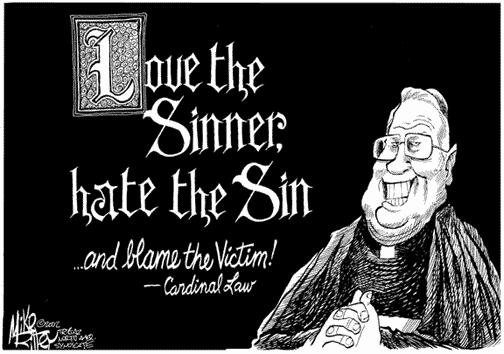
En zelfs dat is deel van de inmiddels bekende strategie, die walgelijke estafette vanuit de rooms katholieke kerk met Bernard Law en Mahony en hun iers gemijterde maten als twijfelachtig voorlopig kampioen, Mario Oliveri en zijn Berslusconiaans pleinen-justitie rond "Don Lu" als pathetisch nakomertje voor de dweilwagens: rekken met het naar buitenkomen van de feiten.
Zelfs de Korte, met geopende mond over internet-geweld, deed voor Duitsland hem inhaalde in zijn door de EO gesponserde oproep tot de publieke tribune nog een gooi tot het waar nederlands herderschap:
Inmiddels is het de vraag: werd Klaus Mertes rector Berlijn, nu wel of niet door zijn provinciaaloverste genaaid.
Zoals er ook nu als inmiddels al is gebleken, géén "versteckte Hinweise" waren - die blijken er simelweg nauwelijks ooit te zijn! - in deze situatie heeft de dader zelf bovendien duidelijk gemaakt dat hij zélf zijn gepleegde misbruik daar al bekennend had meegedeeld!
bereits 1991 seinen "damaligen deutschen Provinzialoberen eingehend über meine verbrecherische Vergangenheit informiert" Auch der Vatikan war laut S. über die Verfehlungen im Bilde.
- "immer wieder engen Kontakt sowohl mit Folterern als auch mit Opfern" der Pinochet-Diktatur gehabt. Daher, so S., "war ich fast täglich mit meinem Spiegelbild als jahrelanger Kinderquäler konfrontiert".
-"eine traurige Tatsache, dass ich jahrelang Kinder und Jugendliche unter pseudopädagogischen Vorwänden missbraucht und misshandelt habe". Daran sei "nichts zu entschuldigen".
"an alle Personen, die ich als Kinder und Jugendliche missbraucht habe“. Wörtlich heißt es: „Was ich dir und euch angetan habe, tut mir leid. Und falls du fähig bist, mir diese Schuld zu vergeben, bitte ich darum.“
Net zo min als de provinciaal overste met zijn handelswijze nu, is ook de dader daarbij tenslotte de eerste niet!
Wat dan - als bij de kip en de overkant - en ook dat niet voor het eerst een aardig, ook, theologisch probleem oplevert:
Der Jesuitenprovinzial sagte, es stelle sich „die bohrende Frage, warum die Vorfälle damals nicht ans Licht gekommen sind“. Offensichtlich hätten die Vorgesetzten der beiden Verdächtigen damals keine Meldepflicht gesehen. „Es wäre richtig gewesen, die Fälle an eine Strafverfolgungsbehörde zu übergeben“, betonte er. Dies sähen auch die seit 2003 gültigen Richtlinien für Ordensangehörige vor.
Der Rektor des Canisius-Kollegs, Klaus Mertes, räumte ein, dass es bereits 1981 „versteckte Hinweise“ auf die Missbrauchsfälle in dem Jesuiten-Gymnsiaum gegeben habe. Die hätten sich in einer schriftlichen Kritik von ehemaligen Schülern am Konzept der Sexualpädagogik gefunden. „Ich schäme mich, dass die Schule damals nichts unternommen hat“, so Mertes wörtlich. Er sagte auf Nachfrage, der Orden sei für finanzielle Ersatzansprüche der Opfer offen. Nach seinem Eindruck sei ihnen eine lückenlose Aufklärung der Vorfälle die wichtigste Wiedergutmachung.
Taten verfährt?
Dartmann kündigte an, der Jesuitenorden werde auch überprüfen, inwieweit seine Verantwortlichen in der damaligen Zeit ihrer Dienstpflicht nicht nachgekommen seien. Zuvor müsse jedoch der für Mitte Februar angekündigte Bericht der Beauftragten des Ordens für die Opfer sexuellen Missbrauchs, Rechtsanwältin Ursula Raue, abgewartet werden.
Raue sagte am Montag, sie werde nun die Akten einsehen und wolle darüber sprechen, „welche Strukturen es befördert haben, dass es im Dunkeln blieb“. Sie vermute den Ursprung in der katholischen Sexualmoral. „Ich weiß von zwei Tätern, mit denen ich auch Kontakt habe“.
Die Berliner Staatsanwaltschaft prüft unterdessen, ob die Taten inzwischen verjährt sind, wie ein Sprecher auf Anfrage sagte. „Offenbar ist das der Fall“, fügte er hinzu und erläuterte. „Dann ist das Thema für uns als Strafverfolgungsbehörde durch.“ Selbst wenn es Anfang der 1990er Jahre Strafvereitelung gegeben habe, sei auch diese längst verjährt.
...
Neben mehr als 20 Missbrauchsfällen in den 70er und 80er Jahren am Berliner Canisius-Gymnasium durch zwei Lehrer habe es auch Fälle in Sankt Blasien, Hamburg, Göttingen, Hildesheim, Chile und Spanien gegeben. Dartmann schloss nicht aus, dass noch weitere Missbrauchsfälle bekannt werden.
Zugleich entschuldigte sich Dartmann bei Opfern, Lehrern und Eltern für die Fälle sexuellen Missbrauchs am Canisius-Gymnasium: "Ich bitte um Entschuldigung für das, was von Verantwortlichen des Ordens damals an notwendigen und genauem Hinschauen und angemessenem Reagieren unterlassen wurde".
Die Berliner Beauftragte des Ordens für die Opfer, die Rechtsanwältin Ursula Raue, sagte dem SWR, einer der beiden Patres, denen auch die Missbrauchsfälle am Berliner Canisius-Gymnasium angelastet werden, habe den Missbrauch eines früheren Schülers aus St. Blasien gestanden.
Die Vorwürfe sind juristisch bereits verjährt.
zondag, januari 31, 2010
Malta Felix Cini Curia silent on paedophile priest’s appointment in Malta
by DAVID LINDSAY
31 January 2010
The Archbishop’s Curia this week chose to remain silent about the nature of the appointment given to a Maltese priest in Malta in the mid-1990s who was convicted of paedophilia in Italy in 2004.
While acknowledging that Fr Felix Cini had served in Malta between 1995 and 1996, and insisting that he had not returned to Malta since the conclusion of Italian court action against him 2004, the Curia refused to answer questions on where he had served in Malta, and in what capacity.
...
An Italian investigation into Fr Cini had begun in late 2002, just six years after he had served in Malta, and after 17 children aged between 10 and 14 years of age reported having received undue attention at the hands of the priest.
Charges were filed in 2003 and Fr Cini eventually submitted a plea bargain in 2004, avoiding a lengthy trial and a possible prison sentence, and instead being landed with a two and a half year sentence in a special community.
The proper Italian legal term used is ‘patteggiamento’ – in other words he accepted the sentence to shorten the trial. Later he said that he was advised to do so, even though he felt he was innocent and that it was a case of mistaken identity.
He claimed that unnamed ‘political pressure’ was brought to bear upon him to make him take this legal way. His claim was met with rather widespread scepticism.
Although a number of Italian media reports claim he had returned to Malta for some time following the sentencing, the Maltese Curia insists that he has not returned to Malta since 2004.
The abuse took place while Fr Cini was in Comunità Siloe in Sasso d’Ombrone in the commune of Cinigiano near Grosseto.
During the investigation, all 17 children, accompanied by their parents, testified to “undue attention” received from the priest. Two computers were also taken from him and police investigators claimed they found a history of porno-paedophile web pages having been accessed.
After being posted to Cercemaggiore, the people of the small community were outraged to find out through the Internet, and through a local paper, about the murky past of the new priest in their parish.
Some of the people were aghast that such a priest had been thrust upon them without them receiving any warning, but others objected to the protest.
They claimed that, in the months he has been in the new parish, he has succeeded in attracting more and more young people to the church. A candlelight protest was held, attended by many people, and 3,000 signed a petition asking the bishop to let him remain there. It was also claimed that, ever since he came to Cercemaggiore, his behaviour had been “impeccable”.
Archbishop of Campobasso-Bojano, Monsignor GianCarlo Bregantini, has announced that the priest is being sent elsewhere, thus closing the issue, at least in his diocese.
Clergy exposed in Murphy 'must take responsibility'
Saturday, January 30, 2010
SIMON CARSWELL in Davos, Switzerland
The archbishop of Dublin, Dr Diarmuid Martin, has said the Catholic clergy and others associated with the cover-up of clerical child sex abuse, as exposed in the Murphy report, must accept general responsibility for their failure to protect children.
Dr Martin was responding to criticism of him by the former Dublin auxiliary bishop, Dr Dermot O'Mahony, who claimed in letters published this week that the archbishop had failed to support priests in the Dublin diocese following the publication of the report.
Speaking at the World Economic Forum in Davos, Dr Martin said that Dr O'Mahony had, like many others, not accepted accountability for the failings outlined in the report and that he "perpetuates this mistake by misquoting the report" in his correspondence.
"All I would like to see is people accept accountability and say, 'look this is what happened'. In that letter, there is a certain rejection of what happened - that this horrendous scandal and the cover- up never took place. This I don't accept," said Dr Martin.
Dr O'Mahony said suggestions that the clergy failed to take cognisance of the safety of children was "inaccurate and unjust". He said that "the acceptance by the media and current diocese policy that a cover-up took place must be challenged" in letters circulated to the council of priests.
People didn't want to admit that "we got it remarkably wrong", said Dr Martin, but this conclusion was justified and wider accountability must be accepted.
"People can criticise me but I believe that, for me, the reaction to the Murphy report must be predominant - something horrendous happened on our watch and we got it spectacularly wrong."
Dr O'Mahony criticised Dr Martin for being out of the Dublin diocese for 31 years and having "no idea" of the trauma of dealing with sex abuse allegations without protocols or guidelines.
"Nobody knows where they would have been," said Dr Martin. "However, it is again a case of blame everybody else, saying: 'Where were you, what would you have done?' "
Dr Martin said that it was "not easy" to determine where accountability lay, but it was wrong to deny general accountability and to blame "some impersonal systems failure".
The pope's decision to call the bishops to a meeting in Rome next month was "a sign of his concern" and "an unusual thing", Dr Martin added. "I am glad it is taking place."
Dr Martin, who attended Davos to participate in debates with academics and healthcare specialists, said that there were parallels between the crisis in the Church over the Murphy report and the global financial crisis, with a general lack of accountability common to both.
"We are identified by what we tolerated and our identity as an institution is measured by the things we allow happen, even if it happens in a way in which you cannot pin down specific responsibility," he said.
"I would say the same in the banks - it isn't necessarily that people were encouraging bankers to behave in an irresponsible way but it was tolerated and therefore that is part of the identity of the institution that does it."
Dr Martin said there was a certain collective responsibility that existed in allowing mistakes to be made but that no one individual was responsible.
"Something terrible happened in the diocese of Dublin - at least 2,000 children, I believe, were abused.
"The lives of their parents, their spouses, their children have been irrevocably damaged and changed and [ it is sad] that nobody is responsible, that it is a systems failure," he said.
"It doesn't mean that everybody has to go up and say that I alone am responsible, but it is not enough to say that the system was wrong."
Kopvel.

Pathologisch verlangen naar exotische oorden waar de zon altijd schijnt? Tob niet langer maar geef je gevoelens creatief vorm met fruit. Het Innocent Smoothie receptenboek helpt je daarbij.
Snij bijvoorbeeld ½ geschilde ananas in stukken. Stop ze in de sapcentrifuge en giet het sap in de blender. Doe het vruchtvlees van 10 lychees, 1 geschilde perzik en ½ banaan erbij en blender alles. Hak ong 1 cm citroengras fijn, zonder de buitenblaadjes. Doe het met 100 ml kokosmelk bij de rest en laat de blender nog 4x mengen.
Je moet er toch niet aan denken dat in de film over Tutu als voorzitter van die verschrikkelijke commissie de camera wél mee naar achteren was gegaan, nadat hij met zijn kop op tafel sloeg en weg moest lopen voor hij weer terug kwam.

30.01.2010
...
Der frühere Sportlehrer und Jesuitenpater Wolfgang S., 65, räumte zudem in einer an seine Opfer gerichteten Erklärung ein, es sei "eine traurige Tatsache, dass ich jahrelang Kinder und Jugendliche unter pseudopädagogischen Vorwänden missbraucht und misshandelt habe". Daran sei "nichts zu entschuldigen".
Darüber hinaus gab der heute in Südamerika lebende Kirchenmann an, bereits 1991 seinen "damaligen deutschen Provinzialoberen eingehend über meine verbrecherische Vergangenheit informiert" zu haben. Somit wusste der Jesuitenorden seit etwa 19 Jahren von dem vielfachen Missbrauch. Stefan Dartmann, der heutige Provinzial der Jesuiten in Deutschland, bestätigte dem SPIEGEL, dass der Orden seinerzeit Kenntnis von den Straftaten des S. hatte. Man habe jetzt eine Anwältin mit einer Prüfung der Akten beauftragt, "um festzustellen, was genau die Jesuiten damals wussten und welche Konsequenzen erfolgten". 1992 trat S. aus dem Orden aus. Zuvor soll er auch an anderen Jesuitenschulen in Deutschland Jungen missbraucht haben, was S. heute nicht kommentieren will. Unter anderem war er an der Hamburger Sankt-Ansgar-Schule und von 1982 bis 1984 in Sankt Blasien im Südschwarzwald tätig. Dem damaligen Schuldirektor, Pater Hans Joachim Martin, war seinerzeit das "innige, väterliche Verhalten" des Pädagogen zu einigen Schülern aufgefallen. S. musste später das Gymnasium verlassen. Auch der Vatikan war laut S. über die Verfehlungen im Bilde. Er habe, heißt es in seiner Erklärung, dort "Zeugnis von meiner nichts beschönigenden Ehrlichkeit" abgelegt.
In Südamerika habe er "immer wieder engen Kontakt sowohl mit Folterern als auch mit Opfern" der Pinochet-Diktatur gehabt. Daher, so S., "war ich fast täglich mit meinem Spiegelbild als jahrelanger Kinderquäler konfrontiert". Mehrere Opfer reagierten entsetzt auf den Tonfall des Schreibens. In dem Dokument, datiert vom 20. Januar, wandte sich S. "an alle Personen, die ich als Kinder und Jugendliche missbraucht habe". Wörtlich heißt es: "Was ich dir und euch angetan habe, tut mir leid. Und falls du fähig bist, mir diese Schuld zu vergeben, bitte ich darum."
Dem SPIEGEL erklärte er: "Ich bin mit meiner Vergangenheit vor Gott und der Welt im Reinen."
...
Auf Lehrer R., der nach seiner Berliner Zeit in Niedersachsen als Seelsorger in der Jugendarbeit wirkte, soll vor einigen Jahren eine Messerattacke verübt worden sein. Bei dem mutmaßlichen Angreifer soll es sich um einen ehemaligen Schüler des Canisius-Kollegs gehandelt haben.
complete artikel
Ex-Pater gesteht jahrelangen Missbrauch
30. Januar 2010 22:42
Von Michael Behrendt, Peter Oldenburger und Katrin Schoelkopf
Der ehemalige Jesuiten-Pater Wolfgang St. hat zugegeben, über Jahre Schüler missbraucht zu haben. Das sagte der 65-Jährige, der heute in Südamerika lebt, dem Magazin "Der Spiegel". Der zweite Beschuldigte, Peter R. aus Berlin, streitet hingegen alle Vorwürfe ab.
Im Missbrauch-Skandal am Berliner Canisius-Kolleg hat einer der beschuldigten ehemaligen Jesuiten-Patres seine Schuld gestanden. Wolfgang St., der seit den 80er-Jahren in Südamerika lebt, räumte laut dem „Spiegel“ in einer Erklärung an seine Opfer die Taten ein. Es sei „eine traurige Tatsache, dass ich jahrelang Kinder und Jugendliche unter pseudopädagogischen Vorwänden missbraucht und misshandelt habe“. Daran sei „nichts zu entschuldigen“, heißt es demnach in dem Schreiben.
Anzeige
Nach Informationen von Morgenpost Online bereitet St. seine Rückkehr aus Chile nach Deutschland vor. Der offizielle Vertreter des Kolpingwerks für Lateinamerika, Luis E.D. Soffia, sagte, der 65-Jährige sei aus der Erwachsenenbildung seiner Organisation ausgeschieden und werde am 12. Februar in sein Heimatland zurückkehren. Nähere Gründe dafür seien ihm nicht bekannt. Wolfgang St. habe laut Soffia die vergangenen Jahre in der Hauptstadt Santiago de Chile als Manager ein Hotel für Studenten geleitet. Von den Missbrauchsvorwürfen zeigte sich der Kolping-Vertreter überrascht. Soffia erklärte, er habe mehrfach in dienstlichen Angelegenheiten mit St. Kontakt gehabt und beschreibt den 65-Jährigen als netten Mann, der bei jedermann beliebt gewesen sei.
Wolfgang St. hat mittlerweile geheiratet und ein Kind
Pater Wolfgang St. habe bis Ende des vergangenen Jahres bei der Sozial- und Entwicklungshilfe des katholischen Sozialverbandes Kolpingwerk in Chile gearbeitet, sagte am Sonnabend der Geschäftsführer der Sozial- und Entwicklungshilfe des Kolpingwerkes, Hans Drolshagen. „Er hat es verlassen, weil er mit 65 in Rente ging. Wir haben von den Missbrauchsbeschuldigungen erst am Donnerstag durch Anrufe der Presse erfahren.“ St., der „ungefähr zehn Jahre“ beim Kolpingwerk gearbeitet habe, sei nie auffällig geworden. „Wenn das alles so stimmt, ist das fürchterlich und eine Katastrophe“, sagte Drolshagen. „Das wird juristisch aufgearbeitet werden müssen.“
St. sei zuständig für die Erwachsenenbildung in Chile und auch in anderen Ländern gewesen und habe sich vor circa zehn Jahren beim Kolpingwerk auf eine entsprechende Stelle beworben. „Als er bei uns anfing, lebte er schon in Chile, war aus dem Orden ausgetreten, also kein Priester mehr, und mit einer Chilenin verheiratet“, so Drolshagen. „Er hat ein zwölf- oder dreizehnjähriges Kind.“ Solange es keine Ergebnisse einer juristischen Aufarbeitung gebe, wolle Drolshagen sich einer Bewertung von St. und der Missbrauchsanschuldigungen enthalten.
St.s Frau erklärte am Sonnabend Morgenpost Online, ihr Mann sei nicht zu sprechen. Aus seinem Schreiben, über das der Leiter des Canisius-Kollegs, Pater Klaus Mertes, von der Mediatorin Ursula Raue informiert wurde, geht hervor, dass Wolfgang St. bereits 1991 seinen „damaligen deutschen Provinzialoberen eingehend über meine verbrecherische Vergangenheit informiert“ habe. Somit muss der Jesuitenorden seit etwa 19 Jahren von dem vielfachen Missbrauch gewusst haben. Dies habe Stefan Dartmann, der heutige Provinzial der Jesuiten in Deutschland, dem Magazin bestätigt.
Da die Opfer seinerzeit um absolute Diskretion gebeten hätten, sei erst jetzt „mit dem Hervortreten einiger Opfer“ ein Untersuchungsverfahren zur vollständigen Aufklärung der Missbrauchsfälle möglich und zwingend. Es gehe darum, welches Wissen es seinerzeit um die Vorfälle bei den Verantwortlichen am Canisius-Kolleg und dem Jesuitenorden gegeben habe. „Zusammen mit Pater Klaus Mertes, dem Rektor des Kollegs, teile ich die Trauer und Scham über die Verbrechen unserer ehemaligen Mitbrüder“, so Dartmann. Der Provinzial kündigte für Montag seinen Besuch in Berlin an. Er werde dann weitere Auskünfte geben.
Man habe jetzt eine Anwältin mit einer Prüfung der Akten beauftragt, „um festzustellen, was genau die Jesuiten damals wussten und welche Konsequenzen erfolgten“. St. soll auch an anderen Jesuitenschulen in Deutschland Jungen missbraucht haben, was er heute nicht kommentieren will. Unter anderem war er an der Hamburger Sankt-Ansgar-Schule und von 1982 bis 1984 in St. Blasien im Südschwarzwald tätig.
Auch der Vatikan war über die Verfehlungen im Bilde
Dem damaligen Schuldirektor Pater Hans-Joachim Martin war seinerzeit das „innige, väterliche Verhalten“ des Pädagogen zu einigen Schülern aufgefallen. St. musste später das Gymnasium verlassen. Auch der Vatikan war laut St. über die Verfehlungen im Bilde.
Mehrere Opfer reagierten entsetzt auf den Tonfall des Schreibens von St. In dem Dokument vom 20. Januar, wandte er sich „an alle Personen, die ich als Kinder und Jugendliche missbraucht habe“. Wörtlich heißt es: „Was ich dir und euch angetan habe, tut mir leid. Und falls du fähig bist, mir diese Schuld zu vergeben, bitte ich darum.“
Bei dem zweiten Beschuldigten handelt es sich um den 69-jährigen ehemaligen Religionslehrer Peter R. aus Berlin, der im Gegensatz zu St. vor Vertretern des Canisius-Kollegs sämtliche Vorwürfe bestreitet. Einer der von Peter R. missbrauchten Schüler hat sich jetzt in einem Internet-Forum als Betroffener geoutet und freimütig von den Taten des ehemaligen Paters berichtet. Der frühere Canisius-Schüler erzählt von einem Bett, das sich im „Burg“ genannten Gebäude des Kollegs befand. Davor hätten Schüler von R. kniend masturbieren sollen. Wer „seine Sache“ gut gemacht habe, dem habe der Pater eine Schallplatte geschenkt.
Auf Lehrer R., der nach seiner Berliner Zeit im südlichen Niedersachsen als Seelsorger in der Jugendarbeit wirkte, soll vor einigen Jahren eine Messerattacke verübt worden sein. Bei dem mutmaßlichen Angreifer soll es sich um einen ehemaligen Schüler des Canisius-Kollegs gehandelt haben.
zaterdag, januari 30, 2010
Duitsland Essen Essener Priester wegen Missbrauchsvorwurf beurlaubt
...
rest artikel
Essen. Ruhrbischof Franz-Josef Overbeck hat einen 66-jährigen Priester mit sofortiger Wirkung beurlaubt, da die Staatsanwaltschaft wegen sexuellen Missbrauchs gegen den Geistlichen ermittelt. Opfer soll ein 16-Jähriger sein.
Die Staatsanwaltschaft Essen wirft dem Essener Domkapitular Rainer A. sexuellen Missbrauch zum Nachteil eines 16-Jährigen vor. Ruhrbischof Franz-Josef Overbeck hat den 66-Jährigen Priester von allen seinen Diensten beurlaubt. „Wir haben den Erlass eines Strafbefehls beantragt“, bestätigte Oberstaatsanwalt Wilhelm Kassenböhmer das Verfahren. Weder Staatsanwalt noch Bistum machten am Donnerstag aber Angaben zur Person.
Die Tat ereignete sich einen Tag nach Weihnachten in der Wohnung des Geistlichen. „Aber das war nicht der typische Fall: Priester missbraucht Kind“, sagt Stephan Holthoff-Pförtner, Rechtsbeistand von Rainer A. Zum Verhängnis sei dem Geistlichen geworden, dass er dem 16-jährigen Türken kurdischer Herkunft auf dessen Wunsch Geld gegeben habe. Als dessen Familie das Geld entdeckt habe, habe ein Angehöriger Anzeige erstattet.
Priester muss sich auf innerkirchliches Verfahren einstellen
Über den Strafbefehl, der eine Geldstrafe in Höhe von mehr als 90 Tagessätzen vorsieht und dazu führen würde, dass A. vorbestraft wäre, ist bislang nicht entschieden. „Der Täter muss aber geständig sein, sonst würde es bei diesem Delikt niemals einen Strafbefehl geben“, erläuterte Presserichter Gerd Richter vom Amtsgericht in Essen. Die Entscheidung soll in der kommenden Woche fallen.
Rainer A., der Kulturhauptstadtbeauftragter und Vorsitzender des Kunstvereins im Bistum Essen ist und bis Dezember 2008 acht Jahre lang als Offizial das kirchliche Gericht leitete, muss sich auch auf ein innerkirchliches Verfahren einstellen. Nicht nur kirchliche Titel und Ämter könnten dabei aberkannt werden, sondern auch Pensionsansprüche.
Gemäß der „Verfahrensordnung bei sexuellem Missbrauch Minderjähriger durch Geistliche“ ist A. auf jeden Fall bis zur Aufklärung und zum Abschluss aller Verfahren beurlaubt. Er selbst habe, so das Bistum, auf alle Ämter verzichtet.
Das kirchliche Verfahren sieht aber nicht nur Sanktionen gegen den Täter wegen der Straftat vor, sondern auch eine „seelsorgliche Begleitung des Opfers“ und seiner Angehörigen durch einen Bischöflichen Beauftragten. Dies dürfte im vorlegenden Fall nicht nur wegen des Strichermilieus äußerst schwierig werden, sondern auch, weil das Opfer muslimischen Glaubens ist.
Nog meer Berlijn: Sexuelle Übergriffe in Kirchengemeinde
Im Osten Berlins wird ein katholischer Pfarrer verdächtigt des sexuellen Missbrauchs verdächtigt. Er ist nicht mehr im Amt
VON LALON SANDER
In Hohenschönhausen ist ein weiterer Vorwurf des sexuellen Missbrauchs eines Minderjährigen in der katholischen Kirche bekannt geworden. Wie ein Sprecher des Erzbistums mitteilte, hatte eine Person im Juli vergangenen Jahres die Vorwürfe gegen den Pfarrer erhoben. Sie bezogen sich auf das Jahr 2001. Der Pfarrer trat kurz danach von seinem Amt zurück. Seitdem wohnt er nicht mehr in der Pfarrei und ist auch nicht seelsorgerisch tätig.
Anzeige
"Über den Missbrauchsvorwurf haben wir die Gemeinde noch nicht offiziell informiert", sagte ein Sprecher des Erzbistums. Sie soll erst am Wochenende über die wahren Hintergründe aufgeklärt werden. Gleichzeitig soll auch der Zwischenstand der kircheninternen Ermittlungen vorgestellt werden. Bislang hatte es vor Ort geheißen, dass der Pfarrer aus gesundheitlichen Gründen zurückgetreten sei. "Die Vorwürfe sind nicht so schwerwiegend, dass staatsanwaltschaftliche Ermittlungen eingeleitet werden müssten", hieß es aus dem Erzbistum. Eine Anzeige bei der Polizei habe das Opfer abgelehnt. Ein Sprecher der Polizei sagte, von Amts wegen seien Ermittlungen gegen Unbekannt eingeleitet worden.
Kirchenintern wird der Fall von einer Kommission untersucht, in der neben Kirchenvertretern auch eine Kirchenrechtsprofessorin und eine ehemalige Kriminalbeamtin sitzen. Gleichzeitig habe auch in Rom eine Untersuchung begonnen. "Aus der internen Untersuchung gibt es bisher keine Ergebnisse", sagte der Erzbistumssprecher. Befragungen im Umfeld des Opfers hätten keine weiteren Vorwürfe ergeben.
Duitsland Canisius-Kolleg Berlin Even wennen.
Onwillekeurig betrap ik mezelf erop dat het "even wennen" is en de confrontatie die dat nu weer betekent. Ook die hoort kennelijk bij "even wennen".
God, wat komt dat - stap na stap na stap - noodzakelijke en voordurende proces van even wennen hoor, me mijn neus uit!
En wat is dat "even" wennen gevaarlijk.
Welt on Line
28. Januar 2010,
„Liebe ehemalige Schülerinnen und Schüler,
in den vergangenen Jahren haben sich mehrere von Ihnen bei mir gemeldet, um sich mir gegenüber als Opfer von sexuellem Missbrauch durch einzelne Jesuiten am Canisius-Kolleg zu erkennen zu geben. Die Spur der Missbräuche zieht sich durch die 70er Jahre hindurch bis in die 80er Jahre hinein. Mit tiefer Erschütterung und Scham habe ich diese entsetzlichen, nicht nur vereinzelten, sondern systematischen und jahrelangen Übergriffe zur Kenntnis genommen. Es gehört auch zur Erfahrung der Opfer, dass es im Canisius-Kolleg und im Orden bei solchen, die eigentlich eine Schutzpflicht gegenüber den betroffenen Opfern gehabt hätten, ein Wegschauen gab. Allein schon deswegen gehen die Missbräuche nicht nur Täter und Opfer an, sondern das ganze Kolleg, sowohl die Schule als auch die verbandliche Jugendarbeit. Aus demselben Grund bitte ich hiermit zunächst alle betroffenen ehemaligen Canisianerinnen und Canisianer stellvertretend für das Kolleg um Entschuldigung für das, was ihnen am Kolleg angetan wurde.
In den Gesprächen mit einigen der Opfer habe ich besser verstanden, welche tiefen Wunden sexueller Missbrauch im Leben junger Menschen hinterlässt, und wie die ganze Biographie eines Menschen dadurch jahrzehntelang verdunkelt und beschädigt werden kann. Zugleich konnte ich in den Gesprächen von den Opfern hören, wie befreiend es ist, wenn man beginnt, über die Erfahrungen zu sprechen, auch dann, wenn sie zeitlich weit zurückliegen. Es gibt nämlich Wunden, welche die Zeit nicht heilt.
Seitens des Kollegs möchte ich Sie darauf hinweisen, dass der Orden 2007 eine Beauftragtenstelle eingerichtet hat, an die sich Missbrauchsopfer von Jesuiten und Angestellten von Jesuiteninstitutionen wenden können: Frau Ursula Raue, Rechtsanwältin und Mediatorin, (...) war lange Jahre Vorsitzende der deutschen Sektion von „Innocence in Danger“, einer internationalen Organisation, die sich der Bekämpfung von Kindesmissbrauch im Internet widmet. Sie ist Ansprechpartnerin nicht nur für mögliche aktuelle Verdachtsfälle und Opfermeldungen. Sie ist ebenfalls Ansprechpartnerin für Missbrauchs-Opfer aus länger zurückliegenden Zeiten, wenn diese wieder Kontakt mit dem Orden oder mit dem Kolleg aufnehmen wollen. Sie ist berechtigt und verpflichtet, zusammen mit den Opfern an den Orden heranzutreten und zu vermitteln. Sie arbeitet mit bei der Konfrontation der Täter. Alle Informationen, die sie bekommt, werden nur mit ausdrücklicher Zustimmung der Opfer an andere weitergegeben.
Ich respektiere es selbstverständlich, wenn Betroffene auf Grund ihrer Erfahrungen für sich die Entscheidung getroffen haben, mit dem Kolleg, mit dem Orden und mit der katholischen Kirche zu brechen. Andererseits möchte ich gegenüber denjenigen, die den Kontakt zum Kolleg und zum Orden suchen, das Signal nicht unterlassen, dass wir ansprechbar sind. Dabei ist Frau Raue eine Möglichkeit zur Ansprache. Sie können sich natürlich auch an jede andere Person Ihres Vertrauens wenden, die mit dem Orden und dem Kolleg zu tun hat. Innerhalb des Jesuitenordens in Deutschland hat P. Provinzial schon vor einiger Zeit darüber informiert, dass es in der Vergangenheit unzweifelhaft Fälle von Missbrauch von Jugendlichen beiderlei Geschlechts durch einzelne Jesuiten gegeben hat. Diese Information hat bei den Mitbrüdern große Betroffenheit ausgelöst.
Neben der Scham und der Erschütterung über das Ausmaß des Missbrauchs in jedem einzelnen Fall und in der – bisher sichtbaren – Anhäufung müssen wir uns seitens des Kollegs die Aufgabe stellen, wie wir es verhindern können, heute durch Wegschauen wieder mitschuldig zu werden. Wegschauen geschieht ja oft schon in dem Moment, wo man sich entscheidet, nicht wissen zu wollen, obwohl man spürt, dass man eigentlich genauer hinschauen sollte. Das ist eine Herausforderung für die persönliche Zivilcourage jedes Einzelnen wie auch für die Überprüfung der Strukturen. Denn es drängt sich zugleich auch die Frage auf, welche Strukturen an Schulen, in der verbandlichen Jugendarbeit und auch in der katholischen Kirche es begünstigen, dass Missbräuche geschehen und de facto auch gedeckt werden können. Hier stoßen wir auf Probleme wie fehlende Beschwerdestrukturen, mangelnden Vertrauensschutz, übergriffige Pädagogik, übergriffige Seelsorge, Unfähigkeit zur Selbstkritik, Tabuisierungen und Obsessionen in der kirchlichen Sexualpädagogik, unangemessenen Umgang mit Macht, Abhängigkeitsbeziehungen. An diesen Themen haben wir in den letzten Jahren sowohl im Orden als auch am Kolleg gearbeitet und werden es auch weiterhin tun. In diesem Sinne danke ich den Opfern, die durch ihren Mut zu sprechen auch dem Kolleg und dem Orden einen Dienst erweisen, indem sie diese Themen anstoßen.
Seitens des Kollegs möchte ich durch diesen Brief dazu beitragen, dass das Schweigen gebrochen wird, damit die betroffenen Einzelnen und die betroffenen Jahrgänge miteinander sprechen können. In tiefer Erschütterung und Scham wiederhole ich zugleich meine Entschuldigung gegenüber allen Opfern von Missbräuchen durch Jesuiten am Canisius-Kolleg.“
Märkische Allgemeine
30.01.2010
...
Viel Zuspruch für seine offensive Strategie habe er erhalten, sagt Mertes, als er gestern die Presse über den Fall informierte. Auch Hass-Mails waren darunter. Und 15 Briefe von ehemaligen Canisius-Schülern, die selbst Opfer sexuellen Missbrauchs wurden.
Damit erhöht sich die Zahl der bekannten Opfer auf 22. Sie alle belasten die beiden mutmaßlichen Täter, zwei Patres, die das Kolleg 1982 beziehungsweise 1983 verließen. Mertes glaubt, dass sich weitere Opfer offenbaren.
...
Gestern erhärtete sich der Verdacht, dass die sexuellen Übergriffe gegen Schüler des Kollegs schon lange bekannt waren – und zwar nicht nur als Gerücht. Mertes, der selbst erst seit 1994 an der Schule unterrichtet, spricht vom Canisius-Kolleg der 70er und 80er Jahre als „wegschauende Institution“. Dies hätten ihm die Opfer glaubwürdig beschrieben.
Auch Mertes selbst hatte zunächst geschwiegen. Schon 2004 und 2005 hatten sich ihm zwei ehemalige Schüler anvertraut und von Mertes absolutes Stillschweigen verlangt. „Das ist ein hochkomplexes Problem“, sagt der Rektor. Er habe die Fälle an den Provinzial des deutschen Jesuitenordens gemeldet. Warum das keine Konsequenzen nach sich zog, ist bislang unklar. Erst als sich ihm kürzlich weitere Absolventen offenbarten, wandte sich der Rektor in einem Brief an rund 600 ehemalige Kollegiaten. „Ich wurde gebeten, meinen Beitrag zum Brechen des Schweigens zu leisten“, sagt Mertes. Dann zitiert er frei nach dem Johannes-Evangelium: „Die Wahrheit macht frei.“
...
Wie das alles passieren konnte, ist Sache der Aufarbeitung, die Pater Mertes verspricht. Das Image seiner renommierten Schule dürfe dabei keine Rolle spielen, sagt er. „Wichtiger ist, dass die Wahrheit ans Licht kommt.“
Klar ist für ihn, dass die Strukturen der katholischen Kirche sexuelle Übergriffe auf Kinder und Jugendliche begünstigen. „Die Kirche hat ein Angstproblem“, sagt Mertes und nennt als Beispiel die Tabuisierung von Homosexualität. Hinzu komme das Problem der Sprachlosigkeit: „Wenn sich die Lehre der Kirche so weit von den realen Erfahrungen junger Menschen entfernt, führt das die junge Generation zu großen Teilen in eine Sprachlosigkeit.“
Während Klaus Mertes dies alles erklärte, wurde gestern ein weiterer Missbrauchsfall innerhalb des Erzbistums Berlin bekannt. Die Kirche ermittelt gegen einen katholischen Gemeindepfarrer, der sich 2001 an Kindern vergangen haben soll. (Von Torsten Gellner)
vrijdag, januari 29, 2010
Allassio il canto de maffia Luciano Massaferro
“Uno dei fondamenti delle società liberali occidentali, forse quello più importante e che ci differenzia dalla ferocia e iniquità del feudalesimo è l’uguaglianza di tutti i cittadini innanzi alla legge. L’equilibrio tra i poteri istituzionali, ovverosia tra legislativo, esecutivo e giudiziario rimane forse l’unico parametro che distingue ancora le democrazie dalle tirannie o dalle oligarchie.
Questa breve introduzione porterebbe ovviamente a ragionare su cosa è oggi il nostro paese, e di come sia diventata fragile la nostra democrazia costituzionale rispetto alle spallate subite in questi ultimi 16 anni. Tuttavia mi limiterò ad una preoccupata riflessione sul caso “locale” del parroco di Alassio, Luciano Massaferro, in carcere dal 29 dicembre 2009, accusato di un reato gravissimo e odioso, di molestie sessuali su una bambina di 11 anni, aggravate dal fatto di essere
sacerdote-educatore.
Premetto che non intendo entrare nel merito del caso, ma solo riflettere su come molte personalità, istituzioni, politici si siano “esposti” enormemente a difesa del sacerdote arrestato, senza conoscere ovviamente gli atti d’indagine, giudicando solo per motivi ideologici, emozionali, di opportunità, attraverso i mezzi di comunicazione. Trovo che la campagna mediatica scatenata contro la magistratura savonese sia il segnale preoccupante che la giustizia italiana dovrebbe, secondo alcuni, essere amministrata dalle piazze.
Se una persona accusata, per esempio, per associazione mafiosa (magari quale mandante di omicidi) normalmente risultasse essere una persona educata, gentile, addirittura premurosa, i cittadini del paese del mafioso potrebbero chiedere che tale persona, pur mafiosa, sia “manlevata” dal rispondere sul piano giudiziario dei propri reati penali, a prescindere dal procedimento giudiziario penale obbligatorio, perché normalmente rispettabile, addirittura buona. Per quanto riguarda il caso in oggetto ho notato, con inquietudine, l’escalation di accuse nei confronti della Procura di Savona mosse da un quotidiano nazionale come Avvenire, da persone che rappresentano le istituzioni come il sindaco di Alassio, da deputati (ricordo da subito l’onorevole Scandroglio della PDL, e poi dall’onorevole Buttiglione dell’UDC…) che si sono immediatamente lanciati in accuse contro i magistrati inquirenti, si direbbe per delegittimare per l’ennesima volta uno dei poteri dello Stato (la Magistratura) per favorirne evidentemente un altro (il Governo).
Capisco, fino ad un certo punto, le persone (facilmente strumentalizzabili) che in buona fede sostengono la sicura innocenza del sacerdote, ma dalla stessa diocesi albenganese mi sarei aspettato una maggiore prudenza, mentre il Vescovo di Albenga ha dichiarato di considerare inverosimili le accuse e di considerarsi certo dell’innocenza del proprio sacerdote. Mi aspetterei, inoltre, da parte delle stesse istituzioni e di persone che si proclamano “cristiane” maggiore rispetto e solidarietà nei confronti di una bambina, e della propria famiglia, che potrebbe avere subito un’esperienza terribile, drammatica, esperienza che potrebbe segnarle l’intera esistenza.
Personalmente non intendo giudicare il caso, e mi rendo conto delle accuse gravissime e infamanti se il sacerdote risultasse innocente, tuttavia mi chiedo se, un domani, Don Luciano Massaferro, risultasse colpevole, cosa dovrebbero fare le persone che si sono non solo poste a sua difesa, ma che hanno attaccato così pesantemente i magistrati senza dimostrare la minima attenzione ed empatia per il dramma di una bambina e della sua famiglia? Io credo che dovrebbero dare le dimissioni immediate dalle istituzioni che rappresentano, cominciando dal sindaco di Alassio, che bene avrebbe fatto a usare maggiore responsabilità istituzionale.
Se i processi si dovessero spostare dalla realtà processuale (che non è la realtà assoluta) al voto delle piazze e ai suoi umori finiremmo nel tornare allora ai roghi in piazza, all’inquisizione, agli “auto da fè”, non si è garantisti se si è innocentisti, si è garantisti se si rispetta il principio del diritto, senza creare confusione di ruoli tra i poteri dello stato. Sono molto preoccupato per la mancanza di risposte istituzionali a tutela del ruolo della stessa magistratura, lasciata in balia di attacchi mediatici molto pericolosi, per questo motivo ho sentito la necessità di scrivere queste riflessioni che spero possano suscitare un dibattito e prese di posizione a difesa dell’ordine costituzionale.”
Giovanni Durante, Presidende Arci di Savona
21/01/2010
donderdag, januari 28, 2010
Archbishop Martin criticised for failure to support priests
Mary Rafferty
En dan nu maar hopen dat zo'n man als Mgr. de Korte ook over dit confrontaties eens gaat lezen. Dan heeft hij misschien nog wel nooit een slachtoffer gesproken, maar wie weet komt er dan dankzij zijn collegae en heel veel Iers belastinggeld nog eens ooit een tijd dat, zelfs in nederland, een historicus-bisschop wél weet waar hij het over heeft ipv zichzelf schaamteloos te kijk te zetten bij de EO en daarmee mensen de grond in te trappen.
"...the Murphy report covers far more than what individual Bishops did or did not do. Fundamentally it is about how the leadership of the Archdiocese failed
over many decades to respond properly to criminal acts against
children.
...
I should have challenged the prevailing culture.
...
I hope it honours the truth that the survivors have so bravely uncovered and opens the way to a better future for all concerned. "
Mgr. Moriarty, 23 december 2009
Jamie Smyth,
Social affairs correspondent
A former Dublin auxiliary bishop has strongly criticised Archbishop Diarmuid Martin, claiming he failed to support priests in the Dublin diocese following publication of the Murphy report into clerical child sex abuse.
Bishop Dermot O’Mahony, auxiliary bishop emeritus, has also called on priests to challenge the acceptance by media and current diocese policy that the church engaged in a “cover-up” of child sex abuse over several decades.
“The archbishop did nothing to counteract the statement of the Murphy report, widely circulated in the media, that the majority of clergy knew and did nothing. Indeed, I feel he made matters worse by giving an example of a parish that could be clearly identifiable to the priests of the diocese,” wrote Dr O’Mahony in letters sent to Dr Martin and the Council of Priests in recent weeks.
In the letters, published in the Irish Catholic, Dr O’Mahony admits there were shortcomings in how the diocese responded to allegations of child sex abuse. But he also defends certain aspects of the church’s past response to allegations of child sex abuse by priests in the diocese and emphasises the difficulty in dealing with the issue.
“To suggest our approach failed to take cognisance of the safety of children is inaccurate and unjust. The acceptance by media and current diocese policy that a cover-up took place must be challenged,” wrote Dr O’Mahony, who took the unusual step of circulating his own correspondence with Dr Martin to the Council of Priests.
He criticises Dr Martin for his public comment that “the management of cases was inexcusable”.
“I said that your criticism was unfair. You were out of the diocese for 31 years and had no idea how traumatic it was for those of us who had to deal with allegations without protocols or guidelines in the matter of child sex abuse,” wrote Dr O’Mahony, who was criticised personally by the Murphy report for his “particularly bad” handling of complaints and suspicions of sexual abuse.
The report said he was aware of complaints involving 13 of the priests in the representative sample looked at by the report.
In a letter to Dr Martin on December 30th, Dr O’Mahony wrote that he had been shocked at the tone of a previous letter he had received from Dr Martin, which had addressed the Murphy report.
“I regret that I must add that the letter was the harshest communication I have ever received from anyone during my 34 years as a bishop and almost 50 years as a priest,” he wrote.
A spokeswoman for the archbishop told The Irish Times this letter to Dr O’Mahony, which was dated December 2nd, 2009, was sent following detailed conversation between the men. It was sent three days after a meeting of the diocesan council which discussed the Murphy report.
“Your comments at Monday’s meeting of the Diocesan Council left me extremely concerned in your criticism and even rejection of the findings and of many of the underlying presuppositions of the commission of investigation into the sexual abuse of children by priests in the archdiocese of Dublin,”
wrote Dr Martin, who criticised Dr O’Mahony for not showing public remorse following publication of the report.
In the letter, Dr Martin asked Dr O’Mahony to refrain from publicly administering Confirmation and to cease his association with a charity bringing disabled children to Lourdes. He also withdrew his invitation to Dr O’Mahony to sit at meetings of the Diocesan Council.
“I regret – and I know that this regret is shared by many believing people in the parishes in which you served – that your commitment as auxiliary bishop to the priests and people of the diocese now appears tarnished by the findings of the report and your refusal to recognise that fact,” he wrote.
Dr O’Mahony said he sent a statement of apology to the archbishop’s press office for publication, which was never published. A spokeswoman for the archbishop said a press statement was sent in but the communications office was never asked to publish it.
KEY QUOTES: ARCHBISHOP DIARMUID MARTIN AND BISHOP O'MAHONY
Key quotes from correspondence between Bishop O’Mahony, Auxiliary Bishop Emeritus of Dublin, and Archbishop of Dublin Diarmuid Martin and a subsequent letter sent by Bishop O’Mahony to the Council of Priests.
“ I profoundly regret that any action or inaction of mine should have contributed to the suffering of even a single child. I want to apologise for my failures from the bottom of my heart.”
Statement of Bishop O’Mahony sent to press office of Dublin archdiocese, which was never issued publicly. (Oct 27th, 2009)
“Your comments at Monday’s meeting of the Diocesan Council left me extremely concerned in your criticism and even rejection of the findings and of many of the underlying presuppositions of the commission of investigation into the sexual abuse of children by priests in the archdiocese of Dublin.”
“I regret that you did not express any public clarification or remorse or apology. It appears that you underestimate the degree of dismay and anger that people feel about the commission’s references to you.”
Letter sent by Dr Martin to Dr O’Mahony, December 2nd, 2009
“I regret that I must add that the letter was the harshest communication I have ever received from anyone during my 34 years as a bishop and almost 50 years as a priest.”
Letter sent by Dr O’Mahony to Dr Martin, December 30th, 2009 “ You were out of the diocese for 31 years and had no idea how traumatic it was for those of us who had to deal with allegations without protocols or guidelines in the matter of child sex abuse.”
Letter from Dr O’Mahony to the members of the Council of Priests, December 30th, 2009
Martin's handling of report criticised
27 januari 2010
A retired auxiliary bishop of Dublin severely criticizes the city’s current
Catholic leader, Archbishop Diarmuid Martin, in letters that have been obtained by the weekly Irish Catholic newspaper. Bishop Dermot O’Mahony complains that Archbishop Martin failed to defend the bishops and priests of Ireland against charges that they engaged in a “cover-up” of sexual abuse. The retired bishop charges that Archbishop Martin—who was working at the Vatican during the years covered by the Murphy Commission report—was “unfair” in his criticisms.Bishop O’Mahony took special exception to the new archbishop’s complaint that he—Bishop O’Mahony—had never apologized to the victims of sexual abuse. The retired bishop said that he had written an apology, but the Dublin archdiocese never made it public. A spokesman for the archdiocese confirmed that Archbishop Martin was aware of the apology letter.
The letters from Bishop O’Mahony—a rare display of frank criticism of one bishop by another—will be made public in the January 29 issue of the Irish Catholic.
Source(s): these links will take you to other sites, in a new window.
•Dublin divided Irish Catholic
SNAP Press Statement Archdiocese Says Accused Irish Priests Were Transferred To Boston; SNAP responds
Statement by Barbara Dorris, National Outreach Director 314 862 7688
Survivors Network of those Abused by Priests
This is an outrage. Cardinal O'Malley has basically morphed into his predecessor and become 'Cardinal Law Lite.' Shame on him for hiding from Catholics and citizens the news that at least four credibly accused Irish pedophile priests were welcomed into the Boston archdiocese. Shame on him for belatedly disclosing this only under pressure.
(SNAP, the Survivors Network of those Abused by Priests, is the nation's oldest and largest support group for clergy abuse victims. We've been around for 21 years and have more than 9,000 members across the country. Despite the word "priest" in our title, we have members who were molested by religious figures of all denominations, including nuns, rabbis, bishops, and Protestant ministers. Our website is SNAPnetwork.org)
Contact David Clohessy (314-566-9790 cell, 314-645-5915 home), Barbara Blaine (312-399-4747), Peter Isely (414-429-7259)
Archdiocese Says Accused Irish Priests Were Transferred To Boston By DEBORAH BECKER Published January 27, 2010 UPDATED 7:17 AM | BOSTON — For the first time, the Boston Archdiocese has confirmed that some priests who were accused of sexual abuse in Ireland were then transferred to Boston. An Irish government report last year outlined rampant clergy sex abuse in Ireland, but the Boston Archdiocese has never before acknowledged that any of those priests worked here.
The Archdiocese released a statement Tuesday saying that three accused priests from Ireland did, at one time, work in the Boston Archdiocese.
It only named the priests, without giving further information about where or when they worked here. But the Archdiocese did say it was unaware of any abuse accusations against the three men and that no similar allegations were made against them in Boston.
Terry McKiernan, with the group bishopaccountability.org, wants more details about the priests. “It’s a bit of surprise and not really a surprise,” McKiernan said. “It seems to me a shame that this is still the way things are working. Surely the Boston Archdiocese by now should know it needs to come forward, it needs to come clean about situations like this.”
The late priest Brendan Smyth was accused of molesting children in Ireland, Britain, North Dakota and Rhode Island. In this undated file photo, Smyth leaves a courthouse in northern Ireland. (AP) Bishopaccountability.org has been documenting the U.S. clergy sex abuse scandal. After the Irish government released its report (PDF) on rampant clergy sex abuse last year, bishopaccountability.org started asking questions about what may have happened on this side of the Atlantic.
Last month it published a list of about 70 priests it said were either born in Ireland or are of Irish descent and who re-offended children in the U.S. Among them was a notorious abuser, the late Brendan Smyth, who was accused of molesting children in Ireland, Britain, North Dakota and Rhode Island.
Helen McGonigle, now an attorney in Connecticut, alleges that Smyth abused her when she was six years old and he was at Our Lady of Mercy Church in Rhode Island. “He molested me in school, in church and in my home,” she said. “When he first molested me, he told me I can’t tell anybody because his finger was the finger of God. That if I told anybody, I would end up like the body in the woods. It was a death threat. He was a monster.”
McGonigle said Smyth abused her after he was sent back to Rhode Island following his treatment in Ireland for abusing children. She has an active lawsuit pending against the Providence Diocese. The Providence Diocese says it has referred the issue to its child protection advisory board, which meets next month.
The priest, Brendan Smyth, died in prison in Dublin shortly after his
1997 conviction on charges of abusing dozens of children. “I am outraged,” McGonigle said. “Because if he abused so many kids in Ireland and my parish, it’s not a leap of faith to suspect that he abused kids in the Boston Archdiocese.”
The Boston Archdiocese, which would not go on tape for this story, maintained there were no similar abuse allegations against Smyth or the other two Irish priests during the time they worked in Boston. The Archdiocese did say one current Irish priest is alleged to have abused a child here some 30 years ago and is now under investigation. The Archdiocese said law enforcement and the priest’s religious order have been notified. But it gave no further details.
Olan Horne works with clergy sex abuse survivors in Massachusetts. Two years ago he met with the pope to talk about the clergy sex abuse crisis. He is outraged that the Vatican and the pope have not taken stronger action following the Irish government’s report on the abuse.
“It’s Groundhog Day all over again, and it keeps happening again and again,” he said.
Horne also said the Boston Archdiocese and the pope should respond to clergy sex abuse survivors and come forward with the personnel records of priests from Ireland who have worked, and may still be working, in Boston.
“There needs to be a response, and one thing sorely missing, especially from the Vatican, is that survivors should be front and center,” Horne said. “He needs to hear from a large group of people about what needs to be done. People are outraged across the globe about the Catholic church and how it handles itself and continues to handle itself. ”
Horne expects that dozens of survivors will try to meet with the pope this fall to push for more transparency about how the Ireland priest scandal may have affected churches around the world. And bishopaccountability.org said it will continue to press Catholic officials in Boston and Rhode Island for more details about their priests.
Survivors Network of those Abused by Priests
www.snapnetwork.org
Three priests in Irish sex abuse scandal spent time in Boston

By Milton J. Valencia, Globe Staff
January 27, 2010
The Boston Globe
The Archdiocese of Boston announced today that three priests named in the clergy sex abuse scandal in Ireland previously served in Massachusetts, but said no allegations were made that they had abused anyone while they were here.
The archdiocese said a fourth priest from Ireland -- who was not named in the Irish scandal -- is being investigated for an alleged abuse that occurred here 30 years ago.
The disclosure comes as the archdiocese announced the formation of an Office of Pastoral Support and Child Protection, a merger of several child advocacy and background screening departments, to better document and safeguard against child abuse. The church also has established an Office of Professional Standards and Oversight .
“The Archdiocese of Boston has worked diligently to ensure our children’s safety and to promote healing and reconciliation in the wake of the clergy sexual abuse crisis,” Cardinal Sean P. O’Malley said in a statement. "Much has been accomplished by our efforts, but more remains to be done. The establishment of these two new offices will allow us to continue our critical work in the areas of prevention and protection and to continue to care for those impacted by clergy sexual abuse in a more integrated manner.”
The disclosure that three accused priests from Ireland had worked here came less than a month after two victims' advocate groups, The Survivors Network of those Abused By Priests and BishopAccountability.org, had called on the cardinal to open up its files on Irish priests. The request was made after a report in the fall showed that church officials in Dublin had concealed a massive sex abuse crisis and in some cases sent accused priests to other countries.
The archdiocese said the three priests who worked here were: Joseph Maguire, Dennis Murphy, and Brendan Smyth. Smyth became the face of the sexual abuse crisis in Ireland after pleading guilty to sexually abusing 20 boys and girls between 1958 and 1993. He died in an Irish prison in 1997.
While he is not the subject of any allegations in Massachusetts, Smyth has faced allegations of abuse in Rhode Island, according to victims' advocates.
Victims' advocates plan a news conference this afternoon to call on the archdiocese to detail the places that Maguire, Murphy and Smyth worked during their stay in the area, and to identify the fourth priest whose accusations remain under investigation.
woensdag, januari 27, 2010
dinsdag, januari 26, 2010
Vlechtenkoppies
‘Hoewel onbetwistbaar de meerderheid van de doden in de concentratiekampen joden waren, waren er onder meer ook katholieken, Polen en Italianen bij’, aldus de prelaat. ‘Het is dus niet toegestaan dat men zich deze tragedie toeëigent om propaganda te maken’, voegt de bisschop eraan toe.
‘Er waren ook veel Polen bij maar deze waarheid wordt vaak ontkend’, aldus de bisschop, die oud secretaris en ex- woordvoerder is van het Poolse episcopaat. Volgens de prelaat wordt de Shoah gebruikt als een propagandawapen en om vaak ongerechtvaardigde voordelen te bekomen.
‘De joden genieten van een goede pers omdat zij ondersteund worden door machtige financiële middelen, een enorme macht vormen en kunnen rekenen op de onvoorwaardeljke steun van de VS, wat een zekere arrogantie bevordert die ik vreselijk vind’, aldus bisschop Pieronek. ‘Natuurlijk, dit alles betekent geen ontkenning van de schande van de concentratiekampen en de aberraties van het nazisme’, voegt de prelaat eraan toe.
bron F - 24 januari 2010 00.10 uur
G - 24 januari 2010 03.40 uur
H - 24 januari 2010 10.30 uur
I - 24 januari 2010 17.30 uur
J - 24 januari 2010 18.10 uur
K - 24 januari 2010 20.40 uur
L - 25 januari 2010 04.40 uur
M - 25 januari 2010 12.30 uur
N - 25 januari 2010 18.30 uur
O - 25 januari 2010 20.30 uur
P - 25 januari 2010 21.40 uur
Q - 26 januari 2010 04.50 uur
R - 26 januari 2010 05.00 uur
S - 26 januari 2010 09.20 uur
T - 26 januari 2010 21.30 uur
U - 26 januari 2010 23.30 uur
V - 26 januari 2010 23.40 uur
W - 27 januari 2010 05.10 uur
Y - 27 januari 2010 12.00 uur
Z - 27 januari 2010 12.10 tot 14.00 uur
Survivors of institutional child abuse want €500,000 – which has been earmarked for a monument to victims – to be given to survivors of the Haiti earthquake.
The proposal was made to Taoiseach Brian Cowen in a meeting last Friday with two of the main groups representing victims. Michael O’Brien of Right of Place, who met Cowen in Clonmel, said that the direct aid gesture would ‘‘genuinely mean more to victims of clerical abuse than a piece of stone on O’Connell Street’’.
The erection of a monument to survivors of abuse was one of the proposals in the Ryan Report into the abuse of children in state-run institutions.
The government established a committee last October to consider the location and nature of the memorial, which was to include the 1999 apology to abuse victims by former taoiseach Bertie Ahern.
Cowen told the groups that the government would consider the proposal.
--> rest
vrijdag, januari 22, 2010
Slachtoffer business class De rituele dans om het geld: Diözese - Württembergische Heimerziehung in der Nachkriegszeit wird erforscht
worden van de rituele dans om het geld, met deze week het meer dan dieptepunt de onwaarschijnlijk cynische (en m. i. dom nationalistisch!) waanzin mbt. de Magdalenes in het Dail debat terwijl ook binnen eigen netwerken en -organisaties een wel heel doordringende rotte-eierlucht zich begint te verspreiden, lijken ook in
Duitsland vooruitlopend op het werk van de Ronde Tafel de zakcalculatortjes het werk te doen wat eerder, en zeker vanuit de RK Kerk, ontkend werd.Slachtoffer businessclass.
Euphrasiaatje spelen, Goede Herder Leiderdorp


19.01.10
Ad Hoc News Berlin
Die Diözese Rottenburg-Stuttgart will die Heimerziehung in den fünfziger und sechziger Jahren in katholischen Kinder- und Jugendheimen in Württemberg erforschen lassen. Eine entsprechende Studie zur Aufarbeitung der Geschichte habe die Diözese beim Stuttgarter Institut für angewandte Sozialwissenschaft (Ifas) in Auftrag gegeben, teilte der Caritasverband der Diözese Rottenburg-Stuttgart am Dienstag in Stuttgart mit. Die Diözese erwarte von der Studie möglichst viele Erkenntnisse über die Lebenswirklichkeit in den katholischen Heimen während der Nachkriegszeit, sagte die für die Caritasarbeit in der Diözese zuständige Ordinariatsrätin Irme Stetter-Karp. Die Forschungsergebnisse sollen bis Februar 2011 vorliegen.
Ziel der Untersuchung ist den Angaben zufolge nicht allein eine möglichst vollständige quantitative Erhebung und Darstellung der Träger, Einrichtungen und stationären Hilfeformen. Der Anspruch sei vielmehr, die Heimerziehung jener Zeit aus der Sicht von Betroffenen und Pädagogen darzustellen. Aus der Analyse sollten zudem Erkenntnisse für die heutige Erziehungspraxis in den Heimen abgeleitet werden.
Der Bundestag hatte Anfang 2009 einen Runden Tisch eingerichtet, um mögliche Misshandlungen in Erziehungsheimen der jungen Bundesrepublik Deutschland aufzuarbeiten. Dem 21-köpfigen Gremium gehören Vertreter der Länder, der Kirchen und Betroffene an.
Diözese vergibt Forschungsauftrag zur Aufarbeitung der Geschichte
klikEin Forschungsprojekt zur Aufarbeitung der Geschichte der Heimerziehung in den 50er und 60er Jahren hat die Diözese Rottenburg-Stuttgart in Auftrag gegeben. Sie wolle sich so „verantwortungsvoll und proaktiv ihrer Vergangenheit stellen“, sagte die für die Caritasarbeit in der Diözese zuständige Ordinariatsrätin Irme Stetter-Karp.
Ordinariatsräting Stetter-Karp erwarte von der Studie möglichst viele Erkenntnisse über die Lebenswirklichkeit in den katholischen Kinder- und Jugendheimen in Württemberg während der Nachkriegszeit. Betreut wird das Projekt vom Caritasverband der Diözese, durchgeführt vom Stuttgarter Institut für angewandte Sozialwissenschaft (Ifas). Im Februar 2011 sollen die Ergebnisse vorliegen.
Ziel der Forschung ist nach den Worten von Caritasdirektor Johannes Böcker nicht allein eine „möglichst vollständige quantitative Erhebung und Darstellung der Träger, Einrichtungen und stationären Hilfeformen“. Der Anspruch sei vielmehr, die Heimerziehung jener Zeit aus der Sicht von Zeitzeugen – Betroffenen wie Pädagogen - darzustellen, sie in ihrem zeitgeschichtlichen Zusammenhang zu analysieren, aus diesen Ergebnissen zu lernen und nicht zuletzt daraus Erkenntnisse abzuleiten für die heutige Erziehungspraxis in Heimen. Damit solle ein Bogen geschlagen werden von der Vergangenheit in die Gegenwart und in die Zukunft. Gerade die Fragen von Kinderschutz und Kinderrechten seien entscheidend für die Glaubwür-digkeit katholischer Einrichtungen. Dies liegt auch im Interesse der in der diözesanen Arbeitsgemeinschaft der Einrichtungen der Erziehungshilfe (AGE) zusammengeschlossenen Trägern, die das Forschungsprojekt nachdrücklich unterstützen.
Pressemeldung Caritasverband Diözese Rottenburg-Stuttgart
Issue of women committed to Magdalenes Laundries needs to be resolved
Labour Spokesperson on Finance
Issued : Thursday 21 January, 2010

The issue of women who were committed to Magdalenes Laundries is one of the last unresolved issues of the hidden Ireland of institutions, religious orders and the State, so eloquently set out in the Ryan report and a whole series of articles, films and programmes.
Just before Christmas, the ‘Justice for Magdalene’ group met with senior officials in the Department of Justice. At that meeting, Mr. James Martin, Assistant Secretary, stated that after the passage of the Criminal Justice Act (1960), the Department of Justice referred women to the Magdalenes Laundries and paid a capitation grant for each woman so referred.
I welcome the admission by the Department of Justice that “women were routinely referred to various Magdalene Asylums via the Irish court system, in an arrangement entered into by members of the judiciary and the four religious congregations operating Magdalene Laundries in the State.”
“Women were also placed in Magdalene Laundries “On probation” by the Irish court system, in some cases for periods of up to 3 years.”
There is cross-party agreement among significant numbers in the Dáil to support the demand by the ‘Justice for Magdalene’ group and that the records relating to all such women, and to these institutions, should be released.
It would now also seem appropriate that the Minister for Education’s assertion, last September 4th, that “the state did not refer individuals to Magdalene Laundries, nor was it complicit in referring individuals to them” should be withdrawn.
The Minister for Education needs to come into the House and withdraw these references and also his previous references to women in Magdalene Laundries being some form of employee of the laundries.
There is a need to seek to address the wrong that was done to these women. They need a forum in which to tell their story and recover their history. Many of the survivors are now elderly, poor and living in greatly reduced circumstances in Ireland, the UK and the US.
I welcome the fact that the Department of Justice has entered into a serious dialogue with the representatives of these women. The Labour Party brought before the Dáil last July a Bill which sought to address some of the proposals in the all-party resolution which followed on from the Ryan report. This included a proposal to extend the enquiry’s remit to the then age of majority of 21. The Labour Party believes that this would help in a significant number of cases.
For people under 40, there is no memory and no familiarity with the Laundries and the other institutions in which women were incarcerated, in many cases because they were having a child on their own or because they had come to the attention of the courts. Incarceration in these institutions was seen by the court system as a substitute for female prisons.
I believe that the general public in Ireland, and a wide body of cross-party opinion in this house, strongly supports justice and restitution for the women who were incarcerated and who worked like slaves in these Laundries.
Magdalene women ‘not on remand for long’
By Claire O’Sullivan
Thursday, January 21, 2010
Irish Examiner
THE Department of Justice has denied that women sent to Magdalene Laundries by the courts, on remand or on probation, were regularly kept at the institutions for protracted periods.
In meetings before Christmas with the Justice for the Magdalenes (JFM) group, department officials confirmed that after the publication of the 1960 Criminal Justice Bill, the department placed women "on remand" to the Sean McDermott Street Magdalene Laundry and Our Lady’s Home, Henrietta Street in Dublin.
This admission caused embarrassment for Education Minister Batt O’Keeffe, who had refused the Magdalene survivors any redress last September, arguing the State "did not refer individuals nor was it complicit in referring individuals to Ireland’s Magdalene Laundries".
Further information on the state’s role in the Magdalene Laundry culture was revealed in the Dáil yesterday when Justice Minister Dermot Ahern answered parliamentary questions from Deputy Ruairi Quinn.
Mr Ahern said the women on remand were not kept at the homes indefinitely and that their period of detention rarely exceeded seven days. He also confirmed that payments were made by the Department of Justice for those remanded by the courts to the institutions.
"Limited records for one or two years have been located linking payments with individuals remanded to Our Lady’s Home, Henrietta Street. The records indicate periods of remand rarely exceeded seven days and one or two days was the norm. Further research is being carried out to establish if more comprehensive records were kept," he said. The minister confirmed the Henrietta Street institution was inspected by a state inspector when the religious orders sought financial support.
donderdag, januari 21, 2010
Day 3 in Haiti

day 1
day 2
January 20, 2010
By: Paul Kendrick '72
The Mirror
This is one of the dormitories at Project Pierre Toussaint. Two of Perlitz’s abuse victims told me that, late at night, Perlitz would go from bed to bed and flash the illuminated face of his wristwatch in the boys’ faces. Perlitz would then lead one of the boys into the dorm’s private bedroom where he would rape the child.
Editor’s Note – This is the third in a five part series of diary entries written by Fairfield alumnus Paul Kendrick ‘72, who spent last week in Haiti. Kendrick is a long time advocate for sex abuse victims and a co-founder of Voice of the Faithful in Maine, which formed in response to the Roman Catholic sex abuse cases. He had visited Project Pierre Touissant, which was run by fellow Fairfield alumnus Doug Perlitz ‘92 in 2003. Last year, Perlitz was indicted by a Bridgeport grand jury on ten counts of abusing Haitian children. His trial is scheduled to start in April.
Cap-Haitien, Haiti – As Wednesday dawned, I was hoping to be able to see Jean (name changed to protect him from harm) one more time before he raced back to Port-au-Prince to be with his family.
Jean (he is Haitian) was a highly regarded former senior staff member at Project Pierre Toussaint. It took him almost two days to drive to Cap-Haitian from Port-au-Prince due to flooded roads (heavy rains) and two flat tires. He was finally able to meet with Cyrus Sibert (local journalist) and me in the late afternoon on Tuesday. Sensing he was hungry, we went several doors down to La Kay, a local restaurant across the street from the sea walled harbor area.
Jean had traveled to Cap Haitian to meet with me about Perlitz’s abuse of children and the possibilities of reopening the school. Jean and I had met one other time in Haiti.
We were just beginning our meal when the ground began to tremble. Dishes didn’t fall off the table, or anything like that, but the tremor was certainly noticeable. Within ten minutes or so, Haitian radio was reporting large amounts of damage in Port-au-Prince which is located 85 miles south of Cap-Haitian. Soon after, a man came running into the restaurant shouting that the news stations were reporting that a tsunami was about to happen on the north coast where we were located (within in an hour, the tsunami alarm was called off).
Jean’s face was ashen. He was already on his cell phone trying to contact his wife and two children (one and five-years-old) who he had left back in Port-au-Prince. His cell phone wasn’t working, so we headed to higher ground and went to an apartment in the inner city to try one of the other cell phone networks. Nothing seemed to work so Jean disappeared into the heavy rain where he eventually made brief contact with a family member. His family was OK. When the first shock hit, his wife and two kids had run out of their home. Then came the aftershock which caused the walls to fall sideways and the roof to collapse right before their eyes. They were brought to Jean’s wife’s mother’s house in a nearby town.
Later, as we sat in a hotel lobby, I told Jean that I knew he was preoccupied with concerns about his family and we could discuss the Project at another time. His family was safe, he said, “So let’s talk now.” And so we did for the next two hours.
Jean had worked at the Project for many years. He was more than capable of running the day-to-day operations at the village (the boarding school). Doug relied on Jean’s unique abilities.
Then, one day several years ago, a teacher at the school told Jean that some of the students were reporting that Doug was touching them inappropriately. The kids had been afraid to come directly to Jean, because they feared that Jean, by virtue of his position at the school, would defend Doug and not believe them. Jean spoke at length with the students and then invited Doug to lunch at the same hotel we were at.
Jean told Doug what he had learned and wanted Doug to immediately stop abusing the children. In Jean’s mind, if Doug would stop harming the kids and the school could stay open, than Jean would be satisfied that he had done what’s best for the boys. I asked Jean what Doug’s reaction was to being confronted about abusing children. He said, “Doug only wanted to know the names of the children who reported that they were being abused.”
“Who told you this?” asked Doug.
Jean went on to say that in the coming weeks and months, Doug began to act differently towards Jean, often criticizing his work and even suggesting that Jean take some time off to decide if he wanted to remain working at the Project. All of a sudden, Jean’s work performance was unacceptable.
Jean told me that for the next three years, Father Paul Carrier refused to speak to him. Carrier’s behavior was so bizarre, Jean said, that when Jean answered Doug’s cell phone, Carrier would say nothing until Doug came on the line. During the silence Jean would say into the phone, “Hello, is this you, Father Paul? Hello, Hello.” Eerily, Carrier said nothing.
According to Jean, Carrier and Doug spoke on the phone several times each day and Carrier traveled to Haiti on a monthly basis. Jean told me that Carrier and Perlitz vacationed together in the Bahamas. He told me about the time that Carrier, Perlitz and an employee of the school went to Cormier Plage (a small hotel located on the beach 8 miles from the inner city) for the weekend. The employee stayed in one room and Perlitz and Carrier stayed in a second room.
It wouldn’t be much longer before Jean, exhausted from Doug’s constant criticism and suggestions that he find other work, resigned his position. A few years later, and at Doug’s urging, Jean returned to monitor the school while Doug went on a long planned sabbatical. Jean remained until the school was forced to close.
Jean visited the Fairfield, Connecticut area a few times to speak at Haiti Fund fundraisers. On one trip, sometime in late 2005 or early 2006, Jean told me that he confided in a woman who still teaches at Tomlinson school in Fairfield. He told her that Doug was sexually abusing students (she is a close friend of Jean and Tom Tisdale, both of whom are defending Doug’s innocence). Jean asked the teacher to keep this information confidential because he feared the school would be forced to close.
The teacher has not yet returned my call.
The teacher is a mandated reporter. Jean stuck his neck out to protect children by confronting Doug and demanding that he stop the abuse.
And then there’s Jessica Lozier, one of the signers of the letter that disgruntled former board members and Perlitz supporters sent in August 2008 to donors in which the signers disparaged the current board’s decision to fire Perlitz. I learned that during the same 2008-2009 period that there was a warrant for Doug’s arrest in Haiti, Lozier would withdraw money from Doug’s bank account in Cap-Haitien to pay the bus fare for several boys to travel to Santo Domingo to meet with Doug. Some boys would return later in the day. Others would stay with Doug in his hotel room and be sexually molested by him.
I told Jean how sorry I was for the miserable, sick and despicable manner in which he was treated by Perlitz and Carrier in the aftermath of his confrontation with Doug. Jean had trouble finding another job in Cap-Hatien, so he eventually moved his family to Port-au-Prince.
I called former Haiti Fund board member Hope Carter today, introduced myself and asked her to help me help the boys in Haiti. Click. She hung up on me. I wanted to ask Carter if she is bank rolling Doug’s legal defense. As I looked into the sad and troubled faces of the boys who were abused by Perlitz, I couldn’t help but ask myself what kind of people are former Haiti Fund board members such as Tom Tisdale, Fairfield alumnus and area chairperson of the Order of Malta, Madeline and Philip Lacovara, and of course, Father Paul Carrier, Jesuit priest and former Fairfield University campus ministry director. What kind of people are they that they could so easily turn their backs on children who are homeless, hungry, frightened and raped. “Who is their God?” I must ask myself.
I will be talking more in my final two “diaries” about what it will take for the Fairfield University community to reopen the school and drop-in center and I will share with you my vision of what can be accomplished for the children by engaging in a “konbit’ with the Haitian people. .
In Haitian Creole, a konbit is a traditional Haitian method of working together to till your friends’ fields as well as your own – a cooperative effort. In this way, we want to always show our respect for and friendship with the people of Haiti.
If anyone would like to contact me, please call me at 207 838 1319 or email: kendrickpt@aol.com.
10 Weesgegroetjes als penitentie
Ik heb ze nodig op van die dagen dat ik een goddelijke hand op mijn kop wil, zo'n dag dat ik in scheermesjes-justitie wil geloven.
A WOMAN told a jury her priest made her say 10 Hail Marys as penance after he abused her in a confessional room.
Father Maeliosa O Hauallachain (72), of Seafield Road, Killiney, Co Dublin, pleaded not guilty to three charges of indecent assault on dates between July 31, 1981, and August 2, 1982, when the complainant was between 13 and 14 years old.
The Louth woman, who is now 42, told Dublin Circuit Criminal Court yesterday that the priest abused her and told her not to tell anyone.
She told the court she started drinking heavily by the time she was 15 and would self harm and bathe herself in Savlon (an antiseptic cream).
"I felt terrible, dirty; felt there was a smell off my body. My behaviour deteriorated somewhat. I knew it was wrong," she said.
The woman told of how Fr O Hauallachain was manipulating her and how he had power over her.
"I was afraid of him. I felt if I broke my silence, God would harm me," the complainant said.
She said the first assault happened before she went to Fr O Hauallachain to say her confession.
Sinned
She knelt down beside a screen and had just said "bless me Father, for I have sinned" when Fr O Hauallachain "popped his head around and said 'Ah, it's yourself'."
He then took her around the other side of the screen and sat her on his knee. She continued to discuss some issues she was having before he put his arm around her and kissed her on the lips.
She said Fr O Hauallachain then got up and locked the door of the confession room.
He started to touch her breasts and kissed her on the lips. "He put my hand into the pocket of his habit and made me play with his penis.
"He then told me to say 10 Hail Marys for my penance and not to tell anyone what happened," the woman told the jury.
"Like a fool, I went out and said the Hail Marys. I felt so bad and ashamed of what had just happened in the house of God," she continued.
She said that the abuse continued when Fr O Hauallachain would "persuade" her into a room in the priory and touch her inside her underwear.
She said he would kiss her using his tongue and make her masturbate him. She said the same type of abuse would happen in this room in the priory most Sundays and sometimes as she was passing on her way home, up until the age of 15.
The complainant described how, on some occasions, O Hauallachain was not wearing any underwear under his robes.
The trial continues.
dinsdag, januari 19, 2010
Response to Murphy report key
Tuesday, 19 January 2010
The Mayo News
Judging from the media images, the Irish Catholic bishops seemed worried and worn at the funeral of their long-lived patriarch, Cardinal Cathal Daly, on a frosty day in early January. Ordained as Bishop of Ardagh and Clonmacnoise in 1967, Dr Daly’s episcopacy extended from the days of fragile optimism after the Second Vatican Council to the pervasive darkness that has engulfed the Irish Catholic Church in the last 16 years, as the stories of the clerical sexual abuse of children have unfolded.
It is not surprising that the bishops looked so preoccupied at the funeral. They had just been through a torrid time. The fallout from the Murphy report had resulted in the resignation of four members of the hierarchy.
Not since the arms crisis of May 1970, which caused the resignations or removals of four cabinet ministers and one parliamentary secretary has a major Irish institution experienced such a level of attrition.
One former auxiliary bishop of Dublin, Dr Martin Drennan, now Bishop of Galway, has refused to succumb to requests for his resignation from victims of abuse, arguing that the culture of cover-up of such cases had ceased by the time of his appointment in 1997.
On television before Christmas, we saw the extraordinary spectacle of Dr Drennan accusing his colleague, Dr Martin, the Archbishop of Dublin, of impugning his integrity by asking him to reflect on his position in the light of the Murphy report. It is difficult to see how they can serve on the one Episcopal bench with any sense of courteous amity, never mind with the spirit of harmonious love, to which all Christians are challenged to aspire.
Not since the middle of the 19th century has there been such public dissension between bishops. Then Archbishop John MacHale, known as the ‘Lion of Tuam’, and some of his colleagues fought a long campaign against both British colonial oppression and the increasing Roman encroachment into the affairs of the Irish Catholic Church.
In 1848, Rome sent Dr Paul Cullen, the Rector of the Irish College, to impose its discipline. A dour and effective administrator, Cullen accomplished his mission. He left us with a legacy of submissive hierarchies who maintain a stolid consensus in public - up to the present anyway.
The inclement weather, the sad travails of Iris Robinson and the earthquake in Haiti have reduced coverage of the implications of the Murphy report in the media. The report, however, has not gone away. Nor should it. The Catholic Church in Ireland cannot afford to forget or minimise its conclusions.
In limpid prose and measured judgements, it reveals a dysfunctional church: “The Commission has no doubt that clerical child sex abuse was covered up by the Archdiocese of Dublin and other Church authorities over much of the period covered by the Commission’s remit. The structures and rules of the Catholic Church facilitated that cover-up. The State authorities facilitated the cover-up by not fulfilling their responsibilities to ensure that the law was applied equally to all and allowing the Church institutions to be beyond the reach of the normal law enforcement processes. The welfare of children, which should have been the first priority, was not even a factor to be considered in the early stages. Instead the focus was on the avoidance of scandal and the preservation of the good name, status and assets of the institutions and what the institution regarded as its most important members - the priests... It is the responsibility of the State to ensure that no similar institutional immunity is ever allowed to occur again.
This can be ensured only if all institutions are open to scrutiny and not accorded an exempted status by any organs of the State.”
Furthermore, the report asserts that the Church authorities “failed to implement most of their own canon law rules in dealing with clerical child sex abuse.” For many years offenders were neither prosecuted nor made accountable within the church.
The Pope has promised to issue a pastoral letter to the Irish Catholic Church on the crisis.
Hopefully, it will not be full of what the media commentator, Colum Kenny, has called “pious truisms”. The Catholic Church needs to address not only the quality of its corporate governance but also what has been termed its “archaic psychology of sexuality”, if it is to remain a relevant voice. Surprise us, Benedict.
godverkrachter in de incestueuze kerk; ... after all we are prepared to forgive the children
Tuesday, January 19, 2010
Church blames Devil-inspired children over sex abuse
...
The reason why the church covered up the abuse and moved priests about
is because they did not blame the priests, they blamed the children.
With this knowledge observe the reaction of church authorities. They
look as if they would like to say it, but can’t.
And that is it. They can’t because they believe society is now
over-sentimental about children and they would not be understood. This
was confirmed to me when I met an old priest tucked away in a nursing
home despite the fact he was not unwell.
At one point he suggested Cardinal Ó Fiaich should be canonised, I
rejected the idea, pointing out he was involved in the cover-up of abuse.
The old priest said: “People should forgive him, after all we are
prepared to forgive the children.” I asked: “Forgive the children what?”
He replied: “Their share of the blame.”
...
They see themselves as the victims and everything that has happened, up
to and including the Murphy report, is part of the attack that these
Devil-inspired, tempter children have been responsible for in their
attempts to destroy the church.
Every victim who then claims against the church is simply acting in the
role in which they have been cast. Having tempted the poor, weak priest
into sin they then add insult to injury by trying to destroy the church
by attempting to steal its money.
With this logic in mind everything falls into place. The problem is not
a legal or a moral one, it is spiritual.
...
rest
"Now I remember God bless me" *
The full text of a letter sent by Andrew Madden.
Archbishop of Dublin Diarmuid Martin.
Dear Archbishop Martin,
Thank you for your letter of 11th January 2010.
In 1983 the Catholic Church in Dublin decided that I was not suitable for entry into the priesthood.
Two years earlier the same Catholic Church had allowed Ivan Payne to continue as a priest despite knowing that he had sexually abused me for 2 1/2 years when I was aged 12-14 years.
The idea that anyone sexually abusing children was more suitable for the priesthood than I was totally devastated me at that time and a belief in God and his Church, which had survived Ivan Payne’s actions, came to an abrupt and painful end.
In November 2009 the Murphy Report was published. I was deeply saddened at the sexual abuse of children and I was furiously angry at how the Catholic Church had caused the further sexual abuse of children by covering up abuse in different ways.
My anger soon turned to rage when I saw Catholic bishops, including yourself, fail to articulately take responsibility for what your Church had done.
You spoke so well about the awfulness of what some priests had done and the suffering of those abused; but there was no real mention of the sexual abuse caused by Bishops who had covered up for priests.
I was also appalled, as I believe you may have been, by the behaviour of your fellow bishops as they did everything to try and hold onto office, four of them failing, but not before they had added insult to injury by a collective failure to immediately offer their resignations in acknowledgment of what they had done, or failed to do, and out of respect for the experiences of children sexually abused by Catholic priests in Dublin.
A Church whose leading members behave in this way is not a Church I want in my life, not even in name only.
A Church whose Bishops shielded paedophile priests is not a Church I want in my life.
A Church whose priests congregate to express support for those Bishops continuing in office in direct opposition to what many victims asked for is not a Church I want in my life.
A Church which finds Bishop Drennan acceptable in its Episcopal ranks, despite having been part of a Church in Dublin between 1997 and 2004 which covered up the sexual abuse of children is not a Church I want in my life.
A Church which baptises babies but is arrogant enough to tell young people, or their parents, that defection is not possible until they are aged 18 is not a Church I want in my life.
A Church which does not value gay and lesbian people as it does heterosexual people is not a Church I want in my life.
A Church which parades itself as a State when it wants to avoid accounting to the citizens of a country whose children it has abused is not a Church I want in my life.
No priest will ever preach to me standards his own Church doesn’t even try to live up to. No priest will ever comfort me when I am sick. No priest will hear my ‘sins’.
No priest will instruct me in penance. No priest will bless my relationship with my beautiful partner, Alan.
No priest will pray over my coffin when I am dead.
And no priest will bury me in ‘consecrated ground’.
Archbishop Martin, I believe you are a good man. I believe there are good priests, I know some of them. But that is not the same as saying I believe that the Catholic Church will ever change its ways or learn from what it has done.
Yours sincerely,
Andrew Madden
* Christopher Robin is saying his prayers
“A church whose leading members behave in this way is not a church I want in my life, not even in name only.
PATSY McGARRY Religious Affairs Correspondent
The Irish Times -
Monday, January 18, 2010

THE FIRST person in Ireland to have gone public - in 1995 - about his abuse by a Catholic priest has formally left the Catholic Church.
Andrew Madden, who was abused when an altar boy in Cabra parish in Dublin by Ivan Payne, wrote to the Dublin archdiocese before Christmas saying he wished to leave the Church. He received notice of his “cessation of church membership by formal act of defection. . .” from church authorities last week.
He also received a letter, dated January 11th, from Archbishop Diarmuid Martin of Dublin expressing sadness at the decision to leave and saying it made him wonder whether the church could learn from it.
Martin 'respects Madden decision'
Monday, January 18, 2010
PATSY MCGARRY Religious Affairs Correspondent
The Catholic Archbishop of Dublin Diarmuid Martin has said he respects the decision of abuse victim Andrew Madden to formally leave the Catholic Church.
Mr Madden was the first person in Ireland to go public - in 1995 - about his abuse by a Catholic priest as a child. He was abused as an altar boy in Cabra parish in Dublin by Ivan Payne.
He wrote to the Dublin archdiocese before Christmas last saying he wished to leave the Church. He received notice of his “cessation of church membership by formal act of defection. . .” from church authorities last week.
Archbishop Martin said today: “He made this application. I understand and respect his decision. He is a person who came to a priest in trust and that trust was betrayed and anyone can see where that would lead a person. I wish him every success and blessing in his life but I respect his decision.”Asked whether he had tried to dissuade Mr Madden from leaving the Church in any the Archbishop responded “No, no..entirely it’s his decision and I respect that fully.”
Mr Madden received a letter, dated January 11th , from Archbishop Martin expressing sadness at the decision to leave and saying it made him wonder whether he church could learn from it.
zondag, januari 17, 2010
President tells envoys child abuse affects us all

PATSY McGARRY, Religious Affairs Correspondent
“THE PROBLEMS addressed by the Ryan and Murphy reports, as well as the vulnerability of children to abuse in the home, are peculiar neither to Ireland nor to the Catholic Church,” President McAleese said yesterday.
In a seeming retort to comments by Cardinal Claudio Hummes, Prefect of the Congregation for the Clergy, in the Vatican earlier this week, President McAleese said: “These are global problems and to assume otherwise is to offer abusers the same dishonourable secret veil which gave them protection and immunity for far too long.
“I hope the world’s children will benefit from the greater scepticism and vigilance that our experience rightly demands in order to better protect our children.”
She was speaking at Áras an Uachtaráin to members of the diplomatic corps at the annual presentation of new year greetings.
Before she spoke, the papal nuncio to Ireland, Archbishop Giuseppe Leanza, dean of the diplomatic corps, conveyed “sincerest greetings” to the President in a brief address on behalf of his fellow diplomats.
Earlier this week Cardinal Hummes, a Brazilian, said clerical sex abuse scandals in Ireland were not representative of the behaviour of the vast majority of priests in the Catholic Church.
During an interview last Wednesday in the Vatican daily L’Osservatore Romano , he said it would be wrong to “make generalisations” as a result of the Irish experience.
“The painful Irish happenings – which by the way have seen some bishops assume their responsibilities and resign – simply do not relate to the entire episcopal ministry. The bishops are good fathers for their priests,” he said.
He continued: “Certainly, there are some unbecoming situations but they are very limited in number. Unfortunately, we are talking about situations linked to the human condition. And that’s what happened in Ireland.”
Asked whether, in his view, the credibility of priests worldwide has been undermined by such scandals, he said: “Unfortunately, in a society that has little inclination to dig deep in its search for the truth, [such scandals] damage the image of the priest. Above all because the media concentrate on these events rather than on all the good that is done by the vast majority of priests.”
In a wide-ranging address yesterday President McAleese spoke of the lessons learned about “the utter vulnerability of children in the absence of stringent vigilance and accountability of those charged with their care. Irish State authorities and Catholic Church authorities were found seriously wanting and innocent children were hurt as a consequence”.
“Thanks to victims and their advocates, we have been able to offer redress and reassurance that child protection is a high priority, infinitely more important than the status of any institution or individual, and that child abuse is, as it has always been, a heinous crime – but today it is a crime that will be pursued, not suppressed. These matters rightly absorb us in Ireland . . .” she said.
She also told the diplomats “many of you will have seen the strong, caring and generous character of the Irish people showcased in their response to this winter’s recordbreaking floods and freezes. You will also have seen the solid determination of our people to right past wrongs in the publication of the Ryan and Murphy reports into child abuse.”
When asked by The Irish Times later yesterday about the President’s remarks, Archbishop Leanza responded that he had “no comment.”
Zur telefonischen Hotline DBK ehemalige Heimkinder: Wir sind Kirche fordert niederschwellige Beratung für alle Opfer sexueller Gewalt in der Kirche
Maar ik ben toch wel heel erg nieuwsgierig naar wat de reacties maar vooral de werking hiervan zal zijn tbv overlevers en slachtoffers van het residentieel misbruik.
Zelfs mijn toch meestal wel redelijk werkende erkenning van bepaald niet - en dan nog op meerdere terreinen ook - onbevooroordeeld te zijn, weerhoud niet hier toch wel heel erg chagarijnig van te worden en dan is dat nog een understatement ook.
Een utilitaristische erkenning is geen erkenning, maar nog steeds utilistarisme.
Wat schieten (voormalige) slachtoffers (en hun organisaties) in vredesnaam op met dergelijk zichzelf verschonend goedkoop gepolitiseer?
Wir sind Kirche fordert niederschwellige Beratung für alle Opfer sexueller Gewalt in der Kirche - Zur telefonischen Hotline der Deutschen Bischofskonferenz für ehemalige Heimkinder
(München/wsk) - Die KirchenVolksBewegung Wir sind Kirche begrüßt, dass die Deutsche Bischofskonferenz (DBK) jetzt eine telefonische Hotline für Menschen eröffnet, die als Kinder und Jugendliche in kirchlichen Heimen körperliches oder seelisches Leid erfahren haben. Gleichzeitig mahnt die katholische Reformbewegung an, endlich auch vergleichbare niederschwellige Angebote für Menschen einzurichten, die durch Priester und Ordensleute Opfer sexueller Gewalt wurden.
Wir sind Kirche schlägt deshalb vor, die von der DBK zusammen mit der Ehe-, Familien-, und Lebensberatung im Erzbistum Köln realisierte telefonische Hotline für ehemalige Heimkinder auch all denjenigen zu öffnen, die anderswo unter sexueller Gewalt in der römisch-katholischen Kirche gelitten haben oder noch leiden.
Damit würde endlich auch für diese Fälle eine bundesweite, niederschwellige und unabhängige Beratung und Hilfe möglich sein.
Denn einzelne Diözesen scheinen trotz der 2002 von der DBK verabschiedeten „Leitlinien zum Vorgehen bei sexuellem Missbrauch Minderjähriger durch Geistliche im Bereich der Deutschen Bischofskonferenz“ immer noch überfordert zu sein. Dies ist z.B. der Fall, wenn der Personalreferent oder ein Domkapitular als Ansprechpartner fungieren soll, dem die dringend notwendige Distanz zu dem unter Tatverdacht stehenden Geistlichen fehlt.
Da die von den deutschen Bistümern beauftragten Ansprechpartner und Ansprechpartnerinnen für durch Geistliche sexuell misshandelte Kinder und Jugendliche nur schwierig zu ermitteln sind, hat Wir sind Kirche eine Liste der Beauftragten zusammengestellt
Solange die deutschen Bistümer der Forderung nach Einrichtung unabhängiger Beratungsstellen immer noch nicht nachkommen, hält Wir sind Kirche weiterhin das im Jahr 2002 eingerichtete Notruf-Telefon für Opfer sexueller Gewalt durch Priester und Ordensleute bereit: bundesweite Rufnummer 0180-3000862 zu 9 ct pro Minute oder Email an zypresse@wir-sind-kirche.de.
Gegen die „Kultur des Verschweigens und Augen-Verschließens“
Der Ende Mai 2009 in Irland veröffentlichte Ryan-Report straft die oftmals wiederholte Versicherung Lügen, die Misshandlungen seien nur von einzelnen „abnormalen Individuen“ innerhalb kirchlicher Heime begangen worden. Aber auch australische und US-amerikanische Untersuchungen zeigen: Das zur Prävention sexualisierter Gewalt geforderte NEIN!-Sagen ist keine Stärke in Institutionen, die den absoluten Gehorsam fordern. Gewalt, die in streng hierarchischen Systemen von oben her ausgeübt wird, landet irgendwann in potenzierter Form unten bei den Schwächsten.
Auch in Deutschland ist die Zahl kindlicher und jugendlicher Opfer emotionaler, physischer und sexueller Gewalt wesentlich höher, als zunächst von den Kirchen angegeben. In den 1950er- bis 1970er-Jahren existierten etwa 1.500 katholische Heime. Aber die „Kultur der Misshandlungen“ in den Heimen wurde durch eine „Kultur des Verschweigens und Augen-Verschließens“ verschleiert.
Leider besteht bis heute ein großes Interesse, die ganze unsägliche Thematik von Gewaltausübung bis hin zur sexualisierten Gewalt im kirchlichen Bereich möglichst nur sehr kontrolliert zu bearbeiten.
Eine für den 2. Ökumenischen Kirchentag 2010 in München intensiv vorbereitete Podiumsdiskussion wurde kurzfristig von der Kirchentagsleitung abgesagt und in die Zuständigkeit von Caritas und Diakonie verwiesen – die allerdings selber in großem Maße Träger von Heimerziehung waren und sind.
Wir sind Kirche-Not-Telefon für Kinder und Jugendliche bei sexueller Gewalt in der Kirche
Von Wir sind Kirche erstellte Liste der Beauftragten in deutschen Bistümern
zaterdag, januari 16, 2010
Day Two in Haiti (Pre-Earthquake)
By: Paul Kendrick '72
The Mirror

Warning: This article contains some graphic language and content that may be upsetting.
Editor’s Note – This is the second in a five part series of diary entries written by Fairfield alumnus Paul Kendrick ‘72, who is currently spending a week in Haiti. Kendrick is a long time advocate for sex abuse victims and a co-founder of Voice of the Faithful in Maine, which formed in response to the Roman Catholic sex abuse cases. He had visited Project Pierre Touissant, which was run by fellow Fairfield alumnus Doug Perlitz ‘92 in 2003. Last year, Perlitz was indicted by a Bridgeport grand jury on ten counts of abusing Haitian children. His trial is scheduled to start in April.
Cap-Haitien, Haiti – Forty percent of the Haitian population is under 15 years old. Kids are everywhere. In the early morning, one can see them in multitudes as they walk to school all dressed up in their crisp uniforms. They hold hands and giggle with each other. They walk on streets full of pot holes, many of which are strewn with garbage.
On a previous visit to Port Margot, located north of Cap-Haitien, I was standing in the town square at 6:00 a.m. when a little boy came walking by in his checkered brown school uniform. He was walking backwards, staring at me, obviously infatuated by the color of my skin. He was so intent upon looking at me that he didn’t pay attention to where he was going and the poor little guy tripped over himself and fell. When I went to help, he quickly got up and ran away as fast as he could.
I am reporting that more former Project Pierre Toussaint students came to speak with me today. I listened quietly as they told me what Doug Perlitz did to their bodies and souls. In yesterday’s diary, I referred to the two boys I spoke with on Monday as “alleged” victims. I did that to be politically correct, to satisfy Doug’s supporters who believe that people like me are on some kind of a “witch hunt.”
No more. I know for sure that these kids were sexually assaulted and raped by Doug. The trial, if there is one, will only serve to put everything on the record. I have to believe that Doug is already in the process of trying to strike a plea bargain with federal prosecutors. He really has no choice. The boys need to be constantly reassured that Doug will not come back to hurt them.
On October 6, 2000, Fr. Peter-Hans Kolvenbach, S.J., Superior General of the Society of Jesus, spoke at Santa Clara University about faith and justice in Jesuit higher education. He said in part, “Students must let the gritty reality of this world into their lives so they can learn to feel it, think about it critically, respond to its suffering, and engage it constructively. They should learn to perceive, think, judge, choose, and act for the rights of others, especially the disadvantaged and the oppressed.”
Here’s a bit of the “gritty reality” that I am immersed in this week in Haiti. I hope you will engage yourself in this simple exercise so you will better understand how it has been for me to be in the presence of the innocent suffering of Doug’s former students.
I want you to close your eyes and imagine that your child is being brought to the headmaster’s residence at the boarding school your child attends. i want you to envision the headmaster leading your child to his bedroom. The headmaster turns on the TV and begins playing a pornographic movie. The headmaster excuses himself, goes off to take a shower and then reappears in the bedroom with no clothes on. Your child is confused, not understanding what is happening. The headmaster senses this, so he rubs his hand on your child’s arm, gently saying that everything is OK. He suggests that your child take a shower. While your child is showering he can hear the headmaster urinating in the toilet. Your child says, “What are you doing?” “Don’t worry,” says the headmaster, “everything is OK.”
When your child returns to the bedroom after showering, the headmaster is still naked. He tells your child it will be OK if your child sleeps with him in the bed. Your child is beside himself, but he does not dare to say no. He knows of others who have been treated badly by the headmaster when they did not do as he asked. Sometime later, your child is awakened as he feels the headmaster’s body close to his. Your child jumps up when he feels the headmaster’s ejaculation on his body. “What are you doing?” he yells at the headmaster. “Don’t worry, everything will be ok,” he tells your child. Your frightened child freezes up and does not move.
If, instead of describing the sexual abuse of a child in such detail, I described the harms and injuries inflicted on children as a result of a drunk driver crashing head on into their school bus, you would say, “Oh, my God, how are the children?” If I described the gritty reality of their injuries in gory detail, you would say, “Oh, my God, how can I help?” If I showed you photos of their bloodied bodies you would say, “Oh my God, we must hold the other driver responsible and accountable for what he has done to these kids.”
But when I tell you the disgusting things that a popular, charismatic and much admired person has inflicted upon vulnerable children who are among the poorest of the poor – kids who have no home to go to – kids who have no money to pay for school – kids who have nothing to eat – kids who have no one to tuck them in at night – kids who have no one to tell them how loved they are – kids who don’t like themselves – kids who look away in shame when they talk about their abuse – you will quickly say the victims are lying, that they just want money. You will defend Doug at all costs.
I can tell you for sure that the children in Haiti who were sexually molested need our love, compassion and understanding. We need to show them we care.
Jesus said to the disbelievers, “Come and see.”
vrijdag, januari 15, 2010
Supreme Juridical Court confirms Shanley conviction
By David E. Frank
Published: January 18, 2010
In a closely watched case that impacts repressed-memory trials in Massachusetts, the Supreme Judicial Court has upheld the rape and indecent assault convictions of defrocked priest Paul Shanley.
Shanley, who is serving a 12- to 15-year prison sentence, appealed his conviction on grounds that Superior Court Judge Stephen A. Neel improperly allowed a jury to consider his victim's claim of repressed memories.The victim testified at a 2005 trial that more than 20 years had passed before he remembered what had happened to him. He said his memory came back in 2002 after seeing widespread media coverage about the church abuse scandal.
Shanley's appellate lawyer, Robert F. Shaw Jr. of Cambridge, argued that trial attorney Frank Mondano provided ineffective assistance of counsel by failing to properly challenge the repressed-memory evidence.
But the SJC disagreed.
Justice Robert J. Cordy, writing for the court, held that Neel did not abuse his discretion when he admitted expert testimony on the subject of dissociative amnesia.
"[T]he judge's finding that the lack of scientific testing did not make unreliable the theory that an individual may experience dissociative amnesia was supported in the record, not only by expert testimony but by a wide collection of clinical observations and a survey of academic literature," he wrote.
Although Cordy found that the judge's instruction on the statute of limitations was erroneous, he concluded that it did not require a reversal.
Neel told the jury that the statute of limitations for the indecent assault and battery offense would have expired on Sept. 9, 1999, "unless the Commonwealth has proved beyond a reasonable doubt that the defendant was not usually and publicly a resident of the Commonwealth for at least 1,015 days between October 5, 1986, the last date of the offenses, and June 20, 2002, the date the indictments were returned in this case."
Whether the defendant resided in Massachusetts before the statute of limitations began to run, Cordy said, "is not relevant to whether, once statutorily commenced, the six-year period was thereafter tolled for any period of time by the defendant's absence."
The judge wrote that Neel's instruction should have focused the jury's attention only on the defendant's residence after Sept. 9, 1993.
But where the evidence was not objected to and did not involve an element of the crime, Cordy wrote, it did not give rise to a substantial risk of a miscarriage of justice.
"The Commonwealth's evidence that the defendant left the Commonwealth in 1990 and, but for a forty-three day period in 1993, was not usually or publicly a resident of Massachusetts until he returned in May, 2002, was very strong," he wrote. "It was so strong that even though defense counsel had cross-examined the Commonwealth's witnesses, he made no reference to the issue in closing argument."
In a written statement, Middlesex County District Attorney Gerard T. Leone said the court gave credence to the legitimacy of the prosecution's theory of the case.
"As the SJC recognized, repressed memories of abuse is a legitimate phenomenon and provided a valid basis for the jury to find that the victim, a child at the time of the assaults, repressed memories of the years of abuse he suffered at the hands of Paul Shanley," he wrote.
The 50-page decision is Commonwealth v. Shanley, Lawyers Weekly No. 10-014-10.
The full text of the ruling on Bishop Accountability here
donderdag, januari 14, 2010
Day One in Haiti
By: Paul Kendrick '72
The Mirror

Editor’s Note: This is the first in a series of diary entries written by Fairfield alumnus Paul Kendrick ‘72, who is currently spending a week in Haiti. Kendrick is an advocate for sex abuse victims and member of the organization Voice of the Faithful, which formed in response to the Roman Catholic sex abuse cases. He had visited Project Pierre Touissant, which was run by fellow Fairfield alumnus Doug Perlitz ‘92 in 2003. Last year, Perlitz was indicted by a Bridgeport grand jury on ten counts of abusing Haitian children. His trial is scheduled to start in April.
Cap-Haitien, Haiti – For me, it was a highly emotional day. Here I was, sitting in a small office at Justinian Hospital, face to face with two of the many former students who have reported to law enforcement officials that they were sexually abused by Douglas Perlitz, former executive director of Project Pierre Toussaint and Fairfield University alumnus.
Also in the room was Margaret, a compassionate and loving Haitian social worker who has devoted her time and energy to helping the boys by being available to listen to their problems and Cyrus Sibert, a Haitian journalist who first broke the story about the allegations of abuse against Perlitz in late 2007. Margaret was previously employed as the social worker at the Project’s daytime “drop-in” center.
I had decided before traveling to Haiti that I want the boys who have reported their abuse to know that there are tens of thousands of abuse survivors, along with their supporters, advocates and caring and concerned people in the United States and elsewhere who support and encourage their efforts to bring these charges before the U.S. judicial system. Further, I want to know from people here in Haiti what they think it would take to resurrect the Project and reopen the school.
As a long time advocate for priest abuse victims in the Church, I have watched time and time again as Catholic parishioners have rallied to the support and defense of a popular and well-liked priest with no regard for the well being of the alleged victim(s) and no consideration of the evidence being presented. The same situation occurred in this case, as many prominent and influential Fairfield County Catholics abandoned the alleged victims, insinuated that the boys were lying and lobbied financial donors in such a way that funds dried up and the Project was forced to close.
It broke my heart to listen to the boys tell me their stories. It’s difficult to remain calm when an innocent child has been forced to endure such horrific trauma. The disgusting details of their abuse would cause most people to turn away. As in most child sex abuse cases, the boys were groomed by a cunning, manipulative and charismatic child molester. One of the boys told me that Doug told him that he was like a father to the boy.
When I began to speak to the boys, my voice cracked and I had to take a moment to compose myself. I told them that what happened to them should never happen to any child. I told them that it was not their fault. I thanked them for having the courage to report their abuse to law enforcement officials. I thanked them for helping to protect other children.
How can we help you, I asked?
These kids are the poorest of the poor. Cyrus showed me the roof that they sleep on each night behind a church. They have no blankets or pillows. There’s nothing for them to eat when they awake in the morning. There’s no place for them to take a shower. They are always hungry.
I hadn’t thought of it when Cyrus mentioned to me that, sadly, the boys who attended the school have received one very clear message: report child abuse and you will have no school or drop-in center to go to, you will have no place to sleep, no food to eat, many people will attack you for causing problems and some will even threaten you.
It was a great privilege and honor to be with the two boys, Cyrus and Margaret today.
In 2002, an Ursuline nun from Waterville, Maine wrote the Stations of the Cross for child abuse victims. She said in part: “The sexual abuse of a child is a non-erasable fact. It affects the healthy lives of young and old, rich and poor, successful and not successful.”
And I also remember well the words of former Superior General, Peter-Hans Kolvenbach, S.J. who said, ”When the heart is touched by direct experience, the mind may be challenged to change. Personal involvement with innocent suffering, with the injustice others suffer, is the catalyst for solidarity which then gives rise to intellectual inquiry and moral reflection.”
Irish clerical abuse not typical of church, says Vatican prefect “The bishops are good fathers for their priests”
The Church courts, according to Monsignor Dolan, became little more than marriage tribunals, the penal (criminal) law of the Church fell into disuse; and the modern generation of canonists lackedf any experience of it.
Mgr. Dolan " "It remains true that law and authority had a role in the church that was over oerstated which could tend to stifle other values which could be harmful to individuals" " (Murphy 4 on the role of Canon Law )
...This in fact never took place because of the response of Rome to the Framework Document.
According to Mgr. Stenson, Rome had reservations about its policy of reporting to the civil authorities. The basis of the reservation was that the making of a report put the reputation and good name of a priest at risk.
Mgr. Dolan told the Commission that the Congregation for the Clergy in Rome had studied the document in detal and emphasised to the Irish bishops that it must conform to the canonical norms in force.
The congregation indicated that "the text contains procedures and dispositions wih are contrary to canonical discipline.
In particular "mandatory reporting "gives rise to serious reservations of both a moral and canonical nature".
Mgr. Dolan said that the congregation regarded the document as "merely a study document".
...
7.14 ...It was his vieuw that the only way a bishop could properly proceed canonically was with the accused priest's co-operation...
The Irish Times - Thursday, January 14, 2010
...
The cardinal was asked if events “in certain parts of the world” did not suggest that something had “gone wrong” in relations between bishops and their priests.
“The painful Irish happenings – which by the way have seen some bishops assume their responsibilities and resign – simply do not relate to the entire episcopal ministry.
“The bishops are good fathers for their priests,” he said.
“Certainly, there are some unbecoming situations but they are very limited in number. Unfortunately, we are talking about situations linked to the human condition. And that’s what happened in Ireland.
“This is a very painful business which, it is true, hurts above all the victims but it also profoundly wounds the heart of the church. Once responsibility for so much evil has been objectively established, then we need to go all the way, handing the matter over to the state judicial authorities.”
L’Osservatore asked Cardinal Hummes if, in his view, the credibility of priests worldwide has been undermined by such scandals: “Unfortunately, in a society that has little inclination to dig deep in its search for the truth, [such scandals] damage the image of the priest. Above all because the media concentrate on these events rather than on all the good that is done by the vast majority of priests.
“It is undeniable that painful episodes have happened but we are talking about a limited number of cases which, according to the numbers, are proportionately modest.
“These are of course very serious, criminal happenings which the church can in no way tolerate. But let me repeat it, the vast majority of priests worldwide are decent people, committed to their ministry, ready to give their entire lives, often lose their lives, for the Gospel.”
...
complete artikel
society that masks 'totalitarianism' with 'hope' will destroy itself, warns Archbishop Burke
CNA
...
Archbishop Burke then presented the story of St. Thomas More, a lawyer who was martyred for choosing to serve God instead of the king. The patron saint of lawyers, the archbishop reminded, is known for exclaiming, “I die the king’s good servant, and God’s first.” “Saint Thomas More understood that there could be no contradiction between his service of his nation and his service of God, and that, in fact, he could only serve his nation truly and faithfully by his true and faithful service of God,” Archbishop Burke declared.
As he reflected on the calling of those in the legal profession, the archbishop called to mind the traditional formulation of a definitive sentence, “the judge, in giving the final disposition of the sentence, always first declared: 'Having God only before my eyes.'”
“The minister of justice bears a most heavy burden, the burden of emptying himself of himself, in order to have God alone before His eyes, in declaring what is just and right on behalf of his fellow citizens,” noted the archbishop. “At the same time, he enjoys the grace of the Holy Spirit for the carrying out of his service.”
This is no easy task, the Vatican-based archbishop noted as he assessed the current state of the American society.
In our culture, “the law more and more dares to force those with the sacred trust of caring for the health of their brothers and sisters to violate the most sacred tenets of their consciences, and to force individuals and institutions to cooperate in egregious violations of the natural moral law,” he said. “In such a society, the administration of justice is no longer a participation in the justice of God, an obedient response to the prompting of the Holy Spirit, but a façade cloaking our own selfishness and refusal to give our lives for the sake of the good of all our brothers and sisters.”
“It is a society which is abandoning its Judeo-Christian foundations, the fundamental obedience to God’s law which safeguards the common good, and is embracing a totalitarianism which masks itself as the 'hope,' the 'future,' of our nation. Reason and faith teaches us that such a society can only produce violence and death and in the end destroy itself,” Archbishop Burke warned.
Addressing the lawyers and politicians present, he stated, “All of us depend upon you to speak what is just and right on our behalf and on behalf of all our brothers and sisters, especially those whose lives are in any way threatened.”
Acknowledging the difficulty of this task, he prayed that all ministers of justice would always enjoy the comfort, strength, and gifts of the Holy Spirit.
Archbishop Burke concluded his homily by praying, “Let us lift up to the Eucharistic Heart of Jesus those charged with the administration of justice on our behalf, imploring for them the gift of the Holy Spirit to inspire and strengthen them in declaring what is just and right on behalf of all our brothers and sisters, especially those who are in most need."...
woensdag, januari 13, 2010
Kardinale gotspe
Prefect van de Congregatie voor de clerus:
Pedofiele priesters moeten gestraft worden door de “gewone Justitie”
Geplaatst door onze redactie op woensdag 13 januari 2010
VATICAANSTAD (RKnieuws.net) - De priesters die beschuldigd worden van seksuele misbruiken of van pedofilie moeten gestraft worden, ook door de “gewone Justitie”. Dit heeft kardinaal Claudio Hummes, prefect van de Congregatie voor de Clerus, dinsdag verklaard in een interview met de l’Osservatore Romano.
In de misbruikzaken die recent in Ierland aan het licht kwamen moet men volgens de kardinaal de verantwoordelijkheden objectief vaststellen en de zaken tot op het bot uitspitten. ‘Deze zaak schaadt op de eerste plaats de slachtoffers maar ook het hart van de katholieke Kerk’, aldus de prelaat.
De kardinaal betreurt de impact van dit soort zaken op het imago van de priester. Hij verwijt de media de schijnwerpers te plaatsen op dit soort aangelegenheden in plaats van de aandacht te vestigen op de goede zaken die de meerderheid van de priesters doen. Men kan niet ontkennen dat er feiten gepleegd worden die niet door de beugel kunnen maar het gaat om beperkte gevallen, stelt kardinaal Hummes. ’De grote meerderheid van de priesters gedragen zich waardig, doen hun werk met overtuiging, zijn bereid hun leven te geven en verliezen het soms omwille van het evangelie’, aldus de prefect.
dinsdag, januari 12, 2010
GrossArt

KEULEN (RKnieuws.net) - Tot in de jaren zeventig werden vele tehuiskinderen geslagen en onderdrukt - zowel in staats- als kerkelijke instellingen. De Katholieke Kerk begint woensdag een hotline voor mensen die in hun tehuis werden mishandeld. Daarmee wil de kerk een duidelijk signaal sturen, dat er rekening wordt gehouden met de aantijgingen, zei secretaris Hans Langendörfer (foto) van de Duitse Bisschoppenconferentie (DBK) maandag in Keulen
't Blijven knappe jongens, die Duitse katholieken.
Die zijn, en dat terwijl het nationaal onderzoek-hulpproject nog niet halverwege is of tussentijdsverslag heeft uitgebracht, zélfs in staat mensen te trainen in wat tot een jaar terug nog door de katholieke kerk duitsland werd ontkend.
Een zelfreinigend vermogen dat een traan opwekt in een glazen oog, hoor ik een Ier haast zeggen.
Lullig dat Keulen en Aken nog steeds niet op één dag kunnen bouwen.
Hoera, de volgende onzin

Wortelvoorstel aan de Europeese bisschopsconferentie
Start, en dan nog vanaf 2010 ook, een nieuwe europeese processie in Echternach op 20 mei, te beginnen met 1 minuut stilte in het EParlement.
Vroegere gestichtsbewoners kunnen 3/4 van hun reiskosten declaren bij nationale overheden, verblijf eigen risico.
Wonderen verzekerd en 't zou nog wel eens weldadig kunnen zijn ook.
maandag, januari 11, 2010
Conflict met aartsbisschop Eijk escaleert
Geplaatst door onze redactie op maandag 11 januari 2010 om 00:05u
UTRECHT (RKnieuws.net) - Dr. Nelly Stienstra, voorzitter van het ‘Contact Rooms Katholieken’, heeft zondag in een brief de aartsbisschop van Utrecht, Mgr. Dr. W. Eijk, verzocht, om in het conflict dat hij met haar heeft, samen “naar een billijke oplossing te zoeken om rechtsgedingen te voorkomen”.
Vorige week eiste de aartsbisschop van Utrecht in een brief, dat mevrouw Stienstra “met onmiddellijke ingang haar activiteiten als vrijwilliger in de St. Catharinakathedraal in Utrecht staakt”. De voorzitter van het CRK legt zich niet neer bij dit besluit van de aartsbisschop.
Bemiddeling door bisschoppen van Luyn en De Korte
In haar brief stelt mevrouw Stienstra aartsbisschop Eijk voor, om de voorzitter van de Nederlandse bisschoppenconferentie, Mgr. A. van Luyn en de bisschop van Groningen-Leeuwarden, Mgr. G. De Korte, te vragen als bemiddelaar op te treden. “Ik heb hen hierover niet voorafgaand benaderd, aangezien een dergelijk verzoek alleen zinvol is wanneer dat door beide partijen wordt gedaan. Leidt dit niet tot een oplossing dan verzoek ik uitdrukkelijk dat het Diocesaan Geschillenbureau wordt ingeschakeld om het geschil te beslechten”, aldus mevrouw Stienstra.
Kritisch over sluiting ‘Arienskonvikt’
Dr. Nelly Stienstra liet zich onlangs o.a. in het dagblad ‘Trouw’ kritisch uit over het besluit van aartsbisschop Eijk om de priesteropleiding van het aartsbisdom Utrecht, ‘het Ariënskonvikt’, wegens geldgebrek op te heffen. Volgens haar was “er een bedrag van een paar miljoen beschikbaar”.
Integriteit openlijk in twijfel getrokken
Mgr. Eijk liet mevrouw Stienstra vorige week weten dat zij “afbreuk heeft gedaan aan het noodzakelijkerwijs vereiste wederzijds vertrouwen en respect door mijn integriteit openlijk via de media in twijfel te trekken en door meer dan eens tijdens een liturgische viering in de kathedrale kerk van St. Catharina ostentatief te laten blijken dat u het met mijn beleidsbeslissingen niet eens bent. Van vrijwilligers in parochies, vooral wanneer zij publiek hun medewerking verlenen mag tijdens liturgische vieringen, loyaliteit en een waardig optreden worden verwacht”, aldus aartsbisschop Eijk vorige week.
Bisschoppelijke collegialiteit geschonden
Mevrouw Stienstra schrijft in haar brief van 11 januari dat zij het oneens is met het besluit van Mgr. Eijk, dat zij na 21 jaar haar werk als vrijwilligster in de kathedrale St. Salvatorparochie per direct moet staken. Zij verwijt Mgr. Eijk dat hij “zich niet heeft gehouden aan canoniekrechtelijke bepalingen betreffende consultatie van kapittel en priesterraad” en dat hij “de collegialiteit onder de bisschoppen heeft geschonden. Uw woordvoerder heeft dat afgelopen week nog eens overgedaan door de stuitende wijze waarop hij zich heeft uitgelaten over kardinaal Simonis”, aldus mevrouw Stienstra.
Gelovigen wenden zich af
“U hebt zich onzorgvuldig gedragen jegens vele direct betrokkenen door besluiten te nemen, die voor hun verdere leven diepgaande gevolgen hebben zonder zelfs maar op enig moment de suggestie te wekken dat U daarmee rekening hebt gehouden, laat staan dat U daarvoor begrip hebt en meeleeft. Gevolg van Uw beleid is dat vele gelovigen zich niet alleen van het aartsbisdom, maar ook van de Kerk afwenden, aangezien zij geen enkele affiniteit hebben met de wijze waarop U opereert”, schrijft Nelly Stienstra in haar brief.
‘U hebt geen boodschap aan opvattingen van derden’
“Als leek heb ik niet alleen de vrijheid maar zelfs de plicht mij uit te spreken uit overwegingen van beperking van verdere schade met inachtneming van artikel 212 paragraaf 3 CIC, zeker omdat inmiddels ampel bekend is dat U geen boodschap hebt aan opvattingen van derden, zelfs niet als U canoniekrechtelijk gehouden bent die derden te consulteren. Mijn uitlatingen in de media waren en zijn bedoeld als een uiterste middel om te bevorderen dat de sluiting van het Ariënskonvikt ongedaan wordt gemaakt: er resteren nog ongeveer zes maanden om dat te bewerkstelligen”, aldus de voorzitter van het ’Contact Rooms Katholieken’ in haar brief aan Mgr. Eijk.
Bijstand van een advocaat
Mevrouw Stienstra vraagt aartsbisschop Eijk om gehoord te worden op haar bezwaar en meldt dat zij zich zal laten bijstaan door een advocaat. Zij vindt het besluit van Mgr. Eijk haar te verbieden nog langer op te treden als vrijwilligster “buitenproportioneel”.
‘U sluit zich af voor andere mening’
“Op de eerste plaats in het licht van het feit dat ik goede redenen had mijn mening te uiten, te meer omdat U zich afsluit voor iedere andere mening dan de Uwe en bestuurt door voldongen feiten te presenteren, kennelijk vanuit de verwachting dat het stof mettertijd wel neerdaalt en U Uw zin hebt doorgezet, zonder dat daarbij de vraag wordt beantwoord of het kerkelijk belang in redelijkheid met Uw éénzijdig wilsbesluit in overeenstemming is”.
‘Schending van door U geëiste loyaliteit’
“Op de tweede plaats neemt U wel sancties tegen mij omdat ik Uw beleid niet onderschrijf maar treedt U niet handhavend op ten aanzien van schending van kerkelijke voorschriften (en kerkelijke leer), liturgische voorschriften daaronder begrepen. Deze overtredingen worden door U kennelijk van minder betekenis geacht dan pretense schending van de door U geëiste “loyaliteit” voor wat betreft Uw persoonlijke beleidsbeslissingen”, aldus mevrouw Nelly Stienstra.
Afschrift van brief naar Vaticaan
De voorzitter van het CRK schrijft tenslotte dat zij een afschrift van haar brief heeft verstuurd aan Mgr. F. Bacqué, de apostolisch nuntius in Den Haag, kardinaal Rylko, voorzitter van de Pauselijke Raad voor de Leken, kardinaal Grocholewski, de prefect van de Congregatie voor het Katholieke Opvoeding, kardinaal Giovanni Battista Re, prefect van de Congregatie voor de Bisschoppen en kardinaal Bertone, staatssecretaris van het Vaticaan.
Joost Middelhoff
zondag, januari 10, 2010
zaterdag, januari 09, 2010
Sssttt, whisper. Who dares?
lijkt voorbij nu er een aartsbisschop is aangetreden die zelf de touwtjes stevig in handen neemt.Het speelkwartier dat de Nederlandse Kerkprovincie
al veertig jaar verlamt
Jan Peeters, Katholiek Nieuwsblad 8-1-2010
So what could it be ?
Now I remember God bless me
vrijdag, januari 08, 2010
Klimaat pareltjes zien, soms even;

van de Voorzienigheid, Amsterdam.
donderdag, januari 07, 2010
Grote moers zoen van Alexandrie; Mary Daly overleden
“
When we speak we are afraid our words will not be heard or welcomed.
But when we are silent, we are still afraid.
So it is better to speak
”
"It was Mary's wish that if women or people want to memorialize her in any way they should stay in their own locality and have a get-together where they read or discuss her work," said Linda Barufaldi of San Diego, one of several former graduate students of Dr. Daly's who cared for her as her health declined.
woensdag, januari 06, 2010
rommelpotterij, want mijn vader heeft het geld al op de toonbank uitgeteld Machiavelli and the Irish clergy abuse scandale
By Vinnie Nauheimer
VOFT
Four bishops is a good start, but its right out of the Machiavelli playbook. In chapter XIX: Essential to Avoid being Hated or Despised, Machiavelli advising the prince on how to maintain power, he says, “thus if it was in those days necessary to satisfy the soldiers (bishops) rather the people, this was because the soldiers (bishops) were more powerful than the people. Nowadays, princes must satisfy the people, for they are more powerful than the soldiers (bishops).Consider the following passage: “To this end he (the Prince) appointed Messer Remiro d’Orco, a cruel and energetic man, as governor giving him full powers. This official, to his own grea
t renown, soon made the province peaceful and united” The Duke fully aware of the hatred that Messer d’Orco was inspiring rode in and promptly executed him, which brought the Duke instant acclaim from all the people.S. E. R. le Cardinal Franc Rodé au Trône.
The hierarchy of the Roman Catholic Church is feudal in nature. Every bishop and cardinal has to swear a most sacred oath of fealty to the Holy Father including his life if necessary. So what if four bishops have fallen on their crosiers? Does a department store change its culture by replacing the dummies in their windows? There are hundreds of Irish priests standing in line with bated breath ready to assume the title and power that goes with being appointed bishop. Is Diarmuid Martin the pope’s version of d’Orco? Was Martin given the authority to chop heads? If so he is using that authority well.
The danger is, as pointed out in The Prince, that it is in the best interest of both the pope and the church to have a man like Martin in place. Will the abrupt forced resignation of a few bishops after the obligatory protests of innocence appease the masses or will the laity demand more? How far is Martin and his Prince prepared to go to appease the masses?
And what of the Cardinal Emeritus Desmond Connell? Will the Irish laity forget that he appointed the now disgraced Eamonn Walsh as his senior secretary while Archbishop of Dublin? Was that appointment tantamount to pronouncing Walsh as his heir apparent? Will the laity forget that Connell was shamed into
dropping his request to withhold 5,000 documents regarding clerical abuse from the commission even as he was Cardinal Emeritus; this despite those same documents being handed over to the commission by Archbishop Martin? Was that Connell’s final embarrassment leading to a capitulation of the power and papal authority wielded by Martin?Will Martin be rewarded for slaying his fellow bishops with an elevation to the rank of cardinal and be given a shot at the white hat? Most assuredly so, but the biggest question is the following: “Will anything change within the church?” Sadly the answer to that is a resounding no unless the laity gets deeply involved. Why, because the Prince is still in power and the Prince is still calling the shots and no Prince will never voluntarily relinquish power.
dinsdag, januari 05, 2010
BB met R en de orde van de kouseband

Met dank aan T Merton en zijn geitepaadjes
en wist je allang hoe laat of het was

Daar kwam de geleerde en ging het over
en wat het verschil daar tussen was
maandag, januari 04, 2010
Clergy bullying 'rife' says Unite union
By Martin Shankleman
4 January 2010
Workplace bullying of the clergy has become "rife", according to the union Unite which says priests are being picked on by bishops and parishioners.
The union has set up a hotline where the clergy can report abuse, and says it deals with up to 150 cases a year.
"Bishops have got a lot nastier", says the Reverend Gerry Barlow, chair of the faith workers branch of Unite.
Unite says the bullying frequently comes from superiors within the church who may be under financial pressure.
"A bullying case can go on for a long time", says Terry Young, a former minister who runs the helpline.
"They're picked on for everything they do wrong, so in the end the person runs around terrified. You see these people unsupported, driven into depression and a nervous breakdown."
'Campaign of hate'
Mr Barlow said: "Bishops can treat people shamefully. The most common experience is a priest gets called in for a pastoral chat, to 'see how things are going', within half an hour he's telling you he's going to fire you or take your licence away".
Parishioners can also carry out the bullying, according to Unite, citing the case of a priest in rural Worcestershire who claims he was driven out by a campaign of hate.
The Reverend Mark Sharpe resigned in October as rector of Teme Valley South saying he was picked on by members of his community after he tried to tackle financial problems within the parish.
"It started with the tyres getting slashed, ended up with a dog mysteriously dying, the car being smeared with excrement, and broken glass across driveway. There was intimidation people swearing at you. A month ago I had the lights pulled off the car," Mr Sharpe said.
The Bishop of Worcester has refuted claims by Mr Sharpe that his parish was "toxic" calling the allegations "dreadful". The Diocese declined to comment further, pending a hearing to consider the allegations later this year.
When Archbishop of Canterbury Dr Rowan Williams was asked about the issue of bullying at a recent TUC conference, he admitted there was a problem.
"The question of bullying, I'm glad you raise it because I think that's unfinished business for us and I'm very glad that it's flagged up," he said.
The union says priests are vulnerable, because they are classed as self-employed office holders, which means they are exempt from the protection offered by employment law. This means they cannot claim unfair dismissal, or seek protection under health and safety laws.
'Protection'
Unite is lobbying for the government to change the law to give priests greater protection.
But the Reverend John Packer, Bishop of Ripon and Leeds, told the BBC that while the church was "a human community like any other", a change of status was not necessarily the solution.
"The majority of clergy do not actually want employment status, or at least that's been the indication consistently at general synod when this issue has been raised."
"It's regarded as a calling by most clergy, not as a job, but there does need to be protection for people where these very tense situations do arise, particularly between clergy and congregation," he said.
zondag, januari 03, 2010
zaterdag, januari 02, 2010
Father Thomas Doyle, J.C.D : At the Start of the New Year Reflections from 25 Years of Experience
Some would call that wishful thinking. Others may believe it to be delusion. In either case it was obviously magical thinking based on unreality.
None of my past hopes have come true and I doubt they ever will. The contrast between the reality of what has happened and continues to happen to victims at the direction of bishops, and what the bishops themselves claim they have accomplished is a chasm the depth of which defies the imagination.
As this new year of pragmatic action starts I’d like to share some random reflections from my experiences with the Catholic Church and clergy sex abuse. I have been closely involved on all levels since 1984. As many know, I did extensive research on the Church’s historical response for the book I co-authored. I have been involved in thousands of clergy abuse cases as a consultant, expert witness and/or pastoral minister in the U.S., Canada, Ireland (North and South), the U.K., Mexico, Italy, Malta and Israel.
In all of the research I have done and in every case I have seen or been involved in, the initial response of the official church whether it is on the part of the pope, a bishop or religious superior has been to hide the facts from the public. The second response has been just as consistent. The bishops have done everything they could to prevent the case from public exposure. If it does, then they do all they can to manipulate the truth so as to protect the image of the hierarchy first and the institutional church second.
In all of my research and in each and every case I have studied on any level, I have found something profoundly disturbing. I have not seen evidence of one single instance where the bishop or religious superior’s first response was to even ask about the condition of the victim much less reach out to the victim. I know there have been exceptions, but they have been very few and far between.
In every case where the bishop has met with victims, and this has only happened since 2002 with only a very few instances known to me between 1984 and 2002, the meeting has not been a spontaneous gesture by the bishop. In every case known to me the meeting took place because the bishop was mandated to do so in the terms of the settlement.
Throughout the U.S. there have been many cases brought to court where there has been little doubt on the part of either side that the sexual abuse actually happened but where the case was thrown out because it was outside the Statute of Limitations. I know of no such case where the bishop has, in spite of the lack of a civil process, offered to make monetary reparations to the victim. Uniformly…the victims are ignored. The bishops and their lawyers think they have won. They have protected their precious church’s money. But have they won…really? Hardly! They continue to reinforce the image of the “church” as a callous and insensitive business enterprise.
Since 1984 thousands of priests, deacons and brothers have been exposed. Many have ended up in jail or prison. Since 2002 the bishops have been scrambling to get rid of every cleric who has ever abused…but not because of a sense of Justice. Rather, getting rid of them creates the illusion that they are doing something. Getting rid of them reduces the liability!
Over two-thirds of the U.S. bishops have knowingly covered sexual abusers and in so doing have directly caused the ruination of the souls and often the bodies of countless more victims. The almighty Vatican, for all its carefully tooled statements of concern has not called a single bishop to accountability. A few have resigned but so what? They have committed crimes with impunity. Why? Because they are bishops and in the magical thinking of the papacy, bishops are above hard-ball justice. Some bishops have even been sexual abusers themselves. None have been defrocked.
I have seen consistent, hard evidence of a radical disconnect between the mandate of Christ in the Gospel in reference to such matters, and the actual actions of the bishops and the popes. In short, the popes (JP2 and Benedict XVI) and the bishops have not acted as Christians but rather as agnostic, self-serving businessmen.
Thomas Doyle, J.C.D.
January 1, 2010
Serieverkrachter die tientallen jaren zijn gang kon gaan? 'I was not aware of allegations of abuse until Archbishop Connell informed us'
Saturday, January 2, 2010
PATSY McGARRY, Religious Affairs Correspondent
INTERVIEW: Bishop Martin Drennan responds to questions concerning his time in the Dublin Archdiocese
BISHOP MARTIN Drennan of Galway replied yesterday to four questions posed to him by this newspaper last Tuesday concerning the handling of allegations of child sex abuse made against the late Fr Noel Reynolds.
The allegations were made to the archdiocese after Bishop Drennan was ordained an Auxiliary Bishop of Dublin in September 1997 and also affected his areas of responsibility in the archdiocese, which were south Dublin and north Wicklow.
The questions and responses follow.
Was he aware of information available to the archdiocese about Fr Reynolds while he was chaplain at the National Rehabilitation Institute in Dún Laoghaire up to July 1998 and which was located within his area of the archdiocese? If so did he do anything about this?
“I took up duty in Dublin diocese in late September 1997 at which time Fr Reynolds was already appointed to the National Rehabilitation Institute. I would have understood this appointment to be part of the normal summer appointments, which the Archbishop always made. I was not told about Fr Reynolds’s history nor was it indicated that there was something unusual about his transfer to the National Rehabilitation Institute.
“Bishop Moriarty. He was to deal with whatever issues and questions would arise.”
Was he aware of the meeting attended by priests* of his own area of the archdiocese concerning Fr Reynolds? If so, did he do anything relevant following that meeting?
“What the report says is that priests in all the places where Fr Reynolds worked were brought together (cf 35.43), not all the priests of my area of responsibility. They were told about the allegations against Fr Reynolds. I did not attend that meeting, but I did have a meeting with the then parish priest of Glendalough, because of the implications for a parish and especially for a school in my area and because of the possibility of other victims coming forward.”
*The reference in the question is to priests of Glendalough parish.
Was he aware of the legal stance* adopted by the archdiocese against Martha and Mary after they initiated legal action in 2001? If so, did he do anything about it?
“I was not aware of the legal stance taken . . . The Murphy report draws attention to breakdown in communication in the archdiocese. At the time of my appointment, I was not furnished with information concerning priests working in my pastoral area.
“During the period covered by the Murphy report, when I was an auxiliary bishop in the archdiocese, the Archbishop made all major decisions, which was his responsibility by virtue of his office.”
*In opposing a legal action by Martha and Mary the archdiocese argued that, as it was not a legal entity, no claims could be made against it where allegations of abuse by Fr Reynolds of Martha and Mary were concerned. It denied it was the priest’s employer or had any supervisory role in relation to him. It claimed Cardinal Connell was not responsible in law for any alleged wrongdoings by the priest. It said the wrongs alleged against Fr Reynolds were criminal acts and were not a part of his duties.
Bishop of Galway faces more calls to quit
He has also been invited to meet up to 60 survivors of child sex abuse by priests in Dublin.
Bishop Drennan is the only one of the serving bishops mentioned in the Murphy report who has not yet offered to resign. Late on Christmas Eve, both Dublin Auxiliary Bishops Éamonn Walsh and Ray Field said they had offered their resignations to Pope Benedict XVI.
They said: “It is our hope that our action may help to bring the peace and reconciliation of Jesus Christ to the victims/survivors of child sexual abuse. We again apologise to them. Our thoughts and prayers are with those who have so bravely spoken out and those who continue to suffer in silence.”
Last night Marie Collins, who was abused by “Fr Edmondus” when a child at Our Lady’s Hospital for Sick Children in Crumlin, said while she welcomed the offers of resignation from Bishop Éamonn Walsh and Bishop Ray Field, she was “sorry for both men”.
“Bishop Walsh especially, as he was always good to me. But it had to happen. Responsibility had to be taken collectively. We have to put aside the personal due to the fact that he was part of the administration for so long and hadn’t challenged the culture. And it is important for the church that resignations take place,” she said.
She was “disappointed Bishop Drennan has taken the stand he has against resigning”. He was part of the administration of the archdiocese during the period investigated by the Murphy commission, she said.
“If he is not going to resign, then it’s up to the pope and what he decides will be crucial for the future of the church in Ireland. If he leaves him in place it will be a backward step,” she said. “If he removes him then it will be a sign of change, of a new outlook, of a new regime,” she said.
Andrew Madden, who was abused as an altar boy in Cabra by Ivan Payne said the system “which Bishop Drennan was a part of for seven years covered up the sexual abuse of children and caused the sexual abuse of more children”. Bishop Drennan, he said, “states that by the time of his appointment in 1997 child protection structures were already in place”; but the Murphy commission “makes it very clear that the guidelines were in place but were not being implemented”. Change “only began to occur with the appointment of a new head of Child Protection Services, Phil Garland, in 2003,” he said.

He noted that “Bishop Drennan advises against anger and adds insult to injury when he describes our calls for accountability as vengeful. He says he met with 60 priests from the diocese of Galway and seems to enjoy their full support.” He added: “I have today e-mailed the bishop and asked him to formally invite 60 victims of sexual abuse by priests in Dublin to come and meet him in Galway to express their views.”
In his Christmas Eve homily at the Pro-Cathedral in Dublin, Archbishop Diarmuid Martin noted “it has been a painful year. But the church today may well be a better and safer place than was the church of 25 years ago when all looked well but where deep shadows were kept buried.”
Survivors had “turned to a priest sincerely and with idealism and they were met by betrayal of priesthood through abuse or distortion of the priesthood though lack of the care they had a right to receive”.
He added: “There are great priests in this diocese. They too feel betrayed. Many feel that I have not defended them enough and not supported them adequately at this moment. If I have failed them, from this mother church of the archdiocese I ask their pardon. I recognise their dedication and I am sure that the people of the diocese do too.”
Bishop's life out of touch with reality
Irish Times
Monday, December 28, 2009
Martin Drennan is the last bishop standing of all those who served in Dublin during the intensive cover-up of clerical child sex abuse, writes MARY RAFTERY
He, of course, is the last bishop standing of all those who served in Dublin during the period of intensive cover-up of clerical child sexual abuse discovered by the Murphy commission.The bishop believes himself to be different from all the others mentioned in the report, as he alone was not asked to give evidence to the commission. This he appears to equate to some form of vindication.
He has further stated on radio that he believes that as his appointment as bishop in 1997 post-dates the watershed publication of guidelines on clerical child abuse cases, known variously as the “1996 Framework Document” or the “Green Book”, his time in Dublin was entirely blameless.
In this context, Bishop Drennan stated last week that “in 1995 the Dublin diocese decided on a policy of reporting all allegations to the Gardaí”. He added that from 1996 onwards “all allegations were reported to the HSE and the Gardaí.” This is an extraordinary statement. For example, we know from the Murphy report that in 1995, the names of “at least 12 priests” against whom complaints of child abuse had been made were withheld from the Garda by the Dublin archdiocese. At that time, Archbishop Desmond Connell provided the Garda with details of only 17 of the priests against whom complaints had been made.
It was only in 2002 that the Garda became aware of a more complete picture of the extent of clerical child abuse known to the archdiocese. This was five years into Bishop Drennan’s period as auxiliary bishop of Dublin.
We also know that Dr Connell did not take the 1996 Framework Document seriously. Far from being the watershed now described in hindsight by Bishop Drennan, the approach in the late 1990s frequently displayed all of the failures and cover-ups of earlier periods.
For instance, in 1996 Archbishop Connell defended his refusal to pass on information on “Fr Edmondus” to the Garda by saying that he had to protect the good name of his priests and that it would damage the Church were it to get out that files were being passed to the Garda.
He even went so far as to tell abuse survivor Marie Collins that as the Framework Document had no standing in either canon or civil law, he felt free to follow only whatever parts of it he chose to.
For example, as late as 2002, the archbishop continued to assert concerns for confidentiality in the face of the church’s own short-lived attempt to have an internal inquiry into the handling of child abuse, chaired by retired judge Gillian Hussey.
All of this defines the nature of the culture of concealment and cover-up that clearly persisted in the Dublin archdiocese well past the so-called “watershed” of the introduction of the guidelines in 1996.
For Bishop Drennan to assert that everything changed and improved post-1996, and consequently during his period as bishop, simply does not accord with the facts as we know them from the Murphy report.
Just as seriously, the Murphy report states that the dismissive manner in which victims were treated by the archdiocese changed little in the period after 1996 and the publication of the guidelines – the period during which Bishop Drennan was one of its leaders. It was to be 2003 (six years into Bishop Drennan’s tenure) before that callous and insulting culture came to an end, with the introduction under Archbishop Diarmuid Martin of proper support systems for abuse victims.
In addition, there are the specific responsibilities that Martin Drennan himself had as auxiliary bishop. These included overall responsibility for all the parishes in his own designated area of south Dublin and north Wicklow. His direct predecessor here, by the way, was Donal Murray, subsequently of course Bishop of Limerick.
In acquainting himself with his new responsibilities on his elevation to bishop in September 1997, did Martin Drennan notice that there had been a serious hiatus in the parish of Glendalough? Its parish priest, Fr Noel Reynolds, had been transferred out only two months previously.
We know that Fr Reynolds was one of the foulest and most brutal of Dublin’s child rapists, having admitted abusing over 100 children. We also know that as chairman of the board of management of the primary school in Glendalough, he had daily access to the local children.
A number of questions arise for Bishop Drennan from this case. Did he ascertain the reasons for the removal of Noel Reynolds as parish priest? Did he inquire as to whether any special attention might have been required on his part towards the parish of Glendalough, given its obvious difficulties?
Was he aware that the archdiocese knew of complaints by parents against Noel Reynolds from as far back as 1994? Did he know that that Reynolds himself had admitted to the archdiocese that he was sexually aroused by children, and that despite this, no action had been taken to remove him from Glendalough for several years?
But of course all this was before Bishop Drennan’s time. Not his responsibility.
But as soon as it did become his responsibility – in September 1997 – did he seek to discover the new location of the parish priest who had so recently and so abruptly been transferred from one of his parishes – a highly unusual event at any time? Noel Reynolds of course had been not been moved far. In fact, he remained within the bishop’s geographical area of responsibility, and had been appointed chaplain to the National Rehabilitation Hospital in Dun Laoghaire, which had 94 child patients.
We know that the rehab hospital had not been informed by anyone in the archdiocese of the concerns and complaints surrounding Noel Reynolds when he was assigned there as chaplain. He served in the hospital for one year before finally being removed in July 1998, when further allegations were made. It was to be 2002, in the wake of the Cardinal Secrets programme, before the rehab hospital was made aware of Noel Reynolds’s past crimes.
It is of course possible that Bishop Drennan knew nothing of the seismic events that had taken place at the heart of his direct area of responsibility. The Murphy report, after all, makes no reference to him in this context.
Frankrijk Gaston Borges Sens-Auxerre en zijn bisschop Mgr. Yves Patenôtre

[...]Mgr. Yves Patenôtre heeft in verband met deze zaak een mededeling geplaatst op de internetsite van zijn bisdom. ‘Mijn gedachten gaan uit naar de jongeren,
hoewel ik momenteel nog niet weet wat er precies is gebeurd en wat de ernst van
de feiten is. Ik stel het volste vertrouwen in de Justitie van ons land’, aldus
de bisschop van Sens- Auxerre.
Ik begin inmiddels toch ook wel benieuwd te worden naar waar die heren in hun Europeese bisschopsconferentie het wél over hebben. De multi-mediale priester en zijn internet? Het tijdig bellen bij de pink op de naad van de broek? De verzekering en de bedrijfsongevalletjes bij de jongerendagen in Spanje of Polen?
vrijdag, januari 01, 2010
donderdag, december 31, 2009
Italie Alassio Luciano Massaferro en zijn bisschop Mgr. Mario Oliveri

VATICAN CITY, 30 DEC 2009 (VIS) - Pope Benedict XVI's general prayer intention for January 2010 is: "That young people may learn to use modern means of social communication for their personal growth and to better prepare themselves to serve society".
His mission intention is: "That every believer in Christ may be conscious that unity among all
Christians is a condition for more effective proclamation of the Gospel".BXVI-PRAYER INTENTIONS/JANUARY/...
VIS 091230 (80)
Lijkt me een buitengewoon belangrijke gebedsintentie.
Een pauselijke rondzendbrief ter instructie aan de bisschoppen lijkt me daarnaast zondermeer noodzakelijk.
Zodat dit soort geweld van een bischop ten opzichte van een 11 jarig kind verder niet meer voor kan komen.
God heeft tenslotte mensen nodig, kinderen volwassenen die hun verantwoordelijkheid nemen.
"Het nieuws heeft velen onder ons verrast, omdat de beschuldigingen onwaarschijnlijk lijken",
zei bisschop Mario Oliveri van Albenga-Imperia, het bisdom waarin Alassio ligt.
"Ik heb er het volste vertrouwen in dat hij zo snel mogelijk zijn gehele
onschuld zal aantonen in de feiten die hem aangewreven worden."
De door zijn aartsbisschop in alle openbaarheid gestelde vraag aan deze Mario Oliveri of hij niet helemaal goed snik is, en dat mag hij dan nog in keurige termen doen ook, zou daar al een aardig maar meer dan veel te laat beginnetje bij zijn!
woensdag, december 30, 2009
Details Sought On Ireland, US Clergy Abuse Cases ; Group Creates Database Of Accused Priests

BOSTON --
Clergy abuse victims are calling on local church leaders and the Irish government to detail known connections between the clergy abuse scandals in the U.S. and Ireland.
...
"Bishops in Ireland, just like bishops here, have been moving accused priests around even though they know they are dangerous and putting them in populations where they can continue to offend. Unfortunately, the places where they put them include our own back yard," Terry Mckiernan, of bishopaccountability.org.
The Web site bishopaccountability.org, which was started at the height of Boston's clergy sex abuse scandal, now has a new section detailing Irish priests in the U.S. accused of sexual misconduct.
There are dozens of names listed, along with stories of abuse. But advocates have now written to the Irish prime minister, asking him to extend his investigation of child abuse.
The group also wants Cardinal Sean O'Malley to open church files and release any names of priests who moved to Boston after being accused of misconduct in Ireland.
naar artikel
BishopAccountability.org Irish Priests who have worked in the United States and are accused of sexual misconduct
BishopAccountability.org The Catholic sexual abuse crises in the United States and Ireland are deeply connected. Priests who were trained in the Irish seminary system were crucial to the growth of the U.S. church. Many Irish-born priests, including one bishop, are sadly among the priests accused of abuse in the United States. Some priests who offended in Ireland were transferred to the United States, and priests accused of abuse in the United States have sometimes found shelter in Ireland.
Because of the manifold connections between the two churches and the two abuse
crises, the Irish government reports on abuse in the Diocese of Ferns, in residential institutions, and in the Archdiocese of Dublin, are of great significance for the situation in the United States. This webpage, a joint effort by BishopAccountability.org and Mr. Joe Rigert, author of An Irish Tragedy, continues our effort to understand the Irish-American connection that we launched withThe photographs above illustrate Irish-born priests who are significant in this part of the crisis (clockwise from upper left): the Norbertine Brendan Smyth, who offended in both Northern Ireland and the Republic, and in both Providence RI and Fargo ND in the United States, and pleaded guilty to 96 counts of child molestation in 1997, after the Irish government fell over the mishandling of his case; Anthony O'Connell, bishop of Palm Beach FL and Knoxville TN, who molested boys at a seminary he ran in Jefferson City MO, and who resigned his bishopric when his many victims began to come forward in 2002; Oliver O'Grady pictured back in Ireland, whence he was deported after he served prison time in California, where he is alleged to have abused as many as 50 boys and girls; and Patrick Colleary, now residing in Ireland after he was indicted for abuse in Phoenix AZ and fled the country. A request for his extradition was denied.
Hugh Behan , Terence Burke , Patrick Callanan, Michael J. Carroll, Michael Cashman , Paul Cleary, Patrick Colleary, Donal Collins, Patrick Cotter , Sean Cronin, Manus Daly , Thomas English, Matthew Fitzgerald, Frank Flynn, John Flynn , George Foley, Robert Foley, Thomas Foudy, George Michael Gallagher, Michael Garry , Denis Ginty , Patrick Gleeson, James Grimes, Roderic M. Guerrini , Bernard Hanley, Michael Higgins, John Howlett , Michael Anthony Hunt, John Joseph Hurley , Patrick Keane , Patrick Kelly , Michael Kenny , Michael Ledwith , John Lenihan , Bernard Lynch , Patrick Lynch , Eugene MacSweeney, Paul Madden , Francis Magee , Joseph Maguire , Francis Markey , Peter McBride , William McCarthy , Edward McGrath , Paul McHugh , Edward McLoughlin , Patrick Desmond McMahon , Sean McMahon , Thomas McNamara , Patrick McNulty , Andrew Millar Dennis Murphy Patrick L. Nicholson , Charles O'Carroll , Anthony O'Connell , Donal P.O'Connor , James O'Connor , Patrick O'Dwyer , Oliver O'Grady , Patrick O'Keeffe , Patrick O'Leary , James O'Malley , Patrick O'Neill , Patrick Reilly , James Reilly , Andrew Ronan , Augustine Sheehan , Michael Simpson , Brendan Smyth , Patrick Walsh
dinsdag, december 29, 2009
Silent Night, Holy Night, De herdertjes lagen bij nachte, Il Canto di malavita

The Law of Silence
Blind, deaf and dumb am I
I am one of the society
That is a clenched fist
And that rules the land
The man who speaks too much
Will never have it easy
But whoever is deaf and blind and mute
Will live in peace for a hundred years
Applause rings out for Walsh during Mass
Irish Independent
By Gordon Deegan
Monday December 28 2009 
maandag, december 28, 2009
zondag, december 27, 2009
Bishop of Galway stands firm

"As you can see, I'm not exactly young. One of the benefits of not being young is that you are permitted to repeat yourself, and so if you have heard this story before, be nice to an old decrepit man and laugh."
Uit: Neurenberg of collectief geheugenverlies? Een derde weg.
mogen mensen die gruweldaden op hun geweten hebben amnestie krijgen?
Hebben de tallozen slachtoffers van de Apartheid geen recht op vergelding?
Tutu:Ubuntu is erg moeilijk uit te leggen in een westerse taal. Het draait om het wezen van het mens-zijn.
zaterdag, december 26, 2009
CHRISTMAS 2009 - MIDNIGHT MASS
It would be foolish for me to say that this is for me the happiest Christmas that I have experienced in my life or to say that this is the happiest Christmas for many in this Archdiocese of Dublin.Homily notes and Message of
Most Rev. Diarmuid Martin
Archbishop of
Dublin, Primate of Ireland
----------------
Pro-Cathedral, 24th December 2008
It has been a painful year for the diocese as it undergoes the tough process of looking at a period of its recent past. The diocese failed its most vulnerable members. The Archdiocese failed to recognise what was to be done. A false sense of protection of the Church resulted at times in decisions being made and at other times in decisions not being made which resulted in more children being abused. The interests of the ordained were given priority over the needs of the baptised.
It has been a painful year. But the Church today may well be a better and safer place than was the Church of twenty five years ago when all looked well but where deep shadows were kept burried.
The Church in Dublin is called to conversion and to renewal. The origins of the past failings spring in a special way from a false understanding of the Church. They spring from a false understanding of the place of the priest in the Church and from a totally impoverished understanding of the Church as a community of the baptised.
Paradoxically, such a false understanding of the place of the ordained priesthood in the Church has damaged priests. Many survivors of abuse and their families not only had a better understanding of the nature of abuse and its disastrous effects than did the experts of the Church and science. They also had a better understanding of the role and importance of the priest and the vocation of priests to be Christlike in a special way. Survivors turned to a priest sincerely and with idealism and they were met by betrayal of priesthood through abuse or distortion of the priesthood though lack of the care they had a right to receive.
There are great priests in this diocese. They too feel betrayed. Many feel that I have not defended them enough and not supported them adequately at this moment. If I have failed them, from this Mother Church of the Archdiocese I ask their pardon. I recognise their dedication and I am sure that the people of the diocese do too.
Similarly from this Mother Church of the Archdiocese I repeat my words to survivors: “no words of apology will ever be enough for the hurt caused and the way your hurt was brushed aside”.
How does the Church renew itself? Renewal must begin from honestly and brutally recognising what happened in the past. There can be no glossing over the past. Renewal must begin with accepting responsibility for the past. Criminal behaviour must be investigated and pursued. Gross failures in management must be remedied in a transparent way. Current practice must be effectively monitored. Anachronisms left over from past history must be replaced.
But there must be a Church answer to Church problems. What are the Church’s mechanisms of renewal? They must begin by turning again to the word of God. God reveals himself in Jesus as the Word, the concrete expression of who God is. That is the revelation and the message of Christmas. The Jesus whom we recognise and celebrate and ponder in mystery this evening indicates the way towards renewal. His birth to the Virgin Mary was an act of God alone, not due to any human power except the humble acceptance by Mary of God’s design.
Mary knew, pondered on and reflected on the word of God revealed in the scriptures. Her Magnificat is a hymn to what the power of God can do to those who accept his word in lowliness. The power of God can never be revealed through arrogance or power. The Church in Ireland if it wants to renew itself must become a Church in which the word of God is day by day pondered on, in the spirit of revelation itself. We cannot find communion with God only though human experience. God transcends our experience but not in the sense in which the Gods of the ancient pagans became a distant fearful God’s to be found in the harshness and brute force of nature. The Christian God is a God who is other, but who comes towards us and meets us in a way that is always surprising, just as we celebrate here this evening of a God who reveals himself surprisingly in the human powerlessness of an infant. The Christmas story is not a fairy tale. It is a fundamental lesson about who God is and about what humanity is.
Jesus is the Word of God. God reveals himself in communication. God comes out to meet us and invites us to respond in communication, in prayer. Prayer is a second key to renewal. The Church is not just a club of the like-minded. It is not a movement for social reform. It is a community of believers who day after day place themselves humbly before God, recognising his otherness and recognising that the values of our lives must be values that we do not create on our own. Prayer ensures and guarantees that our communication is with God and not with our own interests or desires or personal needs.
The Church’s renewal must pass along the path of rejection of attachment to human power. This is not to say that the Church should vanish from the public square. If the Church follows the path of renewal through abandonment to the demands of God as revealed in Jesus Christ then – but only then - will the Church be strong and will the Church renew itself and allow the message of Jesus, who reveals God’s love, to break into society as a true force for good. As always that message will surprise us and will surprise society. Throughout human history God’s people have been unfaithful, but God’s fidelity to his people has remained and is renewed generation after generation.
In terms of the culture of the day, the humble birth of Jesus did not augur well for a great future. Indeed, Jesus’ life itself was contrary to the cultural mores and values of his time. His entire life was considered by many to be a failure, yet the Spirit was with him and was and is with the community of his followers who throughout the generations followed his path of death to self in order to rise authentically to self. Self is realised through selflessness,
This has not been a good year for the Church. But even saying that can be a bowing to a false reading of reality or even worse a form of self-pity and not allowing the force of renewal which comes from the Spirit of Jesus to change and renew us today as the Spirit has done and will do at any time in the history of the Church.
Christmas transforms! It visibly transforms by bringing the best out of us, through the ability to mend broken relationships, to be caring, to see how simplicity can produce a greater impact than extravagance and exaggeration. Christmas is a time when each of us realises once again that it is often the simplest gift which has the greatest effect. The joy that our self-giving to others can bring greater satisfaction than filing ourselves not just with food but with worthlessness and emptiness. Just the expression of simple happiness in the face of our children makes Christmas worthwhile.
We need to renew our understanding of Christmas and make Christmas simpler and allow that simplicity which springs from the birth of Jesus become the path for our lives and for our Church.
My prayer this evening is that those who suffered and who today survive in pain will tonight receive some of that light from the God who reveals himself to us as child. I pray for the same light for those who have suffered from the current economic crisis; I pray for those who are hurt and wounded in their hearts.
May the light of the Christ-child be with them and with all of us.
Statement of Bishop Eamonn Walsh and Bishop Raymond Field
We, Bishop Eamonn Walsh and Bishop Raymond Field, have this evening informed Archbishop Diarmuid Martin that we are offering our resignation to His Holiness, Pope Benedict XVI, as Auxiliary Bishops to the Archbishop of Dublin. As we celebrate the Feast of Christmas, the Birth of our Saviour, the Prince of Peace, it is our hope that our action may help to bring the peace and reconciliation of Jesus Christ to the victims/survivors of child sexual abuse. We again apologise to them.
Our thoughts and prayers are with those who have so bravely spoken out and those who continue to suffer in silence.
We will not be saying anything further at this time.
Signed: Bishop Eamonn Walsh.
Bishop Raymond Field.
Bishops Walsh, Field resign in wake of abuse report
Friday, December 25, 2009, 18:43
Dublin's remaining two auxiliary bishops are to step down in the wake of the Murphy report into the handling of child abuse complaints in the Dublin Archdiocese.
The resignations of Bishop Éamonn Walsh and Bishop Raymond Field were announced late last night, bringing to four the number of bishops who have stepped down over the report.
"It is our hope that our action may help to bring the peace and reconciliation of Jesus Christ to the victims/survivors of child sexual abuse. We again apologise to them," they said in a statement.
Speaking on RTÉ Radio this afternoon, Archbishop of Dublin Dr Diarmuid Martin said he respected the bishops' offer of resignation.
Last week, Bishop Walsh said he had done nothing wrong in his handling of clerical child sex abuse cases and his resignation would be an "injustice".
Speaking after a Council of Priests' meeting in Dublin on Friday, Bishop Walsh said he would step down if he became "a block on the gospel".
"People may attribute a wrong to me unjustly and people have been unjustly treated in the past. And if that happens again then I will have to be the person to accept that injustice but it’s not a thing I want to do," he said.
"From my own point of view if I find that my position is such that I’m going to be a block to the gospel then I cannot be a block. So I will have to make sure that I maintain my integrity."
The two were among five bishops named in the Murphy report.
Bishop of Kildare and Leighlin James Moriarty said on Wednesday that he had offered his resignation to Pope Benedict, which put further pressure on other serving bishops also mentioned in the report to do likewise.
The fifth bishop, the Bishop of Galway Martin Drennan, has so far resisted calls for him to step down.
Bishop of Limerick Donal Murray resigned earlier this month.
Bishop Walsh, was appointed in April 1990, over a year before Bishop Moriarty was appointed a Dublin auxiliary bishop in September 1991.
Both Bishop Drennan and Bishop Field were appointed auxiliary bishops in Dublin on September 21st, 1997. Bishop Drennan was appointed Bishop of Galway in May 2005.
Dublin north central Labour councillor Aodhan O Riordain welcomed the statement.
'The timing of the announcement is open to question, but the resignations are welcome nonetheless. It is now time for a full and frank debate about the relationship between the church and state institutions in Ireland, especially education. As a principal of a Catholic school, I feel we can hide from that debate no longer," he said.
On Wednesday night, Archbishop of Dublin Diarmuid Martin issued a statement in response to a letter sent by Bishop Walsh to all priests in his area of the Dublin archdiocese in which he said Archbishop Martin had expressed full confidence in his auxiliary bishops, following publication of the Murphy report.
It is claimed Archbishop Martin did so at a meeting with clergy of the archdiocese at Citywest on December 12th last following the meeting with Pope Benedict he and Cardinal Brady had on Friday, December 11th.
A spokeswoman for the archbishop said he wished “to clarify that when asked at the Citywest gathering of priests if he had confidence in his priests and auxiliary bishops, he replied that he had confidence in the ministry they were carrying out”.
She continued “he clearly noted, however, that with regard to the auxiliary bishops, he is still evaluating their positions regarding the manner in which they addressed the question of accountability for the implications of the Murphy report”.
She continued: “Archbishop Martin does not believe that anyone could interpret his comments as giving unconditional support and he has, indeed, received critical comments for his not offering such support.”
vrijdag, december 25, 2009
BBC: geloofscrisis in Donegal, Ierland; bishop "not sure" if more resignations would "contribute in any great way towards healing".
'Twas the night before Christmas, when all through the house
Not a creature was stirring, not even a mouse ..."

A Donegal pensioner has received an unexpected Christmas surprise after he uncovered letters he and his sisters sent to Santa almost 70 years ago.
Workmen replacing the chimney at Neil Doherty's family home in Buncrana discovered the letters stuck in the flue.
He was only five years of age when his sister Mona wrote the letter to Santa for him in 1941.

"My younger sister was three and I was five, and my older sister was nine.
"What strikes me now is the simplicity of it all.
"We started all the letters off with, 'Dear Santa, Would you please send some of these toys...'
donderdag, december 24, 2009
24 december 2009
ANALYSIS: A drip, drip of episcopal resignations is adding to the difficulties for survivors of abuse and for the Catholic faithful, writes PATSY McGARRY
ONE TELLING line in Bishop Jim Moriarty’s statement yesterday will have made it extraordinarily difficult for fellow bishops and others mentioned in the Murphy report to stay on in office.
He said: “I accept that, from the time I became an auxiliary bishop, I should have challenged the prevailing culture.” It is the kernel of the issue where all in positions of authority in the archdiocese between January 1st, 1975 and April 30th, 2004 are concerned.
Bishops Éamonn Walsh, Ray Field and Martin Drennan must by now have reached the same conclusion as Bishop Jim Moriarty and Bishop Donal Murray.
While serving as auxiliary bishops in Dublin over the almost 30-year period investigated by the Murphy commission, they should have challenged the prevailing culture of cover-up in the archdiocese where clerical child sex abuse was concerned. They did not.
But Bishop Moriarty went further yesterday. He said: “The Murphy report covers far more than what individual bishops did or did not do. Fundamentally it is about how the leadership of the archdiocese failed over many decades to respond properly to criminal acts against children.”
He could hardly have stated it more clearly or accurately. And while, like the four other serving bishops and others named in the Murphy report, it took him some time to arrive at that point, his action yesterday was not without grace. “I hope it honours the truth that the survivors have so bravely uncovered and opens the way to a better future for all concerned,” he said.
It was a noble sentiment and a welcome acknowledgment of and tribute to the people at the very centre of this calamity – the brave men and women who persisted through years of pain, personal trauma and widespread disbelief to bring out their awful truth.
It serves no one that this agony be prolonged. A drip, drip of episcopal resignations piles on the pressure for survivors, for the Catholic faithful, for fellow bishops and priests, and for the church itself.
Ideally, all men in positions of authority in the church mentioned in the Murphy report should have sorted out their consciences on the matter by the date of publication, November 26th last, and resigned en masse then. At the least, they would have retained some dignity by doing so. They also had the time to arrive at the state of mind which would have allowed them stand down then.
Each had seen excerpts of the report relevant to themselves many months ago, at its draft stage. It was their entitlement in order to check on errors of fact. Each would, most likely, have become immediately alert to the implications for their own positions following publication of the report.
Each would have been aware of the uncompromising stance by Archbishop Diarmuid Martin on the issue of clerical child sex abuse and could hardly have been surprised by his trenchantly expressed views on the December 1st edition of Prime Time.
Despite this, they hung on. Three bishops still hang on. They must realise, as does almost everyone who has been observing events this past month, that they have been badly damaged by close association with a regime which covered up the rape of children.
Where each of those men individually is concerned, that association does not nearly convey the entire picture, but their involvement, even if it amounted to no more than not shouting stop, means they are tainted by that association. They have to stand down. Otherwise their beloved church simply cannot move on. Nor can survivors, the faithful, or Irish Catholicism.
By staying on, they will remain an obstacle to advancement and a focus of distraction, not just for what some clergy like to refer to disparagingly as “the media circus”, but where the institution itself is concerned. Does anyone really believe otherwise?
Bishops Walsh, Field and Drennan are not the only holders of office in the Dublin archdiocese who are in such a predicament. So too is the chancellor Msgr John Dolan and his predecessor Msgr Alex Stenson, currently parish priest in Killester.
Let us remind ourselves why they are in that position. Let us recall the stark findings of the Murphy report where church authorities in the Dublin archdiocese were concerned and of which all these men were a part up to April 30th, 2004. It helps concentrate minds.
The report stated: “The commission has no doubt that clerical child sexual abuse was covered up by the Archdiocese of Dublin and other church authorities over much of the period covered by the commission’s remit. The structures and rules of the Catholic Church facilitated that cover-up . . .
“The welfare of children, which should have been the first priority, was not even a factor to be considered in the early stages. Instead, the focus was on the avoidance of scandal and the preservation of the good name, status and assets of the institution and of what the institution regarded as its most important members – the priests.”
It is indefensible.
Patsy McGarry
Flappie en Schillebeekx konijnepootjes-katholicisme
Wat jammer eigenlijk dat ik nu waarschijnlijk nooit zal weten of Schillebeekx met zijn opmerkingen over rooms-katholieken en het geloof in konijnepootjes ook dit soort berichtgeving bedoelde.
Wat het in ieder geval wél is, is één van die vele precies-naast-het-doel-geschoten berichtgeving waarmee het rk kerkhof nederland overwoekerd lijkt te zijn dankzij de de kennelijke aversie tegen goed nieuws.
Wat het óók is is domme minachting voor wat er in Ierland (en elders) gebeurt en dus gebeurt is.
Wat mij betreft een van de redenen van dat nederlandse kerkhof, maar daar had één van die andere opperhoofden uit RK Nijmegen toen hij het had over geestelijke luiheid het misschien ook al wel over.
Het Murphy-rapport, Diarmuid Martin én Mgr. Moriarty ook.
Overlevers ervan, vroegere slachtoffers van dat kerkelijk misbruik ook!
Jammer dat zo'n Joost Middelhof (c.s.) de mogelijkheid zal ontberen die Moriarty van Diarmuid Martin cs.kreeg: en nu denk je na of ik laat je er met behulp van Rome uitschoppen.
Sneu. Beroerd voor de slachtoffers van kerkelijk misbruik, beroerd voor die RKK, en beroerd voor de man. Zijn verontschuldigingen - klok die niet weet waar de klepel hing - zouden in ieder geval tegenover
die gelovige Ier(en) meer dan terecht zijn.En wat dít ook is?
Mijn woede over dit soort geschrijf.
Dat is, inmiddels heel duur voldoende aangetoond niet eens het werk (meer) van een poelier maar van een destructiebedrijf: meer dan genoeg geweest.
Mijn instemming met en respect voor Mgr. Muriarty. Mijn woede, maar ook mijn opluchting én mijn blijdschap en jaloezie. Niet-stinkende jaloezie!
Over mijzelf en wat ik vond en kreeg van die Ieren in dat krankzinnige schaakspel van gelovigen, waaronder Mgr. Muriarty en zijn verklaring van vandaag, de zwijgende Benedictus inclusief.
En die konijnenpootjes van Schillebeekx!
Op de site van het binnenkort voormalige bisdom van Mgr. Moriarty staat niet: "...want het ik had het hok toch goed dichtgedaan..." maar Openb. 3 :8.
"...the Murphy report covers far more than what individual Bishops did or did not do. Fundamentally it is about how the leadership of the Archdiocese failed
over many decades to respond properly to criminal acts against
children.
...
I should have challenged the prevailing culture.
...
I hope it honours the truth that the survivors have so bravely uncovered and opens the way to a better future for all concerned. "
Idee onder dankzegging met toestemming , gejat van smulweb:
Slagroom stijf kloppen en de twee delen van (veel) bokkepootjes voorzichtig van elkaar halen.
De taartbodem bestrijken met een goede laag advocaat (zelf gemaakt is het lekkerst) Daarna de helft van de slagroom eroverheen strijken. De halve bokkepoten dicht tegen elkaar leggen, langs de rand beginnen; kruimels bewaren voor bovenop. Strijk vervolgens de andere helft van de slagroom over de taart, werk af met de kruimels en een kers.
Tip: zonder kers maar met een eitje erop ook geschikt voor Pasen.
DUBLIN (RKnieuws.net) - De bisschop van Kildare en Leighlin, Mgr. James Moriarty, is de tweede Ierse bisschop, die vanwege het seksuele misbruikschandaal zijn ontslag aan paus Benedictus XVI heeft aangeboden.
Vorige week trad om dezelfde reden de bisschop van Limerick, Mgr. Donal Murray, terug. Hem werd als hulpbisschop van Dublin verweten niets te hebben gedaan met klachten over een priester, die van seksueel misbruik van kinderen werd beschuldigd.
Doofpot
Op 26 november jl. publiceerde het Ierse Ministerie van Justitie het zogenoemde Murphy- rapport over seksueel misbruik van kinderen door geestelijken in het aartsbisdom Dublin in de periode 1975-2004. In het rapport wordt geconstateerd dat het misbruik door de kerkleiding stelselmatig in de doofpot werd gestopt.
Onvoldoende gedaan met klachten
Bisschop Moriarty verklaarde eerder deze week nog, dat hij geen ontslag zou nemen. Hij was van 1991 tot 2002 hulpbisschop van het aartsbisdom Dublin. Ook hij zou onvoldoende hebben gedaan met klachten over een priester, die kinderen seksueel misbruikte.
Excuses aangeboden
“Ik weet dat iedere stap die ik nu onderneem het lijden van de betrokkenen niet weg kan nemen. Ik bied mijn excuses aan de slachtoffers en hun families. Ik hoop met deze stap de waarheid te dienen, die de slachtoffers zo dapper aan het licht hebben gebracht en de weg zal openen naar een betere toekomst voor hen. Daarom heb ik vandaag mijn ontslag bij de paus ingediend”, aldus bisschop Moriarty woensdag in een verklaring.
Joost Middelhoff
woensdag, december 23, 2009
.Bishop Moriarty offers resignation
Bishop Jim Moriarty has announced that he has offered his resignation as Bishop of Kildare & Leighlin
On the Sunday after the ‘Murphy Report’ into the Archdiocese of Dublin was published (29th November 2009), I stated the following in Carlow Cathedral;
“As you are aware, I served as an Auxiliary Bishop in the Archdiocese of Dublin
from 1991 until my appointment here in 2002. While the Murphy Report does not
criticise me directly, I feel it is important to state that I fully accept the
overall conclusion of the Commission – that the attempts by Church authorities
to ‘protect the Church’ and to ‘avoid scandal’ had the most dreadful
consequences for children and were deeply wrong.”
I do not want to dwell here on individual criticism as I have already responded to that. As I acknowledged in radio interviews last week, the Murphy report covers far more than what individual Bishops did or did not do. Fundamentally it is about how the leadership of the Archdiocese failed over many decades to respond properly to criminal acts against children.
Over the last few weeks, I have been reflecting on what should be my response to the overall conclusion of the Murphy report – particularly because I was part of the governance of the Archdiocese prior to when correct child protection policies and procedures were implemented.
It does not serve the truth to overstate my responsibility and authority within the Archdiocese. Nor does it serve the truth to overlook the fact that the system of management and communications was seriously flawed. However, with the benefit of hindsight, I accept that, from the time I became an Auxiliary Bishop, I should have challenged the prevailing culture.
I know that any action now on my part does not take away the suffering that people have endured. I again apologise to all the survivors and their families. I have today offered my resignation as Bishop of Kildare & Leighlin to the Holy Father. I hope it honours the truth that the survivors have so bravely uncovered and opens the way to a better future for all concerned.
I will endeavour to continue to do my best, as I have throughout my 48 years of ministry, to share Christ’s light and hope for the world. We are about to celebrate Christmas, a time when we welcome Christ as the ‘light that darkness could not overpower’. It is this truth that leads us forward. Christ is our Light.
May the blessing, the grace and the peace of Christmas be with us all.
Notes
Bishop Moriarty will not be making further comment today.
Second bishop to step down over abuse cover-ups
A SECOND Catholic bishop named in the shocking Murphy Report into cover
-ups of clerical child sexual abuse in the archdiocese of Dublin is expected to announce his resignation today.Bishop of Kildare and Leighlin James Moriarty will explain that he is stepping down as head of the diocese in order to give the priests and lay people a fresh start for 2010.
The decision of Bishop Moriarty, a former Dublin auxiliary under Cardinal Desmond Connell, comes six days after Bishop of Limerick Donal Murray's resignation was accepted by Pope Benedict XVI.
Dr Murray stepped aside over his "inexcusable" failings when investigating complaints against notorious paedophile priest Fr Thomas Naughton when he too was an auxiliary bishop in Dublin.
This dramatic second resignation will intensify pressure on two existing Dublin auxiliaries, Eamonn Walsh and Ray Field, to quit as well even though both have told Archbishop Diarmuid Martin that they did no wrong and that it would be a miscarriage of justice for them to resign or be fired.
A fifth former Dublin auxiliary now at risk of losing high office is the Bishop of Galway, Martin Drennan, who until now has put up fierce resistance to going on the grounds that he too did no wrong.
He has also strongly criticised Archbishop Martin's impassioned plea for him to accept collective responsibility for the cover-ups as
questioning his personal integrity.A sixth former Dublin auxiliary, Dermot O'Mahony, who is in retirement, resigned from the presidency of a body which organises annual trips to Lourdes for the disabled and has been ordered by Archbishop Martin not to administer Confirmation to children next spring.
Last night four informed sources in Dublin and Kildare separately said that "Bishop Moriarty will resign tomorrow in order to give his diocese a fresh start for 2010".
Intense
One source suggested that over the weekend Bishop Moriarty (73) decided after intense consultations with trusted colleagues and friends at his residence in Carlow that he would go quickly.
An announcement of acceptance of his resignation by Pope Benedict could come as early as midday today, Rome time.
Other sources, however, questioned this timescale and suggested that Bishop Moriarty plans to say today that he has offered his resignation to the Holy Father.
Because I know -- we know -- the leaves as they fell and the Angelus bell
At the time, he said, “social workers, health boards and the diocese were trying to reform and eventually close down the institutions . . . Consensus soon emerged that the best – and indeed the only – option for Artane would be to close it down, which happened in 1969.”
He was responding to queries prompted by remarks he made in an article published in The Irish Times on May 25th.
There he wrote: “The Ryan report shocked me. But it did not totally surprise me. I was ordained 40 years ago today...
bronWe did what we were told.
We were happy, obedient.
We had come through much.
We knew our place.
Our children beaten,
Starved, raped,
In the homes
They lived in fear of; by Mothers,
By the Brothers.
But we did what we were told.
We were obedient, clean.
Slow to thoughts of vengeance,
Uneasy saying anything.
In that house next door,
The child was beaten daily.
We saw him -- little tyke --
On his way to the school.
A bruise shaped like Ireland
On his eight-year-old face.
The reasons weren't clear.
Didn't like to interfere.
So we did what we were told.
Submissive, compliant,
And so many of us
Had been abused in our time.
So really we were frightened
There might be something to say.
So we did what we were told
And looked the other way.
And life was holy then.
In the sanctity of the slum.
Just a clip on the ear.
A punishment beating.
Oh, you'd leave your door open
In the good old days,
Before new-fangled talk
Of rights, and victims.
Authority's anointed.
And we looked where they pointed.
Never did us any harm.
Way it was in those days.
No.
It never did us
Any harm at all.
But now we find it frightening.
Yes.
Because
I know -- we know --
Who that tortured child was.
I heard nothing. Nothing.
Just the leaves as they fell
And the Angelus bell.
Spiritual.
Lovely.
Secret.
Old.
And they hid in the open.
We did what we were told.
schreef Joseph O'Connor, bijna
Kerst 2009 In loving Memory of Michael "Mickey" Flanagan Abuse victim's brother stages clerical protest. Whammmm recht voor zijn raap!
Wednesday, December 23, 2009
Pamela Duncan

The brother of an abuse victim is to stage a Christmas Eve protest outside the Pro-Cathedral tomorrow calling for criminal charges to be brought against clergy members who withheld information on child abuse, writes .
Kevin Flanagan, from Ballymun, who has been on hunger strike outside the GPO for seven days, described the support he has received from the public as “absolutely overwhelming”.
He is protesting on behalf of his brother Mickey Flanagan, who was sent to the Artane Industrial School in 1952 for housebreaking, aged 11. The case sparked a Dáil debate in 1954 when his arm was broken at the school. Mr Flanagan claims abuse his brother suffered at the school affected him all his life. He suffered depression and alcoholism until his death in 1998, aged 6
1.


dinsdag, december 22, 2009
Pope urged to 'repent' over abuse. 1+ 1 = elementair rekenen
Roger Bacon
Irish Independent
December 22, 2009, 17:13PATSY MCGARRY, Religious Affairs Correspondent
One of Ireland’s leading child abuse campaigners has issued an open letter calling on Pope Benedict to visit Ireland and spend seven days in repentance here.Christine Buckley, of the Aislinn Centre in Dublin said he should do so also to assist Archbishop Diarmuid Martin in a “major spring-cleaning” of the Irish Catholic church.

While he is here, Pope Benedict should invite abuse survivors to tell him directly “their harrowing tales in the presence of those responsible for their suffering or the leaders of those organisations that were responsible,” said Ms Buckley, who spent time as a child in the Goldenbridge orphanage in Inchicore
“I am utterly dismayed at your apparently apathetic approach to heinous acts of depravity perpetrated on children by priests, nuns, Christian Brothers and members of other religious orders as outlined in the Ryan and Murphy reports and covered up by Cardinal Desmond Connell and the bishops
mentioned in the Murphy report,” she said in her letter.“Following the Ryan report you met Cardinal Brady and Archbishop Diarmuid Martin for 30 minutes,” she said. “In God’s name Pontiff what aspects of that five-volume report did you have time to discuss given the brevity of that meeting?”
She said the former Bishop of Limerick Donal Murray wasn’t so privileged. “He travelled to Rome to hand in his letter of resignation. He never laid eyes on you; instead he had to wait seven days to meet your stand-in- the Protector of the Faith, Cardinal Re.”
That, she felt illustrated three things.

“Not alone are you detached from the laity but you are equally detached from your religious leaders who govern in your name. It reaffirms what we have known for a long time – that the protection of Church assets is paramount over the slaughtering and raping of children by the holy men and women.
“Is it any wonder that Cardinal Desmond Connell behaved in such a flawed manner?” she asked. “How could such a man advise archbishops, bishops, priests, Christian Brothers and nuns when there was no
moral leadership from Rome?”Cardinal Connell, she said, should have no further involvement in church matters here or in Rome and that “all bishops mentioned in the Murphy report should have stood down on the day the report was published”.
Addressing the Pontiff directly, she said: “Pope Benedict it is time that you came to Ireland . It is time that you listened to the pain of all victims of abuse. In addition you have a responsibility to the laity. Many feel betrayed and confused particularly those who have worked tirelessly and voluntarily for the good of the Church.

“Just as we as children slaved in institutions to produce wealth for the religious orders, so too did many laity who raised millions of euros over the years to swell the coffers of the Catholic Church and spread its influence around the world
“Now you should spend seven-day repentance here – that is the time that the former Bishop Donal Murray had to wait to meet the Protector-of-the-Faith, Cardinal Re.”
She said Benedict had sent Dr Martin back to Ireland to clean up the church image. “Now it’s time, Pope Benedict, that you also came to assist in this major spring-cleaning. Come to Dublin and Armagh and invite
survivors to tell you directly their harrowing tales in the presence of those responsible for their suffering or the leaders of those organisations that were responsible.“This is the least you should do Pontiff. Donal Murray’s resignation has at last shown that bishops are beginning to see some sense of accountability. Now our young people and others in positions of responsibility need to see that this accountability goes all the way to the top.”
She concluded by saying she awaited the Pope’s response.

Retired Garda calls for investigation
By Staff reporter
A RETIRED garda, who investigated one of the country's most notorious paedophile priests, has called for a commission of investigation into the Raphoe Diocese to be established as a matter of urgency.
Martin Ridge said a commission would finally uncover the extent of the damage perpetrated by former priest, Eugene Greene, who was moved between eight different parishes over a 30-year period before finally being convicted in 2000.
He was sentenced to 12 years' imprisonment after pleading guilty to 41 sample charges against 26 victims, some as young as seven and many of whom were altar boys.
"We need a similar commission of investigation here. Why should the people of Dublin or Ferns be more important than the people of Raphoe," said Mr Ridge.
The Bishop of Raphoe, Dr Philip Boyce, who previously admitted there had been "rumours" about Eugene Greene when he took up office in 1995, said recently he would welcome a commission going into the Raphoe diocese.
"I would welcome anything that would help in any way to protect children," he told Highland Radio.
His horrific crimes came to light only after he approached gardai complaining that someone was attempting to blackmail him
maandag, december 21, 2009
Secretariat of State of the Holy See : Declaration on the protection of the figure of the POPE
This morning the Secretariat of State of the Holy See ordered the publication of the following declaration concerning the protection of the figure of the Pope:
"Recent years have witnessed a great increase of affection and esteem for the person of the Holy Father. There has also been a desire to use the Pope's name in the title of universities, schools or cultural institutions, as well as associations, foundations and other groups.
"In light of this fact, the Holy See hereby declares that it alone has the right to ensure the respect due to the Successors of Peter, and, therefore, to protect the figure and personal identity of the Pope from the unauthorised use of his name and/or the papal coat of arms for ends and activities which have little or nothing to do with the Catholic Church. Occasionally, in fact, attempts have been made to attribute credibility and authority to initiatives by using ecclesiastical or papal symbols and logos.
"Consequently, the use of anything referring directly to the person or office of the Supreme Pontiff (his name, his picture or his coat of arms), and/or the use of the title 'Pontifical', must receive previous and express authorisation from the Holy See".
.../PROTECTION FIGURE POPE/... VIS 091221 (230)
Vatican guilty of unholy compassion for paedophiles
By Vincent Browne
The Post.IE The Sunday Business Post On Line
In 1922, the Vatican promulgated an instruction to do with what it called crimen solicitationis (the crime of solicitation within the confessional) and what it called the ‘‘worst crime’’ - the sexual abuse of children. The document was issued in Latin. No authoritative version was produced in English.
The document was circulated only to bishops and under terms of strict secrecy.
A new version of the guidelines was produced in 1962, but this, according to the Murphy Commission, was unknown within the Dublin diocese until some time in the 1990s.
Desmond Connell, the former archbishop, told the commission he had never seen the 1962 document, nor had he met anyone who had seen it.
John Dolan, the chancellor of the diocese and a monsignor, whose job is to ensure that the administrative records of the diocese are kept safe, said he didn’t know that ‘‘lurking in the very end, at the very back [of the decree crimen solicitationis], was a little paragraph on the ‘‘worst crime’’.
He was unaware of the 1962 document until an Australian bishop discovered towards the end of the 1990s that it was still valid. Until then, he did not know of any guidelines by the Vatican on the issue of clerical child sexual abuse.
The Murphy Commission commented on how ‘‘unusual’’ it was, ‘‘whereby a document setting out the procedure for dealing with clerical child sexual abuse was in existence but virtually no one knew about it or used it’’.
In 1996, victims of clerical abuse hounded the bishops into devising a ‘framework document’, setting out guidelines for dealing with allegations of abuse. John Dolan said: ‘‘They [the authors of the framework document] did not feel Rome was supporting them in dealing with this issue ... they were meeting an onslaught of complaints, and Rome was pulling any particular solid ground that they had from under them’’.
The 1922 and 1962 Vatican instructions on dealing with allegations of clerical child sex abuse demanded absolute secrecy in the conduct of investigations. T he secrecy was so pervasive that, to some, it seemed to demand that the complaint also be kept secret from the state authorities.
Cannon 1341 states that the bishop is to ‘‘start a judicial administrative procedure, for the imposition or the declaration of penalties, only when he perceives that neither by fraternal correction nor reproof, nor by any methods of pastoral care, can the scandal be sufficiently repaired, justice restored, and the offender reformed’’.
The Murphy Commission notes: ‘‘This canon was interpreted to mean that bishops are required to attempt to reform the abusers in the first place." In Dublin, efforts were made to reform abusing priests by sending them to therapeutic centres. But, according to the commission, ‘‘the archdiocese seems to have been reluctant to go beyond the reform process, even when it was abundantly clear that the reform process had failed’’.
But, more tellingly, the commission stated they ‘‘could find very little evidence, particularly in the early decades of the commission’s remit, of any attempt by church authorities to restore justice to the victims’’.
I t says the question of harm to the victims never seemed to have been considered by the archdiocese.
In considering whether a person is guilty of the ‘‘worst crime’’, canon law states a person must have ‘‘deliberately’’ violated the canon law. In considering the issue of guilt under canon law, the Canon Law Society of Britain and Ireland has commented: ‘‘Among the factors which may seriously diminish their imputability (guilt) in such cases (cases of clerical child sexual abuse) is paedophilia ...
‘‘Those who have studied this matter in detail have concluded that proven paedophiles are often subjected to urges and impulses which are in effect beyond their control .. .because of the influence of paedophilia (the abuser) may not be liable, by reason of at least diminished immutability (guilt) to any canonical penalty or perhaps to only a mild penalty, to a formal warning or reproof or to a penal remedy."
The commission says it ‘‘finds it a matter of grave concern that, under canon law, a serial child abuser might receive more favourable treatment from the archdiocese or from Rome, by reason of the fact that he was diagnosed as a paedophile’’.
What all this says is that the issue is not just a matter of negligence or complicity in clerical child sexual abuse on the part of individual bishops - it is the culture of the Catholic Church, a culture shaped by the church authorities in Rome and transmitted and refined in dioceses.
A culture that hides the Church’s own guidelines concerning what it itself rhetorically said was the ‘‘worst crime’’; that caused the Vatican authorities to pull the ground from priests who were trying to draft guidelines on abuse; that prioritises the abusers over the abused; that has been essentially indifferent to the harm caused to abuse victims; that regards paedophiles as objects of sympathy and compassion.
A few more episcopal resignations, with a presumption that these settle the matter, is just a continuance of the culture of denial of the Catholic Church’s institutional and cultural complicity in the criminality of clerical child sexual abuse.
The Holy Roman and Apostolic Church is the problem.
deel 2:4
deel 3:4
deel 4:4
Italy row over Church abuse film, 21 Mei 2007
Dublin sex abuse victim calls on bishops to resign, open letter Marie Collins
Monday, December 21, 2009
PATSY McGARRY, Religious Affairs Correspondent
DUBLIN CLERICAL child sex abuse victim Marie Collins has repeated her call for the remaining bishops mentioned in the Murphy report and still holding office to resign.
In a letter to The Irish Times today she says “NO, NO, NO [her emphasis] – Bishops Field, Drennan, Walsh and Moriarty, you cannot hide the fact that you met month after month in the archdiocese, seeing the policy that was in place, and none of you stood up and cried STOP!”
Ms Collins was abused by Fr Edmondus, as he is referred to in the Murphy report. She was a patient at Our Lady’s Hospital for Sick Children in Crumlin, Dublin, where he had been chaplain when the abuse took place...
Madam, – I agree 100 per cent with everything in Mary Rafterys article ‘Still far from accepting personal responsibility’ (December 18th).
The Irish Bishops Conference admitted they were ashamed of what had gone on in the Archdiocese. They said: “The avoidance of scandal, the preservation of the reputations of individuals and of the church, took precedence over the safety and welfare of children. This should never have happened and must never be allowed to happen again.”
They asked for our forgiveness. Yet of the five bishops who were in positions of power in the Archdiocese during the period of the Murphy report all seem to feel they can be excluded from that plea as they feel they have no need of forgiveness.
The damage it causes to the Catholic Church to see these men hanging on with a vice like grip to power, prestige and title is immeasurable. Is there any real repentance in the Church or are the words from the Bishops conference just that “words”.
As a survivor I found the resignation statement of Bishop Murray hard to swallow. He was resigning to save “survivors” from “difficulties”. Not taking any responsibility at all for his mishandling of an abusing priest , rather he was doing us “the survivors” a favour by stepping down!
Similarly Bishop Moriarity has indicated he might step down if it would serve the people, the church and victims! Not because he feels any responsibility whatsoever.
NO, NO, NO - Bishops Field, Drennan, Walsh and Moriarity you cannot hide the fact that you met month after month in the Archdiocese seeing the policy that was in place and none of you stood up and cried STOP!
You do not seem to realise you must go, not because of how you might have handled individual cases – but because you were part of the regime that facilitated abusing priests to carry on abusing and did nothing to stop it or expose it.
When I was a child I learned of the sin of omission. Have none of these men ever heard of it?
They variously say – we were not criticised in the report (it was only a sample), or we do not feel we did anything wrong etc. . . Examine your consciences and realise standing by and doing nothing was a crime. It left children to be hurt and suffer who should never have been touched.
All are guilty of knowing what the system was and all must take responsibility for being part of that system and not having the courage then to say stop – have the courage now to take the responsibility you should have then and please, please go.
MARIE COLLINS
Firhouse, Co Dublin
Archbishop's response criticised
Monday, December 21, 2009
PATSY McGARRY
A FORMER spokesman for the former Archbishop of Dublin, Cardinal Desmond Connell, has criticised the current Archbishop of Dublin, Dr Diarmuid Martin, for his handling of the fallout from the Murphy report.
Eddie Shaw, curre
ntly director with Carr Communications and who worked at the communications office in Archbishop’s House in Drumcondra for a year between 2002 and 2003, said communications strategy by the archdiocese following publication of the Murphy report had been “catastrophic . . . absolutely catastrophic”.Speaking on RTÉ Radio 1’s Marian Finucane programme yesterday, he said: “I think, Marian, it’s wrong, the way it was done is wrong. Communicating with people who are your auxiliaries through the Prime Time programme in the way it was done – that was wrong.
...
He continued: “I get uncomfortable where I see people’s reputation being shredded. I don’t think that is part of a process of recovery . . . reputation is the last